Future Warfare and Indian Defence: Lessons for Vision 2047
Why in News?
An Indian Express Explained piece maps how future warfare — driven by drones, artificial intelligence and grey-zone tactics — is reshaping how nations fight, and what it means for India’s road to a Vision 2047 military. The framing matters because the next war is unlikely to look like the last one: short, technology-saturated, often fought below the threshold of declared conflict.
The discussion lands at a moment when India is mid-way through its biggest defence reform in decades — building Integrated Theatre Commands, deepening Atmanirbhar Bharat in arms, and absorbing lessons from Operation Sindoor (May 2025) and live conflicts in Ukraine and West Asia. For UPSC, the topic ties GS3 defence modernisation to GS2 border and neighbourhood security.
- Warfare is shifting from mass and attrition to precision, speed and autonomy — sensor-to-shooter cycles measured in minutes, not hours.
- Loitering munitions and small drones proved decisive in Ukraine and during Operation Sindoor, compressing strike timelines and reducing risk to soldiers.
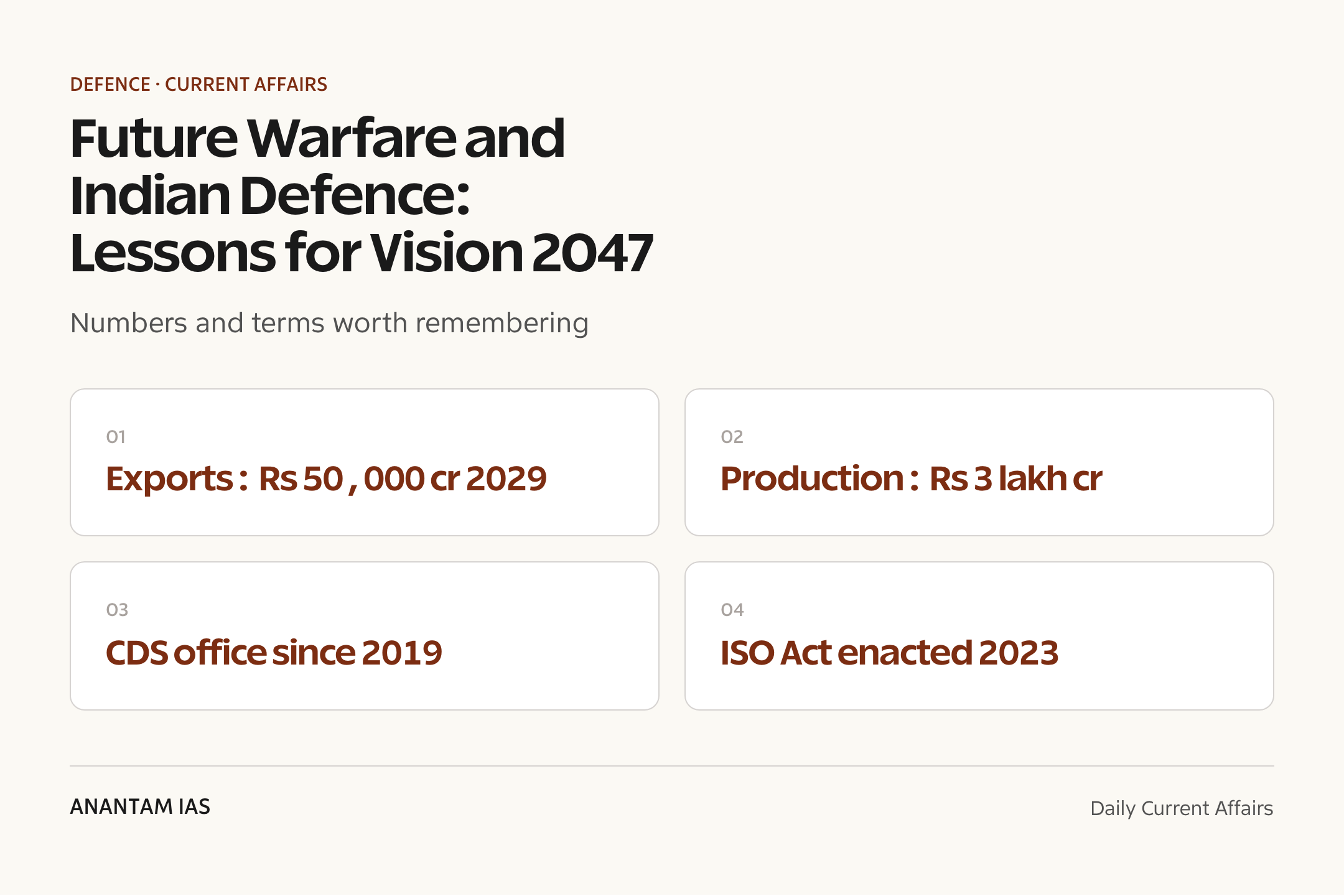
- India’s defence-export target of Rs 50,000 crore by 2029 and a Rs 3 lakh crore production goal anchor the indigenisation drive.
- Reforms in motion — theatreisation, the CDS office, iDEX startups — are being stress-tested against a fast-changing threat picture.
The development matters in the context of:
- Future warfare blends physical (land, sea, air), and newer domains — cyber, space, electromagnetic spectrum and information — into a single multi-domain battlespace.
- India faces a two-front challenge (Pakistan and China) plus persistent sub-conventional threats, making doctrine and jointness urgent rather than academic.
- The reform clock runs alongside a fiscal reality: a large share of the defence budget still goes to salaries and pensions, squeezing modernisation.
UPSC Relevance
Prelims Relevance
- CDS (Chief of Defence Staff): created in 2019; heads the Department of Military Affairs and is the single-point military adviser, tasked with promoting jointness.
- Integrated Theatre Commands: proposed unified commands grouping Army, Navy and Air Force assets under one operational commander for a geography or function; the enabling Inter-Services Organisations Act, 2023 gives commanders authority over personnel of all services.
- iDEX (Innovations for Defence Excellence): launched 2018 under DIO to fund startups, MSMEs and innovators solving defence problems, with the ADITI scheme for critical technologies.
- DAP 2020 (Defence Acquisition Procedure): prioritises Buy (Indian-IDDM) — Indigenously Designed, Developed and Manufactured — as the top procurement category.
- Positive Indigenisation Lists: items banned for import beyond set timelines, issued by MoD and DPSUs to force domestic sourcing.
- Loitering munition: a ‘kamikaze’ drone that hovers/searches over a target area, then dives to destroy it — bridging the gap between a missile and a UAV.
- Grey-zone warfare: coercion below the threshold of open war — cyber intrusions, disinformation, economic pressure, proxies and salami-slicing.
- Operation Sindoor (May 2025): India’s first large-scale ‘non-contact’ operation, where unmanned systems and stand-off strikes featured prominently.
- Agnipath: 2022 short-service recruitment scheme inducting Agniveers for four years; aimed at a younger, tech-savvier force profile.
- DRDO directed-energy and counter-drone work includes laser-based systems and indigenous anti-UAS grids.
Mains Relevance
GS Paper 3
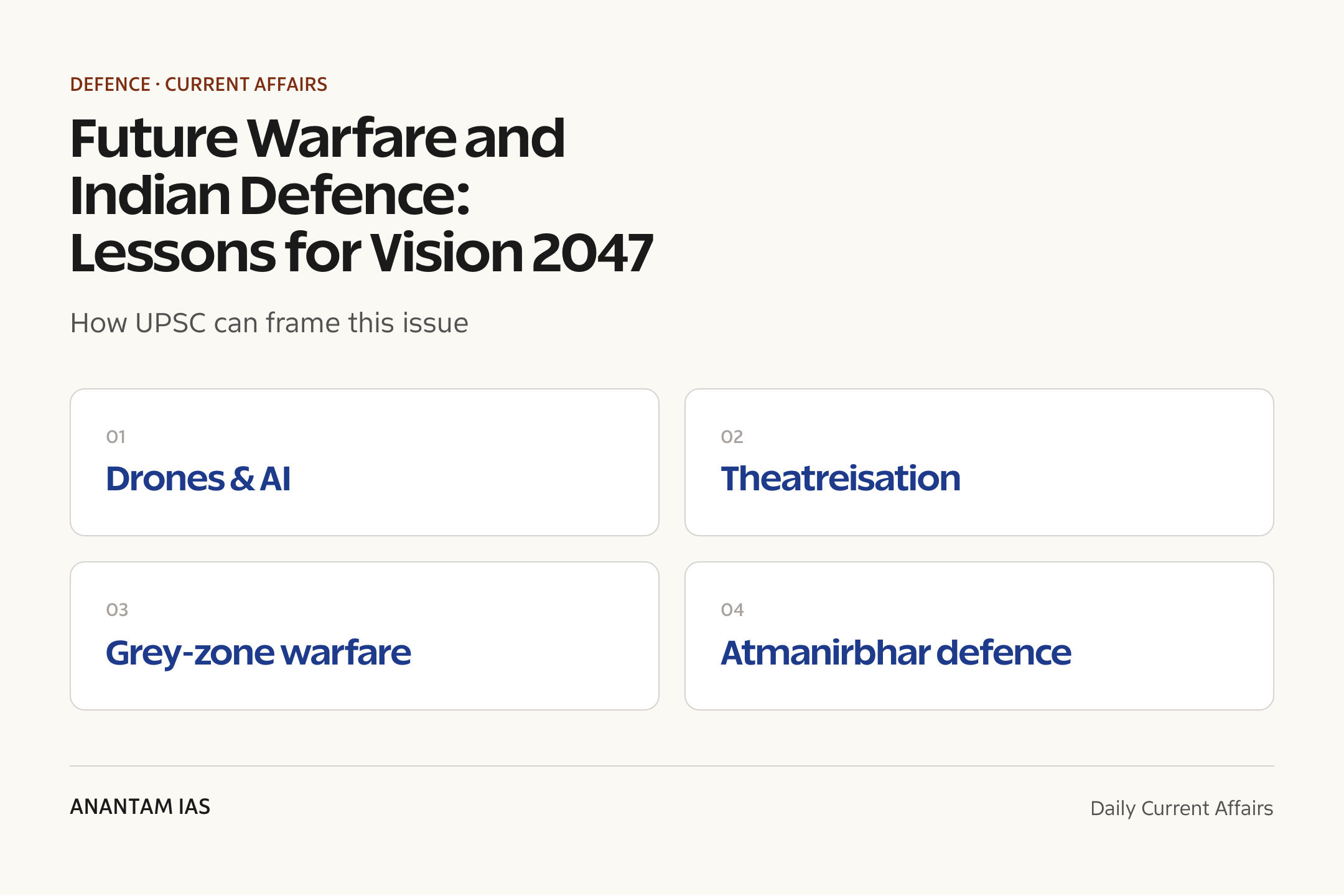
- Examine how drones, AI and grey-zone tactics are changing the character of war, and assess India’s readiness in doctrine, structures and indigenous technology.
- Evaluate theatreisation and Atmanirbhar Bharat in defence as twin pillars of military modernisation — progress, frictions and the road to Vision 2047.
GS Paper 2
- Discuss how a two-front threat and grey-zone coercion on India’s borders shape the case for integrated, multi-domain defence planning.
Essay
- Technology will decide who wins the wars of tomorrow — and who avoids them.
- Self-reliance is the truest form of security.
Background and Context
How warfare is changing
The battlefield is faster, smaller and smarter.
- Unmanned systems — surveillance drones, armed UAVs and loitering munitions — now do reconnaissance and strike that once needed crewed aircraft, at a fraction of the cost and risk.
- Drone swarms and AI-enabled targeting compress the sensor-to-shooter loop, letting forces find, decide and strike in near real time.
- Cyber and electronic warfare can blind sensors, jam communications and disable networks before a shot is fired.
- Space underpins everything — navigation, surveillance, secure communications — making satellites both a force-multiplier and a target.
- Grey-zone and hybrid tactics (disinformation, proxies, economic and cyber coercion) let adversaries gain ground without crossing into open war.
- Conflicts in Ukraine and West Asia have shown cheap drones offsetting expensive platforms, reordering the cost calculus of war.
- Speed of decision is the new advantage: whoever fuses data and acts first inside the opponent’s loop usually wins the exchange.
- The line between combatant and civilian tech is blurring — commercial drones, encrypted apps and cloud compute now show up on the battlefield.
India's reform push: theatreisation and the CDS
Jointness is the organising idea of the current reform wave.
- The CDS post (2019) and the Department of Military Affairs were meant to break service silos and drive integrated planning.
- Integrated Theatre Commands would put land, air and naval assets in a theatre under one commander — replacing today’s largely service-specific command structure (see our explainer on theaterisation of the Indian military).
- The Inter-Services Organisations Act, 2023 gives commanders disciplinary and administrative authority over personnel of all three services, a legal pre-requisite for theatres.
- Newer Army formations — Integrated Battle Groups (IBGs) and drone-heavy units — point toward leaner, faster, multi-domain forces.
- Friction persists over force allocation, air-power apportionment and the pace of rollout; reform is evolutionary, not done.
Indigenisation and the defence-tech ecosystem
Self-reliance is now treated as a security necessity, not just an industrial goal.
- Atmanirbhar Bharat in defence rides on DAP 2020 (Buy Indian-IDDM first) and successive positive indigenisation lists that bar imports of listed items.
- iDEX and ADITI channel funds to startups and MSMEs on AI, drones, counter-UAS and critical technologies.
- DRDO anchors high-end R&D — missiles, radars, directed-energy and counter-drone systems — with a widening private-industry base.
- Defence exports hit a record of roughly Rs 24,000 crore in 2024-25, with a target of Rs 50,000 crore by 2029 and Rs 3 lakh crore in production.
- India now exports items such as Dornier Do-228 aircraft, helicopters, body armour, torpedoes and interceptor boats to over 100 countries.
- Public-private blend: ordnance factories restructured into DPSUs, alongside a rising private sector and startup base, widen the manufacturing pool.
- Technology transfer through co-development and offsets is used to build domestic capability in radars, missiles and electronics.
Lessons from recent conflicts
Ukraine, West Asia and Operation Sindoor are the live syllabus.
- Operation Sindoor (May 2025), launched after the Pahalgam terror attack, showcased stand-off precision strikes and unmanned systems in a short, intense window.
- It underlined that non-contact, technology-led operations can deliver effect while limiting own-force exposure.
- Ukraine demonstrated layered air defence, attrition by cheap drones, and the centrality of resilient communications and cyber defence.
- West Asia showed the value of integrated missile-and-drone defence and the speed of multi-domain escalation.
- Common thread: integration of air power, drones, cyber and EW at the theatre level decides outcomes — exactly what theatreisation seeks.
- Logistics and stockpiles matter again: high-intensity drone-and-missile exchanges burn through munitions far faster than peacetime planning assumes.
- Narrative warfare runs in parallel — controlling the information space shapes domestic morale and international support during a crisis.
Gaps and challenges
Ambition outpaces some hard constraints.
- Revenue-heavy budgets: salaries and pensions crowd out the capital outlay needed for modernisation.
- R&D under-funding: defence R&D remains a small slice of spending, limiting frontier-tech depth.
- Import dependence persists in engines, semiconductors, sensors and some critical components.
- Talent and absorption: rapid tech induction needs trained personnel and doctrine to match — a question mark over the Agnipath scheme‘s four-year cycle for highly skilled roles.
- Implementation lag: theatre commands and procurement timelines have repeatedly slipped against a fast-moving threat.
Way Forward
Finish the structural reform
- Move from blueprints to operational theatre commands with clear allocation of air, land and naval assets.
- Institutionalise a tri-service joint doctrine for multi-domain operations spanning cyber, space and EW.
Build the technology base
- Raise defence R&D spending and scale iDEX/ADITI to deliver drones, counter-UAS, AI and indigenous engines.
- Lock in critical-component self-reliance — sensors, semiconductors, propulsion — through targeted PLI and indigenisation lists.
Master the grey zone
- Strengthen cyber, information-warfare and counter-disinformation capacity for sub-threshold contests.
- Integrate civilian tech, space and private industry into a whole-of-nation deterrence posture.
Get the human capital right
- Align recruitment and training — including Agnipath — with the skills future warfare demands.
- Invest in cyber, drone-operation and data specialists, and retain hard-won technical talent.
Conclusion
Future warfare rewards the side that integrates fastest — fusing drones, AI, cyber, space and electronic warfare into one decision loop, while denying the adversary the same. India’s reforms — theatreisation, a single CDS chain, Atmanirbhar defence-tech and lessons banked from Operation Sindoor — point in the right direction.
The Vision 2047 test is execution: turning structures into operational theatres, R&D into fielded systems, and export ambition into a self-reliant industrial base — fast enough to stay ahead of the threat, not merely catch up with the last war.
UPSC Practice Questions
Prelims MCQ 1
With reference to India’s defence reforms, consider the following statements:
- The Chief of Defence Staff heads the Department of Military Affairs.
- The Inter-Services Organisations Act, 2023 gives a designated commander authority over personnel of all three services.
- DAP 2020 places the ‘Buy (Global)’ category above ‘Buy (Indian-IDDM)’ in procurement priority.
How many of the above statements are correct?
(a) Only one (b) Only two (c) All three (d) None
Answer: (b) Only two
Explanation:
Statements 1 and 2 are correct. Statement 3 is wrong — DAP 2020 places ‘Buy (Indian-IDDM)’ at the top of the procurement priority, not ‘Buy (Global)’.
Prelims MCQ 2
Which of the following best describes a ‘loitering munition’?
(a) A long-range cruise missile with a fixed flight path (b) A surveillance satellite that loiters in geostationary orbit (c) A drone that hovers/searches over a target area before diving to destroy it (d) A static anti-aircraft gun guarding key installations
Answer: (c) A drone that hovers/searches over a target area before diving to destroy it
Explanation:
A loitering munition (a ‘kamikaze’ or suicide drone) loiters over a target area, then strikes it on command — bridging a missile and a reconnaissance UAV.
UPSC Mains Questions
- Drones, artificial intelligence and grey-zone tactics are redefining the character of war. Examine India’s preparedness in doctrine, force structure and indigenous technology, and suggest a road map for Vision 2047. (GS3)
- Theatreisation and Atmanirbhar Bharat are the twin pillars of India’s military modernisation. Critically evaluate the progress and challenges of each. (GS3)
- How do a two-front threat and grey-zone coercion strengthen the case for integrated, multi-domain defence planning in India? (GS2)
Source: Indian Express.
Frequently Asked Questions
What is ‘future warfare’ in simple terms?
It is warfare shaped by drones, artificial intelligence, cyber and space tools, and grey-zone tactics — short, fast, technology-saturated conflicts often fought below the threshold of declared war, rather than long battles of mass and attrition.
What are Integrated Theatre Commands?
They are proposed unified commands that group Army, Navy and Air Force assets for a geography or function under a single operational commander, replacing today’s largely service-specific structure. The Inter-Services Organisations Act, 2023 provides the legal basis for joint command authority.
What is grey-zone warfare?
Coercion that stays below open war — cyber intrusions, disinformation, economic pressure, proxies and ‘salami-slicing’ of territory. It lets an adversary gain advantage without triggering a full military response.
What is India’s defence-export target?
India aims for Rs 50,000 crore in defence exports by 2029, alongside a Rs 3 lakh crore production goal. Exports touched a record of about Rs 24,000 crore in 2024-25.
How does Operation Sindoor link to future warfare?
Operation Sindoor (May 2025), launched after the Pahalgam attack, used stand-off precision strikes and unmanned systems in a short, intense window — a live demonstration of non-contact, technology-led operations and a reference point for India’s doctrine.
What is a loitering munition?
A ‘kamikaze’ drone that hovers and searches over a target area before diving in to destroy it — combining the features of a reconnaissance UAV and a guided missile. Such systems featured in Ukraine and Operation Sindoor.