Introduction
An unmanned aerial vehicle, popularly called a drone, is an aircraft without a human pilot on board, navigated either by onboard computers or by a remote operator on the ground. From the tactical Switchblade loitering munitions used in Ukraine to the $99 million MQ-9B Sea Guardian the Indian Navy is buying from the United States, UAVs have redrawn the economics and ethics of airpower. They are simultaneously a disruptive weapons system, a utility platform for agriculture and disaster response, and the first layer of what strategists call unmanned and autonomous warfare.
For UPSC candidates, UAVs straddle at least three syllabus boxes: GS Paper 3 on defence and emerging technologies, GS Paper 2 on the regulatory state through the Drone Rules 2021 and GS Paper 4 on the ethics of autonomous lethal systems. This note maps the technology landscape, classifies UAV types, surveys Indian platforms and the policy framework, and closes with Prelims pointers and Mains angles.
Quick Facts at a Glance
| Particular | Detail |
|---|---|
| Full form | Unmanned Aerial Vehicle / Unmanned Aircraft System (UAS) |
| Popular name | Drone |
| First military use | Austrian balloon bombs on Venice, 1849 |
| First modern UAV | Ryan Firebee, USA, 1951 |
| Indian regulation | Drone Rules 2021 (Ministry of Civil Aviation) |
| Maximum permissible weight (Nano) | Under 250 g |
| Airspace map | Green, Yellow, Red zones (DGCA) |
| Flagship India import | MQ-9B SkyGuardian / SeaGuardian (31 units, 2024 deal) |
| DRDO indigenous MALE UAV | TAPAS BH-201 (Rustom-II successor) |
| Swarm drone provider to Army | NewSpace Research & Technologies |
| Drone Shakti scheme | Budget 2022-23 announcement |
| Production Linked Incentive | PLI for drones and components, Rs 120 crore (2021) |
Background and Historical Context
The idea of a pilotless aircraft predates manned flight. In 1849, Austrian forces besieging Venice released 200 unmanned balloons carrying explosives, arguably the first combat UAV. The concept matured during the First World War with the Kettering Bug, an American aerial torpedo that could fly 120 km to a preset target. The Second World War produced the German V-1 flying bomb, the first mass-produced cruise missile and a conceptual ancestor of today’s loitering munitions.
The modern reconnaissance drone took shape with the Ryan Firebee in 1951 and the AQM-34 Lightning Bug that flew over 3,000 missions in Vietnam. By the 1990s, the General Atomics RQ-1 Predator revolutionised the category by combining persistent surveillance with Hellfire missile strike, turning the drone into an instrument of targeted killing. The 2000s saw armed drones become central to counter-terrorism campaigns in Pakistan, Yemen and Somalia.
India’s drone journey began in the 1960s with the import of Lakshya target drones, followed by the indigenous Nishant tactical UAV from DRDO. The 1999 Kargil war underscored the value of real-time aerial surveillance, leading to urgent procurement of IAI Searcher II and Heron UAVs from Israel. The 2016 Uri surgical strikes and 2019 Balakot operation relied on drone reconnaissance and battle damage assessment. The 2021 drone attack on the Jammu Air Force Station, the first-ever strike on an Indian military installation by weaponised drones, formally inaugurated the counter-drone era.
Globally, the 2020 Nagorno-Karabakh war demonstrated that mid-tier states could decisively defeat armoured formations using Bayraktar TB2 and loitering munitions. The Russia-Ukraine war since 2022 has industrialised drone warfare, with both sides fielding hundreds of thousands of cheap first-person-view (FPV) drones per month.
Key Features and Types of UAVs
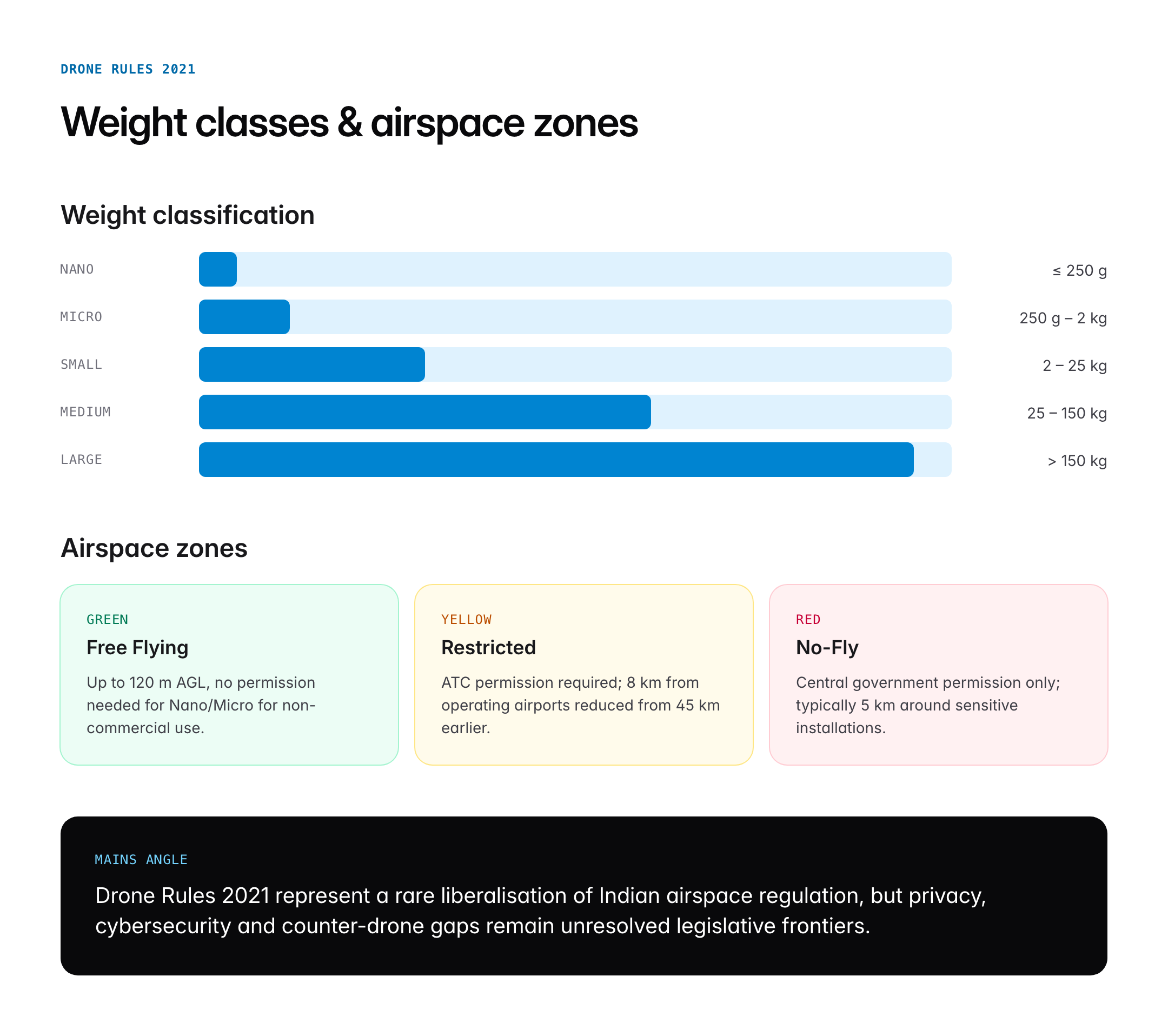
Classification by Weight (Indian Drone Rules 2021)
- Nano: up to 250 g
- Micro: 250 g to 2 kg
- Small: 2 kg to 25 kg
- Medium: 25 kg to 150 kg
- Large: above 150 kg
Classification by Range and Endurance (NATO STANAG 4670)
- Class I (Mini/Micro, up to 150 kg, line-of-sight)
- Class II (Tactical, 150-600 kg, up to 200 km)
- Class III (Strategic, above 600 kg) including MALE, HALE and UCAV sub-classes
Key Categories by Function
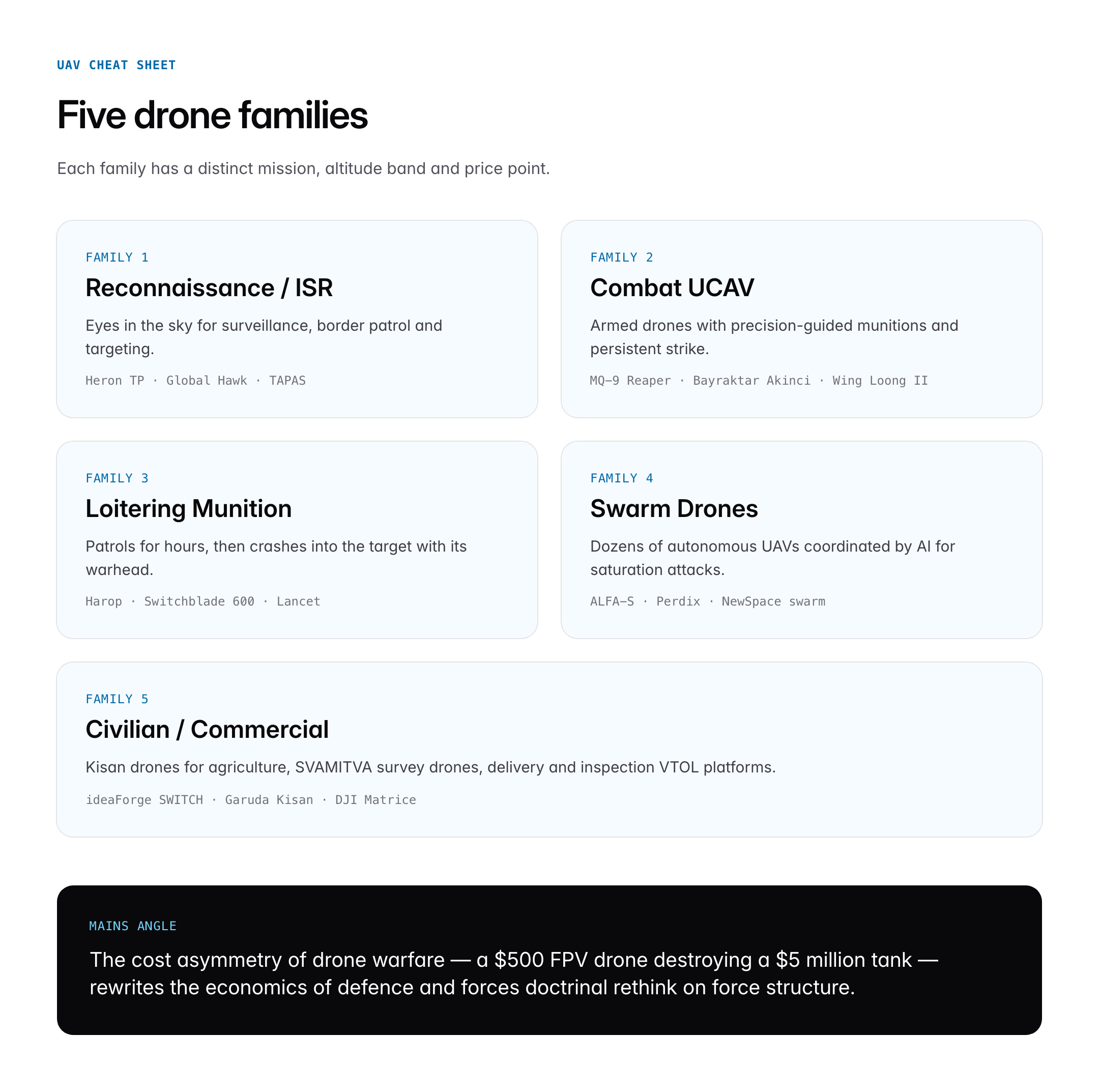
Reconnaissance UAVs carry electro-optical and synthetic aperture radar payloads for intelligence, surveillance and reconnaissance (ISR). Examples: Israeli Heron TP, US RQ-4 Global Hawk, Indian TAPAS BH-201.
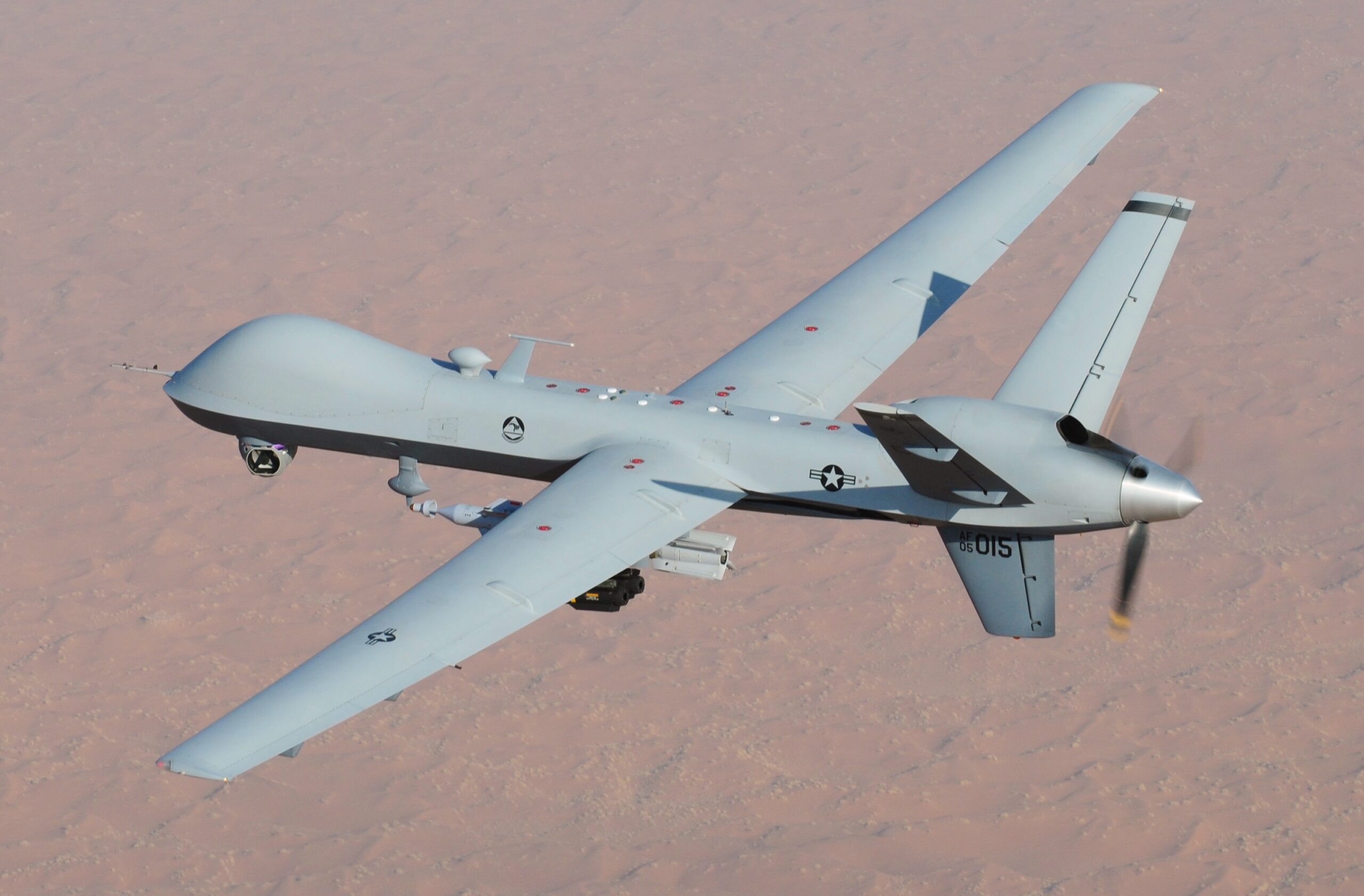
Combat UAVs / UCAVs integrate precision-guided munitions. Examples: MQ-9 Reaper, Turkish Bayraktar Akinci, Chinese CH-5 Rainbow.
Loitering Munitions combine UAV endurance with a warhead, ending the mission by crashing into the target. Examples: US Switchblade 300/600, Israeli Harop (used by India since 2019), Russian Lancet.
Swarm Drones operate in coordinated clusters using AI-driven autonomy. India’s Army inducted the Air Launched Flexible Asset (ALFA-S) swarm from Hindustan Aeronautics Limited in 2023.
Vertical Take-Off and Landing (VTOL) UAVs combine helicopter launch with fixed-wing cruise. Indian startups like ideaForge and Garuda Aerospace lead in this space.
Components of a UAS
Every UAS has four layers: the airframe and propulsion (electric or combustion), the payload (camera, LiDAR, agri-sprayer, missile, electronic-warfare pod), the ground control station with its datalink, and the launch and recovery element. Satellite communications via Ku- or Ka-band enable beyond visual line-of-sight (BVLOS) operation.
Significance for UPSC and General Knowledge
- Exemplifies the convergence of artificial intelligence, robotics and aerospace that defines the Fourth Industrial Revolution.
- Transforms traditional doctrines of airpower by decoupling risk to pilots from strike capability.
- Opens civilian applications in precision agriculture, disaster response, mapping, last-mile logistics and anti-poaching surveillance.
- Poses regulatory and privacy challenges, forcing India to codify the Drone Rules 2021 and airspace mapping.
- Creates asymmetric threats as seen in the Jammu airbase attack and repeated weapon drops along the Punjab border by non-state actors.
- Drives Atmanirbhar Bharat objectives through the drone PLI scheme, Drone Shakti, SVAMITVA survey drones, and the ban on imported drones for defence.
Detailed Analysis: India’s UAV Ecosystem
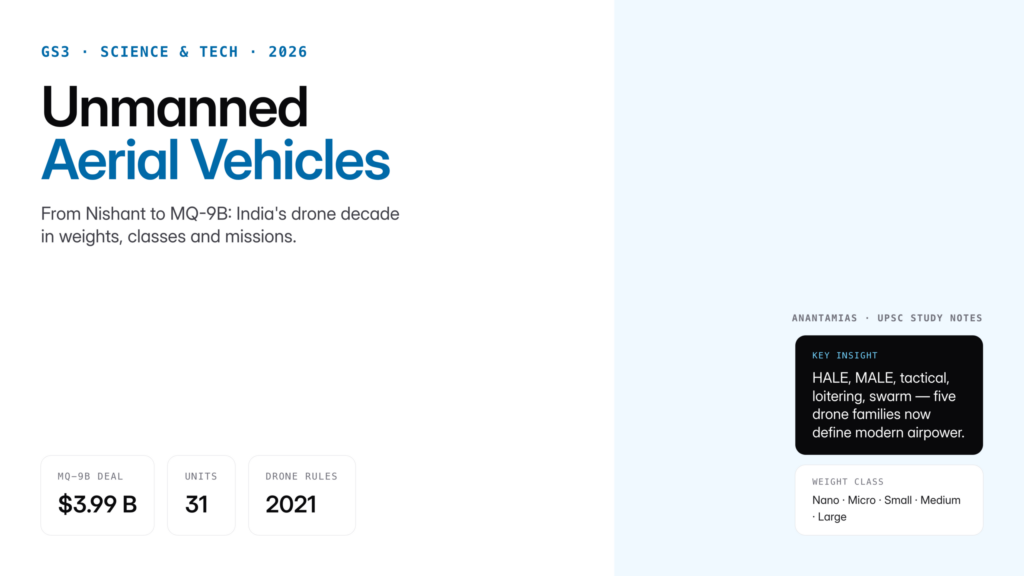
India’s UAV landscape has three concentric rings: armed forces platforms, civilian and agricultural fleets, and indigenous manufacturing. On the military side, the big 2024 headline was the Defence Acquisition Council approval of 31 MQ-9B SkyGuardian and SeaGuardian drones from General Atomics in a $3.99 billion foreign military sale. These high-altitude long-endurance (HALE) platforms give the three services, for the first time, persistent transcontinental ISR and precision strike with Hellfire and SeaSpear missiles.
Indigenous programmes are led by DRDO’s Aeronautical Development Establishment. The TAPAS BH-201, a medium-altitude long-endurance (MALE) UAV, has achieved over 200 flights and altitudes above 28,000 feet, though it has missed the original Preliminary Service Use Clearance milestones and is expected to enter limited service by 2026. The SWiFT stealth UAV demonstrator, which flew in 2022, is the technology seed for the Ghatak unmanned combat aerial vehicle being developed for the IAF.
Private industry has exploded since the 2021 liberalisation. ideaForge (Mumbai) supplies the Army’s SWITCH MK1 UAVs, Garuda Aerospace (Chennai) has over 500 agricultural Kisan drones deployed, NewSpace Research (Bengaluru) is the lead swarm integrator, and Adani-Elbit at Hyderabad produces Hermes 900 airframes. Under the Drone Shakti scheme announced in Budget 2022-23, Drone as a Service (DrAAS) is being promoted through start-ups.
Civilian deployment has a powerful anchor in the SVAMITVA rural land-rights scheme, where drones from the Survey of India have mapped over 3 lakh villages since 2020, generating property cards for millions of rural households. The Ministry of Agriculture’s Kisan Drone initiative and the Namo Drone Didi scheme targeting 15,000 women-led self-help groups represent India’s most ambitious civilian drone programme.
The regulatory spine is the Drone Rules 2021, which replaced the restrictive 2018 UAS Rules. The rules reduced the number of forms from 25 to 5, abolished security clearance for most categories, and introduced the Digital Sky platform for single-window registration, flight authorisation and airspace mapping. An automated permission-not-required (NPNR) policy applies to green-zone flying up to 120 m altitude.
Comparative Perspective: Leading UAV Platforms
| Platform | Country | Type | Endurance | Payload / Armament |
|---|---|---|---|---|
| MQ-9B SeaGuardian | USA | HALE, multi-role | 40 hours | Hellfire, SeaSpear, sonobuoys |
| RQ-4 Global Hawk | USA | HALE ISR | 32 hours | EO/IR, SAR, SIGINT |
| TAPAS BH-201 | India | MALE ISR | 18 hours | EO/IR, SAR (under testing) |
| Bayraktar TB2 | Turkey | MALE UCAV | 27 hours | MAM-L, MAM-C missiles |
| Heron TP | Israel | MALE | 36 hours | ISR, strike (export-dependent) |
| Wing Loong II | China | MALE UCAV | 32 hours | Blue Arrow-7, AR-1 missiles |
| Harop | Israel | Loitering munition | 6 hours | 23 kg warhead, used by India |
The MQ-9B stands apart with the longest endurance and the only all-weather maritime variant. Indian programmes trail by roughly a decade on engines, sensors and beyond-line-of-sight operations, though the civilian drone market is now among the world’s fastest-growing.
Challenges and Controversies
Drone warfare has sparked deep ethical and legal debate. Targeted killings using Reaper drones in Pakistan and Yemen have raised concerns about violations of sovereignty, civilian casualties and the erosion of International Humanitarian Law principles of distinction and proportionality. The United Nations Special Rapporteur has repeatedly called for transparent rules on lethal autonomous weapons systems.
India faces three proximate challenges. The counter-drone gap is urgent after the 2021 Jammu airbase strike and continued narcotics and weapons drops in Punjab. DRDO’s anti-drone system using soft-kill (jamming) and hard-kill (laser) mechanisms is being deployed at vital installations, but coverage of the 3,323 km Pakistan border and 3,488 km China border remains patchy.
Second, the indigenisation paradox: while the drone PLI scheme has mobilised over 200 start-ups, critical components such as motors, flight controllers, carbon fibre airframes and high-resolution sensors still come largely from China, raising supply-chain and cybersecurity risks. The 2022 ban on Chinese components in Indian military drones exposed how deep that dependence runs.
Third, privacy and airspace safety. The absence of a dedicated data-protection regime for drone-collected imagery, combined with rising near-miss incidents at civilian airports, calls for tighter enforcement of the 2021 Rules and a robust UTM (Unmanned Traffic Management) system.
Prelims Pointers
- UAV stands for Unmanned Aerial Vehicle; UAS (Unmanned Aircraft System) includes the ground station and datalink.
- Drone Rules 2021 classify drones by weight: Nano, Micro, Small, Medium, Large.
- Digital Sky is the MoCA platform for drone registration and flight authorisation.
- Green, Yellow and Red zones demarcate Indian airspace for drone operations; Red is prohibited.
- India’s first indigenous UAV: DRDO Nishant tactical UAV.
- TAPAS BH-201 is DRDO’s medium-altitude long-endurance UAV under development.
- India’s 2024 deal for 31 MQ-9B Predator drones with General Atomics worth about $3.99 billion.
- Harop loitering munition from IAI was among the first “kamikaze drones” used by Indian forces.
- SVAMITVA Scheme uses drones to map rural habitations and grant property cards.
- Namo Drone Didi targets 15,000 women-led SHGs for Kisan Drone operations.
- HALE, MALE, MUSE, MASS are the endurance-altitude drone classes.
- India’s first drone attack on a military base: Jammu IAF Station, 27 June 2021.
Mains Practice Questions
Question 1: “The democratisation of unmanned aerial vehicles has fundamentally reshaped the character of modern warfare.” Discuss with reference to recent conflicts and India’s preparedness.
- Map the Nagorno-Karabakh and Russia-Ukraine wars as inflection points for cheap, scalable drone combat.
- Analyse India’s three-tier response: MQ-9B acquisition, DRDO indigenous programmes, private industry swarm capability.
- Identify gaps in counter-drone systems and supply-chain dependence; suggest policy and R&D priorities.
Question 2: Examine the Drone Rules 2021 as a case of balancing technological promise with national security and privacy imperatives.
- Outline key reforms: form reduction, Digital Sky platform, zone mapping, PLI scheme.
- Assess trade-offs: BVLOS permissions, cybersecurity, airspace safety and data-protection gaps.
- Recommend strengthening UTM, data-protection law alignment and counter-drone infrastructure.
Conclusion
Unmanned aerial vehicles have migrated from Cold War curiosities to everyday infrastructure in a single generation. They deliver pesticide to a Punjab farmer, map the roof of a Maharashtra village, and carry Hellfire missiles over the Arabian Sea, all within the same week. This versatility is why they will remain a top-ten technology priority for every major state for the foreseeable future.
For the UPSC aspirant, the drone story is a clean way to practise integrated thinking: technology, security, economy, ethics and federalism all converge in a single airframe flying at 25,000 feet. Learn the platforms and the rules, but also the frameworks that will let you reason about the next unmanned disruption, whether it flies, swims or rolls.
Frequently Asked Questions
What is an unmanned aerial vehicle (UAV)?
An unmanned aerial vehicle is an aircraft flown without an on-board pilot, either by a remote operator via radio link or by onboard computers executing a preloaded flight plan. Together with its ground control station and datalink, it forms an Unmanned Aircraft System (UAS), commonly called a drone. Payloads range from cameras to missiles.
Why are UAVs important for UPSC preparation?
UAVs cut across GS Paper 3 topics on defence, internal security and emerging technologies, GS Paper 2 on drone regulation and GS Paper 4 on ethics of autonomous weapons. Recent Mains and Prelims questions have tested the Drone Rules 2021, SVAMITVA scheme, MQ-9B deal and counter-drone systems, making the topic a high-yield study area.
How is a UAV different from a cruise missile?
A UAV is usually reusable and can return to base after a mission, carrying sensors or weapons. A cruise missile is a single-use aerial vehicle that flies to a target and destroys itself on impact. Loitering munitions blur this line — they patrol like UAVs but detonate like missiles — which is why they are classified separately in most doctrines.
What are the main types of UAVs?
UAVs are classified by weight under India’s Drone Rules 2021 as Nano (up to 250 g), Micro (up to 2 kg), Small (up to 25 kg), Medium (up to 150 kg) and Large (above 150 kg). By mission they are reconnaissance drones, combat UCAVs, loitering munitions and swarm drones. By altitude and endurance they are MALE, HALE or tactical classes.
What is the MQ-9B Predator deal?
In 2024, the Defence Acquisition Council cleared the purchase of 31 MQ-9B SkyGuardian and SeaGuardian drones from General Atomics of the USA for about $3.99 billion. The Navy gets 15 SeaGuardians for maritime ISR and anti-submarine warfare, while the Army and Air Force get 8 each. Induction is planned from 2029.
What are India’s Drone Rules 2021?
Notified by the Ministry of Civil Aviation in August 2021, the Drone Rules reduced the number of required forms from 25 to 5, abolished most security clearances, and introduced the Digital Sky platform for registration and permissions. They created green, yellow and red airspace zones and enabled beyond visual line-of-sight operations through the PLI scheme.
How is India tackling hostile drones at the border?
India uses a mix of radar detection, radio-frequency jamming, GPS spoofing and laser or gun-based hard-kill systems. DRDO has developed an indigenous Anti-Drone System deployed at airports and vital installations. The BSF and NSG have dedicated counter-UAS teams after weaponised drone drops became routine along the Punjab and Jammu border since 2021.
What civilian applications do drones have in India?
Civilian drones are used under the SVAMITVA scheme to map over 3 lakh villages for property cards, by the Kisan Drone and Namo Drone Didi programmes for pesticide spraying and soil mapping, by the Railways and NHAI for corridor surveys, and by state disaster management authorities for flood and landslide response. Delivery pilots are in progress.
Tell Google you want more of this.
Add Anantam IAS as a preferred sourceOne tap, and this site shows up more often in your own Top Stories, AI Overviews and AI Mode. Remove it any time.