G20 Johannesburg Summit 2025: The Global South, Finance and the Climate Agenda
On 22 and 23 November 2025, the world’s premier economic forum did something it had never done in its quarter-century of existence: it met on African soil. South Africa hosted the G20 leaders’ summit at the Johannesburg Expo Centre under the theme “Solidarity, Equality, Sustainability,” and the venue alone was the message. For decades the G20 had gathered in the capitals of the rich world and the larger emerging economies; now, for the first time, a continent of 1.4 billion people that has spent generations on the receiving end of global economic rules was setting the agenda. President Cyril Ramaphosa called it Africa’s summit, and the framing stuck.
And it mattered because of what was missing as much as what was present. The United States — the founder of the leaders’ format, the world’s largest economy and the country due to take over the G20 presidency next — boycotted the summit entirely, sending no head of state and no minister. Even so, the leaders who did turn up adopted a sprawling 122-paragraph Leaders’ Declaration covering debt, climate finance and critical minerals, and they did it on the opening day rather than the last. For the first time since the leaders began meeting in 2008, a G20 summit produced a consensus declaration without the United States in the room. For a UPSC aspirant, that single fact opens a rich seam: the shifting balance between the Global North and South, the durability of multilateral institutions under strain, and India’s quiet but central role in keeping the developing world’s voice at the top table.
Why It’s in the News
The Johannesburg summit made headlines on three counts, and an answer that separates them reads far better than one that blurs them together. The first is the historic location — Africa hosting the G20 for the first time, with South Africa rounding off an unbroken run of developing-country presidencies. The second is the American absence. President Donald Trump declined to attend or send any representative, repeating discredited claims of a “white genocide” against white South African farmers and calling the summit “a total disgrace.” So the host of the next summit stayed away from this one — an extraordinary breach of summit etiquette.
The third is what happened despite that absence. Rather than collapse into deadlock, the remaining members agreed a detailed declaration that leaned hard into priorities the Trump administration dislikes: the seriousness of climate change, ambitious renewable-energy targets and debt relief for poor countries. Only Argentina declined to fully endorse it, citing concerns over language on the Middle East. The optics were striking — the G20 functioning, and even finding its voice, without its most powerful member. And then came the awkward coda: the handover of the presidency to the very country that had boycotted the gathering, setting up a 2026 summit on American soil that will look nothing like this one.
What the G20 Is and Why It Met in Africa
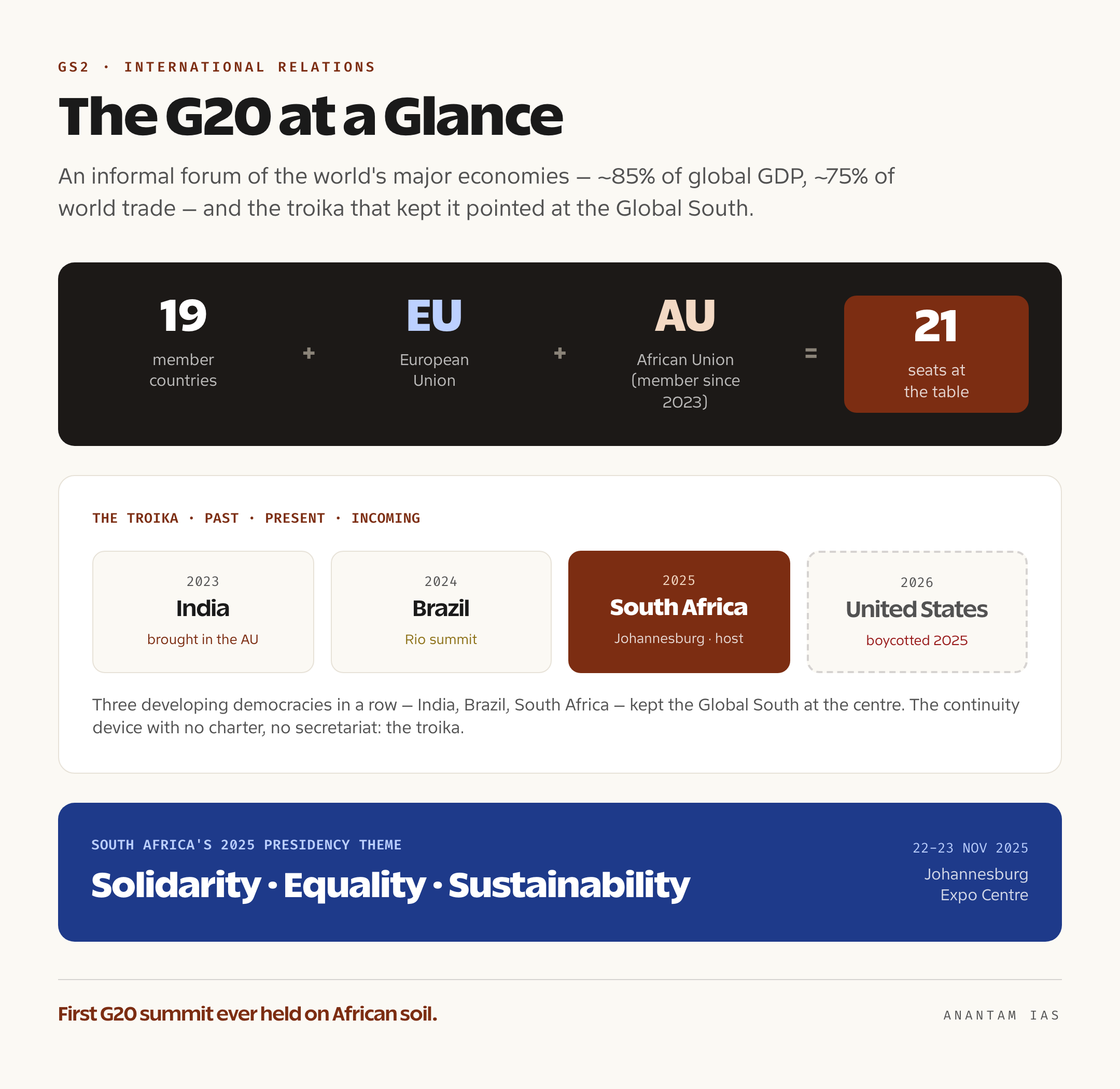
To weigh the summit you need the institution behind it. The G20, or Group of Twenty, is an informal forum of the world’s major economies that together account for around 85 per cent of global GDP, roughly three-quarters of world trade and about two-thirds of the planet’s population. It was born in 1999 as a meeting of finance ministers and central-bank governors after the Asian financial crisis, when it became obvious that the cosy club of rich nations, the G7, could no longer steer the world economy alone. The 2008 global financial crisis then pushed it up a level: leaders themselves began meeting, and the G20 became the main venue where the biggest developed and developing economies sit as equals to manage the global economy.
Its membership is the point. The G20 brings together 19 individual countries — the G7 plus the likes of China, India, Brazil, South Africa, Indonesia and Saudi Arabia — along with the European Union and, since 2023, the African Union as full members. That last addition is India’s handiwork. When India held the presidency and hosted the New Delhi summit in September 2023, it pushed through the admission of the 55-nation African Union as a permanent member, turning the “G20” into a grouping of 21 seats and giving the entire African continent a standing voice for the first time. Two years later, that continent was hosting. The line runs straight from Delhi to Johannesburg.
The forum has no charter, no headquarters and no permanent secretariat, so continuity is carried by a device called the troika — the past, present and incoming presidencies working together so that priorities don’t reset every year. For 2025 the troika was Brazil (which hosted Rio in 2024), South Africa (the 2025 host) and the United States (the 2026 host). Look one step further back and you see something remarkable: India in 2023, Brazil in 2024 and South Africa in 2025 — three developing democracies in a row, a “Global South troika” that kept the concerns of poorer nations at the centre of the agenda for three straight years. That is why a forum that began as a rich-world rescue committee ended up holding its 2025 summit in Africa, talking about debt and development.
What the Johannesburg Declaration Actually Delivered
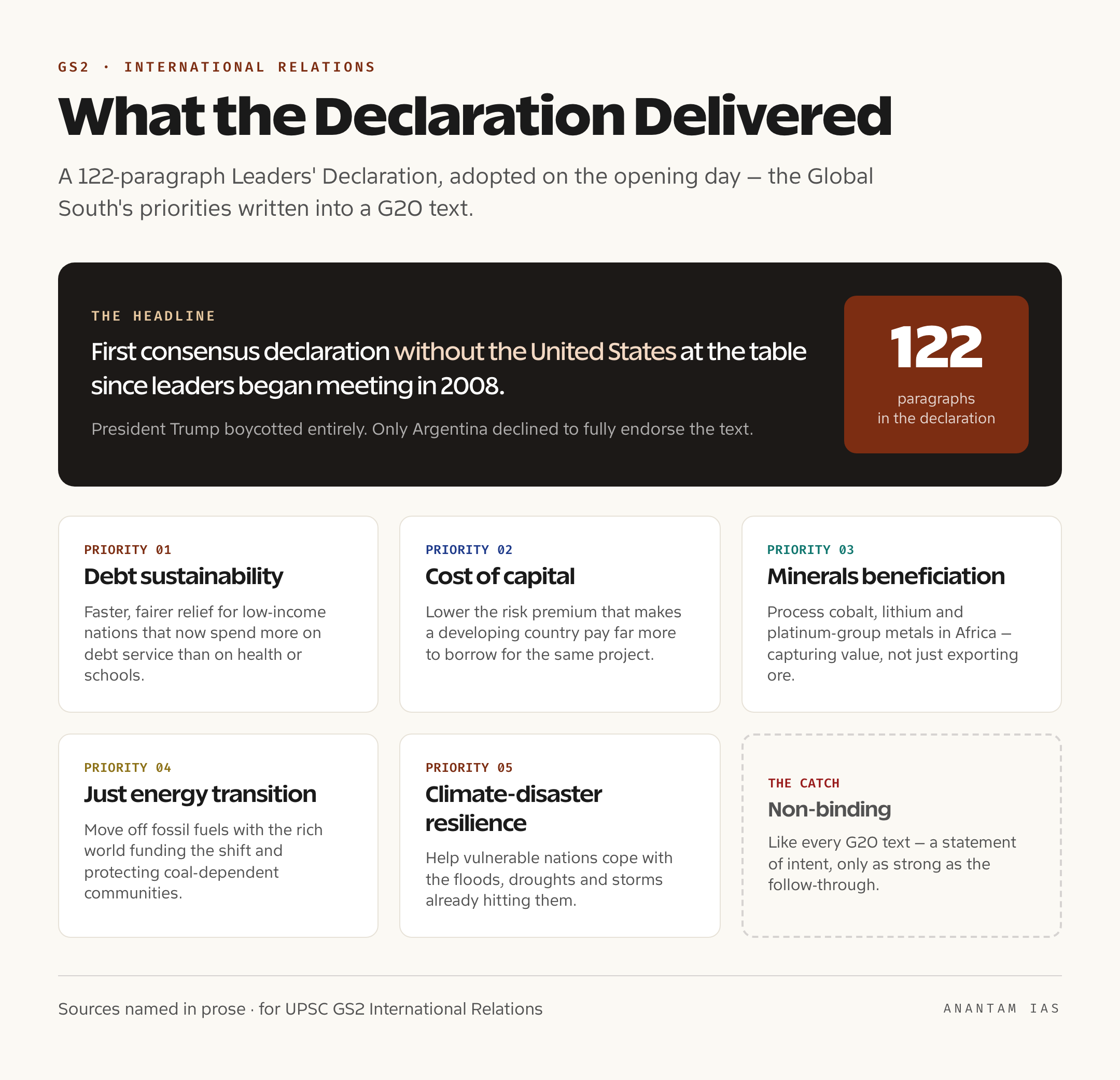
The headline outcome was the 122-paragraph Leaders’ Declaration, and its substance tracked the Global South’s long-standing grievances. Top of the list was debt sustainability for low-income countries. Dozens of poor nations, many in Africa, now spend more on servicing their debts than on health or education, and the declaration pressed for faster, fairer debt relief and a more workable framework for restructuring. Tied to it was the cost of capital — the simple, brutal fact that a developing country pays far higher interest to borrow than a rich one for the very same project, because lenders price in a “risk premium” that is often more perception than reality. South Africa made lowering that premium a signature cause, since cheap finance is the difference between an African solar farm getting built or not.
The declaration also pushed critical-minerals beneficiation, which is the heart of the African pitch. Beneficiation means processing raw minerals into higher-value products at home rather than shipping them out as ore. Africa holds vast reserves of cobalt, lithium, manganese and platinum-group metals that the world needs for batteries and clean energy, yet it captures only a sliver of the value because the refining and manufacturing happen elsewhere. The text backed building more of that supply chain on the continent — turning resource wealth into jobs and industry instead of just exports. On energy, leaders endorsed a just energy transition: moving away from fossil fuels in a way that is paid for by the rich nations most responsible for emissions and that protects the workers and communities who depend on coal. And on climate, the declaration stressed the seriousness of global warming, the need to adapt to it and the importance of climate-disaster resilience — helping vulnerable countries cope with the floods, droughts and storms already hitting them.
What gave all of this its edge was that it was agreed without the United States, and partly because of that. The draft was prepared by G20 envoys without American input, so its language on climate and debt didn’t have to be watered down to keep Washington on board. Critics noted the declaration was, like all G20 texts, non-binding — a statement of intent, not a treaty — and that grand words on debt and finance have been written before without much follow-through. But as a marker of where the centre of gravity now sits, it was unmistakable: the Global South’s wishlist became the G20’s official position.
What It Means and Where India’s Stakes Lie
For the wider world, Johannesburg was a stress test of multilateralism, and the institution passed. The fear going in was that a US boycott would hollow out the summit and prove the G20 unworkable without its anchor. Instead, more than 40 countries and organisations showed up, a substantive declaration was agreed, and the forum demonstrated it could function — at least once — without the United States steering. That is a double-edged result. It shows the resilience of cooperation among the rest, but it also signals a fracturing of the old consensus, a world drifting toward blocs where the largest power increasingly opts out of the very institutions it built.
For India, the stakes are direct and the alignment is comfortable. India sat in the 2025 troika as the immediate past-past host, and Prime Minister Narendra Modi attended the summit and publicly backed Ramaphosa’s leadership, with South Africa openly crediting India for sharing the playbook it had used to run its own presidency. Almost every Johannesburg priority echoes a cause India has championed — affordable development finance, a louder voice for the Global South, the reform of multilateral institutions, and the very African inclusion India delivered in 2023. The continuity of the India-Brazil-South Africa run also revived IBSA, the trilateral grouping of those three democracies, as a working axis of the developing world. So India isn’t a bystander here; it is part of the connective tissue that made three back-to-back Global South presidencies possible, and a beneficiary of a G20 that now takes debt, climate finance and South-South cooperation seriously.
There is a strategic subtlety worth carrying into an answer. India has to walk a fine line: it shares the Global South’s agenda and its frustration with an unfair financial order, yet it also values its deepening partnership with the United States and cannot afford to be seen choosing a developing-world bloc against the West. Johannesburg let India have it both ways — championing the South’s priorities through a consensus declaration while staying clear of the open rupture between Pretoria and Washington. That ability to bridge North and South, rather than pick a side, is exactly the role India wants the world to see it playing.
Challenges and What to Watch
The biggest question now is the handover, because the 2026 presidency passed to the United States — the country that just boycotted the summit. The transfer itself turned into a diplomatic skirmish: Washington proposed that a low-ranking embassy official, a chargé d’affaires, accept the ceremonial handover, and South Africa refused, insisting the presidency could only be handed to a minister or head of state. Pretoria’s stand was about dignity as much as protocol — a signal that Africa would not be handed a second-class role in its own forum. The upshot is a 2026 G20 that will be hosted by an administration sceptical of climate action, multilateralism and the development agenda this summit championed. Expect the American presidency to strip back the climate language, sideline the debt-and-finance push and reshape the G20 toward its own priorities. The Global South’s three-year run at the helm ends, and the agenda may swing sharply.
The deeper challenges are structural and predate Trump. The G20’s outputs are voluntary, so a strong declaration is only as good as the follow-up, and on debt relief the record is thin. The forum is also increasingly squeezed by geopolitics — the rivalry between the United States and China, the war in Ukraine, the conflict in the Middle East — all of which make consensus harder and tempt members to treat the G20 as a stage rather than a workshop. And there is the legitimacy question of an informal club of the powerful setting rules for everyone else, even with the African Union now inside. So the things to watch are concrete: whether any of the Johannesburg commitments on debt and cost of capital turn into actual mechanisms before they are forgotten; how far the 2026 US presidency rolls back the agenda; whether the African Union grows into an active member rather than a symbolic seat; and whether the Global South can sustain its influence once the friendly run of presidencies is over. The summit answered one question — the G20 can survive without the United States — and raised a harder one: what the forum is for, in a world that no longer agrees on the basics.
For Your Mains Answer
This is a high-value topic for GS Paper 2, which covers important international institutions, groupings and forums, India’s relations with the wider world, and the effect of policies of developed and developing countries on India’s interests. It also feeds GS Paper 3 on the global economy and GS Paper 1 on the changing geography of power, plus the Essay paper on themes of multilateralism, the Global South and a fracturing world order. The skill examiners reward is the same one this article uses: anchor the analysis in exact facts — the date, the theme, the 122-paragraph declaration, the US boycott — and then connect the event to the bigger shift in the balance between North and South.
How to Build the Answer
Open with the institution, not the drama — define the G20, its origin in 1999 and 2008, and its weight in the world economy, then place the Johannesburg summit inside it. Move in a logical chain: what the G20 is, why it met in Africa (the Global South troika and the African Union’s 2023 entry), what the declaration delivered (debt, cost of capital, critical-minerals beneficiation, just energy transition, climate resilience), what the US boycott signalled, and what the handover means for 2026. Close by judging multilateralism’s health and India’s bridging role. That arc — institution, context, outcomes, significance, evaluation — fits almost any G20 or international-grouping question.
Common Mistakes to Avoid
Don’t treat the G20 as a treaty body — its declarations are non-binding statements of intent, and saying so earns marks. Don’t confuse the African Union (a member since 2023, India’s achievement) with individual African states, or call the summit a failure because the US stayed away; the real point is that it succeeded without the US. Don’t forget the troika — the past-present-future trio is the bit most aspirants miss. And don’t present India as a pure Global South partisan; show the balancing act between the developing world’s agenda and its ties with the West.
A Compact Answer Spine
G20 = informal forum, ~85% of world GDP, born 1999, leaders’ summits since 2008 → first-ever summit on African soil, Johannesburg, 22-23 Nov 2025, theme “Solidarity, Equality, Sustainability” → African Union a full member since India’s 2023 Delhi summit; Global South troika of India-Brazil-South Africa → 122-paragraph declaration on debt sustainability, cost of capital, critical-minerals beneficiation, just energy transition, climate resilience → adopted despite US boycott (Trump absent), first consensus without the US since 2008 → presidency handed to the US for 2026, agenda may reverse → India in the troika, Modi present, bridges North and South → verdict: multilateralism strained but resilient.
Diagram or Flowchart Idea
Draw a simple horizontal troika arrow — India (2023) → Brazil (2024) → South Africa (2025) → United States (2026) — with the first three boxed as the “Global South run” and the fourth shaded as a likely pivot. Beside it, list the five declaration priorities as a stacked bar. This pairing — the continuity arrow plus the agenda — communicates the whole story at a glance and is quick to sketch.
A Balanced-Conclusion Line
A line that lands the marks: “The Johannesburg summit showed that the G20 can speak for the Global South even without its most powerful member — but its real test is whether voluntary words on debt and climate survive a handover to a presidency that does not share the agenda.”
How to Use Data Without Cramming
You need only a handful of anchors, not a textbook: the dates (22-23 November 2025), the theme (“Solidarity, Equality, Sustainability”), the first summit on African soil, the 122-paragraph declaration, the African Union joining in 2023, and the troika sequence India-Brazil-South Africa-US. Drop those into the right sentences and the answer reads as authoritative. Attribute facts plainly — “as South Africa’s presidency framed it” — rather than scattering numbers without a source.
FAQ
When and where was the G20 Johannesburg Summit held, and why was it historic? It was held on 22-23 November 2025 at the Johannesburg Expo Centre in South Africa under the presidency theme “Solidarity, Equality, Sustainability.” It was historic because it was the first G20 leaders’ summit ever held on the African continent, capping an unbroken run of developing-country presidencies — India in 2023, Brazil in 2024 and South Africa in 2025 — and the first such summit since the African Union joined the forum as a permanent member.
Why did the United States boycott the summit? President Donald Trump declined to attend or send any representative, repeating discredited claims of a “white genocide” against white farmers in South Africa and calling the summit “a total disgrace.” Despite the absence, the remaining leaders adopted a 122-paragraph Leaders’ Declaration on the opening day — the first time since the leaders’ format began in 2008 that a G20 summit reached consensus without the United States at the table.
What were the main outcomes of the Johannesburg Declaration? The declaration focused on Global South priorities: faster debt relief for low-income countries, lowering the high cost of capital that developing nations face when they borrow, critical-minerals beneficiation (processing raw minerals into higher-value goods within Africa), a just energy transition funded by richer nations, and climate-disaster resilience. Like all G20 declarations it is non-binding, but it pushed the developing world’s agenda into the forum’s official position.
What is India’s role in the G20, and what happens in 2026? India hosted the 2023 New Delhi summit, where it secured the African Union’s permanent membership, and it sat in the 2025 troika of past, present and incoming presidencies; Prime Minister Modi attended Johannesburg and backed South Africa’s leadership. The G20 presidency for 2026 passed to the United States — the country that boycotted the 2025 summit — so the climate and debt agenda championed in Johannesburg is widely expected to be scaled back next year.
Practice Questions
Prelims MCQs
- With reference to the G20, consider the following statements: 1) It was founded in 1999 as a forum of finance ministers and central-bank governors. 2) Leaders began holding annual summits after the 2008 global financial crisis. 3) The African Union became a permanent member at the 2023 New Delhi summit. Which are correct?
(a) 1 and 2 only
(b) 2 and 3 only
(c) 1 and 3 only
(d) 1, 2 and 3
Answer: (d) The G20 began in 1999 at minister level, was elevated to leaders’ summits after the 2008 crisis, and admitted the African Union as a permanent member at New Delhi in 2023. - The theme of South Africa’s 2025 G20 presidency was:
(a) “One Earth, One Family, One Future”
(b) “Building a Just World and a Sustainable Planet”
(c) “Solidarity, Equality, Sustainability”
(d) “Recover Together, Recover Stronger”
Answer: (c) South Africa hosted under “Solidarity, Equality, Sustainability”; “One Earth, One Family, One Future” was India’s 2023 theme. - The G20 “troika” refers to:
(a) The three largest economies in the grouping
(b) The past, present and incoming presidencies working together
(c) The G7, the EU and the African Union
(d) The three permanent regional members
Answer: (b) The troika is the previous, current and next host countries — Brazil, South Africa and the United States for 2025 — ensuring continuity across years. - The 2025 G20 Johannesburg Summit is significant because:
(a) It was the first G20 summit held on the African continent
(b) It expelled the United States from the grouping
(c) It converted the G20 into a binding treaty organisation
(d) It admitted the European Union as a new member
Answer: (a) It was the first-ever G20 leaders’ summit on African soil; the US boycotted but was not expelled, and the G20 remains an informal, non-binding forum. - “Beneficiation,” a priority highlighted at the Johannesburg summit, refers to:
(a) Granting development grants to least-developed countries
(b) Processing raw minerals into higher-value products within the source country
(c) Cancelling the debts of low-income nations
(d) Transferring climate technology free of cost
Answer: (b) Beneficiation means adding value to raw minerals at home — for example, refining cobalt or lithium in Africa rather than exporting it as ore.
Mains Practice Questions
- The 2025 G20 Johannesburg Summit was the first to be held on African soil. Examine how the summit reflected the rising influence of the Global South in global economic governance. (15 marks, 250 words)
- “A G20 summit reached consensus without the United States for the first time since 2008.” Critically analyse what the American boycott of the Johannesburg summit reveals about the state of multilateralism. (15 marks, 250 words)
- Discuss the key priorities of the Johannesburg Leaders’ Declaration — debt sustainability, cost of capital, critical-minerals beneficiation and a just energy transition — and their relevance for developing economies. (15 marks, 250 words)
- Trace India’s role in shaping the G20 agenda from its 2023 New Delhi presidency to the 2025 Johannesburg summit. How has India balanced its Global South leadership with its partnership with the West? (10 marks, 150 words)
- The G20’s decisions are non-binding and its membership informal, yet it remains the premier forum for economic cooperation. Evaluate the strengths and limitations of the G20 in the light of the 2025 summit and the 2026 handover to the United States. (15 marks, 250 words)