Greening the MSME Sector: A Roadmap for Low-Carbon Small Industry
Why in News?
Policy attention has sharpened on decarbonising India’s Micro, Small and Medium Enterprises (MSMEs) as the country balances its growth ambitions with the net-zero by 2070 pledge made at COP26. A green-transition roadmap for small industry now sits at the centre of the debate, because the sector is both an engine of jobs and a large, fragmented source of industrial emissions.
The Ministry of MSME and SIDBI have been pushing energy-efficiency, cleaner-process and green-finance instruments, even as the EU’s Carbon Border Adjustment Mechanism (CBAM) — entering its definitive phase from January 2026 — threatens the export competitiveness of carbon-intensive small exporters in steel, aluminium and similar lines.
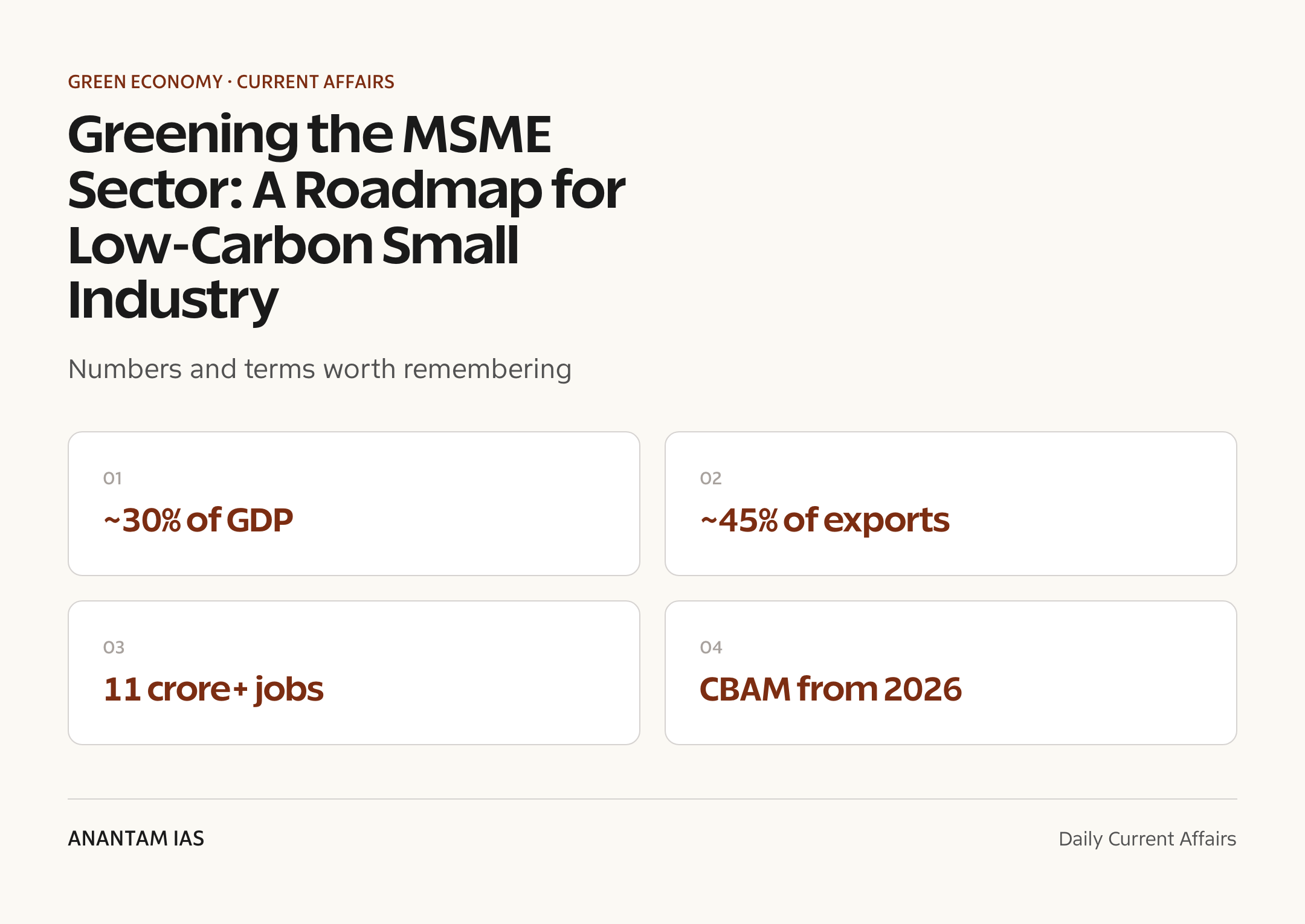
- MSMEs contribute roughly 30% of India’s GDP and about 45% of exports, making their carbon footprint strategically important.
- The sector accounts for a large slice of industrial energy use and emissions, much of it in informal, fuel-inefficient units.
- The Udyam Registration portal has formalised crores of enterprises, creating a data base on which targeted green support can ride.
- The EU CBAM definitive regime begins in January 2026, putting an effective carbon price on imports of steel, aluminium, cement, fertiliser, hydrogen and electricity.
The development matters in the context of:
- In the context of climate finance, the cost of decarbonising small units is a recognised barrier that priority-sector lending and concessional credit are meant to address.
- In the context of just transition, MSMEs employ a vast informal workforce, so any low-carbon shift must protect livelihoods, not just cut emissions.
UPSC Relevance
Prelims Relevance
- MSME classification under the revised composite criteria (investment in plant/machinery + annual turnover).
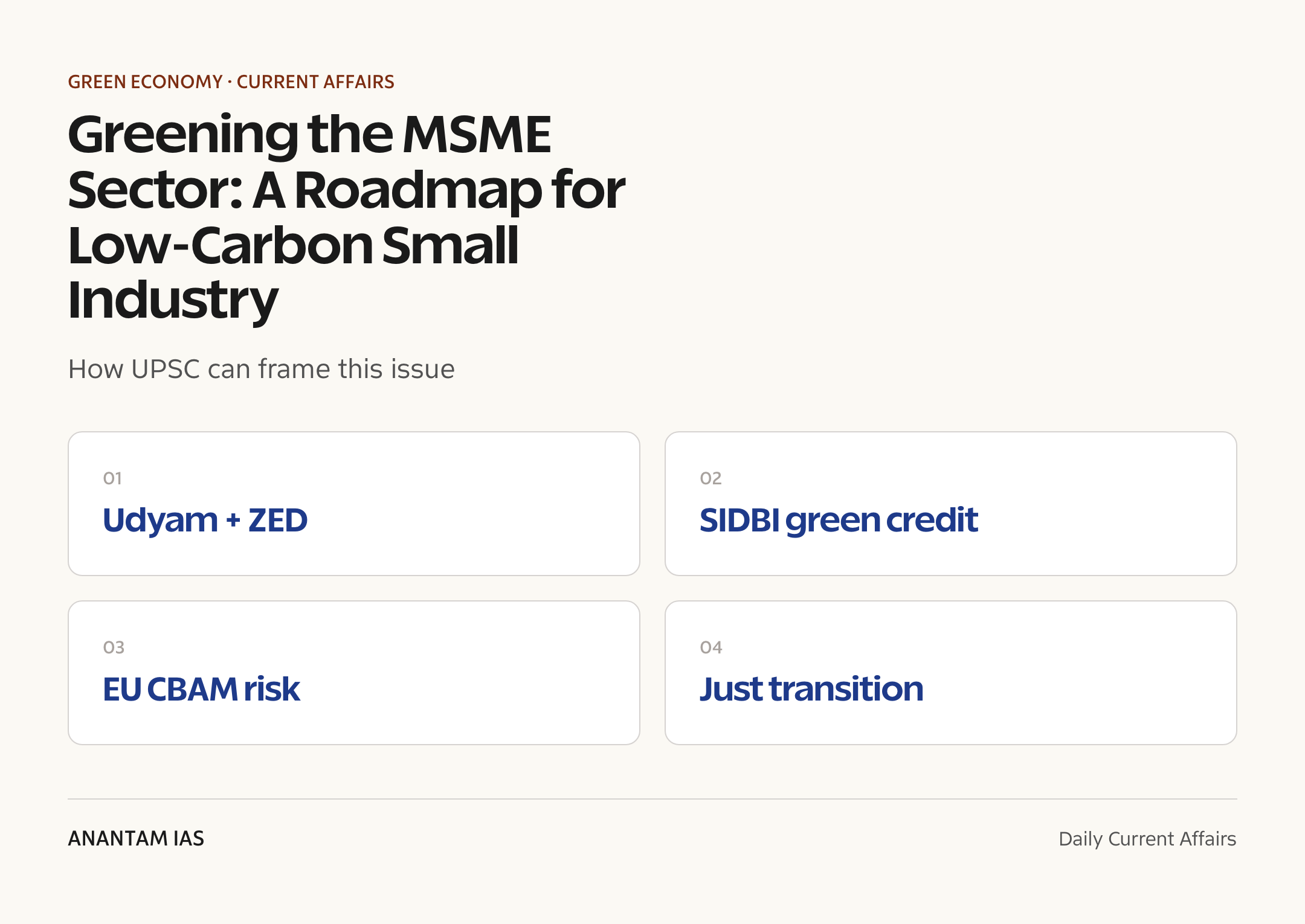
- Udyam Registration — the online self-declaration portal that replaced Udyog Aadhaar.
- ZED (Zero Defect Zero Effect) certification scheme for MSMEs.
- SIDBI — Small Industries Development Bank of India and its green-financing lines.
- Priority Sector Lending (PSL) norms and the renewable-energy/MSME sub-targets.
- EU CBAM — Carbon Border Adjustment Mechanism: coverage sectors and timeline.
- Net-zero by 2070 and India’s COP26 ‘Panchamrit’ pledges.
- PAT (Perform, Achieve and Trade) scheme under the Energy Conservation Act.
- Carbon Credit Trading Scheme (CCTS) and the compliance/voluntary market design.
Mains Relevance
GS Paper 3
- Examine the role of MSMEs in India’s growth, employment and export performance, and the levers for their low-carbon transition.
- Discuss how green finance and energy-efficiency interventions can decarbonise small industry without eroding competitiveness.
GS Paper 2
- Assess the implications of the EU’s CBAM for India’s small exporters and the policy response options available to the government.
Essay
- Growth and green: can a developing economy decarbonise without slowing down?
- A just transition leaves no worker behind.
Background and Context
Why MSMEs are central to the economy
Small industry is disproportionately important to output, jobs and trade.
- MSMEs generate close to 30% of GDP and roughly 45% of India’s exports, spanning textiles, leather, engineering goods, food processing and chemicals.
- The sector employs over 11 crore people, second only to agriculture, with a heavy share of informal and women workers.
- Revised MSME classification uses a composite of investment and turnover; the Udyam portal has registered crores of units, widening the formal base (see our MSME Sector in India notes).
- Their geographic dispersion makes them vital for balanced regional development and rural-urban livelihoods.
The carbon and energy footprint
Fragmentation and old technology make small units energy-inefficient.
- MSMEs consume a large share of industrial energy, often via coal, diesel and biomass in furnaces, boilers and kilns.
- Energy-intensive clusters — foundries, forging, brick kilns, ceramics, glass and textiles — drive a sizeable part of sectoral emissions.
- Thin margins and limited access to capital lock units into obsolete, inefficient equipment.
- Weak metering and awareness mean many enterprises cannot even measure their own carbon footprint.
Levers of a green roadmap
Decarbonisation rests on efficiency, cleaner fuels and process change.
- Energy efficiency: efficient motors, variable-speed drives, waste-heat recovery and better furnace design cut both bills and emissions.
- Cleaner fuels and processes: switching from coal/diesel to natural gas, biomass pellets, solar thermal and rooftop solar.
- Cluster-based interventions: shared infrastructure, common facility centres and bulk procurement spread the cost of clean technology.
- Certification: the ZED (Zero Defect Zero Effect) scheme rewards quality plus environmental performance and opens export markets.
Financing the transition
Green finance is the binding constraint for capital-starved small firms.
- SIDBI runs dedicated energy-efficiency and green-financing lines, often blended with multilateral and climate funds.
- Priority Sector Lending (PSL) norms channel bank credit to MSMEs and renewable energy, lowering the cost of green loans.
- Instruments such as green bonds, partial risk guarantees and concessional credit de-risk lending to small units.
- Awareness and hand-holding — energy audits, detailed project reports and technical support — are as scarce as money itself.
CBAM and export competitiveness
Carbon-border measures turn decarbonisation into a trade survival issue.
- The EU CBAM definitive phase from January 2026 prices the embedded carbon in imports of steel, aluminium, cement, fertiliser, hydrogen and electricity.
- Small Indian exporters in covered lines face reporting burdens and a cost penalty unless they cut and verify their emissions.
- Compliance demands credible emissions measurement, reporting and verification (MRV) that most MSMEs currently lack.
- India’s own Carbon Credit Trading Scheme (CCTS) and a domestic carbon price could blunt CBAM’s bite if recognised.
A just and inclusive transition
The shift must safeguard the workers and informal units it touches.
- A vast informal workforce depends on small units, so abrupt change risks job and income loss — the core of a just transition.
- Skilling and reskilling for clean-technology operation must accompany any equipment upgrade.
- Support should be tiered by size — micro units need grants and hand-holding, not just loans.
- Equity demands that the cost of going green is not loaded onto the smallest, most vulnerable enterprises.
Way Forward
Build a low-carbon credit ecosystem
- Scale SIDBI green lines with simple, standardised products and faster approvals for micro units.
- Strengthen PSL targeting so green MSME loans carry lower rates and lighter collateral.
Cluster-first technology upgradation
- Fund common facility centres, shared solar and waste-heat systems in energy-intensive clusters.
- Pair upgrades with free energy audits and bankable detailed project reports.
Make units CBAM-ready
- Set up affordable MRV and carbon-accounting tools, with cluster-level verification support.
- Negotiate recognition of India’s CCTS carbon price within the CBAM framework.
Embed a just-transition lens throughout — tie every green-finance and technology scheme to skilling, livelihood protection and tiered support so micro enterprises and their workers are not left behind.
Conclusion
Greening the MSME sector is no longer optional. With small industry anchoring 30% of GDP, 45% of exports and crores of livelihoods, its carbon trajectory will shape both India’s net-zero by 2070 goal and the survival of its exporters under carbon-border regimes.
The roadmap is clear in outline — energy efficiency, cleaner fuels, green finance, cluster action and CBAM readiness — but its success turns on execution that is affordable, inclusive and built around a just transition for the smallest firms.
UPSC Practice Questions
Prelims MCQ 1
With reference to the green transition of India’s MSME sector, consider the following statements:
- MSMEs are classified using a composite criterion of investment in plant and machinery and annual turnover.
- SIDBI operates dedicated energy-efficiency and green-financing lines for small enterprises.
- The ZED scheme certifies MSMEs on quality and environmental performance.
How many of the above statements are correct?
(a) Only one (b) Only two (c) All three (d) None
Answer: (c) All three
Explanation:
MSMEs use the revised composite (investment + turnover) criteria; SIDBI runs green-finance lines; and ZED (Zero Defect Zero Effect) certifies on both quality and environment. All three statements are correct.
Prelims MCQ 2
The European Union’s Carbon Border Adjustment Mechanism (CBAM) in its initial coverage applies to imports of which of the following?
(a) Steel, aluminium, cement, fertiliser, hydrogen and electricity (b) Textiles, leather, footwear and handicrafts (c) Pharmaceuticals, software services and gems (d) Tea, coffee, spices and processed foods
Answer: (a) Steel, aluminium, cement, fertiliser, hydrogen and electricity
Explanation:
CBAM’s covered sectors are the carbon-intensive lines — iron and steel, aluminium, cement, fertilisers, hydrogen and electricity — where embedded emissions are priced at the EU border.
UPSC Mains Questions
- MSMEs are simultaneously the backbone of India’s employment and a significant source of industrial emissions. Examine the key levers of a low-carbon roadmap for the sector and the role of green finance in enabling it. (250 words)
- Carbon-border measures such as the EU’s CBAM convert decarbonisation into a question of export survival for small industry. Discuss the implications for India’s MSME exporters and suggest a policy response. (250 words)
- A green transition that ignores its workers is not sustainable. In the context of MSME decarbonisation, analyse how the principle of a just transition can be operationalised. (150 words)
Sources: Ministry of MSME, Government of India and SIDBI.
Frequently Asked Questions
What share of the economy do MSMEs account for?
Micro, Small and Medium Enterprises contribute roughly 30% of India’s GDP and about 45% of its exports, while employing over 11 crore people across manufacturing and services. This makes the sector second only to agriculture in jobs, and a strategically important target for any economy-wide low-carbon transition.
Why does the MSME sector need a green transition?
Small units are often energy-inefficient, relying on coal, diesel and biomass in old furnaces, boilers and kilns. They consume a large share of industrial energy and emissions. Decarbonising them is essential both for India’s net-zero by 2070 goal and to keep exporters competitive under emerging carbon-border rules abroad.
What is the EU CBAM and why does it matter for MSMEs?
The Carbon Border Adjustment Mechanism prices the embedded carbon in imports of steel, aluminium, cement, fertiliser, hydrogen and electricity entering the European Union. Its definitive phase begins in January 2026. Indian small exporters in these lines face reporting burdens and a cost penalty unless they measure, cut and verify their emissions.
How does green finance help small industry decarbonise?
Capital is the binding constraint for thin-margin small units. SIDBI runs dedicated energy-efficiency and green-financing lines, often blended with climate funds, while Priority Sector Lending norms channel cheaper bank credit. Instruments like green bonds and partial risk guarantees de-risk lending, and energy audits help units identify bankable upgrades.
What is the ZED certification scheme?
ZED stands for Zero Defect Zero Effect. It is a certification scheme for MSMEs that rewards both manufacturing quality and environmental performance — minimal defects in the product and minimal adverse effect on the environment. ZED-certified units gain access to incentives and improved standing in domestic and export markets.
What does a just transition mean for MSMEs?
A just transition ensures the shift to low-carbon production protects the vast informal workforce that depends on small units. It pairs technology upgrades with skilling and reskilling, offers tiered support so micro enterprises get grants rather than only loans, and ensures the cost of going green is not loaded onto the smallest, most vulnerable firms.