
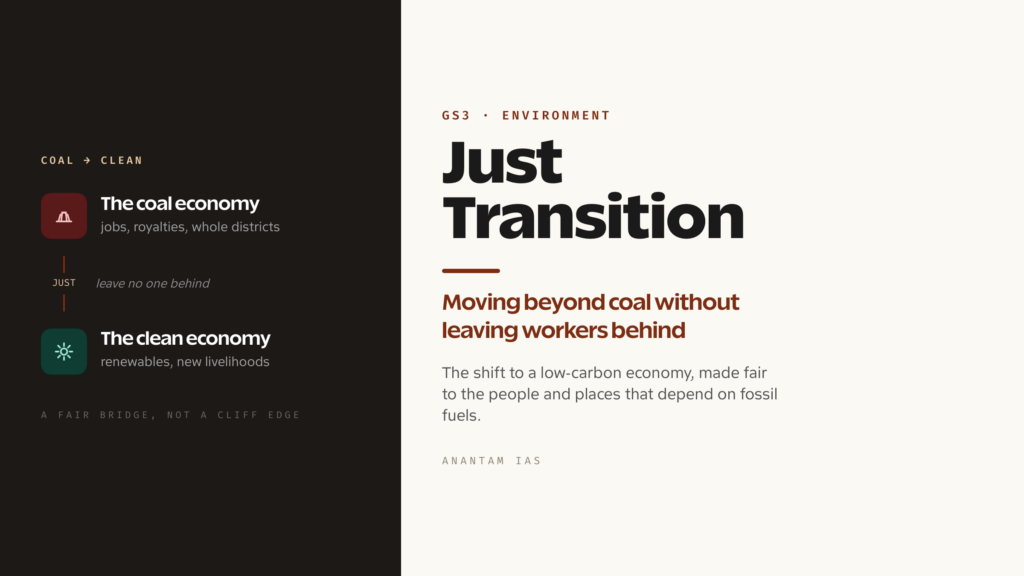
Every climate plan ends with the same comfortable sentence — the world must move off coal. The hard part is the one nobody puts on a poster: somebody has to tell the man who has cut coal for thirty years, in a district where there is no other work, that the seam he depends on is being closed for the good of the planet. A just transition is the idea built around that uncomfortable moment. It says the shift to a low-carbon economy is necessary, but it must not be paid for by the people who can least afford it — the miners, the haulage drivers, the families and whole districts whose livelihoods sit on top of fossil fuels. Put plainly, it is the promise that in the race to net zero, no one is left behind.
And the reason it has moved from a union slogan to a central plank of climate policy is simple arithmetic. You cannot decarbonise an economy without dismantling the industries that built it, and those industries employ millions and bankroll the budgets of entire regions. For India the stakes are unusually high. Coal still keeps the lights on for most of the country, supports the livelihoods of well over ten million people, and funds the welfare spending of states like Jharkhand, Chhattisgarh and Odisha through royalties. So when India argues at climate summits for a slower, fairer exit from coal, it is not dodging responsibility — it is naming the just-transition problem out loud. For a UPSC aspirant, this is one of the few topics that ties environment, economy, federalism and ethics into a single thread.
What a Just Transition Means and Where It Came From
The phrase has a surprisingly specific birthplace, and naming it earns marks. It comes not from environmentalists but from the trade-union movement. In the United States in the 1990s, the labour leader Tony Mazzocchi — watching factory and chemical workers lose their jobs as pollution rules tightened — argued for what he called a “Superfund for workers”: just as polluted land got cleaned up at public expense, the workers displaced by environmental protection deserved income support and retraining, not the dole. The core insight was that environmental progress and workers’ welfare must not be set against each other, because if they are, workers will always side against the planet. That is the seed of the whole idea — protect the environment without sacrificing the people who lose their jobs in the process.
From there it climbed into formal policy. The decisive document is the International Labour Organization’s Guidelines for a Just Transition, adopted in 2015 by governments, employers and trade unions together. The ILO defines a just transition as greening the economy “in a way that is as fair and inclusive as possible to everyone concerned, creating decent work opportunities and leaving no one behind.” That last phrase — leave no one behind — is the heartbeat of the concept and the same principle that anchors the UN’s Sustainable Development Goals. The guidelines rest on social dialogue, meaning the affected workers and communities get a real seat at the table rather than having a plan handed down to them. The 2015 Paris Agreement then wrote “just transition of the workforce” into its preamble, and the idea has appeared in every major climate text since, including the Glasgow and later COP decisions.
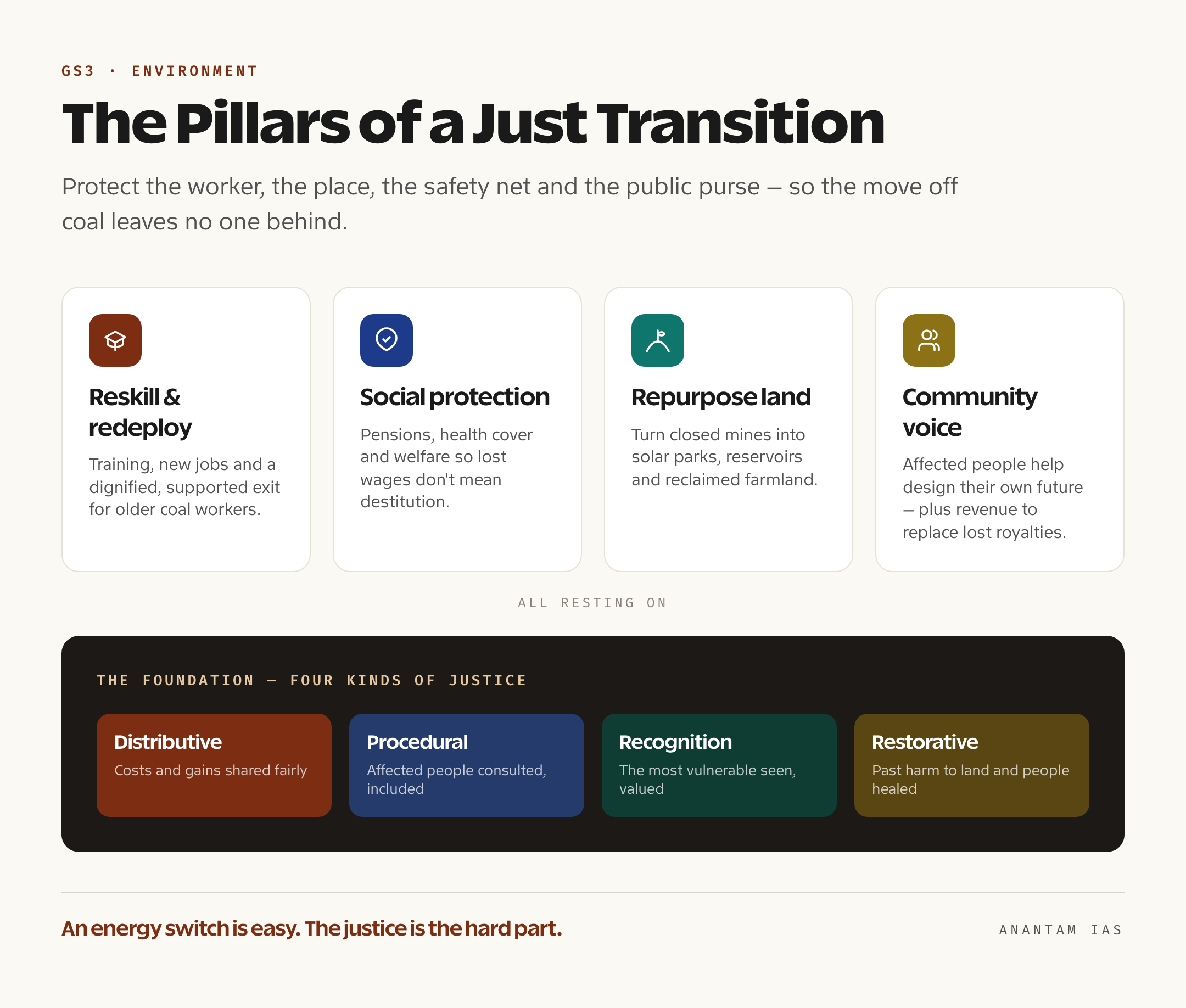
Scholars usually break a just transition into four kinds of justice, and carrying these four words into an answer instantly lifts it. Distributive justice asks who bears the costs and who gets the benefits — the aim is to share both fairly, so the gains of clean energy don’t flow to one group while the losses pile on another. Procedural justice is about process: are workers and communities actually consulted and included in decisions, or is the transition done to them? Recognition justice insists that the most vulnerable — informal workers, women, tribal communities, the landless — are seen and valued, not erased, because transitions tend to widen existing inequalities if left alone. And restorative justice deals with healing past and present harm — to mined-out land, to poisoned water, to communities that were exploited during the fossil-fuel era. A transition that delivers all four is “just”; one that delivers only cheaper, cleaner power is merely an energy transition.
What a Just Transition Actually Covers on the Ground
It is easy to say “leave no one behind” and much harder to specify what that means in a coal district, so this is where the concept turns concrete. The first and most obvious piece is the workforce — reskilling and redeploying the people who currently mine, transport and burn coal. That means vocational training for new trades, help moving into renewable-energy jobs or other sectors, and bridging support — income, pensions, early-retirement schemes — for older workers who realistically will not be retrained. The hard truth, which the ILO is honest about, is that not every fifty-five-year-old miner becomes a solar technician; for many, a just transition is really about a dignified exit rather than a new career.
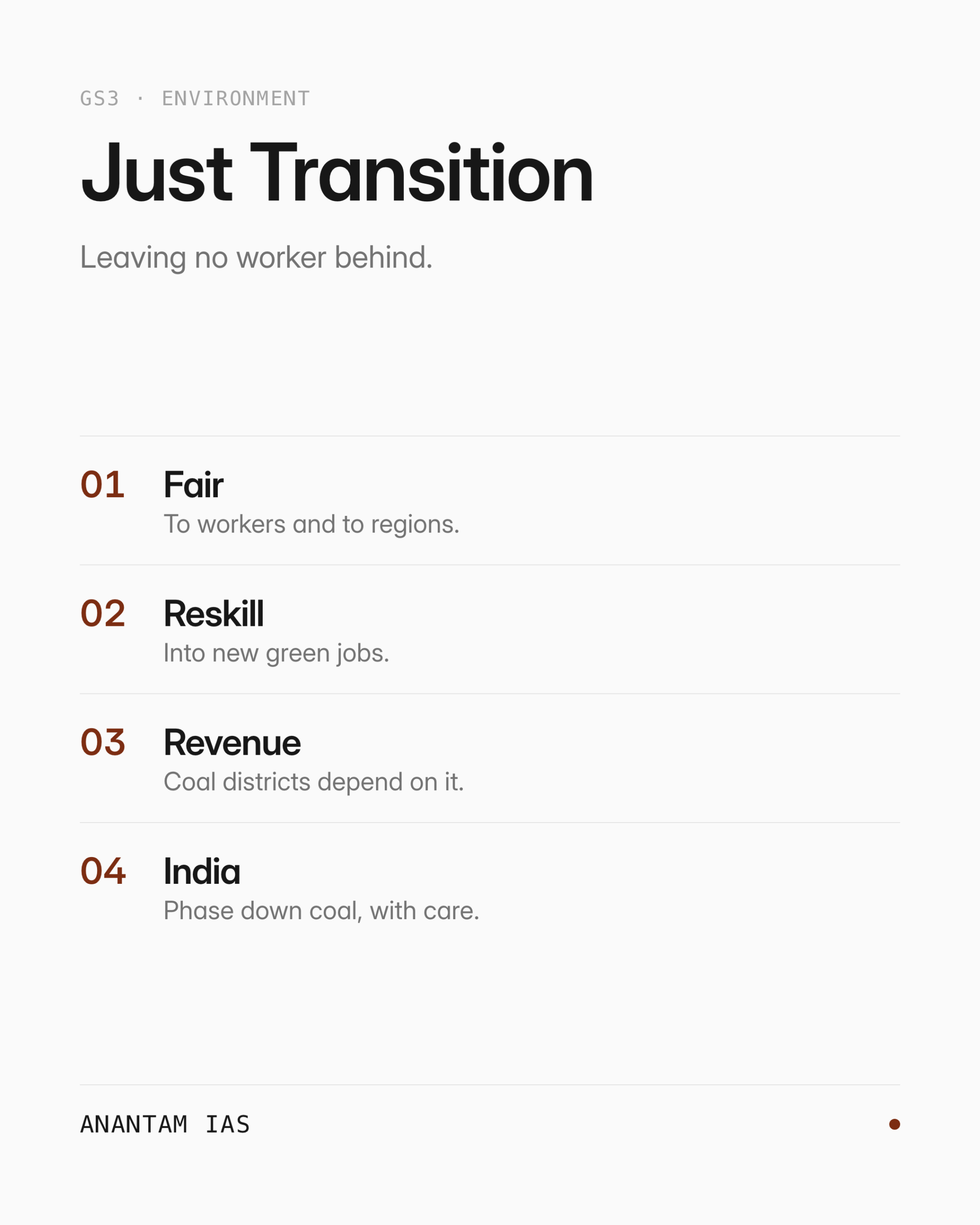
The second piece is the place, not just the person. Coal districts are usually mono-economies built entirely around the mine, so a just transition has to create alternative livelihoods and repurpose the land and assets the industry leaves behind — turning exhausted mines into solar parks, pumped-storage reservoirs, fish farms or industrial zones, and reclaiming the scarred land for farming or forest. This is the explicit aim of India’s RECLAIM framework for mine closure, and you can read more about it in our explainer on the RECLAIM framework for closed coal mines. The third piece is social protection — a safety net of health cover, pensions and welfare so that the loss of a paycheck does not become destitution. The fourth is fiscal: coal-dependent states and districts draw enormous revenue from royalties and levies, money that funds schools and hospitals, and a just transition must replace that revenue stream or those services collapse along with the mines. And running through all of it is community voice — the procedural-justice demand that the people affected help design their own future. Those five — workers, livelihoods and land, social protection, public revenue, and voice — are the working checklist of any just-transition plan.
How the World Is Trying to Finance It: The JETPs
Talk is cheap and decarbonisation is not, which is why the most-watched experiment in just transition is about money — the Just Energy Transition Partnerships, or JETPs. The model is straightforward in theory: a coalition of wealthy countries and development banks offers a coal-dependent developing nation a large pool of finance to retire coal plants faster and build renewables, on the condition that the country protects the affected workers and communities in the process. The headline JETP, announced at the Glasgow summit in 2021, gave South Africa an initial $8.5 billion to begin moving off coal, which supplies the bulk of its power and employs tens of thousands in the Mpumalanga coal belt. A second, larger partnership followed at the G20 in 2022, mobilising around $20 billion for Indonesia, with similar deals later floated for Vietnam and Senegal.
The JETPs matter for India precisely because India has not signed one, and the reasons are instructive. The early experience has been sobering. Much of the promised money turned out to be loans rather than grants, which a heavily indebted country is wary of taking on simply to shut its own industry. The plans proved slow and complicated to implement, and the politics fragile — in early 2025 the United States withdrew from both the South Africa and Indonesia partnerships, pulling out roughly a billion dollars and shaking confidence in the whole model. For a country the size of India, with a far larger coal fleet and workforce, a JETP on these terms looks less like a gift and more like a debt trap that locks in someone else’s timeline. India’s stated preference is to run its own transition on its own schedule, using domestic finance and instruments, rather than accept conditions attached to foreign money. The JETPs are still the most ambitious attempt to put real cash behind a just transition — but they have also become a cautionary tale about how hard fair financing actually is.
India’s Coal Dilemma: The Hardest Just Transition in the World
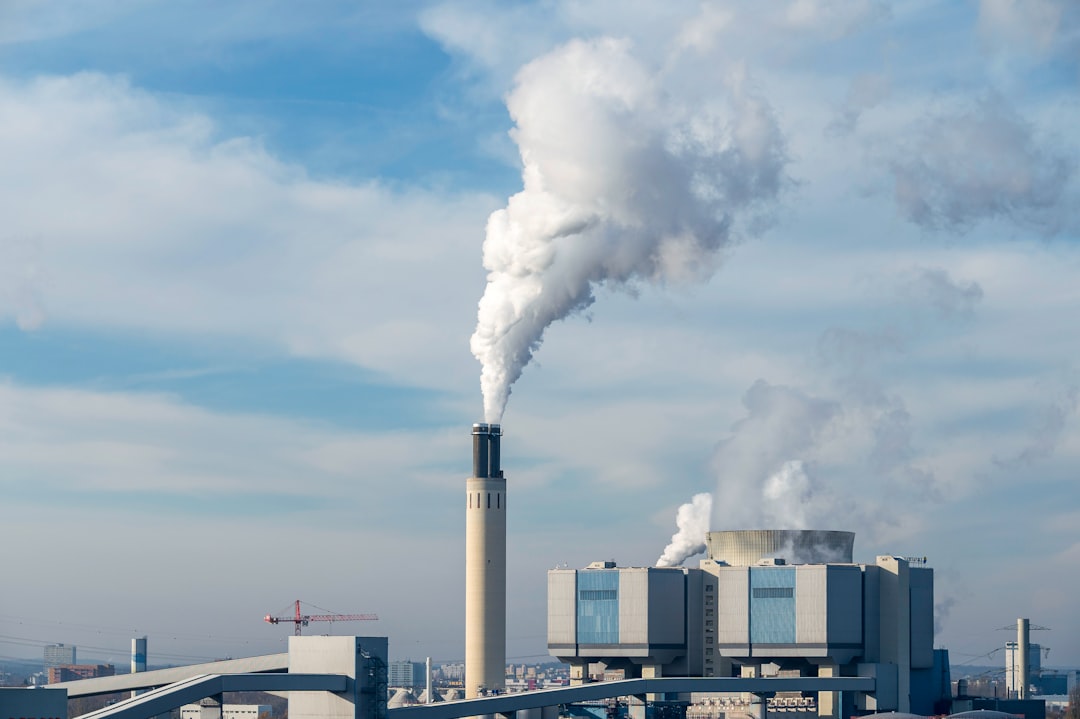
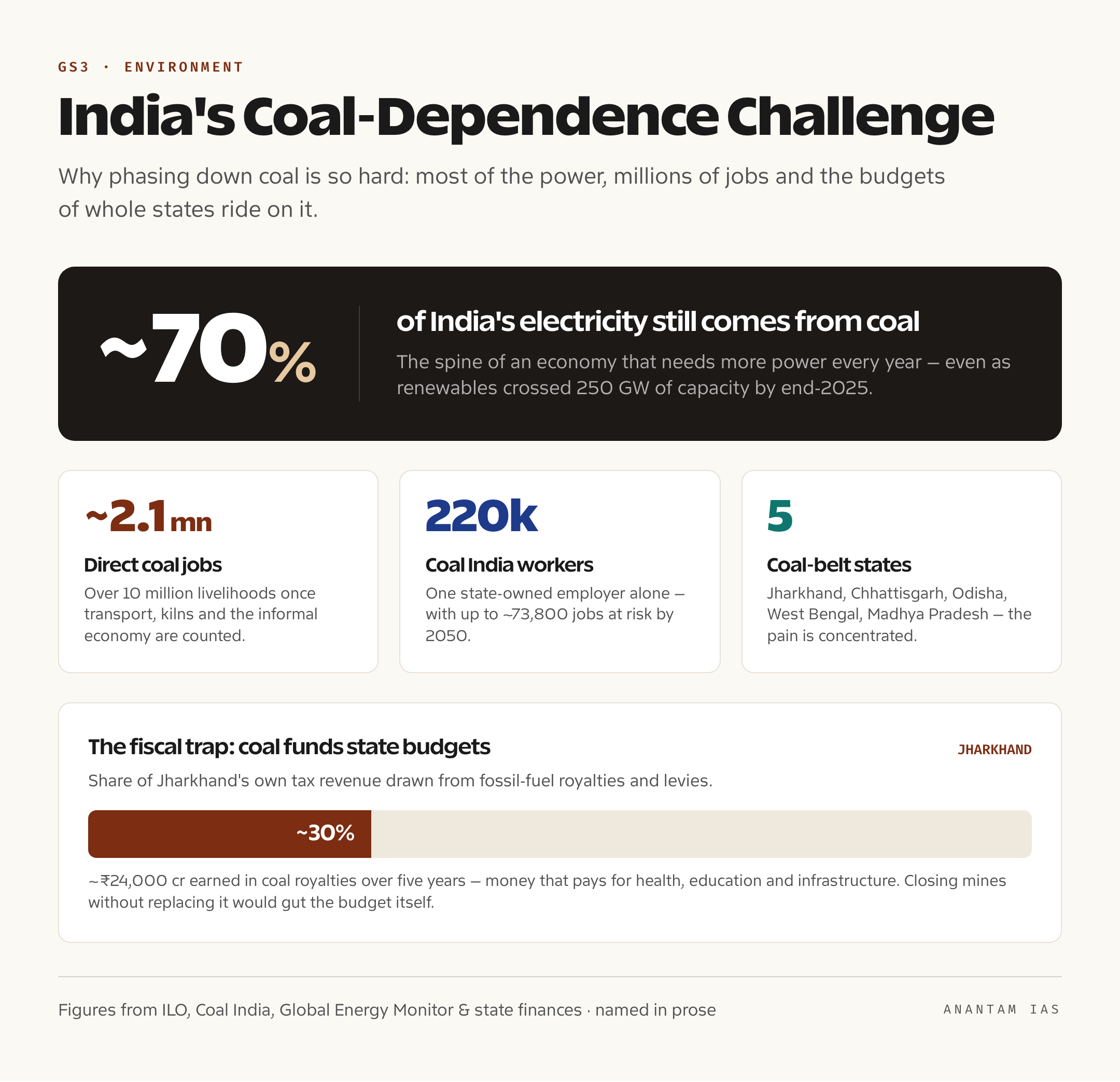
No country faces a steeper version of this problem than India, and laying out the numbers is what makes an answer authoritative. Start with dependence. Coal still generates close to 70 per cent of India’s electricity — the spine of an economy that needs more power every year, not less. The industry directly employs around 2.1 million people, with the state-owned giant Coal India Limited alone accounting for roughly 220,000 workers, and once you add transport, loading, brick kilns and the informal economy that clusters around every mine, coal sustains the livelihoods of well over ten million Indians. Crucially, that dependence is geographically concentrated — packed into the coal belts of Jharkhand, Chhattisgarh, Odisha, West Bengal and Madhya Pradesh, and often within a few kilometres of the pithead, so the pain of closure falls hard on a small number of districts rather than being spread thinly across the country.
Then there is the money the states cannot do without. Coal royalties and levies are a fiscal lifeline for the coal-bearing states. Jharkhand draws close to 30 per cent of its own tax revenue from fossil-fuel royalties; over a recent five-year stretch it earned roughly ₹24,000 crore in coal royalties alone, with Chhattisgarh and Odisha each collecting over ₹16,000 crore. That money pays for health, education and infrastructure in some of India’s poorest regions. Closing the mines without replacing that revenue would not just cost jobs — it would gut the budgets of entire states. There is some cushion in place: the District Mineral Foundation, set up in 2015 under an amendment to the mining law, already channels a slice of mining royalties into the welfare of mining-affected communities, and it is one of the most useful existing instruments for funding a just transition. But the scale of the challenge dwarfs the tools.
This is the context for India’s much-debated stance at climate negotiations. At the Glasgow summit, India led the push to change the final text from “phase out” to “phase down” unabated coal — a single word that captured a whole worldview. India’s argument rests on the principle of common but differentiated responsibilities, or CBDR: the rich nations that burned coal for two centuries to industrialise cannot now ask a developing country to abandon the same fuel before its people have escaped poverty. India has committed to net zero by 2070 and to 500 gigawatts of non-fossil power capacity by 2030, but it insists on a phase-down on its own timeline, not a phase-out on someone else’s. Read uncharitably, this is foot-dragging. Read fairly, it is the just-transition principle applied at the level of nations — equity demands that the country with the least historical responsibility and the greatest development need gets the most time and the most support to make the change.
The optimistic counterweight is that the clean economy is starting to build the jobs the old one will shed. India crossed 250 gigawatts of renewable capacity by the end of 2025 and the sector now employs well over a million people, a figure climbing fast as solar and wind expand. The Ministry of Coal has set up a dedicated Just Transition Division and, through the RECLAIM framework, begun planning for socially fair, environmentally restorative mine closures rather than abandoned pits. The task is to time it right — to grow the new livelihoods fast enough, and in the right places, that a coal worker in Dhanbad has somewhere to go before the seam runs out. Get that sequence wrong, and the transition is neither just nor, in the end, politically survivable.
For Your Mains Answer
This is a high-value topic for GS Paper 3, which covers the environment, conservation, infrastructure (energy) and the Indian economy, and it bleeds naturally into GS Paper 2 (centre-state fiscal relations, welfare of vulnerable sections) and GS Paper 4 (intergenerational and distributive justice as an ethics theme). It is also a ready-made Essay on equity, development and climate. The skill it rewards is the one this article uses: hold the global principle and the Indian numbers together, and always present the phase-down argument as a fairness case, not an excuse.
How to Build the Answer
Open by defining a just transition crisply — the fair, inclusive shift to a low-carbon economy that leaves no one behind — and credit its trade-union origins and the ILO guidelines. Then move in a chain: what it covers on the ground (workers, land, social protection, public revenue, voice), how the world finances it (the JETPs and their stumbles), and the India angle (coal dependence in numbers, the fiscal stake of coal states, the phase-down-versus-phase-out stance grounded in CBDR). Close by judging the balance — that India’s case is sound but the execution, especially reskilling and revenue replacement, is where the real test lies. That arc — define, cover, finance, apply, evaluate — fits almost any just-transition question.
Common Mistakes to Avoid
Don’t treat “just transition” as a synonym for “energy transition” — the whole point is the justice, the people-and-places dimension that a mere fuel switch ignores. Don’t present India’s phase-down position as climate denial; frame it through CBDR and equity. Don’t forget the fiscal angle — examiners reward the insight that coal funds state budgets, not just jobs. And don’t be naively optimistic about reskilling; note honestly that many older workers need a dignified exit, not a second career.
A Compact Answer Spine
Just transition = fair, inclusive shift to a low-carbon economy, “leave no one behind” → origins in trade unions (Mazzocchi’s “Superfund for workers”), formalised by the ILO 2015 Guidelines, written into the Paris Agreement → four justices: distributive, procedural, recognition, restorative → on the ground it means reskilling, alternative livelihoods, repurposing land, social protection, replacing lost royalty revenue, and community voice → global finance via JETPs (South Africa $8.5 bn, Indonesia ~$20 bn), now strained by debt-heavy terms and the 2025 US exit → India: coal ≈ 70% of power, ~2.1 mn direct jobs, Coal India ~220,000, >10 mn livelihoods, royalties fund ~30% of Jharkhand’s own tax revenue → stance: phase-down not phase-out, net zero by 2070, on CBDR/equity grounds → tools: DMF, Just Transition Division, RECLAIM, 250+ GW renewables → verdict: principle sound, execution is the test.
Diagram or Flowchart Idea
Draw a simple two-tier diagram: a top row of four pillars — “reskill workers”, “repurpose land”, “social protection”, “replace revenue” — sitting on a base labelled with the four justices (distributive, procedural, recognition, restorative). Beside it, a small chain arrow: “coal phase-down → lost jobs + lost royalties → just-transition measures → no one left behind.” A clean visual like this shows the examiner you grasp both the structure and the logic.
A Balanced-Conclusion Line
A line that lands the marks: “A just transition reframes the move off coal from a question of engineering into a question of fairness — and for India, getting it right means growing the green economy fast enough that the worker in the coal belt has somewhere to go before the mine closes, not after.”
How to Use Data Without Cramming
You need only a handful of anchors, not a spreadsheet: coal ≈ 70 per cent of India’s electricity, about 2.1 million direct coal jobs, Coal India’s 220,000 workers, and roughly 30 per cent of Jharkhand’s own tax revenue from coal royalties. Add net zero by 2070 and 500 GW of non-fossil capacity by 2030, and the two JETP figures ($8.5 billion for South Africa, around $20 billion for Indonesia). Attribute them plainly — “as the ILO’s 2015 guidelines put it”, “as Global Energy Monitor has estimated” — rather than scattering numbers loose.
Frequently Asked Questions
What is a just transition in simple terms?
It is the principle that the shift away from fossil fuels to a clean, low-carbon economy must be fair to the workers, communities and regions that currently depend on those fuels — so that climate action does not throw miners, their families and whole districts into poverty. The phrase that captures it is “leave no one behind.” It began in the trade-union movement and was formalised by the International Labour Organization’s 2015 Just Transition Guidelines.
Why is a just transition so difficult for India?
Because India’s dependence on coal is enormous and concentrated. Coal generates close to 70 per cent of India’s electricity, directly employs around 2.1 million people — about 220,000 in Coal India alone — and supports the livelihoods of well over ten million when allied sectors are counted. On top of that, coal royalties fund a huge share of state budgets — close to 30 per cent of Jharkhand’s own tax revenue — so closing mines threatens not just jobs but the schools and hospitals those revenues pay for.
What are JETPs and has India joined one?
Just Energy Transition Partnerships are deals in which rich countries and development banks offer a developing nation finance to move off coal faster while protecting affected workers — South Africa’s was launched at $8.5 billion in 2021, Indonesia’s at around $20 billion in 2022. India has not joined one, wary that much of the money comes as loans rather than grants and ties the country to externally set conditions and timelines. India prefers to run its transition on its own schedule with domestic finance.
What is the difference between “phase-down” and “phase-out” of coal?
At the 2021 Glasgow summit, India led the move to change the final climate text from “phase out” to “phase down” unabated coal. “Phase out” implies ending coal use entirely; “phase down” means reducing it gradually. India’s argument rests on common but differentiated responsibilities — that nations which industrialised on coal for two centuries cannot demand that a developing country abandon it before lifting its people out of poverty. India has still pledged net zero by 2070 and 500 GW of non-fossil capacity by 2030.
Practice Questions
Prelims MCQs
- The concept of a “just transition” is most directly associated with which of the following?
(a) Ensuring the shift to a low-carbon economy is fair to affected workers and communities
(b) Transferring judicial powers between courts
(c) The peaceful transfer of political power after elections
(d) Shifting agricultural subsidies to direct cash transfers
Answer: (a) A just transition is the principle that decarbonisation must be fair and inclusive to the workers, communities and regions dependent on fossil fuels, leaving no one behind. - The “Guidelines for a Just Transition towards environmentally sustainable economies and societies for all” were adopted by which organisation?
(a) The World Bank
(b) The International Labour Organization (ILO)
(c) The United Nations Environment Programme
(d) The International Monetary Fund
Answer: (b) The ILO adopted these guidelines in 2015, developed jointly by governments, employers and workers, providing the central reference for just-transition policy. - Just Energy Transition Partnerships (JETPs) have been launched for which of the following countries?
(a) China and Russia
(b) South Africa and Indonesia
(c) Germany and France
(d) India and Bangladesh
Answer: (b) The first JETP was launched for South Africa (2021) and a larger one for Indonesia (2022); India has not joined a JETP. - The District Mineral Foundation (DMF), relevant to financing a just transition in coal regions, was established under an amendment to which law?
(a) The Coal Mines (Nationalisation) Act
(b) The Forest (Conservation) Act
(c) The Mines and Minerals (Development and Regulation) Act
(d) The Environment (Protection) Act
Answer: (c) The DMF was created in 2015 through an amendment to the MMDR Act, to fund the welfare of areas and people affected by mining. - At the 2021 Glasgow climate summit, India led the effort to change the final text to use which phrase regarding unabated coal?
(a) “Phase out”
(b) “Phase down”
(c) “Eliminate immediately”
(d) “Tax heavily”
Answer: (b) India pushed for “phase down” instead of “phase out,” invoking common but differentiated responsibilities and the development needs of poorer nations.
Mains Practice Questions
- What do you understand by a “just transition”? Discuss its core elements and explain why it has become central to global climate policy. (15 marks, 250 words)
- “India faces perhaps the hardest just transition in the world.” Examine this statement with reference to the country’s coal dependence, employment and the fiscal reliance of coal-bearing states. (15 marks, 250 words)
- Analyse India’s stance of “phase-down, not phase-out” of coal in the light of the principle of common but differentiated responsibilities. Is this position justified? (15 marks, 250 words)
- Discuss the Just Energy Transition Partnerships (JETPs) as a model for financing the move away from coal. Why has India been reluctant to join such a partnership? (10 marks, 150 words)
- A just transition is often described as built on four kinds of justice — distributive, procedural, recognition and restorative. Using this framework, suggest measures India should take to ensure its coal transition is genuinely just. (15 marks, 250 words)
Tell Google you want more of this.
Add Anantam IAS as a preferred sourceOne tap, and this site shows up more often in your own Top Stories, AI Overviews and AI Mode. Remove it any time.