Cooling Without Heating the Planet: India’s Sustainable-Cooling Challenge
Why in News?
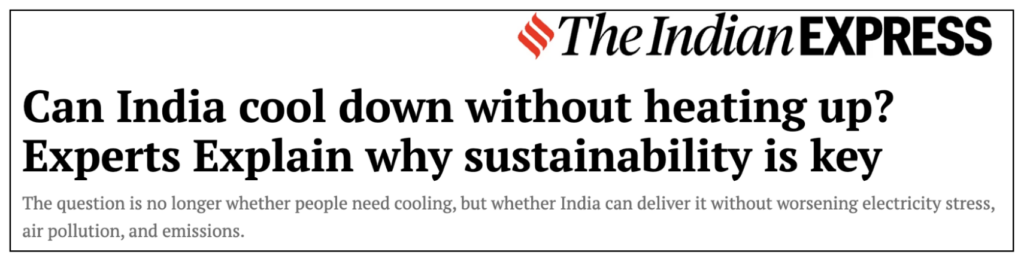
An Indian Express Explained piece (“Can India cool down without heating up?”) flagged a sharpening paradox: as heat waves lengthen and incomes rise, the country’s demand for air-conditioning and refrigeration is exploding, yet the energy and refrigerants this cooling consumes themselves push warming higher.
The cooling-warming loop has moved to the centre of India’s climate planning, anchored by the India Cooling Action Plan (ICAP, 2019) — the world’s first comprehensive national cooling strategy — and by treaty commitments under the Montreal Protocol and its Kigali Amendment.
- Space cooling is one of the fastest-growing sources of electricity demand in India, driven by hotter, longer summers and rising AC ownership.
- Most cooling runs on coal-heavy grid power, so more AC means more carbon dioxide emissions unless the grid and appliances get cleaner.
- Refrigerants used in ACs and fridges are potent greenhouse gases — many HFCs have global-warming potential (GWP) hundreds to thousands of times that of CO2.
- The India Cooling Action Plan (ICAP) targets a steep cut in cooling demand, refrigerant demand and cooling energy by 2037-38 against a 2017-18 baseline.
The development matters in the context of:
- Why this matters for living standards: cooling is shifting from a luxury to a health and productivity necessity as wet-bulb temperatures climb.
- Why this matters for climate goals: uncontrolled cooling growth could erode India’s net-zero by 2070 pathway and its Nationally Determined Contributions.
- Why this matters for equity: heat hits outdoor workers and the poor hardest, yet they have the least access to cooling — a classic climate-justice gap.
UPSC Relevance
Prelims Relevance
- India Cooling Action Plan (ICAP, 2019) — first national cooling plan; lead ministry is MoEFCC
- Montreal Protocol (1987) — phases out ozone-depleting substances like CFCs and HCFCs
- Kigali Amendment (2016) to the Montreal Protocol — phases down HFCs, which are greenhouse gases, not ozone-depleters
- Global-warming potential (GWP) — warming impact of a gas relative to CO2 over a time horizon
- Bureau of Energy Efficiency (BEE) — runs the Star Labelling programme and Standards & Labelling
- Minimum Energy Performance Standards (MEPS) for appliances
- Urban heat island effect; passive cooling and district cooling
- Cold chain — temperature-controlled supply chain for food, vaccines and pharma
- Heat Action Plans (HAPs) — city/state early-warning and response frameworks (Ahmedabad pioneered India’s first in 2013)
Mains Relevance
GS Paper 3
- Sustainable cooling as a climate-mitigation and energy-efficiency challenge: the cooling-energy-emissions nexus.
- Refrigerant transition under the Kigali Amendment and its bearing on India’s climate commitments.
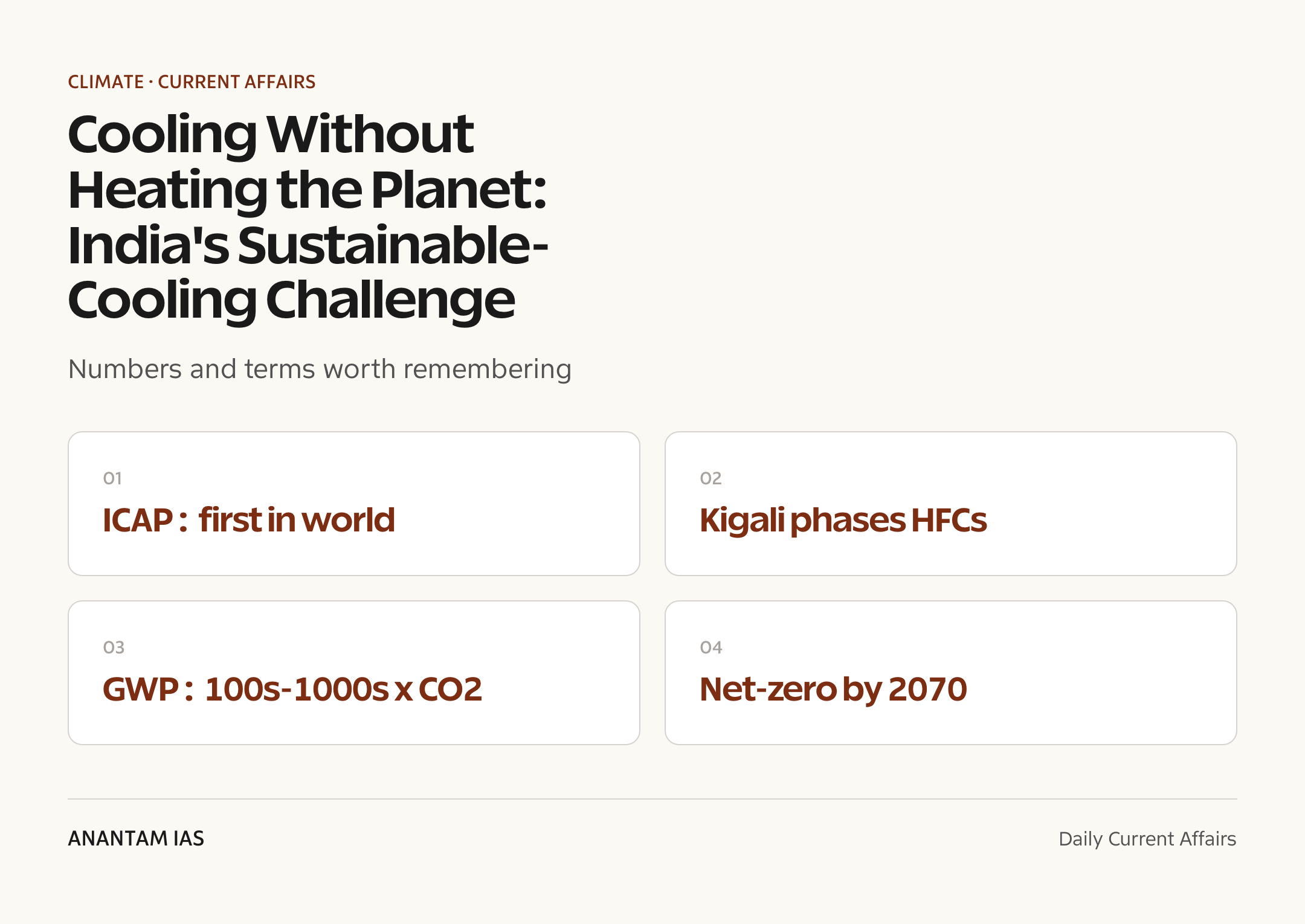
- Role of energy efficiency (BEE star labels, MEPS), passive design and district cooling in demand reduction.
GS Paper 2
- India’s obligations under multilateral environmental agreements (Montreal Protocol, Paris Agreement) and how they shape domestic policy.
- Cooling access as a question of health, equity and disaster management (heat-wave governance).
Essay
- Development creates the very comforts that threaten the planet that sustains it.
- Adaptation and mitigation are not rivals but two halves of the same survival strategy.
Background and Context
The cooling paradox
Cooling protects people from a warming climate while, done badly, accelerating that same warming.
- Demand surge: hotter summers, urbanisation and a growing middle class are driving rapid uptake of air-conditioners, fans, refrigerators and cold storage.
- Two emission channels: the electricity an appliance uses (mostly coal-fired in India) plus the refrigerant it leaks over its life.
- Peak-load stress: AC use spikes on the hottest afternoons, forcing utilities to keep dirty, expensive peaking plants ready and straining the grid.
- Feedback loop: more emissions raise temperatures, which raises cooling demand — a self-reinforcing cycle, the Indian Express piece highlighted.
India Cooling Action Plan (ICAP), 2019
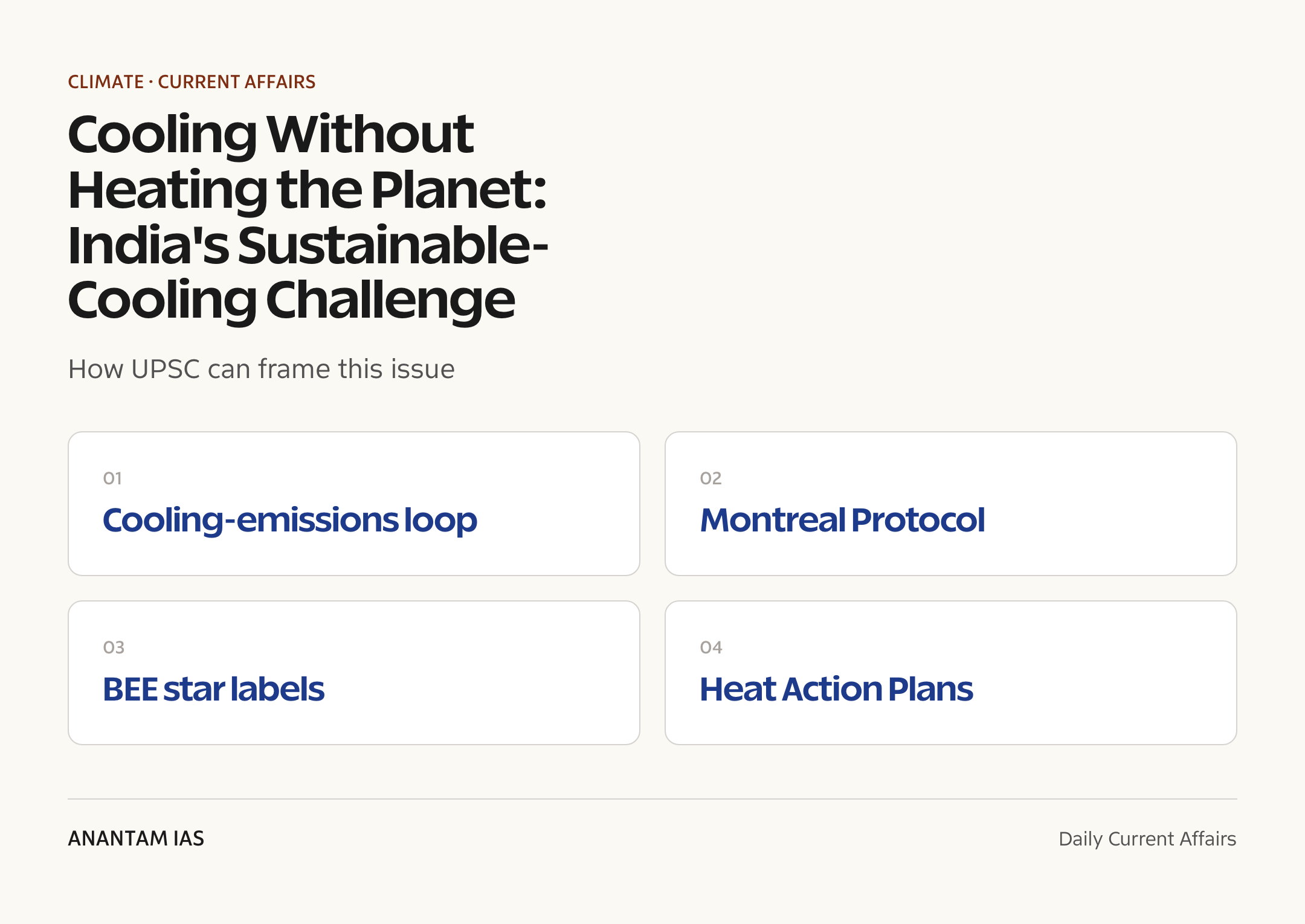
India’s MoEFCC released the world’s first comprehensive national cooling strategy, covering a 20-year horizon.
- First-of-its-kind: the India Cooling Action Plan was the first national plan to take an integrated, cross-sectoral view of cooling — buildings, cold chain, refrigeration, transport, air-conditioning and refrigerants.
- Goal architecture: reduce overall cooling demand, cut refrigerant demand, and lower cooling energy requirements by 2037-38 against a 2017-18 baseline.
- Twin track: it links mitigation (efficiency, low-GWP refrigerants) with access (affordable cooling as a basic need).
- Skilling: ICAP also flagged training servicing technicians, since refrigerant leaks during servicing are a major emissions source.
Refrigerants, GWP and the Kigali Amendment
The chemicals that move heat are themselves a climate problem, governed by the Montreal Protocol family of treaties.
- The chemistry chain: CFCs and HCFCs harmed the ozone layer and were phased out/down under the Montreal Protocol (1987).
- HFCs replaced them — they spare the ozone layer but are potent greenhouse gases, with GWP often hundreds to thousands of times that of CO2.
- Kigali Amendment (2016): brought HFCs under the Montreal Protocol and set a phased HFC phase-down; India ratified it and follows a differentiated, later timeline.
- Next-gen options: low-GWP refrigerants and natural refrigerants (ammonia, CO2, hydrocarbons) plus tighter leak control are central to compliance.
Energy efficiency and standards
The cheapest cooling is the cooling you never need; the next-cheapest is the most efficient unit available.
- BEE Star Labelling: the Bureau of Energy Efficiency rates appliances 1-5 stars, guiding consumers toward efficient ACs and fridges.
- MEPS: Minimum Energy Performance Standards bar the least-efficient models from the market and ratchet up over time.
- Default-temperature push: a recommended AC default of around 24 degrees Celsius cuts energy use sharply with little comfort loss.
- Cold chain efficiency: better-designed cold storage and refrigerated transport reduce both food loss and cooling energy.
Passive cooling, district cooling and urban heat
Beyond appliances, how we build and plan cities decides how much active cooling is even needed.
- Passive cooling: design strategies — shading, insulation, reflective roofs, cross-ventilation, traditional materials — that lower indoor heat without machines.
- District cooling: a central plant chills water and pipes it to many buildings, far more efficient than thousands of individual units.
- Urban heat island: dense concrete, glass and asphalt make cities several degrees hotter than their surroundings, raising cooling loads.
- Cool roofs and green cover: reflective surfaces and urban greenery cut surface temperatures and demand cheaply.
Heat as a health and equity issue
Cooling is not just comfort — it is increasingly a question of survival, productivity and fairness.
- Heat Action Plans (HAPs): Ahmedabad pioneered India’s first HAP in 2013; many cities and states now run heat-wave early-warning and response systems.
- Wet-bulb risk: high heat plus humidity (wet-bulb temperature) can exceed the limits the human body can tolerate.
- Vulnerable groups: outdoor workers, the elderly and the poor face the greatest exposure with the least access to cooling.
- Access gap: ensuring affordable cooling for all is itself a climate-justice and adaptation priority, not a luxury question.
Way Forward
Cut the demand first
- Mainstream passive-cooling design and thermal-comfort norms in building codes and affordable housing.
- Scale cool roofs, urban greening and shading to blunt the urban heat island effect.
Make every unit efficient and clean
- Keep ratcheting up BEE star ratings and MEPS, and promote efficient super-efficient ACs.
- Accelerate the shift to low-GWP and natural refrigerants with strong leak-control and technician training under the Kigali timeline.
Decarbonise the supply and protect people
- Pair cooling growth with renewable energy, storage and demand-side management to flatten peak load.
- Expand and resource Heat Action Plans and equitable cooling access for vulnerable communities.
Conclusion
India’s cooling challenge captures the larger development dilemma: the comforts that make a warming country liveable can, if powered and refrigerated carelessly, deepen the very crisis they ease.
The way out is not less cooling but smarter cooling — cutting demand through design, cleaning up appliances and refrigerants, greening the grid and treating cooling access as a basic right. Get this right, and India can keep its people cool while keeping faith with its climate goals.
UPSC Practice Questions
Prelims MCQ 1
With reference to the cooling-climate nexus in India, consider the following statements:
- The India Cooling Action Plan was among the first national-level cooling strategies in the world.
- The Kigali Amendment to the Montreal Protocol deals with the phase-down of hydrofluorocarbons (HFCs).
- Hydrofluorocarbons (HFCs) damage the ozone layer but have negligible global-warming potential.
How many of the above statements are correct?
(a) Only one (b) Only two (c) All three (d) None
Answer: (b) Only two
Explanation:
Statements 1 and 2 are correct: ICAP (2019) was the world’s first comprehensive national cooling plan, and the Kigali Amendment phases down HFCs. Statement 3 is wrong — HFCs do NOT deplete ozone but are potent greenhouse gases with high GWP.
Prelims MCQ 2
The Standards and Labelling (star-rating) programme for energy-efficient appliances in India is run by which body?
(a) Central Pollution Control Board (b) Bureau of Energy Efficiency (c) Bureau of Indian Standards (d) Central Electricity Authority
Answer: (b) Bureau of Energy Efficiency
Explanation:
The Bureau of Energy Efficiency (BEE), under the Ministry of Power, runs the Standards & Labelling programme and assigns 1-5 star ratings to appliances such as air-conditioners and refrigerators.
UPSC Mains Questions
- “India cannot cool its people without first cooling its cooling.” Examine the cooling-energy-emissions nexus and discuss how the India Cooling Action Plan seeks to break it. (15 marks, 250 words)
- Explain how the Montreal Protocol and its Kigali Amendment together address both ozone protection and climate change, and assess India’s strategy for a low-GWP refrigerant transition. (10 marks, 150 words)
- Access to cooling is becoming a question of health, productivity and equity, not merely comfort. Discuss, with reference to heat waves and Heat Action Plans in India. (15 marks, 250 words)
Sources: Ministry of Environment, Forest and Climate Change and The Indian Express.
Frequently Asked Questions
What is sustainable cooling?
Sustainable cooling means meeting people’s cooling needs — for comfort, health, food and medicines — while minimising the energy used and the greenhouse gases emitted. It combines cutting demand through better building design, using highly efficient appliances, switching to low-warming-potential refrigerants and powering cooling with clean energy, so comfort does not come at the planet’s cost.
What is the India Cooling Action Plan (ICAP)?
ICAP, released in 2019 by the Ministry of Environment, Forest and Climate Change, was the world’s first comprehensive national cooling strategy. Spanning a 20-year horizon, it aims to reduce overall cooling demand, refrigerant demand and cooling energy use by 2037-38 against a 2017-18 baseline, while ensuring affordable cooling access for all.
Why do air-conditioners worsen climate change?
Air-conditioners contribute to warming in two ways. First, they consume large amounts of electricity, which in India is still largely coal-based, releasing carbon dioxide. Second, they use refrigerants that are powerful greenhouse gases — many leak over a unit’s life and have global-warming potential hundreds to thousands of times that of carbon dioxide.
What is the Kigali Amendment?
The Kigali Amendment (2016) to the Montreal Protocol commits countries to phase down hydrofluorocarbons (HFCs). HFCs do not harm the ozone layer but are strong greenhouse gases. India has ratified Kigali and follows a differentiated, later phase-down schedule, shifting industry toward low-GWP and natural refrigerants.
What is passive cooling?
Passive cooling lowers indoor temperatures without mechanical systems. It uses design strategies such as shading, insulation, reflective or cool roofs, cross-ventilation, courtyards and appropriate materials. By reducing how much heat enters a building, passive cooling cuts the need for air-conditioning, saving both energy and money while easing pressure on the power grid.
What are Heat Action Plans?
Heat Action Plans (HAPs) are early-warning and response frameworks that help cities and states protect people during heat waves. Ahmedabad pioneered India’s first HAP in 2013. They include heat-wave alerts, public awareness, adjusting work hours, opening cooling shelters and readying hospitals, focusing on vulnerable groups like outdoor workers and the elderly.