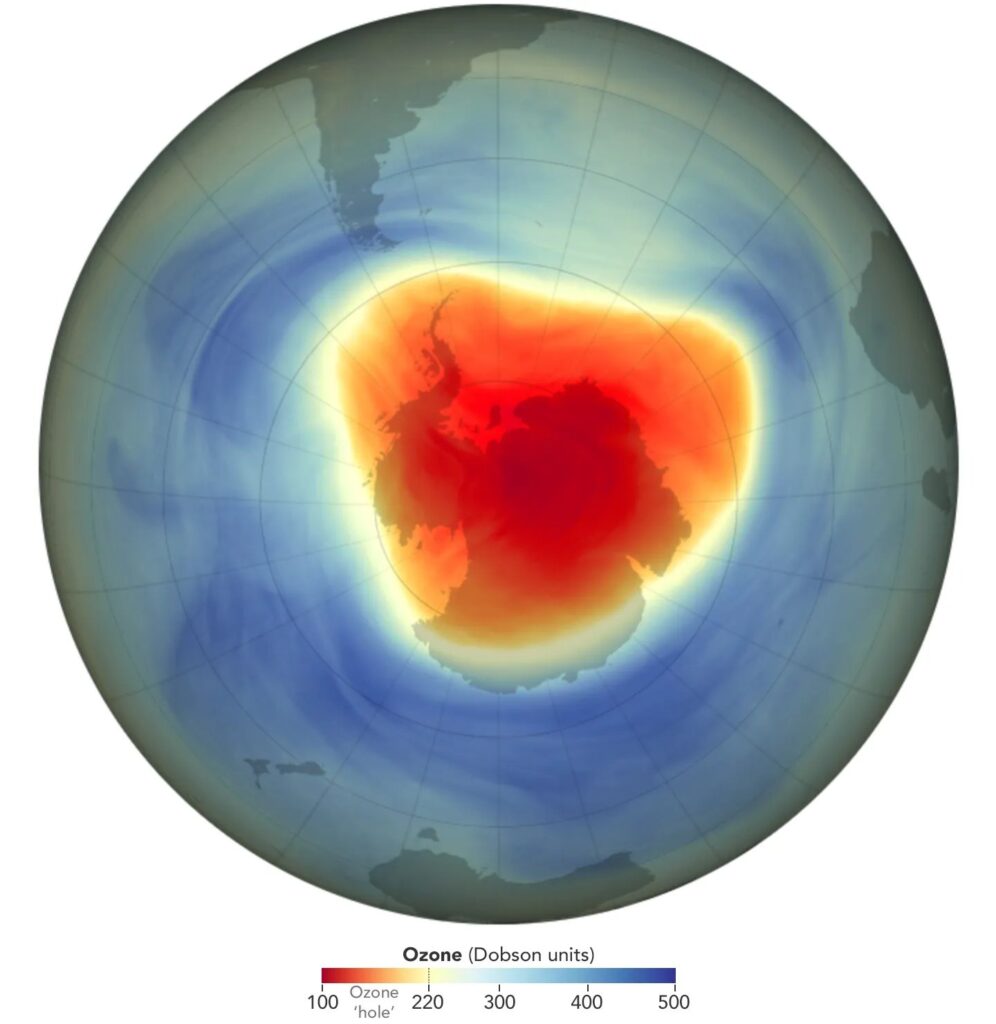
The Montreal Protocol on Substances that Deplete the Ozone Layer is the international treaty designed to protect the stratospheric ozone layer by phasing out the production and consumption of nearly 100 ozone-depleting substances (ODS). Adopted at Montreal, Canada on 16 September 1987 and entering into force on 1 January 1989, the Montreal Protocol is the only multilateral environmental agreement in history to achieve universal ratification — all 197 UN member states plus the European Union and the Holy See are parties. The Montreal Protocol is widely regarded as the most successful global environmental treaty ever negotiated and a model for what climate diplomacy aspires to.
The Montreal Protocol works under the parent Vienna Convention for the Protection of the Ozone Layer, adopted in 1985. Where the Vienna Convention set out the framework, the Montreal Protocol delivered the binding phase-out schedules, the financial mechanism and the trade controls that have driven a 99 percent global reduction in the consumption of controlled ODS. As a result, scientists project full recovery of the ozone layer over most of the planet by the 2040s and over Antarctica by around 2066.
Scientific Background and the Vienna Convention
The Montreal Protocol’s origins lie in atmospheric chemistry of the 1970s. In 1974, Mario Molina and Frank Sherwood Rowland published the chemistry by which chlorofluorocarbons (CFCs) — widely used as refrigerants, propellants and solvents — could destroy stratospheric ozone. The discovery of the Antarctic ozone hole by the British Antarctic Survey in 1985 confirmed that the threat was not hypothetical.
The Vienna Convention (1985)
The Vienna Convention for the Protection of the Ozone Layer was adopted on 22 March 1985 and entered into force on 22 September 1988. Like the UNFCCC, it is a framework convention that commits parties to take “appropriate measures” without specifying targets. The Vienna Convention obliged parties to cooperate on research, exchange information and take measures consistent with their capabilities. It set the stage for the binding Montreal Protocol two years later.
Adoption at Montreal, 1987
The Montreal Protocol was adopted on 16 September 1987 — a date now commemorated every year as the International Day for the Preservation of the Ozone Layer. The protocol initially required developed countries to freeze CFC consumption at 1986 levels by 1989, reduce it by 50 percent by 1998, and to similarly control halons. It entered into force on 1 January 1989 after 11 ratifications.
Controlled Substances and Phase-out Schedule
The Montreal Protocol controls nearly 100 substances grouped into chemical families. Each amendment has expanded the list and accelerated the phase-out.
Chlorofluorocarbons (CFCs)
CFCs were the protocol’s original target. The London Amendment of 1990 set a 2000 deadline for CFC phase-out in developed countries; the Copenhagen Amendment of 1992 brought this forward to 1996. Developing countries had until 2010. Global CFC consumption has been reduced to negligible levels since 2010.
Halons
Halons, used in fire-extinguishing systems, were also phased out by developed countries by 1994 and by developing countries by 2010. Critical-use exemptions remain for certain aviation and military applications.
Methyl Bromide
Methyl bromide, a soil fumigant, was phased out by developed countries by 2005 and by developing countries by 2015, with critical-use exemptions for certain crops and quarantine and pre-shipment applications.
Hydrochlorofluorocarbons (HCFCs)
HCFCs were introduced as interim replacements for CFCs in the 1990s. They have lower but still significant ozone depletion potential. The Montreal Adjustment of 2007 accelerated the HCFC phase-out: developed countries by 2020, developing countries (including India) by 2030.
Hydrofluorocarbons (HFCs) under the Kigali Amendment
HFCs do not deplete ozone but are extremely potent greenhouse gases — many have global warming potentials hundreds to thousands of times that of CO2. The Kigali Amendment of October 2016 brought HFCs under the Montreal Protocol with a global phase-down schedule.
The Kigali Amendment, 2016
The Kigali Amendment, adopted at MOP28 in Kigali, Rwanda on 15 October 2016, is the most consequential extension of the Montreal Protocol since its adoption. It commits parties to phase down HFCs by more than 80 percent over 30 years, avoiding an estimated 0.4 °C of warming by 2100.
Three-Group Schedule
The Kigali Amendment divides parties into three groups with different schedules:
- Group 1 — developed countries (US, EU, Japan, etc.): freeze in 2019, ending with 85 percent reduction from baseline by 2036.
- Group 2 — Article 5 Group 1 developing countries (most developing nations, including China and African countries): freeze in 2024, ending with 80 percent reduction by 2045.
- Group 3 — Article 5 Group 2 developing countries (India, Pakistan, Iran, Iraq, GCC states): freeze in 2028, ending with 85 percent reduction by 2047.
Entry into force was triggered on 1 January 2019 after 20 ratifications. India ratified on 27 September 2021.
India’s HFC Phase-down Schedule
India will freeze HFC consumption in 2028, begin the first 10 percent reduction in 2032, and reach 85 percent reduction below baseline by 2047. The baseline is the average HFC consumption during 2024–2026 plus 65 percent of the HCFC baseline. The Ministry of Environment, Forest and Climate Change is preparing the India Cooling Action Plan and a Kigali implementation strategy.
The Multilateral Fund
The Multilateral Fund for the Implementation of the Montreal Protocol, established in 1991, is the financial mechanism that has enabled developing countries to meet their phase-out obligations. It is the model often invoked in climate negotiations.
Structure and Replenishment
The fund is administered by an Executive Committee of 14 parties (7 developed, 7 developing) and is replenished every three years. By 2024, total replenishments had exceeded USD 5 billion. The fund supports country programmes, refrigerant management plans, training, and conversion of manufacturing facilities.
India’s Receipt
India has received over USD 350 million from the Multilateral Fund for CFC, halon, methyl bromide and HCFC phase-out projects. The Ozone Cell of the Ministry of Environment is the implementing authority. India transitioned its entire CFC-based pharmaceutical metered-dose inhaler manufacturing to HFC-based alternatives by 2012 with Multilateral Fund support — a flagship transition that protected access to asthma medication for hundreds of millions.
Trade Controls and Universal Ratification
Two design features of the Montreal Protocol have driven its near-perfect compliance.
Trade Restrictions
Article 4 of the protocol prohibits trade in controlled substances with non-parties. Combined with the financial incentives of the Multilateral Fund, this gave countries powerful reasons to ratify. The protocol’s universal ratification — every UN member state — is unmatched by any other multilateral environmental treaty.
Non-Compliance Procedure
The protocol established a non-compliance procedure under Article 8. The Implementation Committee meets twice yearly and may recommend assistance, caution or suspension of rights. The system relies on cooperation rather than punishment, but compliance has been close to universal.
Ozone Layer Recovery
The Montreal Protocol has delivered measurable scientific results. The Scientific Assessment Panel’s 2022 report — published jointly by WMO, UNEP, NOAA, NASA and the EU — confirmed that the ozone layer is on track to recover to 1980 levels by around 2040 over most of the planet, by 2045 over the Arctic, and by 2066 over Antarctica.
Co-benefits for Climate
The Montreal Protocol has also been one of the most consequential climate treaties, even before the Kigali Amendment. The phased-out ODS were potent greenhouse gases. Cumulative avoided emissions from the protocol exceed 135 billion tonnes of CO2 equivalent — far more than the emission reductions delivered under the Kyoto Protocol or the first round of pledges under the Paris Agreement 2015.
India and the Montreal Protocol
India acceded to the Vienna Convention and the Montreal Protocol on 19 June 1992 — the same year as the Rio Earth Summit. India has been an active participant in every amendment and adjustment process.
Domestic Implementation
The Ozone Depleting Substances (Regulation and Control) Rules, 2000, notified under the Environment (Protection) Act, 1986, give effect to India’s Montreal Protocol obligations. The rules prohibit the import, export, manufacture and use of CFCs, halons, carbon tetrachloride, methyl chloroform and methyl bromide. HCFC controls are being phased in.
HCFC Phase-out Management Plan
India’s HCFC Phase-out Management Plan (HPMP) is being implemented in stages. Stage I (2012–2017) achieved a 10 percent reduction by 2015. Stage II (2017–2023) targeted a 35 percent reduction by 2020. Stage III (2024 onwards) targets 67.5 percent reduction by 2025 and full phase-out by 2030. The HPMP is funded by the Multilateral Fund.
Lessons for Climate Diplomacy
The Montreal Protocol is often cited as a benchmark for what international environmental governance can achieve. Five design features have driven its success: a precautionary approach that did not wait for full scientific certainty; binding, scheduled phase-outs rather than aspirational targets; financial assistance through the Multilateral Fund; trade restrictions on non-parties; and a flexible amendment process that has incorporated new science.
These features have been imperfectly replicated in the climate regime under the UNFCCC, the Kyoto Protocol and the Paris Agreement 2015. The 2023 global stocktake at COP 28 of UNFCCC, informed by the IPCC AR6 Report, drew explicit parallels with the Montreal model when calling for technology-specific transition pathways.
Montreal Protocol for UPSC
The Montreal Protocol features regularly in UPSC Prelims (Environment) and Mains GS-III. Aspirants should remember the adoption date 16 September 1987 (commemorated as Ozone Day), entry into force 1 January 1989, parent Vienna Convention (1985), universal ratification by 198 parties, the five classes of controlled substances (CFCs, halons, HCFCs, methyl bromide, HFCs after Kigali), the Multilateral Fund, the Kigali Amendment (2016) bringing HFCs under control, India’s HFC freeze year (2028) and India’s contribution to ozone diplomacy.
Frequently Asked Questions
When was the Montreal Protocol adopted and when did it enter into force?
The Montreal Protocol was adopted at Montreal, Canada on 16 September 1987 and entered into force on 1 January 1989. The date of adoption is commemorated every year as the International Day for the Preservation of the Ozone Layer. The protocol works under the parent Vienna Convention for the Protection of the Ozone Layer (1985).
What substances does the Montreal Protocol control?
The protocol controls nearly 100 ozone-depleting substances grouped into chlorofluorocarbons (CFCs), halons, hydrochlorofluorocarbons (HCFCs), methyl bromide, carbon tetrachloride, methyl chloroform and — since the Kigali Amendment of 2016 — hydrofluorocarbons (HFCs), which are potent greenhouse gases rather than ozone depleters.
What is the Kigali Amendment?
The Kigali Amendment, adopted on 15 October 2016 at MOP28 in Kigali, Rwanda, brought HFCs under the Montreal Protocol with a phase-down schedule of more than 80 percent over 30 years. It is projected to avoid around 0.4 °C of warming by 2100. The amendment entered into force on 1 January 2019.
When does India have to phase down HFCs?
India is in Group 2 of Article 5 developing countries under the Kigali Amendment. India will freeze HFC consumption in 2028, begin reductions in 2032 and reach 85 percent below baseline by 2047. India ratified the Kigali Amendment on 27 September 2021.
What is the Multilateral Fund?
The Multilateral Fund, established in 1991, is the financial mechanism of the Montreal Protocol. It supports developing countries in meeting their phase-out obligations through country programmes, training, and conversion of manufacturing facilities. By 2024, cumulative replenishments had exceeded USD 5 billion. India has received over USD 350 million.
When is the ozone layer expected to recover?
According to the 2022 Scientific Assessment Panel report, the ozone layer is on track to recover to 1980 levels by around 2040 over most of the planet, by 2045 over the Arctic, and by 2066 over Antarctica. The Antarctic ozone hole is shrinking but remains a seasonal feature.
Has the Montreal Protocol helped with climate change?
Yes. Because most ozone-depleting substances are also potent greenhouse gases, the protocol’s phase-out has delivered cumulative avoided emissions exceeding 135 billion tonnes of CO2 equivalent. The Kigali Amendment extends this co-benefit by addressing HFCs, which deplete no ozone but are potent greenhouse gases.
Why is the Montreal Protocol called the most successful environmental treaty?
The Montreal Protocol is the only multilateral environmental agreement with universal ratification (198 parties). It has delivered a 99 percent reduction in the consumption of controlled substances, a measurable recovery of the ozone layer and large climate co-benefits. Its design — binding schedules, financial assistance, trade controls and a flexible amendment process — is widely studied as a model for global environmental governance.
Tell Google you want more of this.
Add Anantam IAS as a preferred sourceOne tap, and this site shows up more often in your own Top Stories, AI Overviews and AI Mode. Remove it any time.