India-U.S. Cooperation: From Defence Interoperability to Trusted AI
Why in News?
U.S. Assistant Secretary of State S. Paul Kapur said at a Hoover Institution roundtable that India and the United States were expanding defence and civil nuclear cooperation, including the adoption of trusted artificial intelligence and other emerging technologies.
The statement is a diplomatic description of an expanding agenda, not the announcement of a fresh treaty or completed commercial project. It draws together three existing tracks: the signed 2025 ten-year defence framework, efforts to operationalise civil nuclear commerce, and technology cooperation under the U.S.-India TRUST initiative.
- The official spoke of cooperation that creates jobs and strengthens critical supply chains in both countries and the wider region.
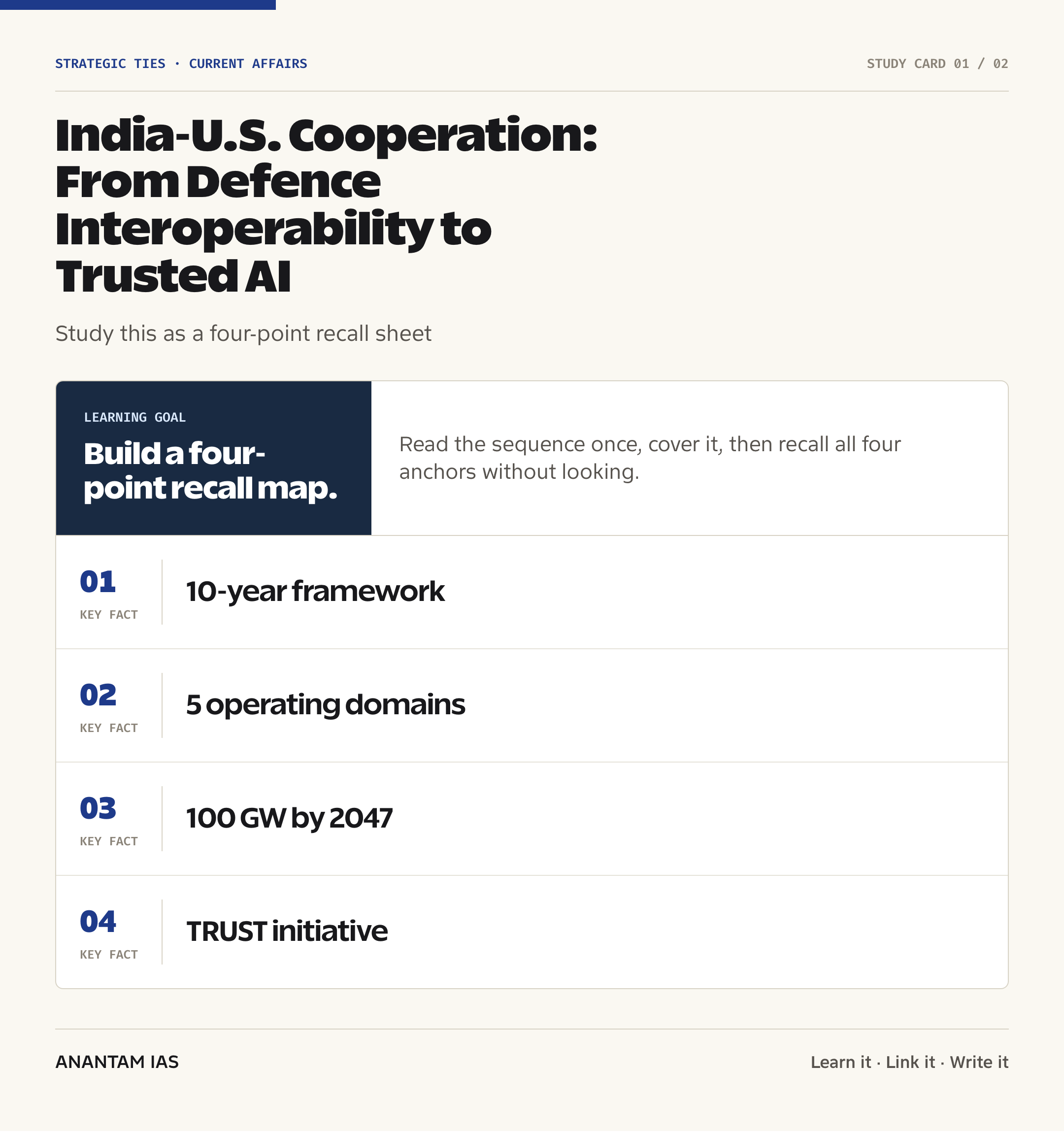
- India and the U.S. signed the Framework for the U.S.-India Major Defense Partnership in October 2025; it is an operative policy framework, not a collective-defence treaty.
- The U.S.-India 123 Agreement has enabled peaceful nuclear commerce since 2008, but proposed U.S.-designed reactor projects still require commercial, regulatory, liability and financing closure.
- The TRUST initiative, launched in February 2025, covers AI, semiconductors, quantum, biotechnology, energy, space and defence while stressing verified vendors and protection of sensitive technologies.
- A May 2026 PIB release recorded discussions with a U.S. nuclear-industry delegation, including private investment, small modular reactors and the proposed Westinghouse AP1000 project at Kovvada; discussions are not the same as a final investment decision.
The development matters in the context of:
- The development matters in the context of India’s effort to combine strategic autonomy with deeper access to advanced military, nuclear and digital technologies.
- It also tests whether broad political commitments can become co-production, localisation and resilient supply chains without compromising security, regulatory accountability or domestic capability.
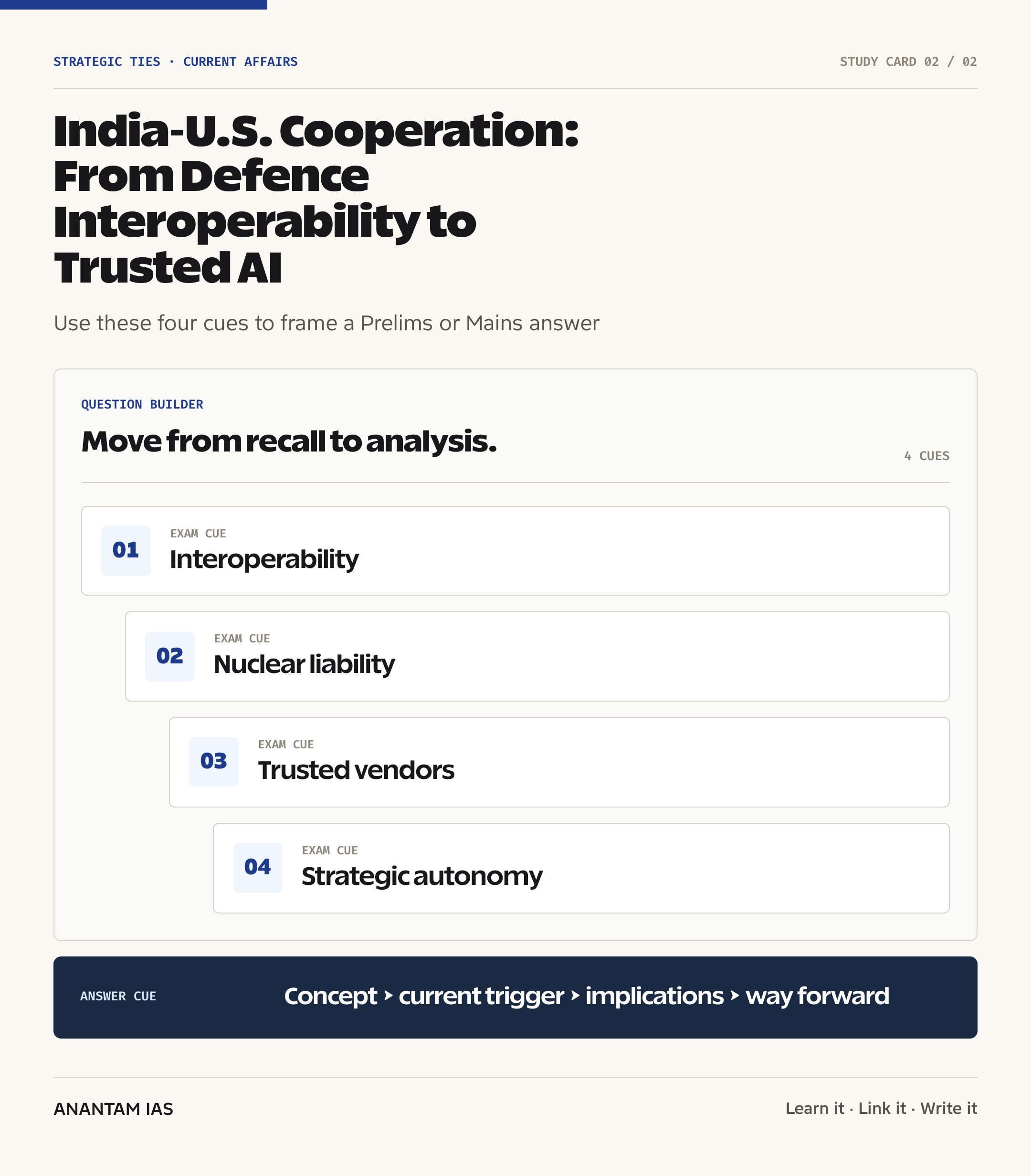
- For UPSC answers, the central distinction is between a signed enabling framework, a negotiated commercial arrangement and an announced intention that still awaits implementation.
UPSC Relevance
Prelims Relevance
- Major Defense Partner is a U.S. designation for India; it does not make India a treaty ally.
- Interoperability means the ability of forces, platforms, communications and procedures to operate together; it does not require identical equipment.
- The 2025 defence framework covers land, maritime, air, space and cyberspace and is intended to guide cooperation for ten years.
- The 123 Agreement takes its name from Section 123 of the U.S. Atomic Energy Act and governs peaceful nuclear cooperation.
- India’s civilian nuclear facilities placed under safeguards are inspected under an India-specific IAEA safeguards agreement.
- The TRUST acronym expands to Transforming the Relationship Utilizing Strategic Technology; the initiative spans government, academia and industry.
- INDUS-X links defence startups, investors, universities and officials in the two countries; it is an innovation ecosystem, not a military exercise.
- Small Modular Reactors are advanced reactors designed with lower unit capacity and modular construction; their commercial deployment still depends on licensing and project economics.
- The Civil Liability for Nuclear Damage framework determines compensation and the allocation of liability after a nuclear incident; liability design can affect supplier participation.
- Read the durable liability concepts in Anantam IAS’s CLNDA explainer rather than treating the current diplomatic statement as a substitute for the law.
Mains Relevance
GS Paper 2
- Use the case to assess how India-U.S. strategic convergence is widening from defence procurement to operational coordination, industrial collaboration, energy security and emerging technology.
- Examine the balance between deeper partnership and strategic autonomy, especially when technology access, export controls, Russia ties and Indo-Pacific expectations pull policy in different directions.
- Distinguish political declarations from institutional delivery: defence frameworks need projects and exercises, nuclear commitments need bankable reactor arrangements, and technology initiatives need measurable research or infrastructure outcomes.
GS Paper 3
- Connect civil nuclear cooperation with energy security, low-carbon firm power, domestic manufacturing and nuclear-safety regulation.
- Analyse trusted AI through compute access, semiconductor supply chains, cybersecurity, data governance and dependence on a narrow group of technology vendors.
- Evaluate whether co-development and localisation can create domestic technological capability instead of reproducing a buyer-seller relationship.
Essay
- Trust in international relations is built not by declarations alone but by institutions, safeguards and repeated delivery.
- Technology partnerships can widen national capability, but dependence hidden inside supply chains can narrow strategic choice.
- Strategic autonomy is not isolation; it is the capacity to cooperate without surrendering independent judgement.
Background and Context
What the Latest Statement Does and Does Not Mean
The current remark should be read as a policy signal that groups several bilateral workstreams under one strategic narrative.
- S. Paul Kapur’s statement confirms the U.S. administration’s political emphasis on India, jobs, supply-chain security and technology adoption; it does not itself create legal obligations.
- No new defence acquisition, reactor contract or AI governance agreement was announced at the Hoover Institution roundtable.
- The phrase trusted AI is a policy concept. In this setting, it points to verified technology vendors, protection of sensitive systems, resilient compute and chip supply chains, and safeguards around high-end technology.
- The safest UPSC formulation is that the statement reaffirmed and connected existing initiatives. Writing that all three sectors have reached completed agreements would overstate the evidence.
- This distinction improves answer quality: an announcement shows intent, a signed framework fixes direction, an implementing arrangement specifies rules, and a commercial contract allocates cost, risk and delivery.
The Signed Defence Framework
Defence is the most institutionally developed of the three tracks because a new ten-year framework was signed in October 2025.
- The official U.S. fact sheet describes the 2025 Framework for the U.S.-India Major Defense Partnership as the defining bilateral defence document and says it supersedes the 2023 defence-industrial roadmap.
- Its priorities include interoperability across five domains, maritime security, information-sharing, military education, exercises, logistics, defence-industrial resilience, advanced technology and counterterrorism.
- Operational interoperability can grow through common procedures, secure communications, logistics access, exercises and experience with shared platforms. It does not erase India’s independent command or sovereign decisions.
- Industrial cooperation seeks to move beyond direct purchases toward co-production, maintenance, repair, supply chains and innovation. Export controls, intellectual-property terms, cost and assured orders still shape what is transferred.
- INDUS-X supports startup and innovation connections, while larger platform or engine projects require separate negotiations and approvals. An ecosystem cannot be counted as a delivered weapon system.
- India’s aim is to turn access into capability while retaining diversified partnerships. The broader defence context is covered in this Anantam IAS defence note.
Civil Nuclear Cooperation: Enabling Law Versus Built Reactors
Civil nuclear relations have a durable legal base, but the gap between diplomatic commitment and an operating U.S.-designed reactor project remains central.
- The 2008 U.S.-India civil nuclear arrangement ended India’s isolation from global peaceful nuclear commerce even though India is outside the Nuclear Non-Proliferation Treaty as a nuclear-weapon state.
- The bilateral 123 Agreement, the India-specific IAEA safeguards arrangement and the Nuclear Suppliers Group waiver form separate but connected parts of this opening.
- A February 2025 leaders’ statement committed both sides to work toward U.S.-designed reactors in India, including localisation and possible technology transfer. The words work toward matter because they describe a path, not a completed build.
- Supplier concern over nuclear liability, alongside financing, tariffs, localisation, regulatory approval and project economics, has slowed conversion of the political deal into reactor construction.
- PIB reported in May 2026 that implementation rules under the SHANTI Act, 2025 were still being finalised. It also listed the proposed Westinghouse AP1000 project at Kovvada among matters reviewed with U.S. industry.
- The same PIB release stated India’s target of expanding nuclear capacity from 8.8 GW to 100 GW by 2047 and referred to nearly ₹20,000 crore for small modular-reactor development. These are Indian policy ambitions, not proof that a U.S. reactor order has closed.
- Candidates can pair this update with Anantam IAS’s SHANTI framework note and test the reform against safety, liability and public accountability.
TRUST and the Meaning of Trusted AI
The technology track aims to create a protected ecosystem for strategic technologies rather than a stand-alone bilateral AI treaty.
- The February 2025 joint leaders’ statement launched TRUST across defence, AI, semiconductors, quantum, biotechnology, energy and space.
- Its design joins government-to-government coordination, academic research and private investment, while encouraging verified vendors and protection of sensitive technologies.
- The leaders also committed to develop a roadmap for accelerating AI infrastructure in India, including data centres, compute, processors, models, applications, financing, power and connectivity.
- Trusted systems need more than a friendly supplier label. They require cybersecurity assurance, auditable model behaviour, secure hardware, data protection, procurement standards and continuity of supply.
- The label can create a geopolitical technology club if vendor verification or export controls exclude other suppliers. India must weigh security gains against vendor lock-in, cost and reduced policy space.
- Absent a published completion record for every promised roadmap or project, candidates should write that the initiative provides an enabling platform, then identify which outputs still need public evidence.
Strategic and Economic Significance for India
The three tracks converge around capability, supply-chain resilience and India’s role in the Indo-Pacific.
- Defence cooperation can strengthen maritime domain awareness, logistics, disaster response and deterrence, especially in the Indian Ocean, while giving India access to advanced platforms and practices.
- Civil nuclear investment can add firm low-carbon electricity and domestic manufacturing demand, but only if safety regulation, liability and waste management retain public credibility.
- AI and semiconductor cooperation can improve compute availability, research links and data-centre capacity, all of which increasingly affect economic and national-security power.
- A combined partnership can reduce single-source dependence, but excessive reliance on one foreign ecosystem can create a new concentration risk. Diversification and domestic absorption must proceed together.
- For India, success is not the volume of announcements. It is the share of technology learned, components made, intellectual property developed, personnel trained and systems maintained within India.
- For the U.S., India offers a large market, skilled talent, a strategic geography and an alternative manufacturing base. The partnership is driven by converging interests, not identical positions on every global issue.
How to Judge Delivery Across the Three Tracks
Each sector has a different implementation chain, so a single claim that the partnership is expanding cannot serve as proof of equal progress everywhere.
- In defence, the first layer is the signed ten-year policy framework. Delivery should then be judged through exercises, secure information-sharing, logistics, maintenance arrangements, industrial orders and equipment that can actually operate together.
- In civil nuclear energy, the legal opening created by the 123 Agreement is only the base. A reactor project also needs a site, technology choice, safety review, liability allocation, financing, tariff viability, fuel arrangements, construction contracts and long-term waste plans.
- In AI, a strategic initiative becomes material when it produces compute capacity, research programmes, secure procurement rules, skilled personnel and deployable applications. A roadmap or vendor principle is useful, but it is not the same as commissioned infrastructure.
- The three tracks also move at different speeds. Military exercises can be scheduled within months, while a nuclear plant takes years of licensing and construction. AI infrastructure can scale faster, but chips, power, cooling and export permissions can become binding constraints.
- Cross-sector links are important. Trusted chips and software can support defence systems; reliable nuclear power can serve energy-intensive data centres; resilient supply chains can reduce disruption across all three. These links also enlarge the cybersecurity and critical-infrastructure attack surface.
- A balanced assessment needs both outputs and safeguards: equipment availability, domestic value added, research results and energy capacity on one side; safety, auditability, competition and sovereign control on the other.
- This framework prevents two common answer-writing errors: treating every diplomatic statement as a completed deal, and dismissing an enabling agreement merely because its final commercial outputs are still under negotiation.
Risks, Constraints and the Strategic-Autonomy Test
A durable partnership must manage differences instead of hiding them behind broad strategic language.
- Technology-transfer controls and intellectual-property restrictions can limit genuine co-development even when political statements promise industrial cooperation.
- Defence interoperability must not be confused with alliance dependence. India retains independent decisions on deployment, procurement and foreign policy.
- Civil nuclear projects face long construction periods, high capital costs, safety scrutiny, liability allocation and questions of spent-fuel and waste management.
- Trusted AI can embed opaque standards set by powerful states or firms. India needs transparent criteria for vendor trust, model assurance, data access and security review.
- The countries can differ over trade, sanctions, third-country relations and market access. Institutional dialogues help prevent one dispute from freezing the entire relationship.
- Parliamentary scrutiny, regulatory independence and public disclosure matter because strategic technology arrangements can distribute commercial risk and public liability for decades.
Way Forward
Publish Trackable Deliverables
- Both governments should issue sector-wise milestones that identify what is signed, under negotiation, financed, contracted and operational.
- Annual public reviews should report exercises, co-production outputs, research awards, manufacturing content and completed regulatory steps without exposing sensitive information.
Build Capability, Not Permanent Dependence
- Defence and nuclear projects should include realistic localisation, maintenance, skills and supplier-development plans tied to measurable outcomes.
- India should preserve diversified partnerships and invest in domestic research so foreign access produces absorptive capacity rather than vendor lock-in.
Define Trusted Technology Transparently
- India needs risk-based standards for secure chips, cloud infrastructure, AI models, critical data and procurement, with independent testing and audit.
- Vendor verification should be based on published security criteria and enforceable safeguards, not only the vendor’s country of origin.
Protect Safety and Accountability
- Civil nuclear expansion must retain strong safety regulation, emergency preparedness, compensation and environmental review while improving investment certainty.
- Commercial confidentiality should not block disclosure of who bears construction, accident, fuel, decommissioning and waste-management risks.
Conclusion
The latest U.S. statement captures a real widening of the India-U.S. strategic partnership, but it should not be read as evidence that every defence, nuclear or AI objective has already been delivered.
The defence framework is signed, the civil nuclear legal relationship is established, and TRUST provides a technology platform. The next test is conversion: interoperable capability, bankable reactor projects, secure AI infrastructure and domestic learning.
India’s best outcome is deeper cooperation with independent judgement. That requires clear milestones, accountable regulation, technology absorption and diversified strategic options.
UPSC Practice Questions
Prelims MCQ 1
With reference to India-U.S. strategic cooperation, consider the following statements:
- India’s designation as a Major Defense Partner makes it a treaty ally of the United States.
- The U.S.-India TRUST initiative includes artificial intelligence, semiconductors, quantum technology, biotechnology, energy and space.
- Interoperability can include common procedures, communications and logistics without placing forces under a common sovereign command.
How many of the above statements are correct?
(a) Only one (b) Only two (c) All three (d) None
Answer: (b) Only two
Explanation:
Statements 2 and 3 are correct. TRUST covers several critical and emerging technologies, and interoperability does not require a common sovereign command. Major Defense Partner is a special U.S. designation, not a mutual-defence treaty.
Prelims MCQ 2
Which one of the following best describes the U.S.-India 123 Agreement?
(a) A collective-defence pact requiring automatic military assistance (b) A bilateral framework for peaceful civil nuclear cooperation (c) An agreement creating a common regulator for artificial intelligence (d) A Quad arrangement for sharing nuclear-powered submarines
Answer: (b) A bilateral framework for peaceful civil nuclear cooperation
Explanation:
The 123 Agreement governs peaceful nuclear cooperation under the relevant U.S. legal framework. It is distinct from India’s IAEA safeguards arrangement and the Nuclear Suppliers Group waiver, although all three helped enable civil nuclear commerce.
UPSC Mains Questions
- The expansion of India-U.S. relations from defence purchases to interoperability, civil nuclear commerce and trusted artificial intelligence creates both capability gains and new dependencies. Examine how India can convert these arrangements into domestic technological capacity while preserving strategic autonomy and regulatory accountability. (250 words)
- Diplomatic announcements, signed frameworks and implemented projects represent different stages of international cooperation. Using recent India-U.S. defence, nuclear and emerging-technology initiatives, explain why this distinction matters for evaluating the depth and durability of a strategic partnership. (250 words)
Sources: PIB, Ministry of Science and Technology and The Hindu.
Frequently Asked Questions
What did the U.S. official announce?
The official described expanding cooperation in defence, civil nuclear energy and trusted AI. The remark did not announce a new treaty, reactor contract or AI agreement. It connected existing workstreams, including the signed 2025 defence framework, civil nuclear implementation efforts and the TRUST technology initiative.
Is India a U.S. treaty ally?
No. India is designated a Major Defense Partner by the United States, but there is no mutual-defence treaty requiring automatic military assistance. The relationship supports exercises, logistics, information-sharing, procurement and technology cooperation while India retains sovereign control over deployment and foreign-policy decisions.
What is trusted AI here?
Trusted AI refers to an ecosystem of verified vendors, protected sensitive technology, secure compute and chips, resilient supply chains, and safeguards for data and model behaviour. TRUST is an enabling strategic initiative, not a single technical standard or a bilateral AI law.
Has a U.S. reactor project begun?
Official statements support U.S.-designed reactors and record discussions on the proposed Westinghouse AP1000 project at Kovvada. But the available documents describe plans and industry engagement, not a completed reactor contract or operating project. Commercial, regulatory, liability, financing and localisation arrangements still determine delivery.
Why does interoperability matter?
Interoperability lets two forces coordinate through compatible procedures, communications, logistics, training and shared understanding of equipment. It can improve exercises, maritime awareness and disaster response. It does not by itself create an alliance, merge command structures or remove India’s freedom to decide when and where its forces operate.
What should UPSC answers emphasise?
Separate announced intent from signed and operational outcomes. Link defence cooperation to strategic autonomy and industrial capacity, nuclear cooperation to energy security and liability, and trusted AI to compute, cybersecurity and vendor dependence. End with measurable implementation, regulatory accountability, domestic absorption and diversified partnerships.