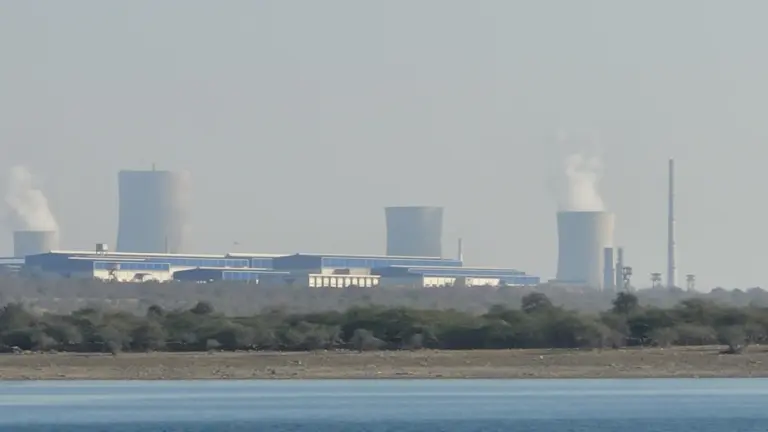
For most of India’s nuclear history, the question of who pays after a nuclear accident did not have a domestic legal answer. Power reactors at Tarapur, Rawatbhata and Kakrapar operated under operator-level discipline, regulatory oversight from the Atomic Energy Regulatory Board and a general understanding that the central government would step in if something went wrong. There was no statute that listed the dues, set the cap and named the parties that would owe what to whom. The Civil Liability for Nuclear Damage Act of 2010, usually shortened to CLNDA, was the law that finally answered those questions.
The Act emerged from a particular moment. In 2008, the India-United States civil nuclear cooperation agreement reopened India’s access to imported reactors and fuel. Foreign vendors like Westinghouse, General Electric and AREVA wanted clarity on what they would owe in the event of an accident at a reactor they had supplied. India, with the memory of the 1984 Bhopal gas tragedy and its long aftermath, wanted clarity that victims would be paid promptly and that suppliers of defective equipment could not simply walk away. The compromise was a statute that adopted the international norm of channeling liability to the operator while keeping a narrow but real right of recourse against suppliers in specific circumstances.
The statute that resulted is short, technical and politically explosive. Section 17, in particular, has become one of the most debated single provisions in any Indian science-and-technology law, holding up reactor imports for over a decade. For UPSC, CLNDA shows up at the intersection of GS-II governance and international relations, GS-III science and technology, and GS-IV ethics in the public response to industrial disaster.
Quick Facts: CLNDA 2010 at a Glance
- Full name: The Civil Liability for Nuclear Damage Act, 2010
- Enacted by: Parliament of India, came into force in November 2011
- Core principle: Strict, no-fault liability channeled to the operator
- Operator liability cap: Rs 1,500 crore for each nuclear incident
- Total liability cap: 300 million Special Drawing Rights (SDR), shared by operator and Central Government
- Right of recourse against supplier: Section 17 of the Act, especially Section 17(b)
- International convention: India is a party to the Convention on Supplementary Compensation for Nuclear Damage (CSC)
- India Nuclear Insurance Pool: Created in 2015 with a corpus of Rs 1,500 crore, managed by the General Insurance Corporation of India
- Operator in India’s commercial nuclear plants: Nuclear Power Corporation of India Limited (NPCIL)
- Regulator: Atomic Energy Regulatory Board, established under the Atomic Energy Act, 1962
What Is the CLNDA?
The Civil Liability for Nuclear Damage Act is the Indian statute that defines who is legally responsible when a nuclear incident causes damage and how that responsibility translates into compensation for victims. The Act creates three things at once. It defines a nuclear incident in legal terms, distinguishing it from radiation accidents that are not reactor-related. It identifies the parties who can be held liable, primarily the operator of the nuclear installation. And it sets the financial and procedural rules under which victims can claim compensation, including the time limits and the forum, the Nuclear Damage Claims Commission, where claims must be filed.
The legal architecture is built on a core principle borrowed from international nuclear law: strict liability. Under strict liability, the victim does not need to prove that the operator was negligent or that the operator’s actions caused the accident. The mere fact that a nuclear incident has occurred at the operator’s installation is enough to establish the operator’s duty to pay. This is sometimes summarised as no-fault liability or, more loosely, the polluter-pays principle. It is meant to deliver speedy compensation in situations where victims would never have the resources or expertise to prove fault in the engineering of a reactor.
The flip side of strict liability is that it is capped. The operator’s liability is limited to a specified amount, and beyond that, the government and an international fund take over. Without a cap, no commercial operator could ever insure against a nuclear accident at a price the electricity market could bear, and reactors would not be built. The trade-off between unlimited fault-based liability and capped no-fault liability is the heart of every nuclear liability statute in the world, including India’s.
Background and Historical Context
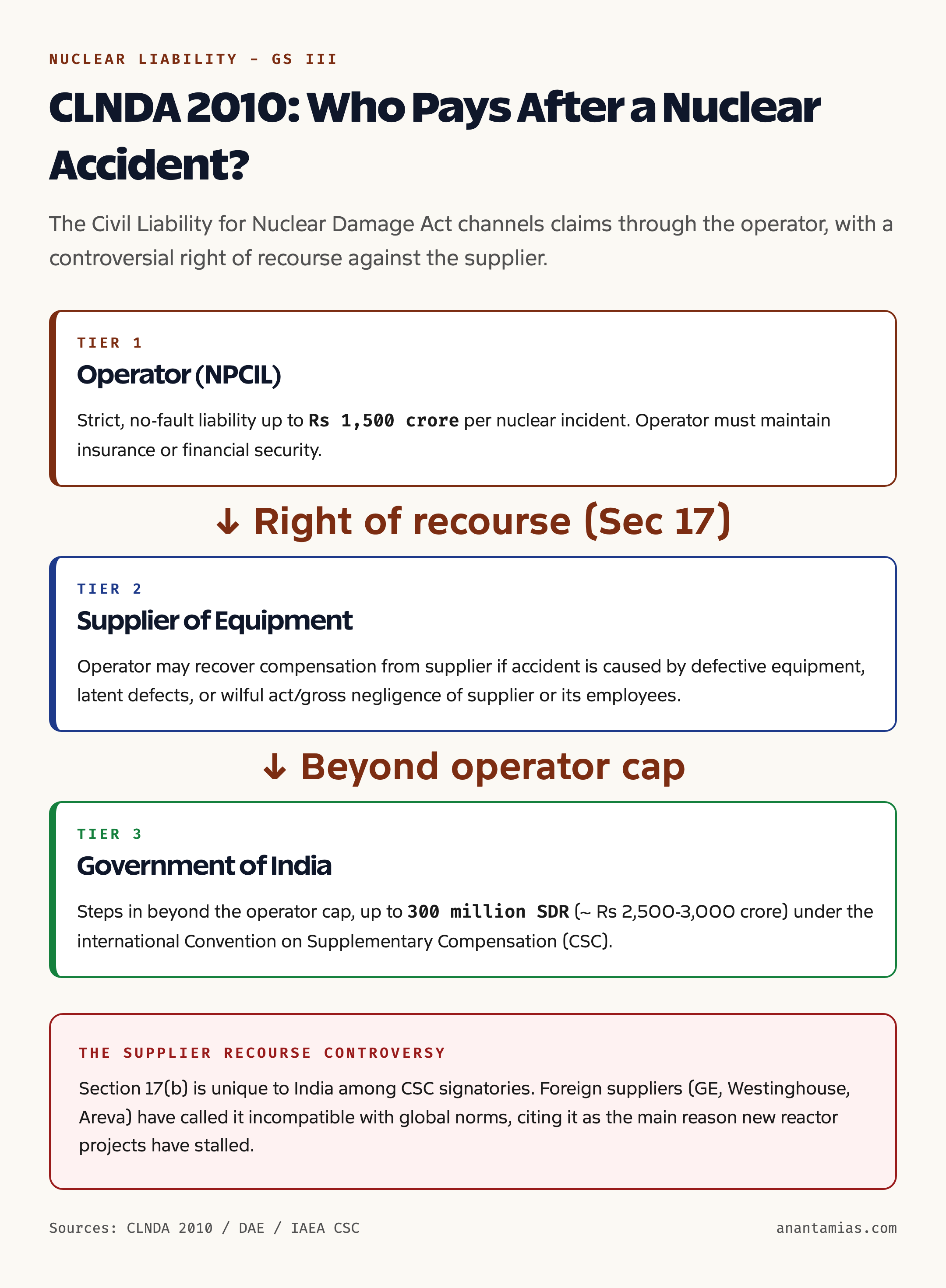
Two histories converge in the CLNDA. The first is international. After the 1979 Three Mile Island accident in the United States and the 1986 Chernobyl disaster in the Soviet Union, the international community began to standardize how nuclear damage would be handled across borders. Two conventions matured in this period. The Vienna Convention on Civil Liability for Nuclear Damage, originally from 1963 and updated in 1997, and the Paris Convention with its Brussels Supplementary Convention, used mainly in Europe. In 1997, the International Atomic Energy Agency adopted the Convention on Supplementary Compensation for Nuclear Damage, or CSC, which created an international fund to top up domestic compensation when a member state’s own resources were exhausted. CSC entered into force in 2015, and India became a contracting party.
The second history is Indian and traumatic. The 1984 Bhopal gas tragedy, which killed thousands and left lasting injuries, exposed the inadequacy of Indian tort law in dealing with industrial mass disasters. The Bhopal compensation settlement, the long judicial struggle over Union Carbide’s liability and the failure to extradite Warren Anderson left a lasting public and political view that foreign suppliers should never again escape accountability for catastrophic damage on Indian soil. This view is the political subtext to every debate about Section 17.
Between 2005 and 2008, the India-United States civil nuclear cooperation agreement, sometimes called the 123 Agreement, reopened civil nuclear trade for India after decades of post-Pokhran isolation. Foreign reactor vendors made it clear that they would not sell to India without a domestic liability framework that conformed to international norms. The CLNDA was passed in August 2010 to fill that gap. Section 17, inserted during parliamentary debate in response to Bhopal-era concerns, made the law more victim-protective than the international norm and more vendor-cautious. The result has been a fifteen-year stalemate over imported reactor purchases, with the situation only partially eased by the creation of the India Nuclear Insurance Pool in 2015. For broader nuclear context, see our pieces on India’s three-stage nuclear programme, nuclear power plants and nuclear fusion.
The Liability Hierarchy: Who Pays What
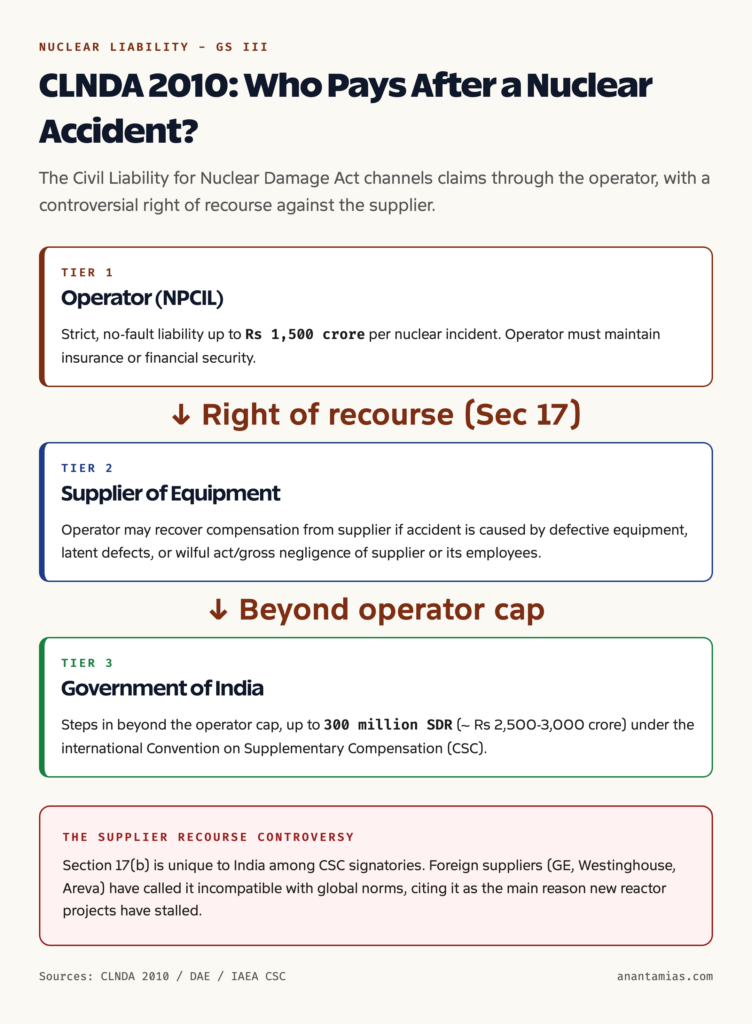
The CLNDA sets up a three-tier compensation structure. The first tier is the operator. The Act channels liability for a nuclear incident exclusively to the operator of the installation where the incident occurred. In India’s commercial nuclear sector, the operator is almost always the Nuclear Power Corporation of India Limited, a public-sector enterprise under the Department of Atomic Energy. The operator’s maximum liability for any single nuclear incident is Rs 1,500 crore. The operator must maintain insurance or another financial security equal to this amount.
The second tier is the Central Government. If the damage from a nuclear incident exceeds Rs 1,500 crore, the Central Government becomes liable for the excess. The total combined liability of the operator and the government is capped at the rupee equivalent of 300 million Special Drawing Rights, the IMF’s basket-weighted reserve asset. At current exchange rates this works out to roughly Rs 3,200 to Rs 3,500 crore, depending on the SDR’s daily value. The intent of this layer is to ensure that victims are paid even when the damage exceeds what the operator alone could absorb.
The third tier sits outside India. As a contracting party to the Convention on Supplementary Compensation, India can access an international fund pooled from contributions by all member states. If the total damage from a nuclear incident exceeds the combined Rs 1,500 crore plus government layer, the CSC fund can be tapped to provide additional compensation. The fund’s size depends on how many states join CSC and the size of their installed nuclear capacity. As of the mid-2020s, the fund was modest by the scale of a major nuclear accident, but it offers a top-up that did not exist before 2015.
Section 17: The Supplier Liability Controversy
The most contentious provision in the CLNDA is Section 17, which gives the operator a “right of recourse” against the supplier of the equipment, materials or services involved in the nuclear incident. There are three sub-clauses. Section 17(a) creates a right of recourse if it is expressly written into the contract between the operator and the supplier. This is unobjectionable internationally. Section 17(c) creates a right of recourse if the act causing damage was done with intent to cause it, that is, in the case of sabotage or wilful damage, also unobjectionable.
The flashpoint is Section 17(b). It allows the operator to sue the supplier if the nuclear incident has resulted from “an act of supplier or his employee, which includes the supply of equipment or material with patent or latent defects or sub-standard services.” In international nuclear liability, the supplier is normally completely shielded. The operator pays the victim, and the operator alone, not the supplier, is the channel of liability. Section 17(b) breaks this pattern by allowing the operator to recover from the supplier in the case of equipment defects.
Foreign reactor vendors raised three objections. First, they argued that Section 17(b) created open-ended liability for them as suppliers, which is uninsurable in commercial markets. Second, they pointed out that the language of “patent or latent defects” was vague and could be invoked decades after delivery. Third, they argued that India’s parallel obligations under the CSC, which channels liability exclusively to the operator, were inconsistent with Section 17(b). The result was a long stalemate. Westinghouse and General Electric were unable to finalise commercial reactor sales to India for over a decade, even after the broader 123 Agreement was in force.
The India Nuclear Insurance Pool: A Partial Solution
To break the deadlock without amending the CLNDA, which would have been politically toxic, the central government and the General Insurance Corporation of India launched the India Nuclear Insurance Pool, or INIP, in June 2015. The INIP is a risk-pooling mechanism that brings together domestic insurers to provide insurance cover for both operators and suppliers of nuclear plants. Its initial corpus was Rs 1,500 crore, matching the operator’s liability cap under the Act.
The INIP offers two products. The first is the Operator Liability Policy, which covers the operator’s no-fault liability up to the statutory cap. The second, and more important from a vendor perspective, is the Supplier Liability Policy, which covers a supplier’s exposure under Section 17 of the CLNDA. The pool’s structure spreads the catastrophic risk across multiple insurers, including the General Insurance Corporation of India and several public-sector general insurers, with reinsurance support.
The INIP made it commercially possible for at least some imported nuclear projects to move forward. The Kudankulam units 5 and 6 with Rosatom of Russia, agreed to in 2014 and under construction in subsequent years, are the most prominent example, although Russian-supplied reactors operate under a separate inter-governmental framework that pre-dates CLNDA. The Westinghouse and General Electric projects have remained slow to materialise, and as of the mid-2020s no large-scale imported reactor sale to India under the CLNDA framework had reached construction. The pool has, however, settled the question of whether suppliers can in principle be insured for Section 17 liability in India: they can, at a price.
Why It Matters: Nuclear Expansion, Energy Security, Climate
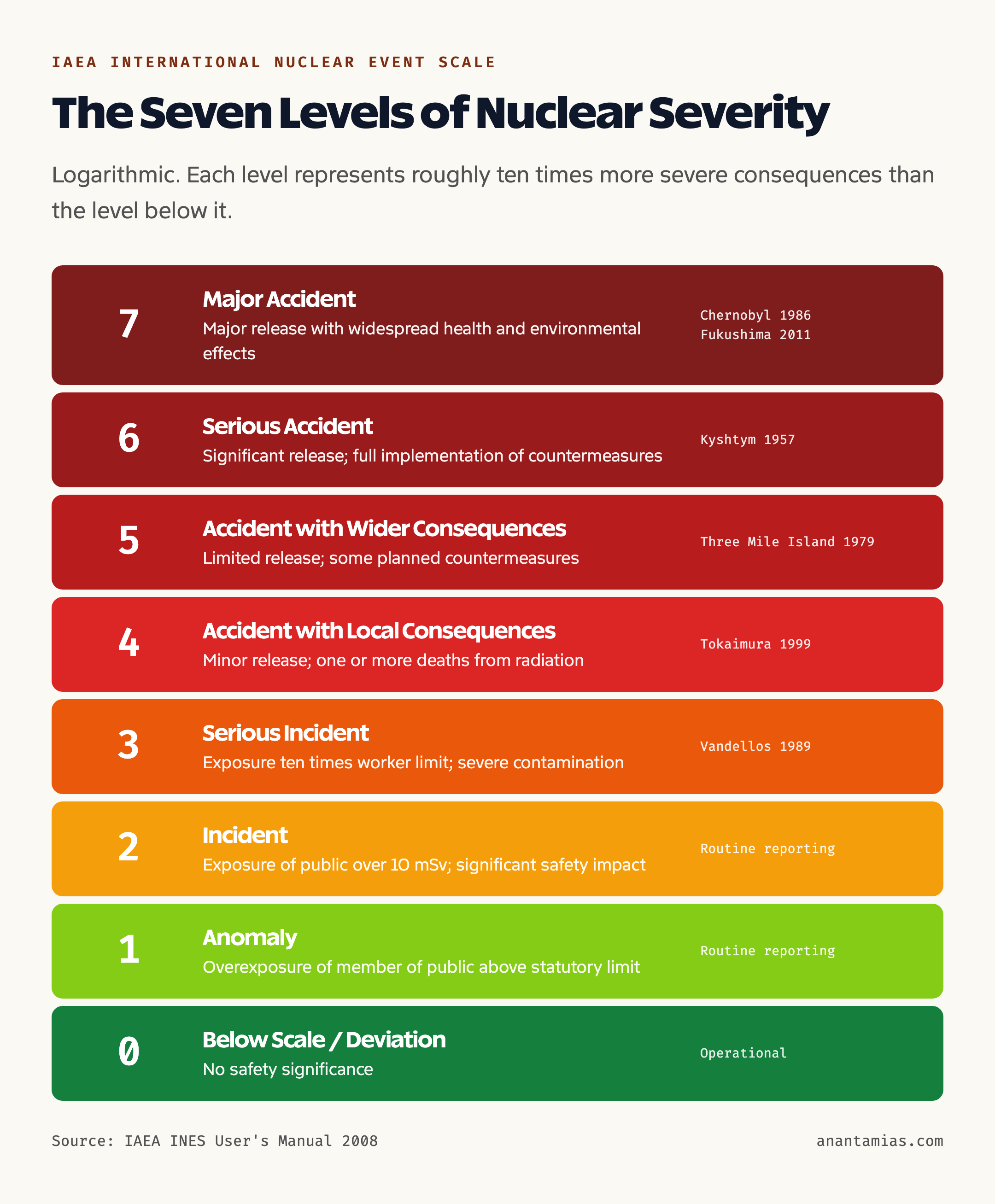
The CLNDA is not just a statute about lawsuits after an unlikely accident. It is the legal foundation for India’s civil nuclear expansion. India’s installed nuclear capacity is around 7 GW as of the mid-2020s, contributing roughly 3 percent of total electricity generation. The government has set ambitious targets for nuclear capacity to grow several-fold by 2047 to support both energy security and the climate transition. Achieving those targets requires both domestic builds, where NPCIL is the sole operator and supplier risk is partly internal, and international cooperation, where CLNDA’s terms set the contractual perimeter.
The Act also matters because it sets the public expectation about what victims of a nuclear incident would receive and how quickly. Strict liability and a no-fault standard, while capped, are far more victim-friendly than the regular tort regime that applied at Bhopal in 1984. The procedural reform of a dedicated Claims Commissioner and Claims Commission shortens the path from incident to compensation. The political legitimacy of nuclear power in India depends, in part, on the credibility of these promises.
For broader policy alignment, the CLNDA also intersects with India’s commitments under environmental and climate law, with constitutional rights to life and a clean environment, and with the architecture of disaster management law.
Comparative Snapshot: India vs International Nuclear Liability
| Feature | India (CLNDA 2010) | Vienna Convention | Paris Convention | CSC |
|---|---|---|---|---|
| Liability standard | Strict, no-fault | Strict, no-fault | Strict, no-fault | Strict, no-fault |
| Channel of liability | Operator | Operator only | Operator only | Operator only |
| Supplier right of recourse | Yes, via Section 17(b) | No, in normal cases | No, in normal cases | No |
| Operator cap | Rs 1,500 crore | Variable by state | EUR 700 million minimum | Variable by state |
| Total cap | 300 million SDR | Variable | EUR 1,500 million minimum | Variable + international fund |
| Time limit for claims | 10 years for property, 20 for personal injury | Similar windows | Similar | Similar |
| International fund top-up | Yes (CSC) | Optional | Optional | Yes |
Challenges and Constraints
The first challenge is that Section 17(b) remains untested in court. No nuclear incident in India has triggered an actual claim under the CLNDA. The provision is therefore a theoretical risk for suppliers, but its precise scope, including what counts as a “patent or latent defect” and how long the right of recourse runs, will only become clear if and when it is invoked. This uncertainty is itself a deterrent to commercial reactor sales.
The second is that the liability cap is regarded by many observers as too low for the scale of damage a serious nuclear accident could cause. Comparable caps in advanced economies are several times higher in absolute terms. India has not revised the cap since the Act was passed in 2010, despite inflation and the much larger nuclear capacity now planned.
The third is the limited reach of the INIP corpus. Rs 1,500 crore is enough to back the operator’s first-tier liability, but it does not absorb the much larger sums that would be required if a major incident exhausted both the operator and government caps. India’s reliance on the CSC fund for top-ups beyond the domestic caps is therefore real.
The fourth is jurisdictional. The Act provides for a Nuclear Damage Claims Commissioner and a Claims Commission, but the procedural rules, the staffing model and the appellate path are not as fully tested as they would be for, say, the Motor Accident Claims Tribunals. Effective redress depends on machinery that has not yet had to handle a real case.
Prelims Pointers
- The CLNDA was enacted in 2010 and came into force in November 2011.
- It applies a strict, no-fault liability standard.
- The operator’s liability is capped at Rs 1,500 crore per nuclear incident.
- The total liability is capped at the rupee equivalent of 300 million SDR.
- Section 17 provides the operator’s right of recourse against suppliers.
- Section 17(b) is the controversial sub-clause referring to patent or latent defects.
- The India Nuclear Insurance Pool was created in 2015 with a corpus of Rs 1,500 crore.
- The General Insurance Corporation of India manages the INIP.
- India is a party to the Convention on Supplementary Compensation for Nuclear Damage.
- NPCIL is the principal operator of commercial nuclear power plants in India.
- Disputes arising from a nuclear incident are heard by the Nuclear Damage Claims Commission.
Mains Practice Questions
- Explain the principle of strict liability under the Civil Liability for Nuclear Damage Act, 2010. Discuss the rationale and the criticisms of capping the operator’s liability at Rs 1,500 crore. (250 words, GS-III)
- Section 17 of the CLNDA, particularly Section 17(b), has been described as both a victim-protective safeguard and a barrier to nuclear technology imports. Critically evaluate this statement. (250 words, GS-III)
- Discuss the role of the India Nuclear Insurance Pool in operationalising the CLNDA. To what extent has it resolved the supplier liability concerns of foreign vendors? (150 words, GS-III)
- “The legal framework for nuclear liability in India must balance victim protection with the practical requirements of an expanding nuclear sector.” Comment with reference to recent developments in India’s civil nuclear cooperation agreements. (150 words, GS-III)
Way Forward
The CLNDA is not going to be repealed. The political costs of weakening Section 17 are too high in a country where the memory of Bhopal still shapes public opinion on industrial liability. What is achievable is a set of incremental refinements that keep the core protections in place while removing avoidable friction.
The first refinement is operational. The Nuclear Damage Claims Commission needs visibility, staffing and procedural clarity well before any incident, not after. A regular review of the cap amounts, indexed to a credible measure such as the SDR or to GDP, would address concerns that the 2010 numbers no longer reflect either inflation or the size of the planned nuclear fleet.
The second is contractual. The standard operator-supplier contract under the CLNDA should specify exactly what counts as a patent or latent defect, what timelines apply for the right of recourse and what insurance arrangements satisfy the supplier’s exposure. Greater contractual specificity would not amend Section 17 but would narrow the practical uncertainty that has discouraged investments.
The third is multilateral. India’s role in the CSC framework is an asset. Active engagement with CSC contracting parties to grow the international fund and to clarify the relationship between national caps and the supplementary tier would strengthen the system as a whole and reduce the perceived gap between Indian law and international practice.
For UPSC purposes, the CLNDA is best understood as a case study in how India’s law-making responds to historical trauma, international pressure and technological promise simultaneously. The statute is a compromise. Whether it is a workable one for the next phase of nuclear expansion is the question the next decade will answer.
Frequently Asked Questions
What is strict liability under the CLNDA?
Strict liability means the operator of a nuclear installation is automatically liable for damage caused by a nuclear incident at that installation, without the victim having to prove negligence or fault. The standard is also called no-fault liability. It is meant to deliver compensation quickly in situations where ordinary tort law would require victims to prove the technical causes of an accident, which is rarely feasible.
Who is the operator under the CLNDA?
The operator is the entity that runs the nuclear installation. In India’s commercial nuclear sector, the operator is almost always the Nuclear Power Corporation of India Limited (NPCIL), a public-sector enterprise under the Department of Atomic Energy. The operator carries primary financial liability up to the statutory cap and must maintain insurance or other financial security to cover that amount.
What does Section 17 actually allow?
Section 17 gives the operator a right of recourse, that is, the right to sue the supplier of equipment or services to recover what the operator has paid out in compensation. Section 17(a) requires this right to be expressly written into the contract. Section 17(b) allows recourse if the incident resulted from a patent or latent defect in the supply or sub-standard services. Section 17(c) allows recourse for acts done with intent to cause damage, that is, sabotage.
Why was the India Nuclear Insurance Pool created?
The INIP was created in 2015 to provide a domestic insurance product that would cover the supplier’s exposure under Section 17 of the CLNDA. Without such a product, foreign reactor vendors could not get commercial cover for the open-ended liability that Section 17 implied. The pool combines the underwriting capacity of public-sector insurers and reinsurers to make supplier-side cover available, breaking the deadlock that had stalled imported reactor projects.
Has the CLNDA ever been used in a real claim?
No. As of the mid-2020s, no nuclear incident in India has triggered a formal claim under the CLNDA. This means the procedural machinery, including the Claims Commissioner and the Claims Commission, has not yet been tested in a contested case. The Act’s provisions are therefore a legal scaffolding awaiting their first real application.
How does India’s Act compare with the Vienna and Paris Conventions?
The Vienna Convention, the Paris Convention and the CSC all use strict, no-fault liability and channel that liability exclusively to the operator. The Indian Act follows the same broad pattern but adds Section 17(b), which allows recourse against the supplier in defect cases. This is the principal divergence and the reason imported reactor suppliers have been cautious about the Indian market.
What is the role of the Convention on Supplementary Compensation?
The CSC is an international convention that creates a supplementary fund to top up domestic compensation when a member state’s own resources are exhausted. India is a contracting party. If a nuclear incident in India caused damage exceeding the combined operator and government caps, India could draw on the CSC fund. The size of the available top-up depends on the contributions of all CSC member states and the installed nuclear capacity covered.
Can the Rs 1,500 crore cap be increased?
Yes, the CLNDA allows the central government to revise the operator’s liability cap by notification. The cap has not been changed since the Act was passed in 2010. Many observers have argued for a periodic review tied to inflation and to the size of the planned nuclear fleet. Any increase would also raise the insurance premium that operators pay, which would feed into the cost of electricity from new nuclear plants.
Does the CLNDA cover military or strategic nuclear facilities?
No. The CLNDA applies to civil nuclear installations licensed for commercial activities. Military and strategic facilities operate under separate frameworks and are governed by the Atomic Energy Act, 1962 and related rules. The civilian-military separation is also a key element of India’s safeguards arrangements with the International Atomic Energy Agency.
Where can I find the official text of the CLNDA?
The full text of the Civil Liability for Nuclear Damage Act, 2010 is published in the Gazette of India and is available on the websites of the Ministry of Law and Justice and the Department of Atomic Energy. The Atomic Energy Regulatory Board and the Department of Atomic Energy also publish explanatory materials and rules made under the Act.
Tell Google you want more of this.
Add Anantam IAS as a preferred sourceOne tap, and this site shows up more often in your own Top Stories, AI Overviews and AI Mode. Remove it any time.