

Why in News?
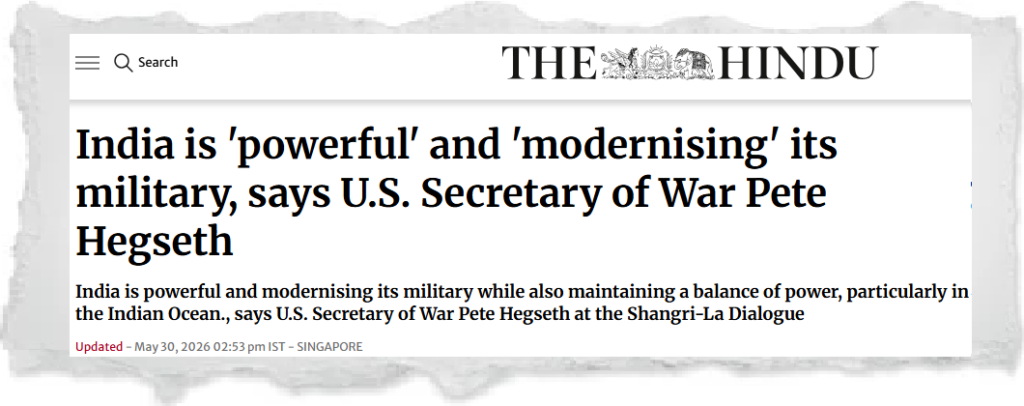
At the 2026 Shangri-La Dialogue in Singapore, U.S. Secretary of War Pete Hegseth described India as a “powerful” nation that is rapidly modernising its military and building industrial and logistics capabilities to sustain high-end military operations. He also highlighted growing India-U.S. defence co-production efforts and India’s role in maintaining the balance of power in the Indian Ocean region.
UPSC Relevance
Prelims: Shangri-La Dialogue, Indo-Pacific, defence co-production, Quad, Indian Ocean Region (IOR), defence industrial ecosystem.
Mains:
GS-II: India-U.S. Relations, International Relations, Regional Groupings,
GS-III: Defence Modernisation, Internal and External Security, Defence Manufacturing, Maritime Security.
Background
The Indo-Pacific has emerged as the primary geopolitical theatre of the 21st century. Increasing strategic competition, particularly involving the United States and China, has elevated the importance of regional powers such as India.
India’s defence modernisation efforts over the last decade have focused on strengthening military capabilities, enhancing indigenous defence production, improving logistics infrastructure, and expanding strategic partnerships. These developments have positioned India as a key stakeholder in maintaining regional stability and maritime security.
The annual Shangri-La Dialogue serves as one of the most important forums for discussing security challenges in the Indo-Pacific region.
What is the Shangri-La Dialogue?
The Shangri-La Dialogue is a premier defence and security summit organised annually by the International Institute for Strategic Studies (IISS) in Singapore.
It brings together defence ministers, military leaders, policymakers, and strategic experts from across the world to discuss emerging security challenges.
The forum has increasingly focused on issues such as:
- Maritime security in the Indo-Pacific.
- Strategic competition among major powers.
- Defence partnerships and military modernisation.
- Regional stability and conflict management.
The 2026 edition witnessed participation from representatives of 44 countries.
India’s Ongoing Military Modernisation
India’s military transformation is driven by the need to address both conventional and emerging security challenges.
Strengthening Indigenous Defence Manufacturing
A major pillar of India’s defence strategy is the push for self-reliance under the Atmanirbhar Bharat initiative.
The government has undertaken measures such as expanding defence production corridors, increasing indigenous procurement, restricting imports of selected defence equipment, and encouraging private-sector participation. The objective is to reduce dependence on foreign suppliers while developing a globally competitive defence-industrial base.
Expansion of Defence Co-Production
The United States has increasingly shifted from a traditional buyer-seller relationship towards defence technology cooperation and co-production with India.
Initiatives such as the India-U.S. Defence Acceleration Ecosystem (INDUS-X), the Initiative on Critical and Emerging Technologies (iCET), and agreements on jet engine and defence technology collaboration reflect this transition. Such partnerships are expected to strengthen India’s technological capabilities and defence manufacturing ecosystem.
Building Logistics and Operational Capacity
Modern warfare depends not only on weapons platforms but also on the ability to sustain prolonged operations.
India has invested significantly in logistics networks, strategic infrastructure, border roads, ammunition reserves, military transportation systems, and integrated theatre logistics. These capabilities improve operational readiness and enable sustained military deployments across multiple theatres.
Maritime Capability Enhancement
Given India’s geographical location, maritime security remains a strategic priority.
India has expanded naval capabilities through aircraft carriers, nuclear-powered submarines, anti-submarine warfare systems, maritime surveillance assets, and coastal security infrastructure. These measures strengthen India’s ability to secure critical Sea Lines of Communication (SLOCs) and protect its interests in the Indian Ocean Region.
India’s Role in the Indo-Pacific
Maintaining the Balance of Power
The Indo-Pacific has witnessed growing strategic competition due to China’s expanding military and maritime footprint.
India’s growing capabilities contribute to a multipolar regional order by ensuring that no single power dominates the Indian Ocean and adjoining maritime spaces. This role has been increasingly acknowledged by partners such as the United States, Japan, Australia, and several ASEAN countries.
Strategic Partnerships and Minilateralism
India has adopted a collaborative approach to regional security through mechanisms such as:
- Quad
- India-U.S. strategic partnership.
- India-Japan security cooperation.
- India-France maritime cooperation.
- Engagement with ASEAN countries.
These partnerships focus on maritime domain awareness, disaster relief, cybersecurity, critical technologies, and supply-chain resilience.
SAGAR Vision
India’s maritime approach is guided by the SAGAR (Security and Growth for All in the Region) doctrine.
The initiative emphasises:
- Regional maritime cooperation.
- Capacity-building among littoral states.
- Sustainable use of ocean resources.
- Collective maritime security.
This framework has strengthened India’s position as a net security provider in the Indian Ocean Region.
India-U.S. Defence Cooperation: Recent Developments
The India-U.S. defence partnership has evolved significantly over the past two decades.
Key milestones include:
- Designation of India as a Major Defense Partner.
- Signing of foundational defence agreements such as LEMOA, COMCASA, and BECA.
- Growing military exercises such as Yudh Abhyas, Tiger Triumph, and Malabar.
- Expansion of defence technology cooperation.
- Increased intelligence sharing and maritime cooperation.
The emphasis on defence co-production indicates a transition from transactional arms sales to long-term strategic collaboration.
What is the Significance for India?
Strategic Significance
India’s military modernisation enhances deterrence against potential adversaries and strengthens its ability to protect national interests across multiple domains.
Economic Significance
Defence manufacturing generates employment, promotes technological innovation, and contributes to industrial growth through backward and forward linkages.
Geopolitical Significance
A stronger India contributes to regional stability and strengthens the collective security architecture of the Indo-Pacific.
Maritime Significance
Enhanced naval and maritime capabilities enable India to secure vital trade routes that carry a significant share of global commerce and energy supplies.
Way Forward
Accelerate Defence Indigenisation
India should deepen research and development capabilities, strengthen public-private partnerships, and enhance domestic manufacturing of critical defence technologies.
Strengthen Defence Innovation
Greater investment in artificial intelligence, cyber security, quantum technologies, drones, and space capabilities will be essential for future military competitiveness.
Expand Strategic Partnerships
India should continue building mutually beneficial defence partnerships while preserving strategic autonomy.
Enhance Maritime Preparedness
Given the growing importance of the Indian Ocean, maritime infrastructure, naval modernisation, and coastal security must remain priority areas.
Conclusion
The remarks made at the Shangri-La Dialogue reflect the growing international recognition of India’s military transformation and strategic relevance. As the Indo-Pacific becomes the centre of global geopolitical competition, India’s defence modernisation, industrial capacity, and strategic partnerships will play a crucial role in shaping regional stability. The challenge ahead lies in balancing military preparedness, technological self-reliance, and strategic autonomy while contributing to a secure and multipolar regional order.
Practice Questions
Prelims Question 1 (Inference-Based)
Consider the following statements:
I. India’s growing defence manufacturing and logistics capabilities enhance its ability to sustain military operations over extended periods.
II. Defence co-production partnerships can contribute to both military modernisation and technological advancement.
III. A stronger maritime capability can improve a country’s role in maintaining regional balance of power.
Which of the following relationships among the above statements is/are correct?
- Statement II complements Statement I by providing a pathway to strengthen domestic military capabilities.
- Statement III can be viewed as a strategic outcome of the capabilities referred to in Statement I.
- Statement I contradicts Statement III because logistics capacity reduces the need for maritime power.
(a) 1 only
(b) 1 and 2 only
(c) 2 and 3 only
(d) 1, 2 and 3
Answer: (b)
Explanation: Defence co-production supports capability enhancement, while stronger logistics and military capacity contribute to maritime influence and regional balancing. Statement 3 is incorrect because logistics and maritime power are complementary rather than contradictory.
Prelims Question 2
With reference to India’s defence partnerships and strategic agreements, consider the following statements:
- LEMOA facilitates reciprocal logistics support between India and the United States.
- COMCASA enables secure communication interoperability between the armed forces of the two countries.
- BECA provides access to geospatial intelligence and navigation data.
- INDUS-X aims to strengthen defence innovation cooperation between India and the United States.
Which of the statements given above are correct?
(a) 1 and 2 only
(b) 2, 3 and 4 only
(c) 1, 2, 3 and 4
(d) 1, 3 and 4 only
Answer: (c)
Explanation: All four statements are correct. LEMOA, COMCASA, and BECA are foundational defence agreements, while INDUS-X promotes defence innovation and technology collaboration.
Mains Questions
- Discuss the significance of India’s military modernisation in the context of emerging geopolitical challenges in the Indo-Pacific region.
- Examine the role of defence industrial capacity, logistics infrastructure, and strategic partnerships in strengthening India’s national security and strategic autonomy.
Tell Google you want more of this.
Add Anantam IAS as a preferred sourceOne tap, and this site shows up more often in your own Top Stories, AI Overviews and AI Mode. Remove it any time.






