Justice Yashwant Varma Case: Can a Judge Escape Impeachment by Resigning?
Why in News?
The Indian Express reported on 7 July 2026 that Lok Sabha Speaker Om Birla has decided to table the report of the statutory committee that investigated former Allahabad High Court judge Justice Yashwant Varma under the Judges (Inquiry) Act, 1968 — even though the judge resigned in April 2026, before the committee concluded its hearings.
The decision takes India’s judicial-accountability framework into uncharted territory. It challenges the assumption — set by the 2011 P. D. Dinakaran and Soumitra Sen episodes — that a judge’s resignation automatically extinguishes a parliamentary probe.
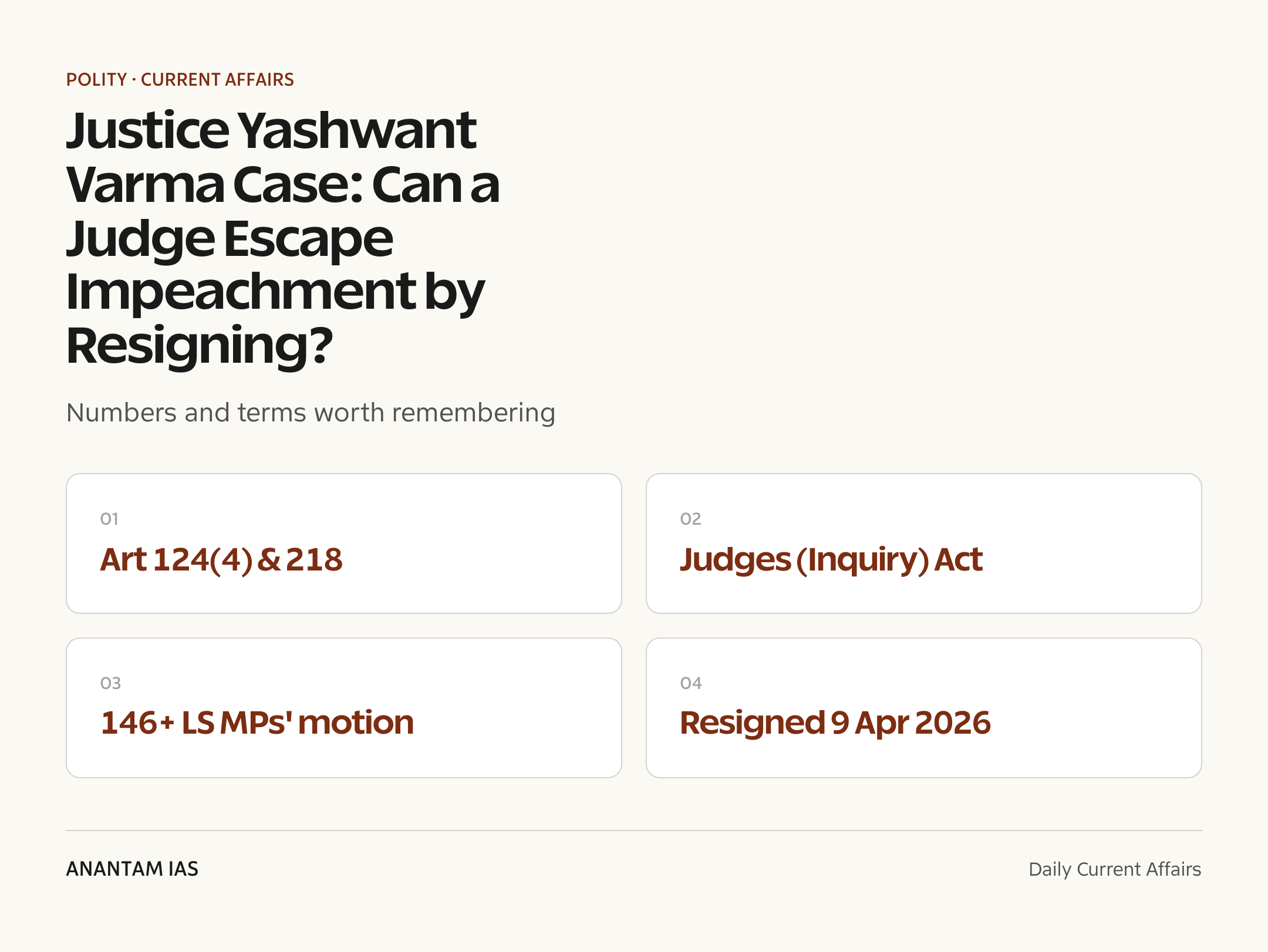
- The case began on 14 March 2025, when wads of burnt currency notes were found in the storeroom of Justice Varma’s official Delhi residence during a fire-fighting operation.
- A Supreme Court in-house inquiry reportedly found him culpable; on 8 May 2025 then CJI Sanjiv Khanna forwarded the report to the President and the Prime Minister.
- Over 146 Lok Sabha MPs moved a removal motion in July 2025; the Speaker constituted a three-member committee under the Judges (Inquiry) Act, 1968.
- Justice Varma resigned to President Droupadi Murmu on 9 April 2026, before the committee finished its work.
- Legal experts quoted by the Indian Express note the law nowhere says an inquiry must lapse on resignation.
The development matters in the context of:
- The removal route under Articles 124(4) and 218 is the Constitution’s only mechanism against a sitting judge — and no judge has ever been removed through it.
- The case revives the design gap exposed in 2011: a judge can end a constitutionally mandated probe simply by resigning, while keeping full post-retirement benefits.
UPSC Relevance
Prelims Relevance
- Article 124(4): a judge is removed by the President after an address by each House, supported by a majority of total membership and two-thirds of members present and voting, on grounds of proved misbehaviour or incapacity.
- Article 124(5) lets Parliament regulate the procedure by law — the Judges (Inquiry) Act, 1968 and the Judges (Inquiry) Rules, 1969.
- Article 218 applies the same removal provisions to High Court judges; under Article 217(1)(a) a High Court judge resigns by writing to the President.
- The Constitution uses impeachment only for the President (Article 61); for judges the correct term is removal.
- A motion needs 100 Lok Sabha or 50 Rajya Sabha MPs; the Speaker/Chairman may admit or refuse it.
- The statutory committee: a Supreme Court judge, a Chief Justice of a High Court and a distinguished jurist.
- Union of India v. Gopal Chandra Misra (1978): a judge’s resignation is unilateral, effective from the chosen date, needing no acceptance.
- V. Ramaswami (1993): first removal motion against a Supreme Court judge, defeated in the Lok Sabha; Soumitra Sen (2011): resigned after the Rajya Sabha passed his removal motion.
Mains Relevance
GS Paper 2
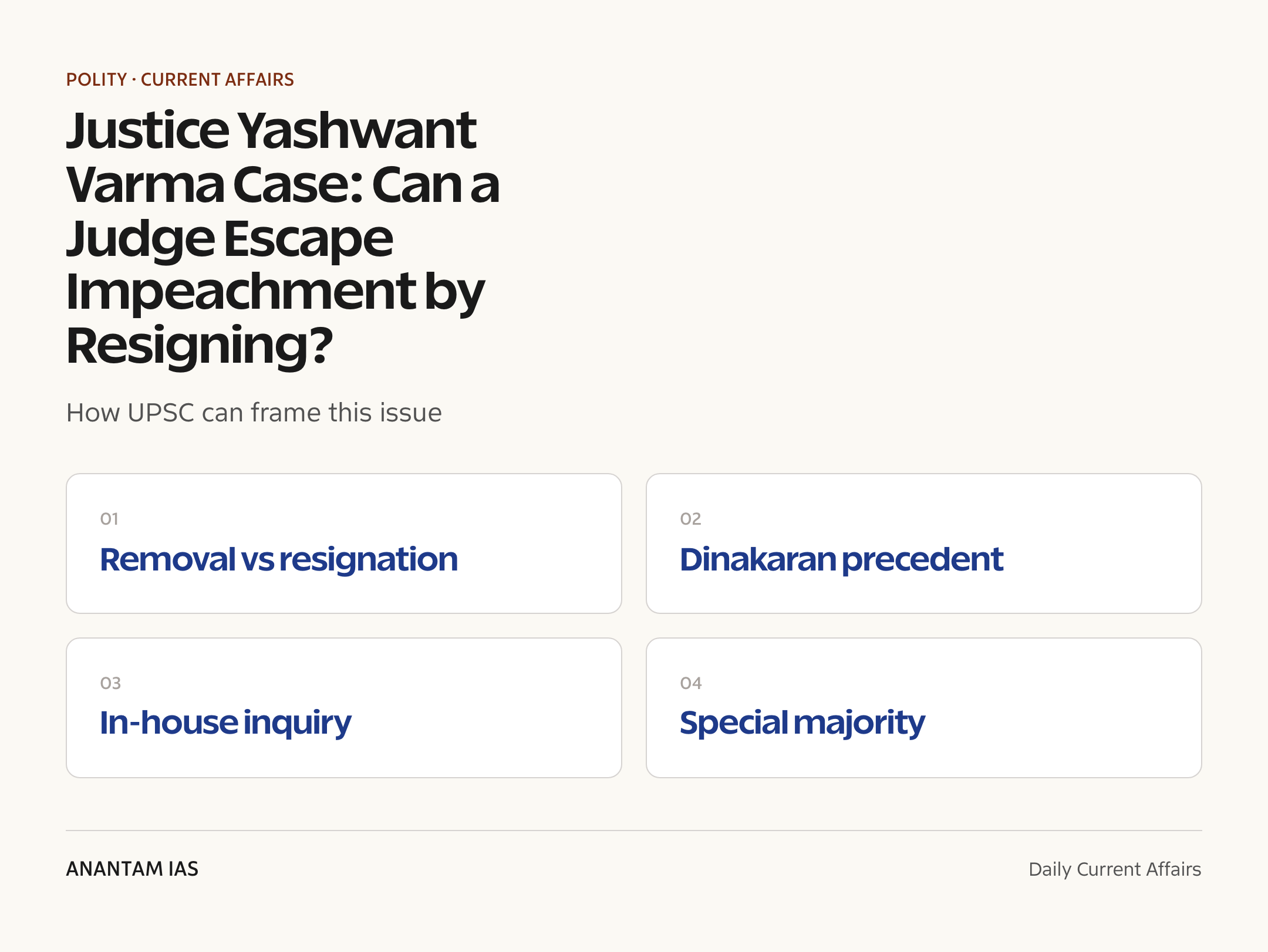
- Judicial accountability vs judicial independence: does the resignation route defeat the scheme of Articles 124(4) and 218?
- Working of the Judges (Inquiry) Act, 1968 — gaps and the case for reform after Ramaswami, Sen, Dinakaran and Varma.
- The in-house procedure as a non-statutory accountability device and its interface with the parliamentary route.
Essay
- Power without accountability corrupts institutions as surely as it corrupts individuals.
- Public trust is the true foundation of judicial authority.
Background and Context
The Cash-Discovery Case: A Timeline
The proceedings have run through every layer of India’s judicial-accountability machinery in sixteen months.
- 14 March 2025: during a fire at his official Delhi residence, fire-service personnel found wads of burnt currency notes in an outhouse storeroom. He was then a Delhi High Court judge.
- Then CJI Sanjiv Khanna ordered a three-member in-house committee inquiry; the judge was transferred to the Allahabad High Court and judicial work was withdrawn from him.
- The committee reportedly concluded he had tacit or active control over the storeroom; on 8 May 2025 the CJI forwarded the report to the President and the Prime Minister.
- On 7 August 2025, the Supreme Court dismissed his writ petition against the in-house findings and the removal recommendation.
- Over 146 Lok Sabha MPs moved a removal motion in July 2025; the Speaker admitted it and constituted the statutory committee, headed by Supreme Court judge Justice Aravind Kumar, with a High Court Chief Justice and senior advocate B. V. Acharya.
- On 9 April 2026, before the committee concluded its hearings, he resigned by writing to President Droupadi Murmu. In July 2026, Speaker Om Birla decided to table the report anyway.
How a Judge Is Removed: Articles 124(4), 217 and 218
The Constitution makes removal deliberately hard — the full procedure is in our explainer on the removal of High Court and Supreme Court judges.
- Article 124(4): removal only by Presidential order, after an address by each House passed in the same session by a majority of total membership AND two-thirds of members present and voting.
- The only grounds are proved misbehaviour or incapacity — neither term is defined in the Constitution.
- Article 218 extends the same procedure to High Court judges; Article 124(5) is the constitutional hook for the 1968 Act.
- No judge has ever been removed under this procedure since 1950; every episode has ended in a failed vote or a pre-emptive resignation.
The Judges (Inquiry) Act, 1968: Step by Step
The 1968 Act splits the process into a judicial-style investigation and a political vote.
- A motion needs at least 100 Lok Sabha or 50 Rajya Sabha MPs; the Speaker or Chairman may admit or refuse it.
- If admitted, a three-member committee is constituted: a Supreme Court judge, a High Court Chief Justice and a distinguished jurist.
- The committee frames charges, hears the judge, and conducts a quasi-judicial investigation and proof of the allegations.
- A not guilty finding kills the motion; a guilty finding sends the report to the House for debate and the special-majority address in both Houses.
- The Act is silent on what happens if the judge resigns midway — the heart of the present controversy.
Resignation Under Article 217: The 1978 Ruling
Resignation is legally the judge’s unilateral exit door.
- Under Article 217(1)(a), a High Court judge may resign by writing under his hand addressed to the President.
- Union of India v. Gopal Chandra Misra (1978): resignation is a unilateral act — it takes effect on the date the judge chooses and needs no acceptance.
- Legal scholar Shubhankar Dam, quoted in the Indian Express, notes the 1978 ruling never considered a judge resigning mid-probe.
- A resigning judge typically keeps the same pensionary benefits as one who retires normally — why critics call resignation an accountability escape hatch.
Precedents: Ramaswami, Sen and Dinakaran
Three earlier episodes shaped the assumption that resignation kills a removal process.
- V. Ramaswami (1993): the inquiry committee found him guilty on 11 of 14 charges, but the Lok Sabha motion failed when the ruling party abstained — the address never reached the required majority of total membership. He served until retirement.
- Soumitra Sen (2011), Calcutta High Court: the Rajya Sabha passed his removal motion — the first House ever to do so — but he resigned before the Lok Sabha vote, and the motion was dropped.
- P. D. Dinakaran (2011), Chief Justice of the Sikkim High Court: he resigned mid-probe; the Rajya Sabha secretariat held that resignation made the committee’s work infructuous.
- Jurist G. Mohan Gopal, then on the Dinakaran panel, urged colleagues to finish the probe — distinguishing investigation and proof from removal, and warning that resignation gives judges a de facto veto over accountability.
- The probe was wound up anyway: a vacancy made the committee dysfunctional, and Chairman Hamid Ansari considered the removal objective moot.
The Legal Question: Does Resignation End the Probe?
The Varma case squarely poses a question the 2011 episodes ducked — presented here as the two competing readings.
- View one — the process is spent: the sole object of the Article 124(4)/218 route is removal; once the judge resigns there is no office to vacate, so the inquiry serves no operative purpose. This was the 2011 position.
- View two — accountability survives: nothing in the Constitution or the 1968 Act says the inquiry lapses; the investigation-and-proof stage is an end in itself, creating a public record of judicial conduct.
- Lawyer Alok Prasanna Kumar told the Indian Express that tabling the report lets the Speaker overturn the Dinakaran precedent, and that the public is entitled to the findings of an inquiry run on public money.
- Experts argue a finding of proved misbehaviour could support stopping post-retirement benefits and opening criminal action.
- The counter-concern is judicial independence: pursuing a person who is no longer a judge has no express constitutional anchor — a tension central to the separation of powers between the judiciary and the executive.
The Wider Accountability Architecture
The formal removal route sits alongside softer, non-statutory mechanisms.
- The in-house procedure (adopted in 1999) lets the CJI have allegations examined by a peer committee; its strongest sanctions are withdrawal of work and a request to resign.
- The Judicial Standards and Accountability Bill, 2010 — proposing a National Judicial Oversight Committee — was passed by the Lok Sabha but lapsed with the 15th Lok Sabha.
- Appointment-side reform met a parallel fate: the NJAC Act was struck down in 2015 — see our explainer on judicial appointments, the collegium and the NJAC.
- The Varma episode is unusual for its transparency: official disclosures and a media leak of the in-house report were public before the statutory committee reported.
Way Forward
Close the statutory gap
- Amend the Judges (Inquiry) Act, 1968 to state expressly whether — and how — an inquiry continues after a judge resigns.
- Require a committee that has framed charges to deliver its findings even if the removal motion becomes infructuous.
Link findings to consequences
- Legislate clear rules on post-retirement benefits where a committee records proved misbehaviour, so resignation does not automatically preserve full pension.
- Clarify the pathway from an adverse finding to criminal investigation and asset inquiries.
Rebuild the standards framework
- Revive a modernised Judicial Standards and Accountability Bill with graded sanctions — censure, withdrawal of work — short of removal.
- Codify the in-house procedure‘s interface with the parliamentary route, preserving judicial primacy in fact-finding.
Conclusion
The Justice Varma case has moved the impeachment debate from the abstract to the immediate. Tabling the statutory committee’s report tests whether the removal process under Articles 124(4) and 218 is only a mechanism to vacate an office, or also a constitutional instrument of public accountability whose findings matter even after the office is gone.
Either way, the episode has exposed the design gap in the Judges (Inquiry) Act, 1968: a process that a judge can switch off by resigning protects neither judicial independence nor public trust. Statutory clarity — on continuation of inquiries, benefits and graded sanctions — is the unavoidable next step.
UPSC Practice Questions
Prelims MCQ 1
With reference to the removal of judges of the Supreme Court and High Courts in India, consider the following statements:
- A motion for the removal of a judge must be signed by at least 100 members of the Lok Sabha or at least 50 members of the Rajya Sabha.
- The committee constituted under the Judges (Inquiry) Act, 1968 consists of a Supreme Court judge, a Chief Justice of a High Court and a distinguished jurist.
- The Constitution expressly provides that removal proceedings against a judge lapse the moment the judge resigns.
How many of the above statements are correct?
(a) Only one (b) Only two (c) All three (d) None
Answer: (b) Only two
Explanation:
Statements 1 and 2 correctly describe the Judges (Inquiry) Act, 1968 scheme. Statement 3 is wrong — the Constitution and the Act are silent on the effect of resignation; the 2011 lapsing of the Dinakaran and Sen probes rested on secretariat reasoning, not any express provision.
Prelims MCQ 2
Which one of the following judges was the first against whom a removal motion was put to vote and defeated in the Lok Sabha?
(a) Justice V. Ramaswami (b) Justice Soumitra Sen (c) Justice P. D. Dinakaran (d) Justice Yashwant Varma
Answer: (a) Justice V. Ramaswami
Explanation:
In 1993, the motion against Supreme Court judge V. Ramaswami failed in the Lok Sabha despite a guilty finding on 11 of 14 charges, for want of the required majority of total membership. Sen and Dinakaran resigned before any Lok Sabha vote.
UPSC Mains Questions
- The removal procedure for judges under Articles 124(4) and 218 has never resulted in an actual removal, while resignation has repeatedly halted proceedings midway. Critically examine whether the Judges (Inquiry) Act, 1968 needs amendment to balance judicial independence with public accountability.
- The investigation and proof of misbehaviour is an end in itself, distinct from removal from office. In the light of the Justice Yashwant Varma episode, discuss whether a statutory inquiry against a judge should continue after the judge resigns.
Sources: The Judges (Inquiry) Act, 1968 — India Code and The Indian Express (Explained).
Frequently Asked Questions
Why is the Justice Varma case in the news?
Lok Sabha Speaker Om Birla decided to table the report of the statutory committee that investigated Justice Yashwant Varma, though the judge resigned in April 2026 before the inquiry concluded. This challenges the 2011-era assumption that resignation automatically ends removal proceedings against a judge.
How is a judge removed in India?
Under Articles 124(4) and 218, a Supreme Court or High Court judge is removed by the President after each House of Parliament passes an address, in the same session, by a majority of total membership and two-thirds of members present and voting, on grounds of proved misbehaviour or incapacity.
What does the Judges (Inquiry) Act, 1968 provide?
It operationalises removal: a motion signed by 100 Lok Sabha or 50 Rajya Sabha MPs, admission by the Speaker or Chairman, and investigation by a three-member committee — a Supreme Court judge, a High Court Chief Justice and a distinguished jurist. Only a guilty finding lets the motion proceed to a vote.
Can a judge resign while facing impeachment?
Yes. A judge resigns by writing to the President, and the Supreme Court held in 1978 that resignation is unilateral and needs no acceptance. The law is silent on what happens to a pending inquiry, which is why resignation has worked as an escape route in past cases.
What happened in the Dinakaran and Sen cases in 2011?
Justice P. D. Dinakaran resigned mid-probe and Justice Soumitra Sen resigned after the Rajya Sabha passed his removal motion but before the Lok Sabha voted. Both proceedings were dropped, on the reasoning that removal had become pointless once the judge left office.
Has any Indian judge been removed by Parliament?
No. Since 1950 no judge has been removed under the constitutional procedure. The closest case was Justice V. Ramaswami in 1993, where the committee found proved misbehaviour but the Lok Sabha motion failed for want of the required special majority.