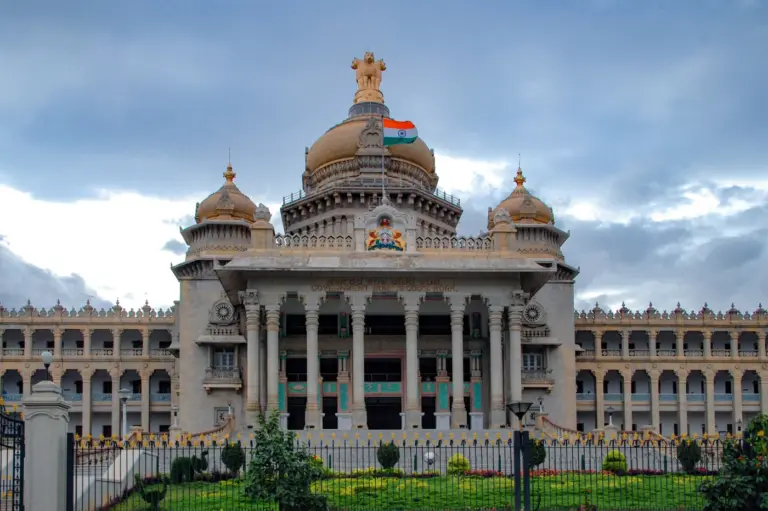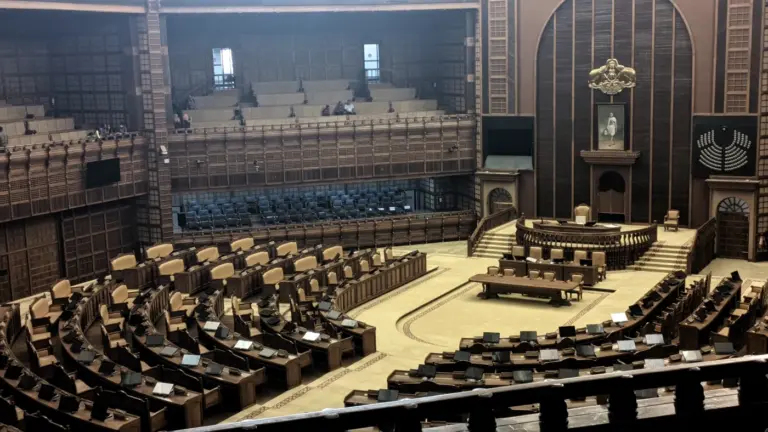
The phrase “Super Parliament” entered the Indian constitutional conversation when Vice-President Jagdeep Dhankhar criticised the Supreme Court for setting deadlines on the President and Governors to act on bills. The criticism touched a nerve. Indian democracy is built on the assumption that no organ of the state has unchecked authority, and the Constitution distributes power through a careful, deliberately untidy network of overlaps, immunities and reciprocal limits. The Super Parliament charge is provocative because it inverts the picture. It accuses the Court of doing what the Constitution forbids any organ from doing: standing above the others.
The debate is older than the catchphrase. Every generation has rehearsed it through a different controversy. Indira Gandhi’s emergency-era amendments tested whether Parliament could rewrite the Constitution at will. The NJAC verdict of 2015 tested whether the executive could share the appointment of judges. The recent rulings on gubernatorial assent test whether the executive can stall bills indefinitely. Each controversy returns to the same question: where does the line between organs lie, and who polices it.
This guide walks through the constitutional architecture of separation of powers in India, the textual hooks in Articles 50, 121, 122, 124 and 211, the doctrine of basic structure, the Ram Jawaya Kapur and Kesavananda judgments, the NJAC reasoning, the recent Tamil Nadu Governor case, and the comparative position in the United States and the United Kingdom.
Quick Facts on Separation of Powers in India
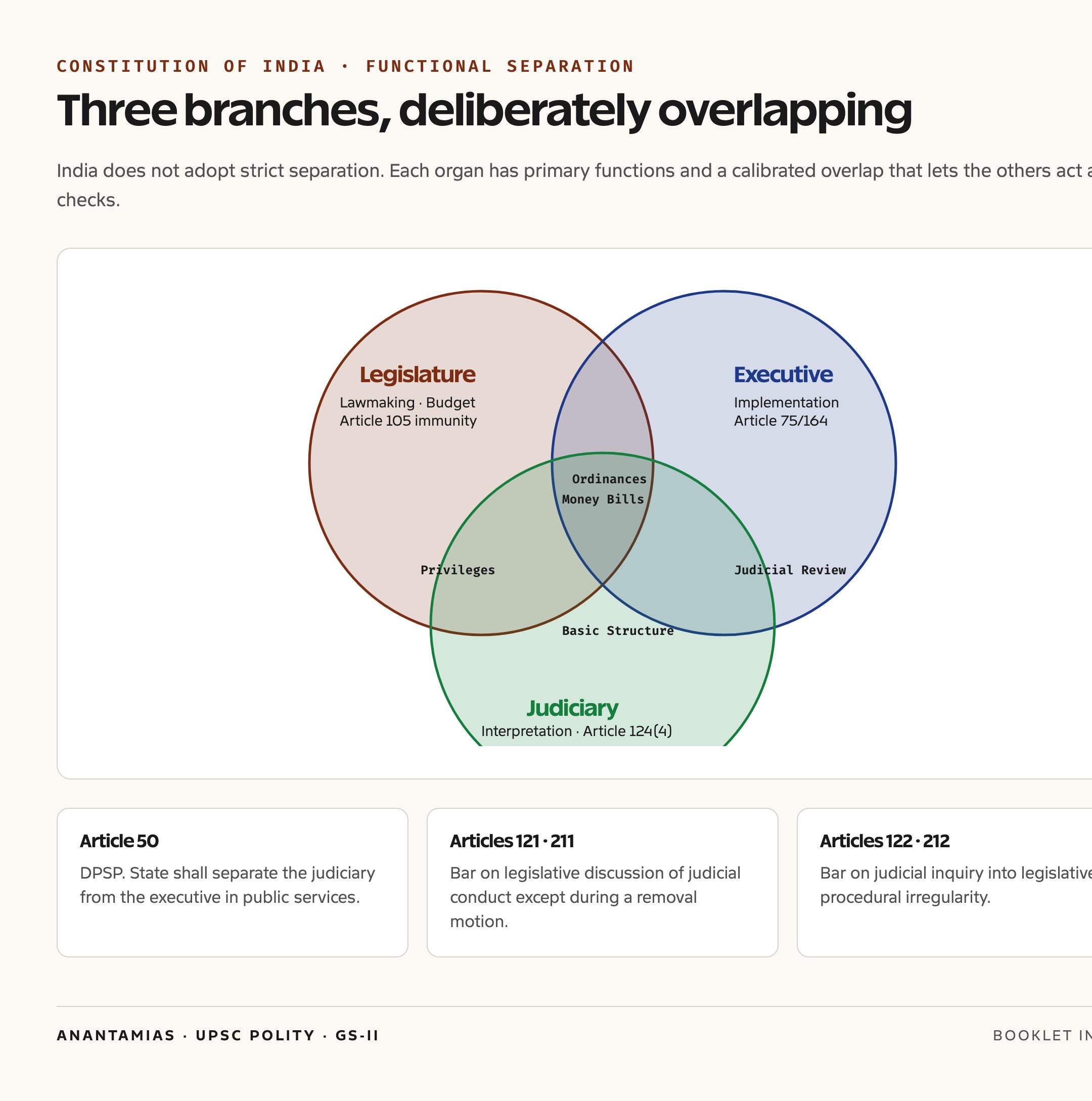
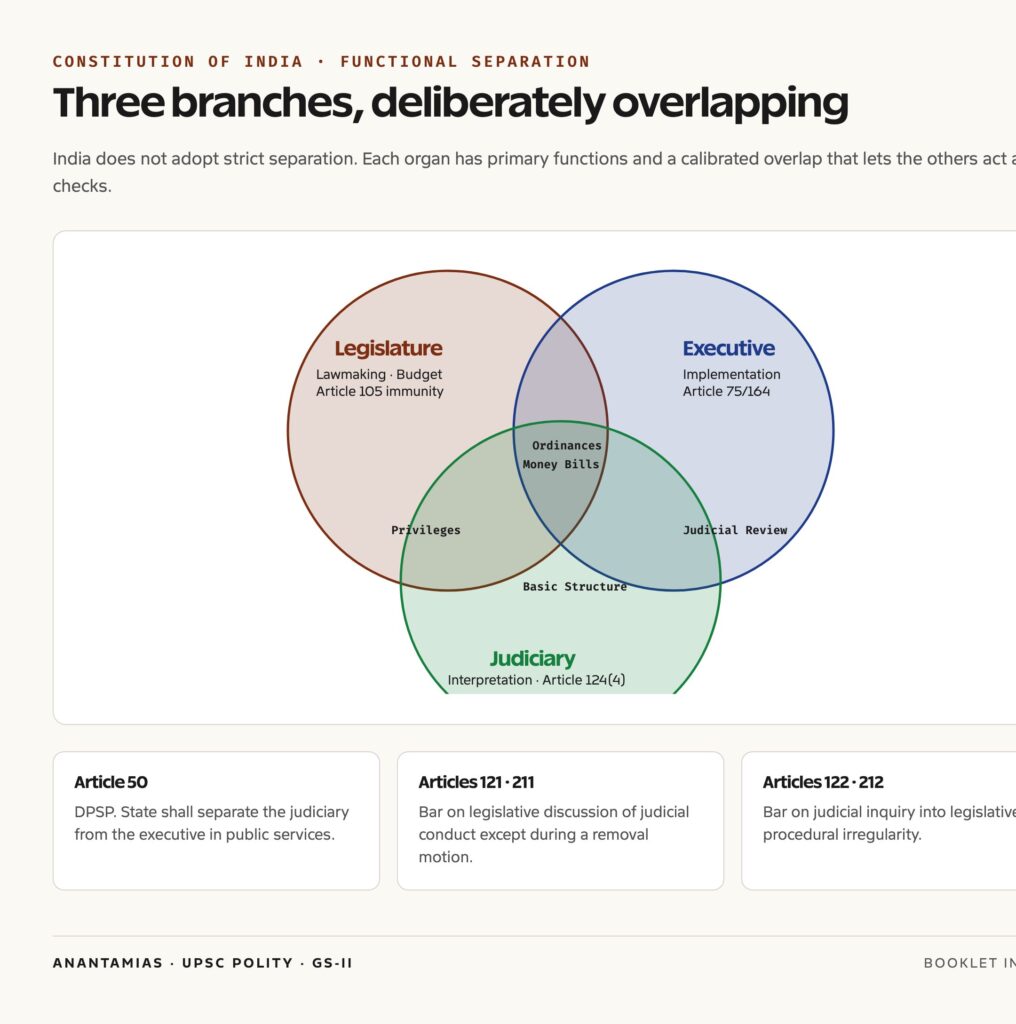
India follows a flexible separation of powers built on checks and balances. The three organs are the Legislature, the Executive, and the Judiciary. Article 50 of the Constitution, a Directive Principle of State Policy, asks the State to separate the judiciary from the executive in the public services of the State. Article 121 and Article 211 forbid Parliament and state legislatures from discussing the conduct of judges of the Supreme Court and High Courts except during a motion for removal. Article 122 and Article 212 bar courts from inquiring into the validity of legislative proceedings on grounds of procedural irregularity. Article 124(4) prescribes the removal of Supreme Court judges for proved misbehaviour or incapacity. The Supreme Court ruled in Kesavananda Bharati v. State of Kerala, 1973 that separation of powers is part of the basic structure of the Constitution. In Ram Jawaya Kapur v. State of Punjab, 1955, the Court held that the Indian Constitution does not adopt the rigid US-style separation but assigns sufficiently differentiated functions to each organ.
What Separation of Powers Actually Means
Separation of powers is the idea that the law-making, law-executing and law-interpreting functions should not concentrate in the same hands. The classical statement comes from Montesquieu in The Spirit of Laws, but the working principle predates him by centuries. The point is not that the three functions never overlap. The point is that no single body should perform all three at the same time, because that body would then escape every check.
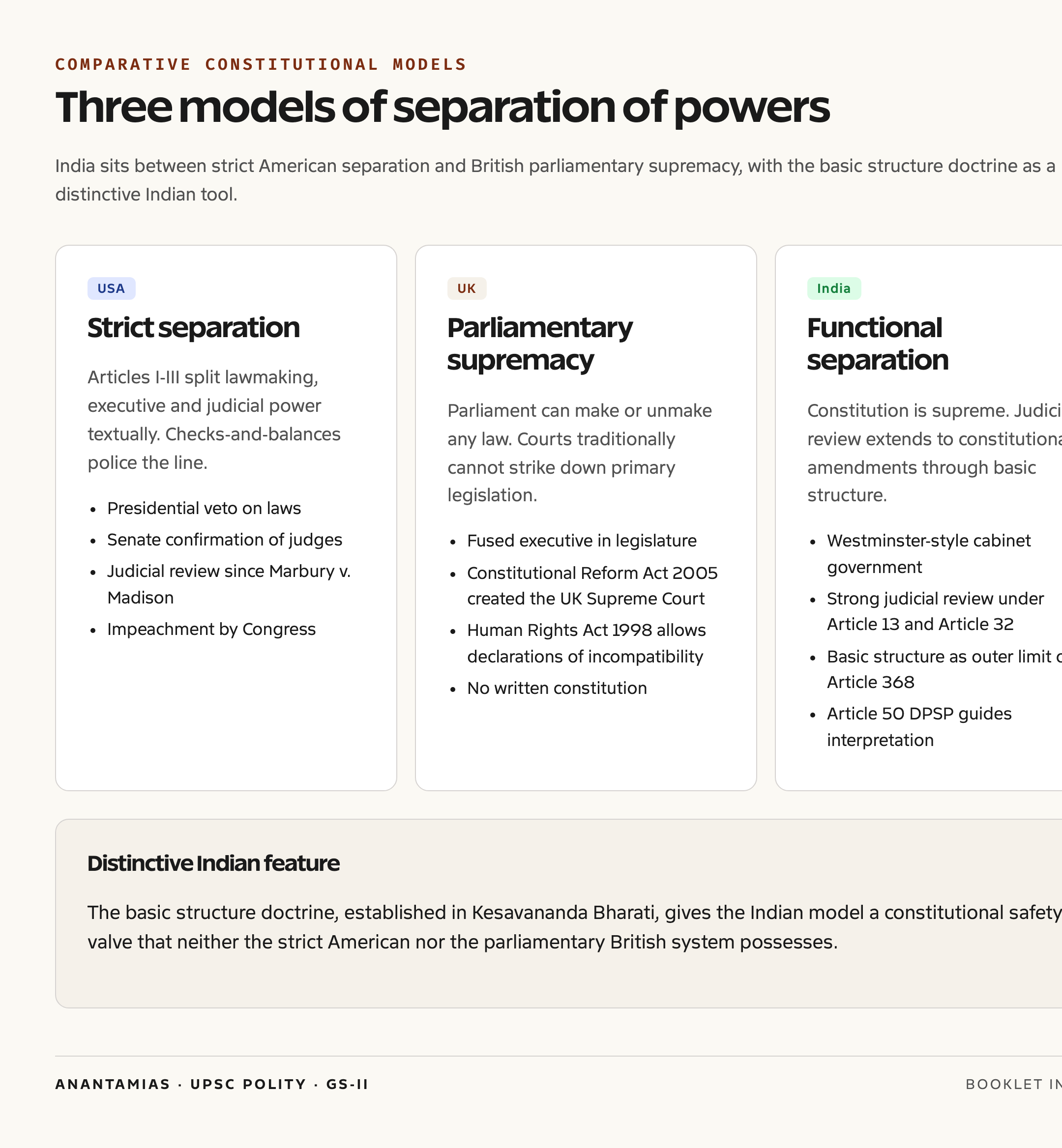
Three models have emerged in modern constitutional practice. The strict separation model, exemplified by the United States, draws hard textual lines between Congress, the President and the Supreme Court, and uses checks and balances to police those lines. The parliamentary sovereignty model, exemplified historically by the United Kingdom, fuses the executive into the legislature and treats Parliament as the supreme law-making body, with judicial review of legislation traditionally limited. The Indian model is closer to the parliamentary fusion of executive and legislature but adds the basic structure doctrine and a strong judicial review power that has no clear UK analogue.
Background and Historical Context
The Indian Constitution did not borrow any single foreign model wholesale. The Constituent Assembly debates show a deliberate choice. Dr. B.R. Ambedkar argued that strict separation as in the United States would not suit India’s parliamentary executive. The President and the Council of Ministers were modelled on the Westminster system, while judicial review and a written Bill of Rights were borrowed from the American tradition. The result was a mixed constitution that took the strengths of both and accepted the tensions that come with the mix.
The first decade of the Constitution placed the question quietly. The Supreme Court began to develop judicial review through cases like A.K. Gopalan v. State of Madras in 1950 and Ram Jawaya Kapur in 1955. The 1960s and 1970s sharpened the question. Parliament, drawing on its amending power under Article 368, began to amend fundamental rights and constitutional provisions in ways that the Court found increasingly hard to reconcile with the constitutional design.
The pivot came in Kesavananda Bharati v. State of Kerala in 1973. A 13-judge bench, by 7:6, held that Parliament could amend any part of the Constitution, including fundamental rights, but could not damage or destroy the basic structure of the Constitution. The list of basic structure features has expanded over time and includes separation of powers, judicial review, federalism, secularism, the rule of law, and the independence of the judiciary. After Kesavananda, the constitutional design rests on the basic structure as the outer limit of every organ’s power, including Parliament’s power to amend.
The Constitutional Architecture: Articles That Anchor the Doctrine
The Constitution does not contain a single article titled “separation of powers”. The doctrine is read out of multiple provisions. Article 50 is the most explicit. It is a Directive Principle of State Policy that asks the State to separate the judiciary from the executive in the public services of the State. The article is not directly enforceable, but the Court has used it to justify a strict line between magistrates of the executive type and judicial magistrates.
Article 121 and Article 211 protect judges of the Supreme Court and High Courts from being discussed in Parliament and state legislatures except during a removal motion. Article 122 and Article 212 protect legislative proceedings from judicial inquiry on grounds of procedural irregularity. Article 124(4) and Article 217 prescribe the conditions for the removal of judges, requiring an address of each House supported by a special majority. Article 105 and Article 194 give legislators immunity for what they say in the legislature. Article 75 and Article 164 establish that the Council of Ministers is collectively responsible to the lower House at the Union and state level.
The basic structure doctrine is the umbrella that ties these provisions together. The Court has held that any constitutional amendment that destroys the separation of powers, the independence of the judiciary, or the power of judicial review can be struck down. The 42nd Constitutional Amendment of 1976 attempted some of these encroachments and was rolled back partly by the 42nd amendment of indian constitution corrective amendments and partly by the basic structure doctrine itself.
Why the Doctrine Matters in 2026
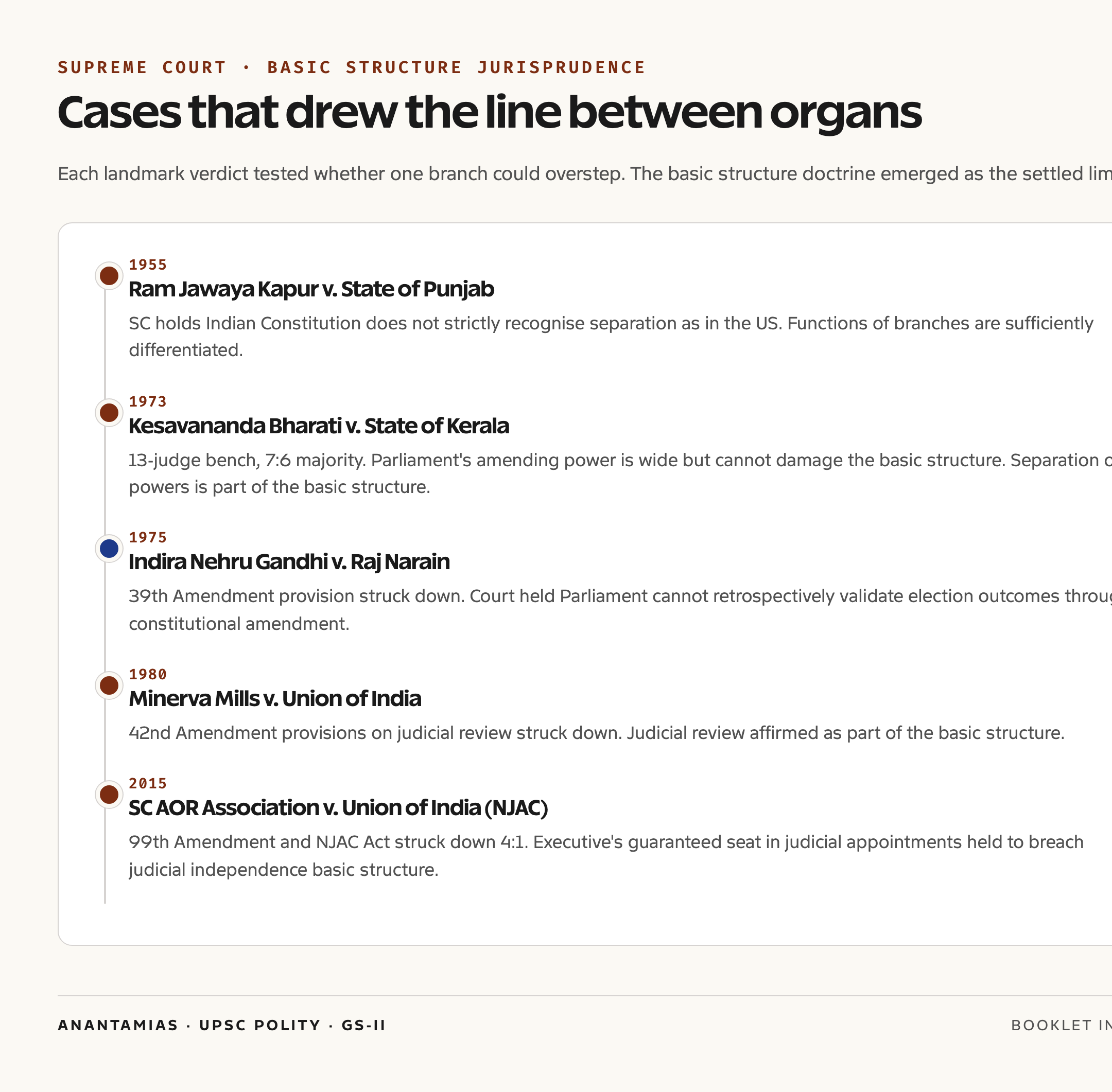
The doctrine matters because India’s constitutional disputes increasingly test the boundaries between organs. Three recent fault lines illustrate the live stakes. The first is the gubernatorial assent question, which forms the backdrop to the Super Parliament debate. State legislatures have passed bills, sent them for assent, and waited months or years for a decision. The Supreme Court ruled in the Tamil Nadu Governor case that “withholding assent” does not kill the bill but triggers a mandatory return to the legislature. The ruling sets a timeline and limits gubernatorial discretion.
The second is the appointment of judges. The 99th Constitutional Amendment of 2014 introduced the National Judicial Appointments Commission Act and reorganised the way judges of the higher judiciary are picked. The Supreme Court struck down the NJAC Act and the 99th Amendment in October 2015, holding that the executive’s role in judicial appointments breached the basic structure principle of judicial independence.
The third is the boundary of judicial review of constitutional amendments. The Court continues to refine which amendments cross the basic structure line. The principle is well settled, but its application is contested with each new amendment.
Detailed Analysis: Kesavananda, NJAC and the Tamil Nadu Governor Case
Kesavananda Bharati v. State of Kerala, 1973 is the constitutional fixed point. The 13-judge bench held that Article 368 gives Parliament a wide power to amend, but not a power to alter the constitutional identity. The basic structure includes the supremacy of the Constitution, the federal character, the secular character, the separation of powers between the legislature, executive and judiciary, and the rule of law. Every later case on the boundary between organs has been decided against this benchmark.
The NJAC verdict in Supreme Court Advocates-on-Record Association v. Union of India, 2015 illustrates how separation of powers is policed in practice. The 99th Amendment had created a six-member commission with the Chief Justice of India, two senior-most judges of the Supreme Court, the Union Law Minister, and two eminent persons. The Court struck down the amendment by 4:1, holding that giving the executive a guaranteed seat at the table for judicial appointments compromised the basic structure principle of judicial independence. The dissent argued that the executive role would be a healthy corrective to the collegium system, but the majority held that the constitutional design preferred judicial primacy.
The Tamil Nadu Governor case is the latest chapter. In State of Tamil Nadu v. Governor of Tamil Nadu, the Supreme Court ruled that a Governor cannot withhold assent to a bill indefinitely. Article 200 gives the Governor four options: assent, withhold assent, return the bill for reconsideration, or reserve it for the President. The Court held that “withhold assent” is not a permanent veto. It must be followed by a return of the bill to the legislature with a message. If the legislature passes the bill again, the Governor must give assent. The ruling fixes a timeline and rules out the pocket veto.
Comparative Frame: United States, United Kingdom, India
A short comparison sharpens the Indian model. The United States Constitution writes separation of powers into its first three articles. Article I creates Congress, Article II the Presidency, and Article III the federal judiciary. Each article begins with the phrase “The legislative Power”, “The executive Power”, and “The judicial Power”, and the textual structure forces the question of which power is being exercised. The doctrine of checks and balances, which lets each branch police the others, runs through veto power, judicial review, advice-and-consent on appointments, and impeachment.
The United Kingdom historically operated under parliamentary sovereignty. Parliament could make or unmake any law, and the courts traditionally did not strike down primary legislation. The Constitutional Reform Act of 2005 created a separate Supreme Court of the United Kingdom, separating it from the House of Lords, and signalled a stronger institutional separation. The Human Rights Act of 1998 allows courts to issue declarations of incompatibility but not to strike down primary legislation.
India sits between the two. The Constitution is supreme, not Parliament. Judicial review is robust and extends to constitutional amendments via the basic structure doctrine. The executive is fused into the legislature, as in the UK. The Indian model is best described as functional separation with strong judicial review, anchored in the basic structure.
Challenges and Open Questions
Three challenges deserve attention. The first is the legitimacy of judicial review of constitutional amendments. The basic structure doctrine is judge-made and has expanded over the decades. Critics argue that this gives the Court a final say over Parliament’s amending power, which weakens the democratic mandate. The Court’s defenders reply that without basic structure review, no constitutional limit would survive a sufficiently determined parliamentary majority.
The second is the appointment of judges after NJAC. The collegium system continues, but the controversy over judicial appointments has not gone away. The recent appointment of Justice Surya Kant as the 53rd Chief Justice of India has rekindled the debate, alongside the live discussion in ca:appointment-of-judges-in-the-higher-judiciary-2025-justice-surya-kant-recommended-as-the-53rd-chief-justice-of-india-constitutional-provisions-memorandum-of-procedure-explained on the Memorandum of Procedure.
The third is the executive role in setting deadlines. The Tamil Nadu Governor case fixes a timeline. The pending Presidential Reference on the Governor and President’s powers, currently being heard, may revise or refine that ruling. The outcome will shape how directly the judiciary can constrain the executive on constitutional duties without crossing into legislative territory.
Prelims Pointers
The doctrine of separation of powers in India is part of the basic structure. The 42nd Constitutional Amendment of 1976 added several centralising changes, some of which were rolled back by the 44th Amendment of 1978. Article 50 is a Directive Principle of State Policy, not a fundamental right. Articles 121 and 211 bar legislative discussion of judicial conduct except in a removal motion. Articles 122 and 212 bar judicial inquiry into legislative proceedings on procedural grounds. Article 124(4) prescribes special majority removal of Supreme Court judges. The Kesavananda Bharati case was decided in 1973 by a 7:6 majority on a 13-judge bench. The NJAC verdict was delivered in October 2015 by a 4:1 majority. The Indian model is functional separation with strong judicial review, neither strict like the US nor parliamentary supremacy like the UK.
Mains Practice Questions
A standard GS-II question is: “The Indian Constitution does not adopt a strict doctrine of separation of powers, but draws functional lines between organs and polices them through the basic structure doctrine. Discuss with reference to Kesavananda Bharati and the NJAC verdict.” A second variant is: “Recent disputes over gubernatorial assent and judicial appointments have intensified the debate on the boundary between the executive and the judiciary in India. Critically examine the constitutional architecture and the role of the judicial activism in resolving these disputes.” A third option is comparative: “Compare the separation of powers in India with the strict separation in the United States and the parliamentary supremacy of the United Kingdom. Identify the strengths and weaknesses of the Indian model.”
Way Forward
The doctrine works when each organ self-restrains while exercising its full constitutional power. Three reforms can strengthen the design. First, codify the timelines for gubernatorial assent in a constitutional amendment, putting the Tamil Nadu Governor case on a textual footing. Second, revise the Memorandum of Procedure for judicial appointments to reduce friction between the collegium and the executive without reopening the NJAC settlement. Third, build a stronger institutional dialogue between the three organs through legislative committees, judicial workshops, and executive consultations on draft legislation, which will reduce the volume of constitutional litigation by addressing tension at the design stage.
The Super Parliament charge is best answered by the constitutional text. The Constitution is supreme, and every organ is its servant. The Court does not stand above Parliament. It applies the limits that the Constitution itself imposes. As long as those limits are honestly read and faithfully applied, the doctrine continues to do its quiet, indispensable work.
Frequently Asked Questions
Does the Indian Constitution explicitly mention separation of powers?
No single article in the Constitution uses the exact phrase. The doctrine is read out of Article 50 (DPSP), Articles 121, 122, 211 and 212 (mutual immunities of organs), Article 124(4) and Article 217 (removal of judges), and the basic structure doctrine laid down in Kesavananda Bharati. The Supreme Court has held that separation of powers is part of the basic structure of the Constitution.
Is the Indian model the same as the American model?
No. The American model adopts a strict separation in its first three articles and uses checks and balances to police the boundary. The Indian model fuses the executive into the legislature, on the Westminster pattern, while retaining strong judicial review and the basic structure doctrine. The Court itself confirmed this difference in Ram Jawaya Kapur v. State of Punjab, 1955.
What did the Supreme Court rule in the NJAC case?
The Supreme Court struck down the 99th Constitutional Amendment and the National Judicial Appointments Commission Act in October 2015 by a 4:1 majority. The Court held that giving the executive a guaranteed seat in the appointment of higher-court judges breached the basic structure principle of judicial independence. The collegium system continues, with refinements through the Memorandum of Procedure.
Can the Supreme Court strike down a constitutional amendment?
Yes, but only if the amendment violates the basic structure of the Constitution. This power flows from the Kesavananda Bharati ruling of 1973. The Court has used the power sparingly. NJAC, the 39th Amendment provision in Indira Nehru Gandhi v. Raj Narain, and parts of the 42nd Amendment in Minerva Mills are the leading cases.
What is the significance of Article 50?
Article 50 is a Directive Principle of State Policy that asks the State to separate the judiciary from the executive in the public services of the State. The article is not directly enforceable in court, but the Supreme Court has used it as an interpretive guide to support the line between executive magistrates and judicial magistrates and to defend the operational independence of the judiciary.
Does Article 50 make the judiciary independent of the executive?
Article 50 expresses the constitutional aspiration. The actual independence of the judiciary is delivered by other provisions: security of tenure under Article 124 and Article 217, the special procedure for removal under Article 124(4), the protection of salaries and allowances under Article 125, the bar on practice after retirement, and the basic structure doctrine that protects the institution from amendments that would compromise its independence.
What was the Tamil Nadu Governor case about?
The State of Tamil Nadu challenged the Governor’s failure to act on bills passed by the state legislature. The Supreme Court held that the Governor cannot withhold assent indefinitely. Article 200 obliges the Governor to either assent, return the bill with a message, or reserve it for the President’s consideration. A u0022withhold assentu0022 decision must be followed by a return to the legislature, and if the legislature passes the bill again, the Governor must assent.
Are judges of the Supreme Court above the law?
No. Judges are subject to constitutional removal under Article 124(4) for proved misbehaviour or incapacity, on a motion supported by a special majority of each House of Parliament. They are also subject to the criminal law for offences. The protection in Article 121 only bars discussion of their conduct in legislative proceedings, except during a removal motion.
Why is the Super Parliament criticism considered constitutionally inaccurate?
The criticism assumes that the Court has placed itself above Parliament. The constitutional position is that the Constitution, not Parliament, is supreme. Article 13 makes any law inconsistent with the fundamental rights void, and the basic structure doctrine extends this to constitutional amendments. The Court applies the Constitution’s own limits. It does not legislate or set itself up as a higher chamber.
What role does the basic structure doctrine play in separation of powers?
The basic structure doctrine is the constitutional limit that even Parliament cannot cross when amending the Constitution. The Supreme Court has held that separation of powers, the rule of law, judicial review, and the independence of the judiciary are part of the basic structure. Any amendment that would destroy any of these features can be struck down. The doctrine is the ultimate guardrail of the Indian separation of powers design.
Tell Google you want more of this.
Add Anantam IAS as a preferred sourceOne tap, and this site shows up more often in your own Top Stories, AI Overviews and AI Mode. Remove it any time.