Maharashtra Farmer Loan Waiver: Rollout and Fiscal Trade-Offs
Why in News?
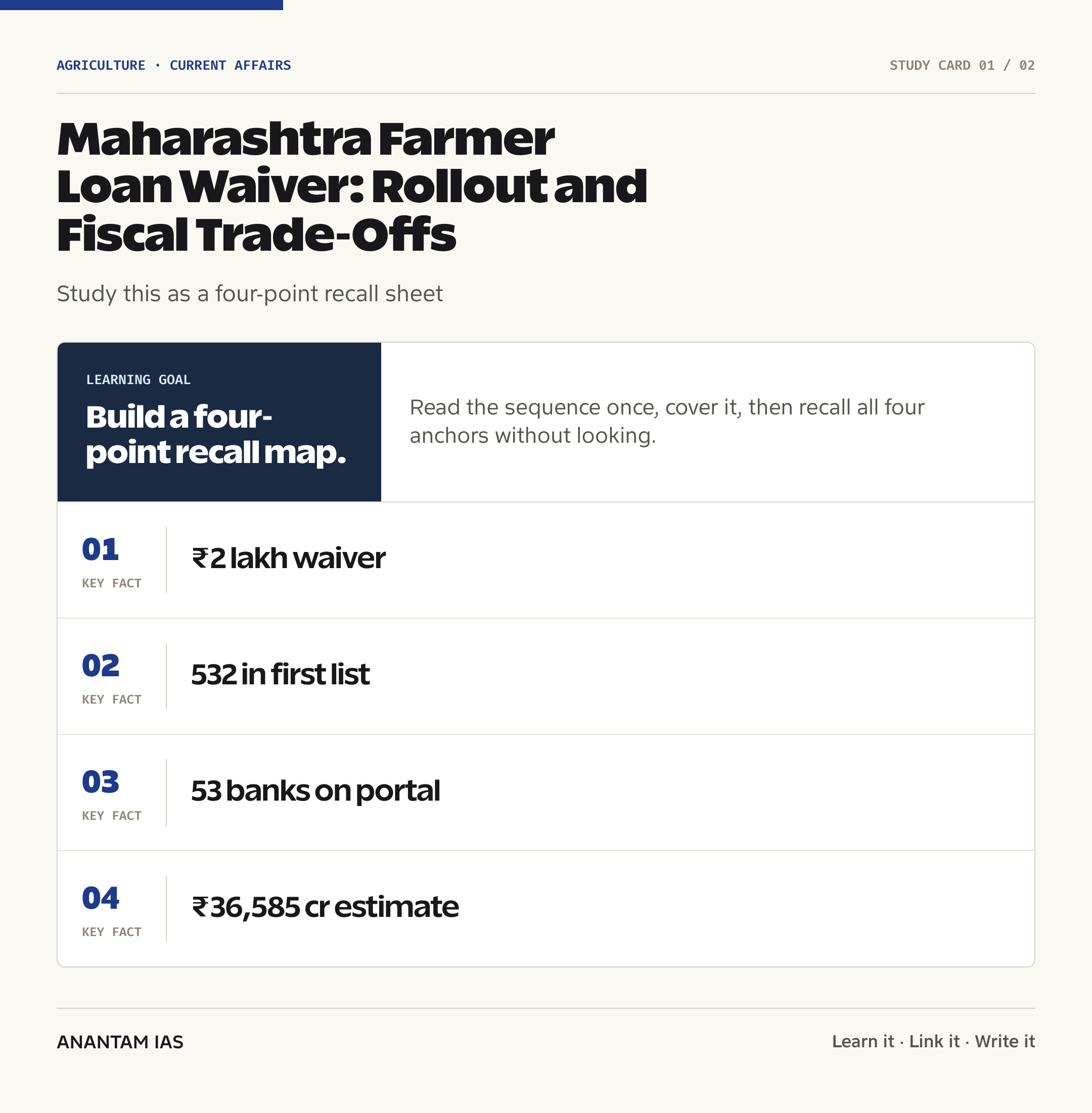
Maharashtra began the beneficiary-verification phase of the Punyashlok Ahilyadevi Holkar Shetkari Karjmukti Yojana 2026 on 22 July. The official Maharashtra DGIPR launch note recorded a representative first list of 532 eligible beneficiaries from seven districts; The Hindu described the rollout more generally as the first 500 beneficiaries.
The first list is an eligibility milestone, not proof that the full waiver estimate has already been spent. Beneficiaries must complete AgriStack registration and Aadhaar authentication before the approved amount is credited by Direct Benefit Transfer to the relevant loan account.
- The Maharashtra Cabinet approved the scheme on 2 June 2026, and revised criteria were issued through a Government Resolution dated 15 July 2026.
- The scheme is projected to cover about 56 lakh farmer families and carry an estimated benefit of ₹36,585 crore.
- The waiver ceiling is ₹2 lakh for eligible short-term crop-loan arrears, including eligible restructured and re-restructured crop loans.
- A total of 53 banks, including 30 District Central Cooperative Banks and 12 nationalised banks, uploaded loan-account data to the MahaIT portal.
- The official note targeted 31 July for eligible DCCB cases, followed by commercial-bank transfers.
UPSC Relevance
Prelims Relevance
- Punyashlok Ahilyadevi Holkar Shetkari Karjmukti Yojana 2026 is a Maharashtra State scheme for eligible crop-loan relief and repayment incentives.
- Eligible loans are short-term crop loans taken from 1 April 2019 to 31 March 2025, overdue on 30 September 2025 and unpaid on 31 March 2026.
- The principal waiver ceiling is ₹2 lakh; revised rules allow relief up to this ceiling even when the total overdue amount is higher.
- AgriStack registration and Aadhaar authentication precede the transfer of benefit to the loan account.
- The covered lending network includes nationalised banks, private banks, Regional Rural Banks, DCCBs and PACS-linked crop credit.
- PACS are the village-level base of the short-term cooperative credit structure, linked upward to DCCBs and State Cooperative Banks.
- The scheme includes an incentive of up to ₹50,000 for eligible regular borrowers, separate from the waiver for defaulters.
- Excluded groups include specified elected representatives, public employees above the notified threshold and persons paying income tax on non-agricultural income.
Mains Relevance
GS Paper 3
- Agricultural credit, farm indebtedness and the difference between temporary balance-sheet relief and durable improvements in farm incomes.
- Impact of repeated waivers on repayment behaviour, bank asset quality, fresh credit, investment and the State’s quality of expenditure.
- Role of crop insurance, irrigation, price-risk management, income support and Farmer Producer Organisations as alternatives to episodic debt cancellation.
GS Paper 2
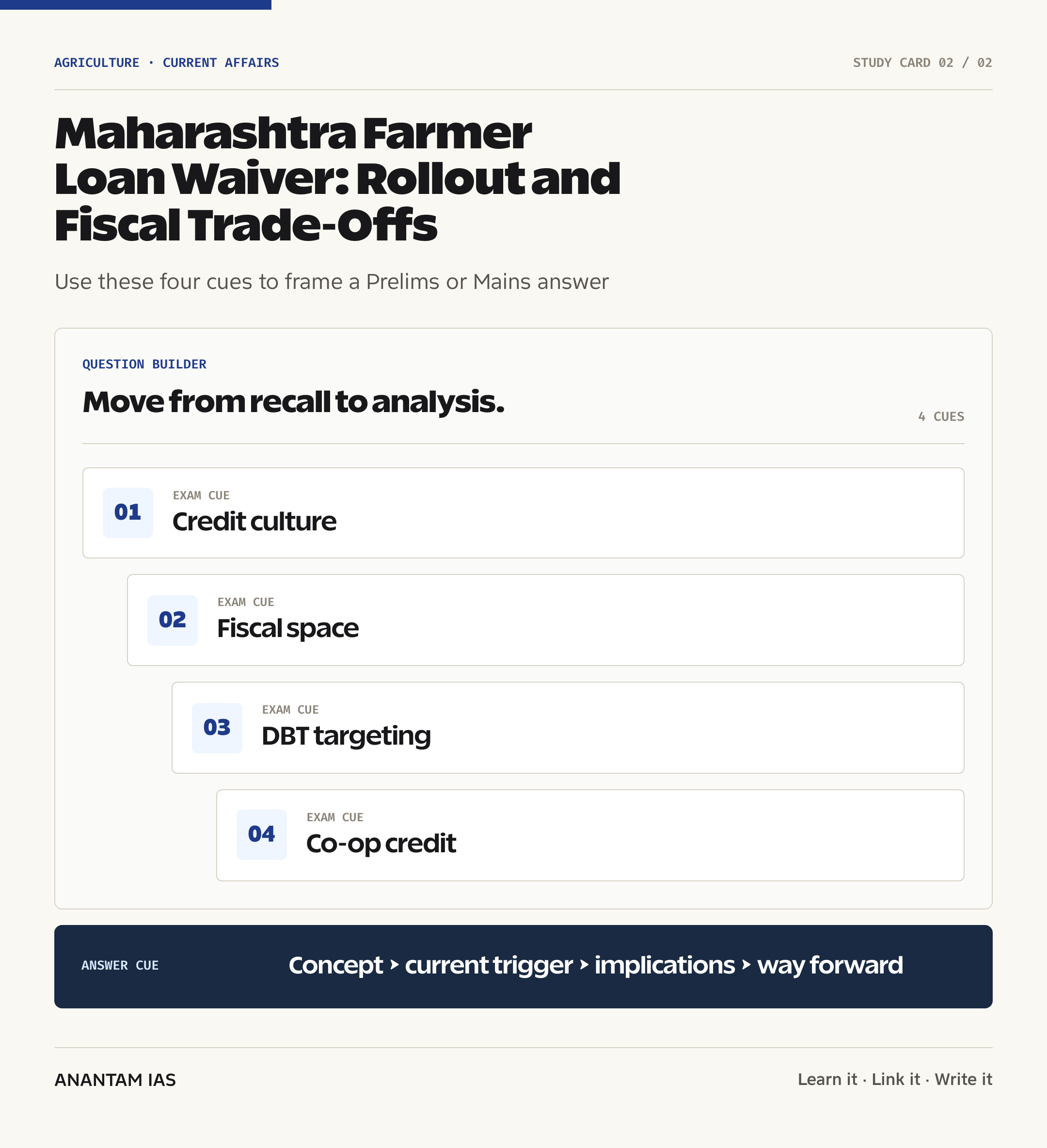
- Digital welfare delivery through Aadhaar, AgriStack, DBT and grievance redress, including the tension between de-duplication and exclusion.
- Cooperative federalism and institutional accountability when a State-funded scheme depends on public, private, regional rural and cooperative banks.
Background and Context
Scheme Design and Updated Eligibility
The scheme combines debt relief for eligible defaulters with a separate reward for borrowers who maintained repayment discipline.
- Loan window: eligible short-term crop loans were taken between 1 April 2019 and 31 March 2025, remained overdue on 30 September 2025 and were unpaid on 31 March 2026.
- Relief ceiling: the government waives eligible principal and interest up to ₹2 lakh across one or more loan accounts; there is no landholding-size ceiling in the notified design.
- July revision: a borrower owing more than ₹2 lakh can still receive relief up to ₹2 lakh without first clearing the entire excess amount, removing the earlier one-time-settlement barrier.
- Previous beneficiaries: farmers who benefited under the Mahatma Jyotirao Phule Shetkari Karjmukti Yojana 2019 are no longer restricted to the earlier ₹50,000 ceiling and may qualify for relief up to ₹2 lakh under the revised conditions.
- Regular borrowers: eligible timely repayers may receive an incentive up to ₹50,000; the July revision removed the condition that they must take and timely repay a new crop loan in 2026-27.
- Restructured debt: eligible crop loans converted or re-converted after crop loss or disaster are included, recognising that restructuring changes repayment terms but doesn’t remove the underlying farm shock.
- Account relief, not free cash: the benefit settles an eligible institutional liability. Its policy purpose is to clean the overdue account so a genuinely distressed farmer can again seek seasonal crop finance.
How the Digital Rollout Works
The delivery chain uses lender records as the starting point and adds identity checks before any benefit reaches a loan account.
- Banks upload data: 53 participating banks supplied crop-loan account records to a portal developed by MahaIT, while cooperation-department auditors checked District Central Cooperative Bank records.
- Exclusion matching: the system cross-checks specified ineligible categories, including elected office-holders, public employees and taxpayers on non-agricultural income.
- Farmer verification: an eligible person receives an SMS and a unique beneficiary number, then completes Aadhaar authentication after registering on AgriStack.
- Assisted access: the State identified about 32,000 Aaple Sarkar Seva Kendras for authentication support, while lists are also displayed through gram panchayats, cooperative societies and bank branches.
- Transfer stage: only after authentication is the approved benefit sent through DBT to the crop-loan account, allowing the lender to regularise the account and assess fresh credit.
- The process connects directly with AgriStack’s farmer registry, but data-driven delivery still needs offline correction channels for name, land, mobile and Aadhaar mismatches.
Formal and Cooperative Credit Channels
A waiver works through institutional lenders, so its reach depends on who already has a formal crop-loan account.
- Commercial banks bring scale and regulated appraisal, while Regional Rural Banks specialise in rural borrowers and priority-sector lending.
- Cooperative credit follows a three-tier structure: PACS at village level, District Central Cooperative Banks at district level and State Cooperative Banks at the apex.
- PACS offer local knowledge and last-mile access, but weak governance, poor records and dependence on higher-tier refinancing can affect asset quality.
- The Maharashtra rollout prioritises verified DCCB accounts before commercial-bank transfers, showing the operational weight of cooperatives in seasonal crop finance.
- A cleaned loan account can restore formal eligibility, but a waiver doesn’t automatically create a sound next loan. Banks still need credible crop, cash-flow and repayment information.
- The broader architecture is covered in Anantam IAS notes on agricultural credit in India and NABARD’s rural-credit role.
Targeting Gains and Exclusion Risks
Digital verification can reduce leakage, but the scheme may still miss distressed cultivators outside formal records.
- Aadhaar authentication helps establish identity and de-duplicate claims, while bank-account matching ties relief to an actual eligible liability rather than a cash application.
- AgriStack can connect farmer, land and crop records, making future credit and disaster relief faster when the underlying records are accurate.
- Exclusion error arises when a genuine farmer has a spelling mismatch, an unlinked mobile number, pending mutation, joint land title or incomplete AgriStack registration.
- Tenant farmers, sharecroppers and oral lessees may borrow informally because they lack clear title or bank collateral; a formal-loan waiver can leave their most expensive debt untouched.
- Removing the landholding cap simplifies administration but weakens progressivity unless income, vulnerability and repeat-beneficiary rules are applied transparently.
- District grievance committees and public display of lists should operate with time-bound correction, reasoned rejection and an appeal trail, not merely a complaint inbox.
Moral Hazard, Credit Culture and Bank Balance Sheets
A waiver can repair distressed accounts immediately, yet repeated expectations of cancellation can change both borrower and lender behaviour.
- Moral hazard means protection from repayment consequences may encourage some borrowers to delay payment in anticipation of a future waiver, even when they can repay.
- Credit culture weakens if disciplined borrowers feel penalised relative to defaulters; Maharashtra’s separate ₹50,000 incentive is designed to reduce this fairness problem.
- Strategic default must be distinguished from genuine distress caused by drought, flood, crop disease, price collapse or health shocks. A blanket design treats unlike cases alike.
- For banks, government settlement can reduce reported overdue accounts and reopen lending, but delayed reimbursement strains liquidity and may make branches more cautious about subsequent farm loans.
- If lenders become more cautious after repeated political intervention, smaller borrowers may be pushed back toward informal moneylenders.
- A sound evaluation must track fresh credit after relief: account regularisation is incomplete if eligible farmers remain unable to finance the next sowing season.
Fiscal Scale and Opportunity Cost
The key fiscal question is not only whether Maharashtra can finance the waiver, but what public spending it may displace.
- The official ₹36,585 crore figure is a projected scheme benefit or fiscal estimate. The first list of 532 names is only a verification milestone and doesn’t show that this amount has been booked or disbursed.
- Maharashtra’s 2026-27 Budget estimates total expenditure excluding debt repayment at ₹7,69,467 crore; the scheme estimate is about 4.8% of that total.
- The same Budget estimates a ₹40,552 crore revenue deficit and a ₹1,50,491 crore fiscal deficit. The waiver estimate is about 90% of the former and 24% of the latter, illustrating scale rather than proving a one-for-one increase in either deficit.
- Actual impact depends on appropriation, phasing, bank reconciliation, rejected claims and payment timing. Announced beneficiary estimates must not be reported as audited expenditure.
- Because waiver payments are normally revenue expenditure, their opportunity cost can fall on irrigation, extension, storage or insurance unless the State raises revenue or reprioritises other spending.
- Fiscal evaluation should publish the number authenticated, amount sanctioned, amount transferred, lender-wise pendency and the share of beneficiaries who regain fresh crop credit.
Relief Versus Durable Farm Resilience
Debt cancellation addresses the stock of eligible arrears; resilience policy must reduce the shocks that create the next arrear.
- Crop insurance should pay quickly after verified loss so a climate shock doesn’t become a loan default; see the design and implementation issues in PM Fasal Bima Yojana.
- Income support such as PM-KISAN is predictable and crop-neutral, though its small annual transfer can’t replace insurance, remunerative markets or productive investment.
- Irrigation, soil health, extension and climate-resilient seeds reduce yield volatility, while warehouses and negotiable receipts reduce distress sales immediately after harvest.
- Farmer Producer Organisations can aggregate inputs, output and market power, helping small farmers lower costs and negotiate better prices.
- Interest subvention and Kisan Credit Cards can make timely formal credit cheaper, but limits should reflect local crop costs and repayment should track the harvest cycle.
- A rules-based disaster restructuring framework is more predictable than ad hoc political announcements: objective triggers can pause repayment, reschedule principal and preserve borrower credit histories.
Way Forward
Publish an auditable fiscal dashboard
- Separate estimated liability, sanctioned amount and cash transferred by month, lender, district and scheme component.
- Disclose whether payments use existing budget provision or supplementary grants, along with the effect on revenue expenditure and fiscal-deficit projections.
Make verification inclusion-safe
- Allow assisted, offline and exception-based authentication for farmers facing Aadhaar, mobile, land-record or AgriStack mismatches.
- Give every rejection a reason code, a time limit for correction and an appeal to an independent district-level authority.
Protect repayment discipline
- Pay the regular-borrower incentive promptly and retain a clean credit history for farmers who repay despite shocks.
- Use repeat-waiver data, disaster exposure and repayment capacity to distinguish unavoidable distress from strategic default.
Convert relief into renewed credit
- Require banks to report whether a regularised borrower receives a fresh, adequately sized Kisan Credit Card or crop loan for the next season.
Shift spending toward risk reduction
- Expand irrigation reliability, weather services, crop insurance, storage, FPOs and price-risk management to reduce recurring defaults.
- Design formal credit for tenants, women cultivators, sharecroppers and Joint Liability Groups so relief and resilience don’t remain tied only to titled landholders.
Conclusion
Maharashtra’s rollout shows how a farm loan waiver can be made more verifiable through bank data, AgriStack, Aadhaar authentication and DBT. The real test is whether these safeguards remove ineligible claims without shutting out distressed cultivators who sit at the edge of formal records.
The waiver can give a borrower breathing space and reopen a blocked crop-loan account. But its success should be judged by restored access to productive credit, lower future distress and transparent fiscal reporting, not by the size of the announced estimate alone.
A durable farm policy must make waivers exceptional. Insurance, irrigation, stable markets, timely credit and shock-responsive restructuring should do the routine work of keeping farmers solvent.
UPSC Practice Questions
Prelims MCQ 1
With reference to Maharashtra’s Punyashlok Ahilyadevi Holkar Shetkari Karjmukti Yojana 2026, consider the following statements:
- It covers eligible short-term crop loans, including specified restructured crop loans.
- AgriStack registration and Aadhaar authentication are part of the beneficiary-verification process.
- Only loans issued by District Central Cooperative Banks are covered.
How many of the above statements are correct?
(a) Only one (b) Only two (c) All three (d) None
Answer: (b) Only two
Explanation:
Statements 1 and 2 are correct. The lending network extends beyond DCCBs to nationalised, private and regional rural banks, as well as eligible cooperative credit channels, so statement 3 is incorrect.
Prelims MCQ 2
Which one of the following best explains moral hazard in a farm loan-waiver programme?
(a) Banks receive repayment from the government instead of the borrower (b) Borrowers may delay repayment because they expect a future waiver (c) Farmers shift from crop loans to long-term investment loans (d) Aadhaar authentication excludes duplicate beneficiaries
Answer: (b) Borrowers may delay repayment because they expect a future waiver
Explanation:
Moral hazard arises when protection from the consequences of default changes behaviour. An expected future waiver may weaken timely repayment even among borrowers able to pay.
UPSC Mains Questions
- Farm loan waivers can restore a distressed cultivator’s balance sheet but may also weaken credit discipline and State finances. Evaluate this trade-off with reference to Maharashtra’s 2026 rollout and suggest safeguards that distinguish genuine distress from strategic default.
- Digital beneficiary verification can reduce leakage while creating new forms of exclusion. Examine the roles of Aadhaar, AgriStack, bank data and local grievance redress in making agricultural support both precise and inclusion-safe.
- Why do repeated loan waivers fail to resolve structural farm indebtedness? Propose a durable policy package combining formal credit, crop insurance, irrigation, market-risk management, income support and shock-responsive loan restructuring.
Sources: Maharashtra DGIPR and Department of Cooperation and The Hindu.
Frequently Asked Questions
What is Maharashtra’s 2026 loan-waiver scheme?
The Punyashlok Ahilyadevi Holkar Shetkari Karjmukti Yojana 2026 is a Maharashtra government programme that provides eligible crop-loan relief up to ₹2 lakh and a separate incentive up to ₹50,000 for qualifying regular borrowers.
How many names were in the first list?
The official Maharashtra DGIPR launch note reported a representative list of 532 eligible beneficiaries across seven districts. Some news coverage rounded the opening phase to the first 500 beneficiaries.
Has the full waiver amount been spent?
No such conclusion follows from the first list. ₹36,585 crore is the announced scheme estimate. Actual expenditure depends on authentication, final sanction, bank reconciliation and DBT. The government must separately disclose amounts approved and transferred.
Why are Aadhaar and AgriStack required?
They help verify identity, match farmer and loan records, and reduce duplicate or ineligible claims. But farmers with data mismatches, unclear land records or limited digital access need assisted authentication and a time-bound correction process.
Do loan waivers cover informal debt?
Usually not. The programme works through eligible institutional crop-loan accounts. Tenant farmers and other cultivators who borrow from moneylenders may receive no relief, even when their interest burden is higher than that of formal borrowers.
What is a durable alternative to waivers?
No single instrument replaces emergency relief. A durable package combines affordable formal credit, timely crop-insurance claims, reliable irrigation, storage, market and price-risk support, income transfers, FPOs and automatic restructuring after objectively verified disasters.