President Rule

Why in News:
The Lok Sabha has passed a statutory resolution to extend President’s Rule in Manipur for another six months, citing the need to maintain peace and normalcy after ongoing ethnic violence in the state.
For this extension to take effect, the Rajya Sabha must also pass the resolution.
UPSC CSE Relevance:
It involves the application of Article 356 of the Constitution, highlighting the role of the Union in maintaining constitutional machinery in states. UPSC has already asked question related to President rule in prelims and mains examination.
UPSC Prelims PYQ 2017:
Q: Which of the following are not necessarily the consequences of the proclamation of the President’s rule in a State?
1.Dissolution of the State Legislative Assembly
2.Removal of the Council of Ministers in the State
3.Dissolution of the local bodies
Select the correct answer using the code given below:
A) 1 and 2 only
B) 1 and 3 only
C) 2 and 3 only
D) 1, 2 and 3
About President Rule:
Constitution of India Provisions for president rule:
Part XVIII of the Indian Constitution:
Article 355:

Article 356:
Provisions in case of failure of constitutional machinery in States.
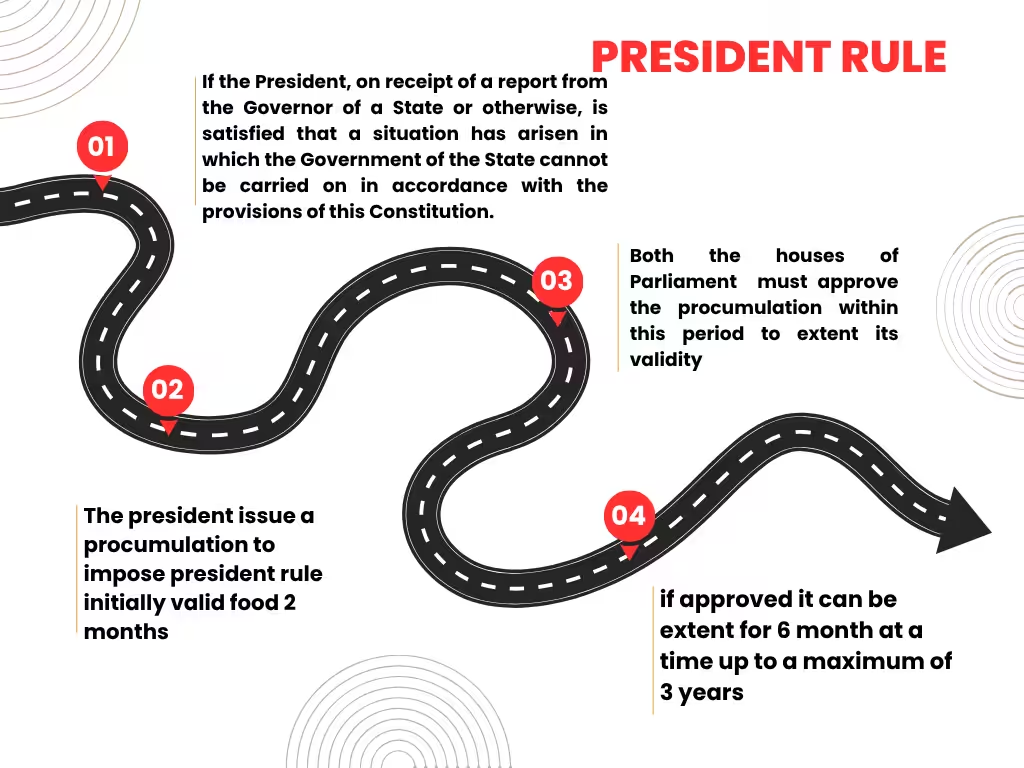
- If the President, on receipt of a report from the Governor of a State or otherwise, is satisfied that a situation has arisen in which the Government of the State cannot be carried on in accordance with the provisions of this Constitution.
Then,
The President may by Proclamation:
- Assume to himself all or any of the functions of the Government of the State and all or any of the powers vested in or exercisable by the Governor or any body or authority in the State other than the Legislature of the State.
- Declare that the powers of the Legislature of the State shall be exercisable by or under the authority of Parliament.
- Make such incidental and consequential provisions as appear to the President to be necessary or desirable for giving effect to the objects of the Proclamation, including provisions for suspending in whole or in part the operation of any provisions of this Constitution relating to any body or authority in the State.
Provided that nothing in this clause shall authorise the President to assume to himself any of the powers vested in or exercisable by a High Court, or to suspend in whole or in part the operation of any provision of this Constitution relating to High Courts.
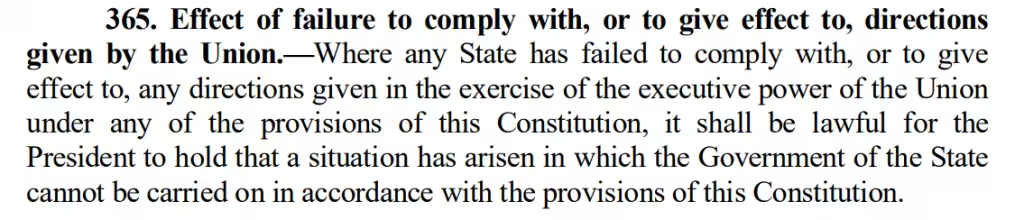
Article 365:
How president rule impose:
Important Point:
- President’s Rule cannot continue beyond one year unless:
- A National Emergency is in force in the entire country or in that specific state. The Election Commission certifies that elections to the state assembly cannot be held due to difficulties.
Issues:
- Article 356 has often been the subject of intense debate due to its frequent misuse. In many instances, President’s Rule has been invoked not out of genuine constitutional necessity, but rather to serve political interests or settle personal scores.
- Such actions disrupt the spirit of federalism by allowing the central government to directly override the autonomy of elected state governments. As a result, this provision has emerged as one of the most contentious and heavily criticised aspects of the Indian Constitution.
Landmark Judgement:
S.R. Bommai v. Union of India:
- A landmark judgment aimed at curbing the misuse of Article 356. The views expressed by the judges in this case closely align with the recommendations provided by the Sarkaria Commission. The Supreme Court deliberated on key issues, including the justiciability of proclamations made under
Article 356 and the extent of the President’s powers to invoke emergency. - In essence, the Supreme Court examined whether proclamations made under Article 356 could be
subject to judicial review and scrutiny, thereby determining their justiciability. Additionally, the court
addressed the question of whether the President’s authority to invoke emergency powers under Article 356 was absolute or subject to certain limitations.
Case Study:
Misuse of Article 356 – The Arunachal Pradesh Crisis (2016)
- The state was ruled by the Indian National Congress (INC), with Nabam Tuki as the Chief Minister.
- A political tussle began when a group of dissident Congress MLAs rebelled against the leadership, aided allegedly by the opposition BJP and the Governor J.P. Rajkhowa.
- The Governor preponed the Assembly session without the advice of the Council of Ministers, which led to a situation where the Speaker was removed and a parallel session was held in a community hall, where the rebel faction “removed” the Chief Minister.
Imposition of President’s Rule:
- Without testing the government’s majority on the Assembly floor, the President’s Rule was imposed under Article 356.
- Citing a constitutional breakdown, the Union Cabinet recommended President’s Rule in January 2016.
Supreme Court’s Verdict: Nabam Rebia v. Deputy Speaker (2016):
In a historic and unanimous 5-judge Constitution Bench decision, the Supreme Court quashed the imposition of President’s Rule in Arunachal Pradesh and ordered the restoration of the Nabam Tuki government.
Sarkaria Commission Report, 1983:
Failure of Constitutional Machinery can manifest in four scenarios:
- A Political crisis may ensue when, following general elections, no government can be formed, or if the existing ministry resigns or loses majority without a viable alternative. In such cases, imposition of emergency measures becomes necessary.
- Internal Subversion occurs when a state government intentionally disrupts constitutional provisions, creating deadlock or employing its power for unconstitutional purposes.
- Physical breakdown signifies a government’s inability to address internal disturbances or natural calamities, resulting in paralysis of state administration or jeopardizing state security.
- Failure to adhere to directives issued by the Union government by the State Government, particularly if such non-compliance impacts center-state relations, also constitutes a failure of Constitutional Machinery.
The Constitution of India establishes a federal system, albeit with a tilt in favor of the Central government. Within the domains allocated to the States, they wield supreme authority. The equilibrium of powers delineated in the Constitution between the Centre and the States is commendable, offering a framework that safeguards the integrity and ethos of the nation. Article 356, far from encroaching on state autonomy, is crucial for upholding the federal structure.