SHANTI Act 2025: NITI Aayog consultation kicks off implementation
Why in News?
PIB confirmed that NITI Aayog convened the first Stakeholder Consultation on Implementation of the SHANTI Act 2025 on 10 July 2026 at the Dr. Ambedkar International Centre, New Delhi. The meeting brought government, regulators, research institutions and industry to one table to shape the operational framework of the law that has replaced the Atomic Energy Act, 1962 and the Civil Liability for Nuclear Damage (CLND) Act, 2010.
The consultation, chaired by Prof. Abhay Karandikar (Member, NITI Aayog), marks the shift of India’s biggest nuclear-sector reform from statute to rollout — the draft rules, the nuclear FDI policy, insurance arrangements and capacity-building plans are all now under active design.
- The consultation was held on 10 July 2026 at Samrasta Auditorium, Dr. Ambedkar International Centre, New Delhi; PIB released the summary on 11 July 2026.
- Participants included the Secretary, Ministry of Power (Pankaj Agrawal), the Chairperson of the Central Electricity Authority, the CMD of NTPC Ltd, and senior officials of the Department of Atomic Energy (DAE) and the Atomic Energy Regulatory Board (AERB).
- Discussions ran on three pillars: Legislative & Regulatory Framework; Finance, Insurance & Public Perception; and Manufacturing, Operations & Capacity Building.
- The opening technical segment presented the statutory compliance mechanisms under the Act and how foreign capital can be attracted while safeguarding domestic interests.
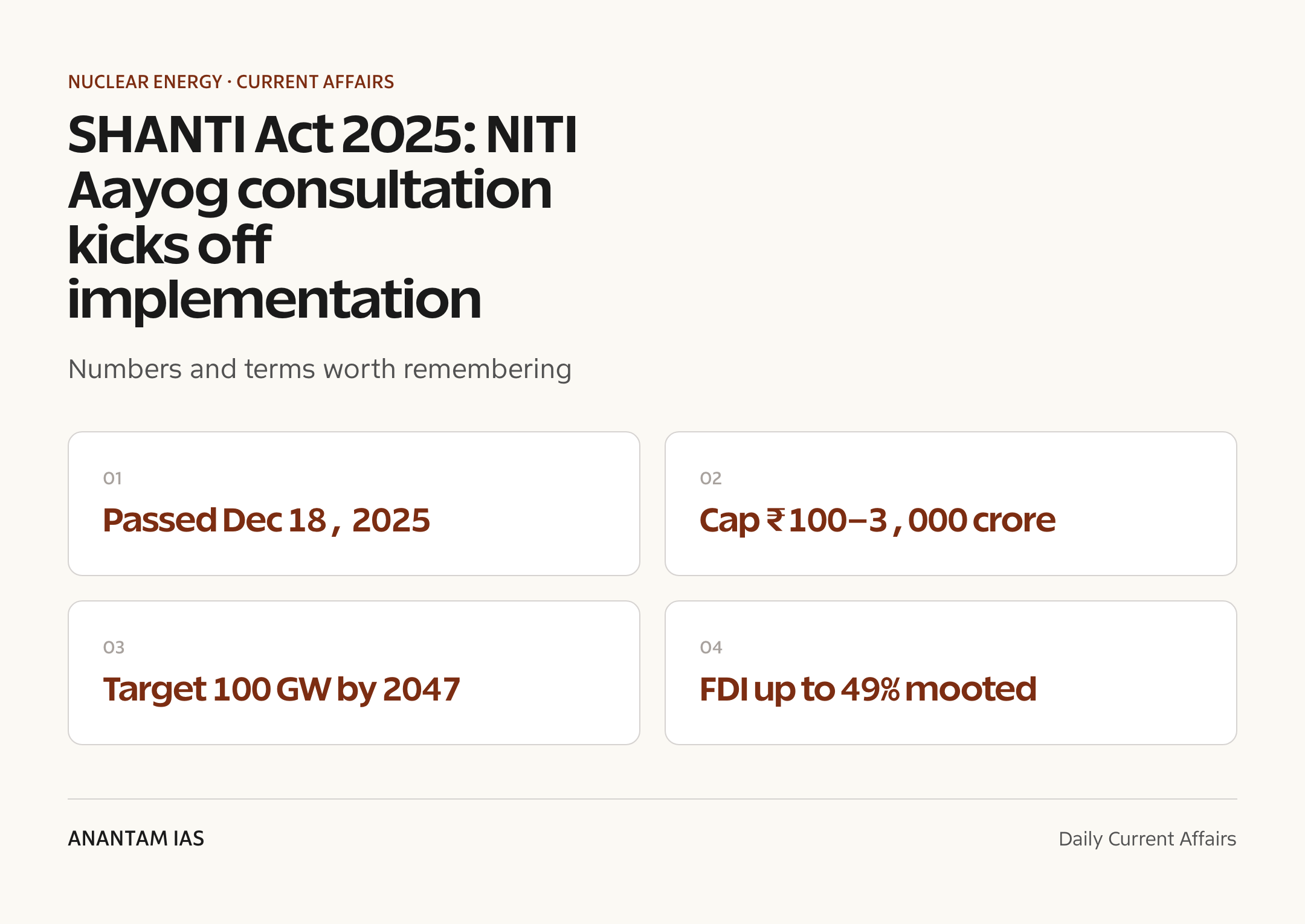
- The SHANTI Act was passed by the Lok Sabha on 17 December 2025 and the Rajya Sabha on 18 December 2025, per PRS Legislative Research.
The development matters in the context of:
- This is the operational follow-through on India’s 100 GW nuclear capacity by 2047 goal under the Nuclear Energy Mission announced in Budget 2025-26 — a roughly twelve-fold jump from today’s installed base of about 8.2 GW.
- The presence of the Ministry of Power, CEA and NTPC signals that nuclear power is being mainstreamed into general electricity planning, not treated as a sealed DAE enclave.
- How the rules, FDI policy and insurance pools are drafted will decide whether private and foreign capital actually flows — the statute alone only opens the door.
UPSC Relevance
Prelims Relevance
- SHANTI = Sustainable Harnessing and Advancement of Nuclear Energy for Transforming India Act, 2025.
- Repeals and replaces TWO laws: the Atomic Energy Act, 1962 and the CLND Act, 2010.
- Passed: Lok Sabha 17 Dec 2025, Rajya Sabha 18 Dec 2025; introduced 15 Dec 2025 (Ministry of Science and Technology and Earth Sciences, per PRS).
- Licences can now go to Indian private companies and JVs — but NOT to companies incorporated outside India.
- Operator liability becomes a tiered structure: ₹100 crore to ₹3,000 crore by power capacity (the 2010 Act had a flat ₹1,500 crore cap for reactors of 10 MW thermal and above).
- The Act removes the operator’s right of recourse against suppliers for defective equipment — the clause that had frozen foreign vendor interest since 2010.
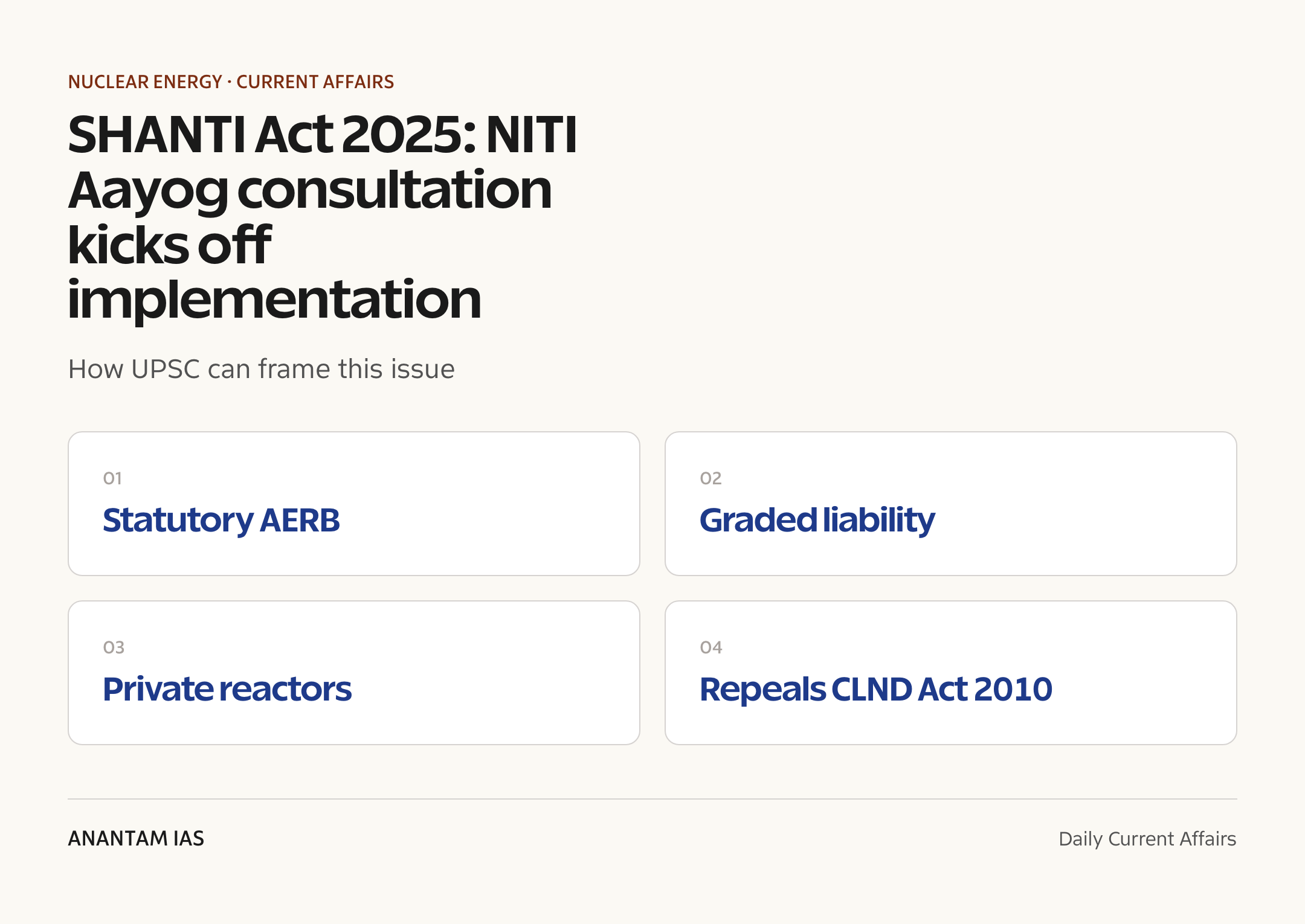
- AERB gets statutory status: chairperson + 1 whole-time member + up to 7 part-time members, chosen via a search-cum-selection committee.
- New appellate body: Atomic Energy Redressal Advisory Council, chaired by the Chairperson of the Atomic Energy Commission; further appeals lie before the Appellate Tribunal for Electricity (APTEL).
- Consultation convener: NITI Aayog; chaired by Prof. Abhay Karandikar; venue: Dr. Ambedkar International Centre, New Delhi.
Mains Relevance
GS Paper 3
- Energy security and the clean-energy transition: nuclear as firm, low-carbon baseload for the net-zero by 2070 pathway and the 100 GW-by-2047 target.
- Mobilising private investment in strategic infrastructure: licensing design, graded liability, insurance pools and FDI sequencing as instruments of calibrated liberalisation.
- Science-technology ecosystem: Small Modular Reactors (SMRs), domestic manufacturing, supply-chain resilience and skilled-workforce pipelines discussed at the consultation.
GS Paper 2
- Statutory regulators and governance: converting AERB from an executive body under the DAE into a statutory regulator — independence, appointments and accountability design.
- Policy implementation architecture: NITI Aayog’s convening role in translating a statute into rules, regulations and institutional capacity.
Essay
- Atoms for prosperity: can state monopolies reform themselves without surrendering safety?
- Energy transitions are institutional transitions first and technological transitions second.
Background and Context
What the SHANTI Act 2025 is
One statute now governs both nuclear development and nuclear liability in India.
- The Sustainable Harnessing and Advancement of Nuclear Energy for Transforming India (SHANTI) Act, 2025 replaces the Atomic Energy Act, 1962 (development and control of atomic energy) and the CLND Act, 2010 (liability and compensation after a nuclear incident).
- Parliament cleared it in the 2025 Winter Session — Lok Sabha on 17 December 2025, Rajya Sabha on 18 December 2025 — ending a 63-year government monopoly over nuclear power.
- The reform rests on the Nuclear Energy Mission (Budget 2025-26), which set the 100 GW by 2047 capacity goal and committed ₹20,000 crore for Small Modular Reactor R&D, with at least five indigenously designed SMRs targeted by 2033.
- For the full statutory design, see our explainer on the SHANTI Act 2025 and the primer on nuclear energy in India.
Ending the monopoly: who can hold a licence now
The licensing chapter is where the 1962 architecture changes most.
- Under the 1962 Act, licences for atomic-mineral mining and for producing, using or trading nuclear substances could go only to central government entities or government companies — in practice, NPCIL ran the power plants.
- The SHANTI Act lets the Centre license any Indian company, joint ventures between government entities and private firms, and any other person it expressly permits — for building, owning or operating a nuclear plant or reactor, and for fabrication, transport, trade or storage of nuclear fuel.
- Companies incorporated outside India remain barred from holding a licence — foreign participation is routed through equity in Indian entities instead.
- Every activity involving radiation exposure additionally needs a safety authorisation from the AERB, keeping a single safety gate across public and private operators.
Liability rework: graded caps and the supplier clause
The Act keeps the no-fault principle but redraws the numbers that scared investors away.
- The no-fault operator liability of the 2010 Act survives: the operator compensates victims regardless of negligence, backed by mandatory insurance, with the Centre bearing liability beyond the cap.
- The flat cap of ₹1,500 crore (for reactors of 10 MW thermal and above) gives way to a tiered structure of ₹100 crore to ₹3,000 crore linked to power capacity — smaller caps for SMRs, larger for big plants.
- The operator’s right of recourse against suppliers for defective equipment — Section 17(b) of the CLND Act, the clause blamed for stalling deals with foreign vendors after 2010 — is removed; recourse now survives only via contract or intentional acts.
- Territorial coverage widens: compensation can extend to nuclear damage in a foreign state’s territory caused by an incident in India, subject to conditions.
- The caps are already contested — a plea before the Supreme Court has argued the limits are too low for a Fukushima-scale disaster; see our note on the SC challenge to SHANTI liability caps.
A statutory AERB and a new appeals ladder
Regulatory independence moves from promise to statute — with caveats.
- The Act gives the Atomic Energy Regulatory Board statutory recognition; since 1983 it had existed only by executive order under the Department of Atomic Energy — the very entity it regulated, a conflict flagged by the CAG in 2012.
- Composition: a chairperson, one whole-time member and up to seven part-time members, appointed by the Centre on the recommendation of a search-cum-selection committee constituted by the Atomic Energy Commission; terms run three years, extendable by three.
- A new Atomic Energy Redressal Advisory Council — chaired by the Chairperson of the Atomic Energy Commission, with the Directors of BARC, AERB and CEA — hears appeals against orders of the Centre or the AERB.
- Appeals against the Council go to the Appellate Tribunal for Electricity (APTEL), stitching nuclear regulation into the wider electricity-law appellate system.
- Critics note the selection loop still runs through the Atomic Energy Commission, so full arm’s-length independence of the regulator remains a design question for the rules.
What the NITI Aayog consultation actually covered
PIB’s release organises the rollout agenda into three pillars.
- Legislative & Regulatory Framework — the Act’s draft rules and regulations and the related FDI policy provisions; the opening segment mapped statutory compliance mechanisms and how to attract foreign capital while safeguarding domestic interests.
- Finance, Insurance & Public Perception — financial and risk-mitigation frameworks, insurance arrangements for long-term projects, and strategies to build public awareness and community trust around nuclear plants.
- Manufacturing, Operations & Capacity Building — domestic manufacturing depth, operational readiness, supply-chain resilience and dedicated skilling programmes for the nuclear workforce.
- Attendance told its own story: the Ministry of Power, Central Electricity Authority and NTPC sat alongside DAE and AERB — nuclear power is being planned as part of the general grid, and NTPC is positioning as a major nuclear operator.
- Stakeholder inputs from all three pillars will feed into the Act’s implementation framework, PIB said.
The FDI question: policy, not yet statute
The Act opens the sector to Indian private players; foreign money needs a separate policy change.
- India’s extant FDI policy prohibits FDI in atomic energy; the SHANTI Act itself does not amend that — it only makes foreign minority equity legally workable by allowing licensed Indian companies.
- Press reports around the Cabinet clearance said the government intends to allow up to 49% FDI in nuclear power; Business Standard reported in April 2026 that the Atomic Energy Commission has cleared the draft FDI policy and sent it for inter-ministerial consultation.
- The PIB release confirms FDI policy provisions were a live agenda item at the consultation — the caps, entry routes and security screening are being settled now.
- Global vendors (from the US, France, Russia and South Korea) had long cited the supplier-liability clause and the licensing bar as deal-breakers; the new framework removes both, contingent on credible rules.
Way Forward
Notify credible rules fast
- Publish the draft rules and AERB regulations for public comment with clear timelines — licensing criteria, safety codes and decommissioning norms decide investor confidence more than the statute does.
- Finalise the nuclear FDI policy with unambiguous caps, entry routes and national-security screening so foreign partners can price risk.
Build the financial plumbing
- Deepen the India Nuclear Insurance Pool and design long-tenor insurance products matched to 60-year plant lives.
- Clarify tariff treatment and offtake for private nuclear power through the CEA-CERC framework so projects are bankable.
Protect regulatory independence and public trust
- Operationalise the statutory AERB with independent funding, transparent appointments and published safety reviews.
- Institutionalise community engagement around plant sites — the consultation’s public-perception pillar acknowledges that social licence, not technology, is often the binding constraint.
Conclusion
The SHANTI Act 2025 rewired the legal foundations of India’s nuclear sector in a single stroke — one statute in place of two, private operators in place of a state monopoly, graded liability in place of a flat cap, and a statutory regulator in place of an executive one. But statutes don’t build reactors; rules, money and trust do.
That’s why the NITI Aayog consultation matters. The draft rules, the FDI policy, insurance pools and skilling pipelines discussed on 10 July 2026 are the machinery that will decide whether the 100 GW-by-2047 ambition becomes bankable projects or stays a slogan. For aspirants, this is a living case study in how a landmark law travels from Parliament to the ground.
UPSC Practice Questions
Prelims MCQ 1
With reference to the SHANTI Act, 2025, consider the following statements:
- It replaces both the Atomic Energy Act, 1962 and the Civil Liability for Nuclear Damage Act, 2010.
- It permits companies incorporated outside India to obtain a licence to operate nuclear power plants in India.
- It gives statutory recognition to the Atomic Energy Regulatory Board (AERB).
How many of the above statements are correct?
(a) Only one (b) Only two (c) All three (d) None
Answer: (b) Only two
Explanation:
Statements 1 and 3 are correct. Statement 2 is wrong — the Act extends licensing to Indian private companies and JVs but expressly excludes companies incorporated outside India; foreign participation can come only as equity in Indian entities under a separate FDI policy.
Prelims MCQ 2
Under the SHANTI Act, 2025, appeals against the decisions of the Atomic Energy Redressal Advisory Council lie before which body?
(a) The Supreme Court of India directly (b) The National Green Tribunal (c) The Appellate Tribunal for Electricity (d) The Atomic Energy Commission
Answer: (c) The Appellate Tribunal for Electricity
Explanation:
The Council — chaired by the Chairperson of the Atomic Energy Commission — hears appeals against orders of the Centre or the AERB; further appeals go to the Appellate Tribunal for Electricity (APTEL), linking nuclear regulation to the electricity-law appellate chain.
UPSC Mains Questions
- The SHANTI Act, 2025 replaces state monopoly with calibrated liberalisation in India’s nuclear sector. Examine how its licensing, graded-liability and regulatory provisions attempt to balance private investment with nuclear safety and security. (250 words)
- Statutory independence of the regulator is a precondition for opening a high-risk sector to private capital. Discuss with reference to the Atomic Energy Regulatory Board under the SHANTI Act, 2025. (250 words)
- India’s target of 100 GW nuclear capacity by 2047 is as much an institutional challenge as a technological one. In the light of the ongoing implementation of the SHANTI Act, 2025, discuss the financing, insurance and skilling gaps that must be closed. (250 words)
Sources: PIB, NITI Aayog and PRS Legislative Research.
Frequently Asked Questions
What is the SHANTI Act 2025?
The Sustainable Harnessing and Advancement of Nuclear Energy for Transforming India Act, 2025 is India’s new umbrella nuclear law. Passed in December 2025, it replaces the Atomic Energy Act, 1962 and the CLND Act, 2010, opens nuclear power to Indian private companies, restructures liability and makes the AERB a statutory regulator.
Why was NITI Aayog’s consultation in news?
On 10 July 2026, NITI Aayog convened the first stakeholder consultation on implementing the SHANTI Act at the Dr. Ambedkar International Centre, New Delhi. Chaired by Prof. Abhay Karandikar, it discussed the draft rules, nuclear FDI policy, insurance arrangements, public perception and manufacturing capacity — the operational framework of the Act.
Can private companies now run nuclear plants in India?
Yes, in law. The Act lets the Centre license Indian private companies and joint ventures to build, own and operate nuclear plants and handle nuclear fuel — ending the government-only regime of the 1962 Act. Companies incorporated outside India are excluded, and every operator still needs AERB safety authorisation.
How does the Act change nuclear liability?
It keeps the operator’s no-fault liability but replaces the flat ₹1,500 crore cap with a tiered structure of ₹100 crore to ₹3,000 crore based on plant capacity. It also removes the operator’s right of recourse against suppliers for defective equipment — the CLND Act clause that had deterred foreign vendors since 2010.
Is 49% FDI in nuclear energy already allowed?
Not yet. The extant FDI policy still prohibits FDI in atomic energy. Press reports say the government intends to permit up to 49% foreign investment, and the Atomic Energy Commission has cleared a draft FDI policy now in inter-ministerial consultation. The PIB release confirms FDI provisions were discussed at the consultation.
What changes for the AERB under the Act?
The AERB, created by executive order in 1983 under the DAE, becomes a statutory body with a chairperson, one whole-time member and up to seven part-time members chosen through a search-cum-selection committee. A new Redressal Advisory Council hears appeals, with further appeals lying before the Appellate Tribunal for Electricity.