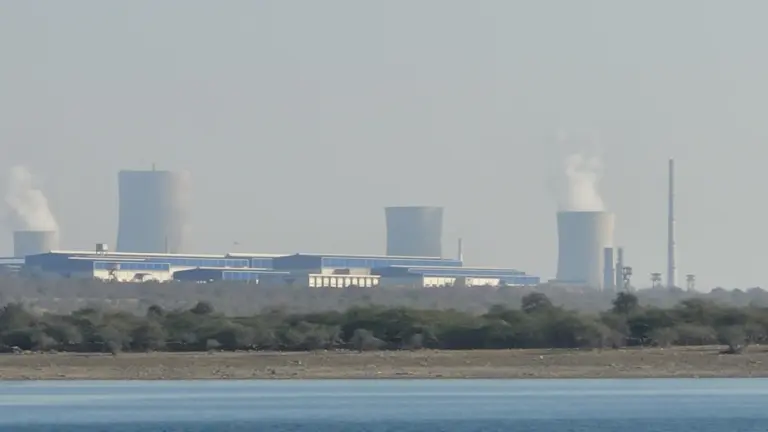
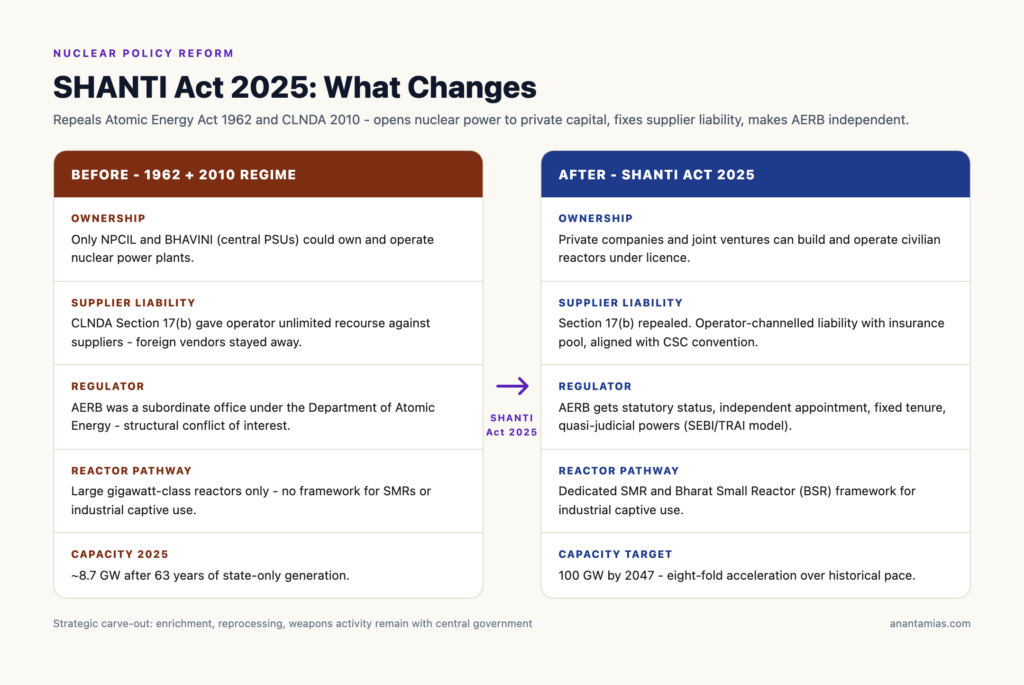
The Sustainable Harnessing and Advancement of Nuclear Transforming India Act, 2025, abbreviated as the SHANTI Act, is the largest single piece of nuclear legislation India has enacted since independence. It rolls back two foundational statutes (the Atomic Energy Act of 1962 and the Civil Liability for Nuclear Damage Act of 2010), opens the nuclear generation business to private capital for the first time, fixes the supplier-liability problem that kept foreign vendors out of the Indian market for fifteen years, and gives the Atomic Energy Regulatory Board the statutory backbone of a SEBI or a TRAI. The headline target is 100 GW of installed nuclear capacity by 2047, up from a little under 9 GW today.
For the syllabus, SHANTI sits squarely inside GS-III under energy security, infrastructure, and science and technology, with cross-cutting threads into GS-II (legislation and regulation) and the indirect tax-energy nexus that surfaces every Budget. It is also the cleanest example available right now of a government deliberately dismantling a public-sector monopoly while keeping strategic activities (uranium enrichment, fuel reprocessing, weapons-related work) under central control. A candidate who can summarize the four pillars of the Act, link them to India’s net-zero-by-2070 commitment, and cite one or two paragraphs of comparison with global liability conventions has a serviceable answer for almost any nuclear-related question that may appear.
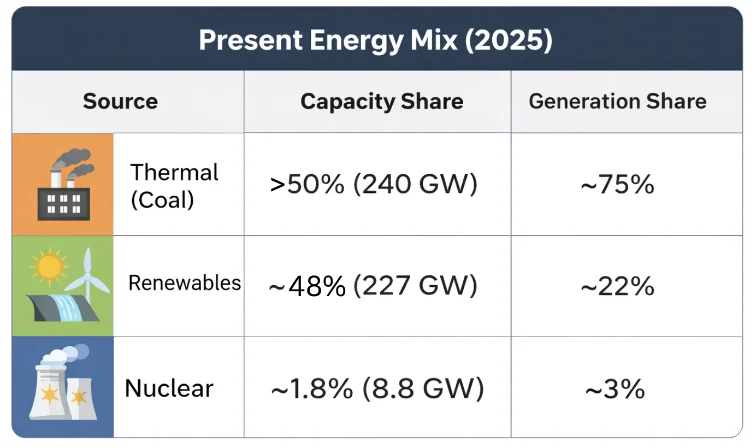
This guide treats the Act as a reform package with four logically connected pieces. We cover what the Act replaces and why those laws were considered insufficient, what the four big provisions actually say, why the legislation matters for India’s energy mix and for foreign-investment flows, and the practical and political challenges that determine whether the 100 GW number remains aspirational or becomes real.
Quick Facts on the SHANTI Act
- Full form: Sustainable Harnessing and Advancement of Nuclear Transforming India Bill, enacted in 2025.
- What it replaces: Atomic Energy Act, 1962 (ownership monopoly) and Civil Liability for Nuclear Damage Act, 2010 (liability framework).
- Headline target: 100 GW of nuclear capacity by 2047, up from about 8.7 GW in 2025.
- Private sector: Allowed to build and operate nuclear power plants, including in joint ventures with foreign suppliers.
- Strategic carve-outs: Uranium enrichment, fuel reprocessing, and weapons-related activities remain with the central government.
- Regulator: Atomic Energy Regulatory Board (AERB) gets statutory status and full powers to penalize violators.
- Reactor focus: Small Modular Reactors (SMRs) and Bharat Small Reactors (BSRs) for industrial captive use.
- GS paper relevance: Prelims (Sci-Tech, Polity, Energy), GS-II (Government Policies, Regulation), GS-III (Energy Security, Infrastructure).
What the SHANTI Act Is
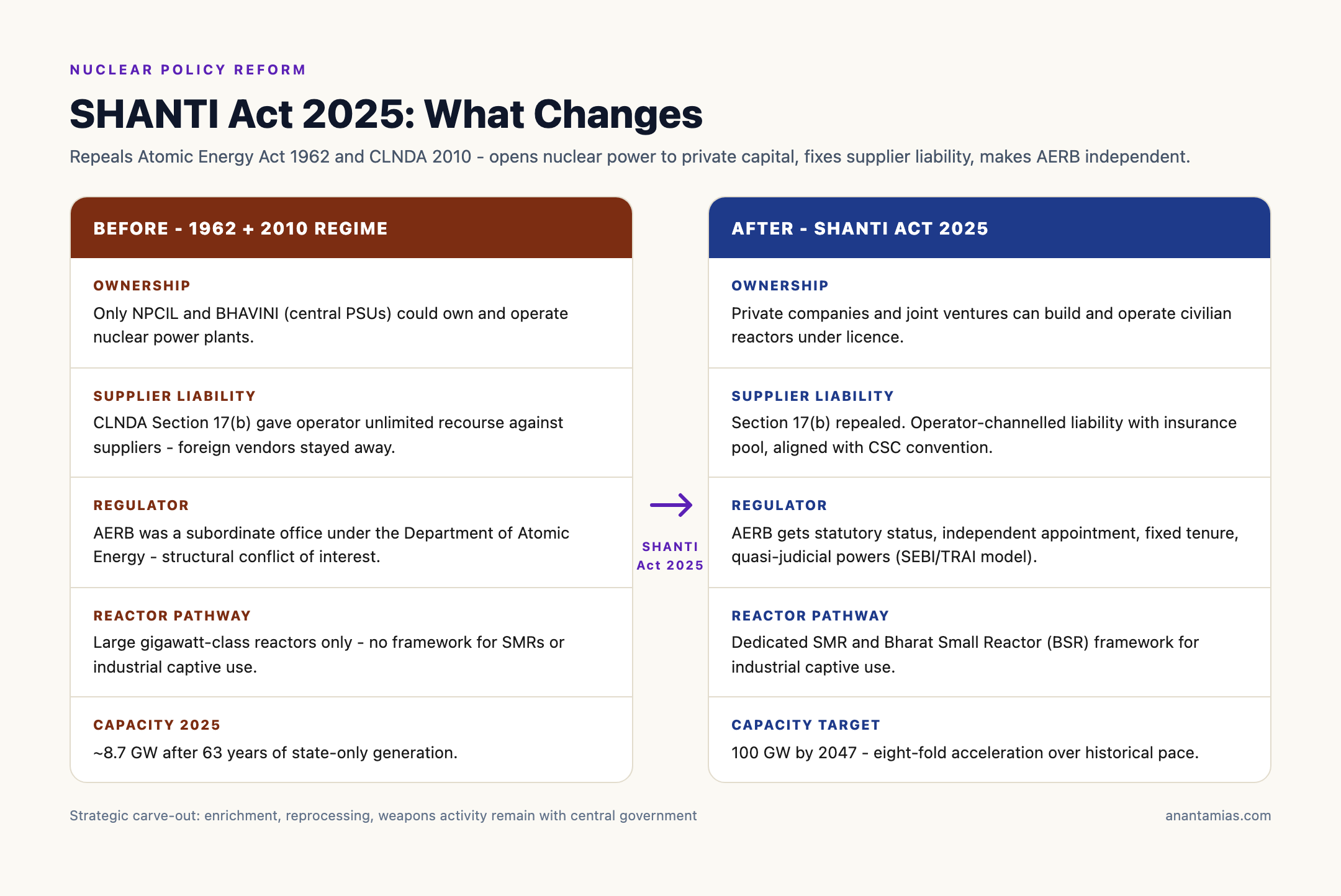
The Act is a single piece of comprehensive nuclear legislation that consolidates licensing, ownership, liability, regulation, and small-reactor frameworks into one statute. The legal hook is the Union government’s exclusive jurisdiction over atomic energy under Entry 6 of the Union List. By repealing the Atomic Energy Act of 1962 and the CLNDA of 2010, the Act removes the two structural barriers that earlier capped private and foreign participation: state-owned-only ownership and unlimited supplier exposure.
The Act keeps a hard line between civilian and strategic nuclear work. Power generation, including all reactor design, construction, operation, and waste handling at the plant level, is opened to private operators under licence. Uranium enrichment, plutonium reprocessing, fuel-cycle facilities, and any weapons-adjacent activity remain a state monopoly under the Department of Atomic Energy. The carve-out is what makes private participation politically viable; it preserves national-security control while liberating the commercial layer.
Background and Historical Context
India’s nuclear law was built in the early years of independence around the Nehruvian premise that atomic energy was too dangerous, too expensive, and too strategic to be trusted to anyone other than the state. The Atomic Energy Act of 1948 reserved all activity to the central government. The 1962 replacement preserved the monopoly while creating the Department of Atomic Energy and the apparatus that became Nuclear Power Corporation of India (NPCIL) and Bharatiya Nabhikiya Vidyut Nigam (BHAVINI). The system delivered safely but slowly. Sixty-three years of state-only generation produced fewer than 9 GW of capacity.
The CLNDA of 2010 was passed to enable the Indo-US civil nuclear deal of 2008. It signed India onto the Convention on Supplementary Compensation (CSC) framework but added Section 17(b), an unusual clause that gave operators a “right of recourse” against suppliers for latent defects. International vendors (Westinghouse, GE-Hitachi, Areva, Rosatom for some contracts) read this as effectively unlimited supplier liability and refused to commit. The Kudankulam VVER reactors went ahead because the deals predated the CLNDA, but no greenfield foreign reactor proceeded between 2010 and 2025.
The deeper history of how India arrived at its current nuclear footprint is captured in the three-stage Indian nuclear programme blueprint that Homi Bhabha framed in the 1950s. By the early 2020s, three pressures converged. India’s net-zero-by-2070 commitment under the UNFCCC required a far larger non-fossil baseload than 8 GW could provide. The global civil nuclear renaissance, driven by Small Modular Reactors and rising electricity demand, made private financing newly available. And the strategic environment, particularly the desire to deepen US, French, Japanese, and Russian ties through commercial nuclear deals, raised the political cost of remaining stuck. The Energy Transition working group of the 2023 Budget recommended a comprehensive rewrite. The SHANTI Bill was introduced in 2024 and enacted in 2025.
Key Provisions of the SHANTI Act
The Act has four big-ticket reforms, each addressing one of the older laws’ chokepoints.
The first is private-sector entry. Under the 1962 framework, only NPCIL and BHAVINI could own and operate nuclear power plants. The SHANTI Act allows licenced Indian private companies and joint ventures (Indian-foreign or pure-domestic consortia) to build and run civilian reactors. The licence is granted by the AERB after technical and financial fitness review. Power purchase agreements work like those for thermal or solar plants: the operator generates, distribution companies buy, and the Central Electricity Regulatory Commission sets the tariff framework.
The second is liability reform. The Act repeals Section 17(b) of CLNDA, which had been the deal-breaking clause for foreign vendors. Under the new framework the operator carries primary, channelled liability up to a statutory cap, with mandatory insurance and a state-backed top-up pool. Suppliers retain liability only for express contractual warranties and for willful misconduct or gross negligence, aligning India with the CSC norm and with the practice of nuclear-using democracies. This single change is what the Act is mostly remembered for in the international press.
The third is independent regulation. The Atomic Energy Regulatory Board has existed since 1983 but operated as a subordinate office under the Department of Atomic Energy, the very body whose units it was supposed to regulate. The SHANTI Act gives the AERB statutory status, modeled on the SEBI Act and the TRAI Act, with the chairperson appointed by an independent committee, fixed tenure, financial autonomy, and quasi-judicial powers to levy penalties, suspend licences, and order shutdowns. The structural conflict of interest that international peer reviews (notably the IAEA’s IRRS missions) had flagged for two decades is finally resolved.
The fourth is the SMR/BSR framework. Small Modular Reactors (typically 50-300 MW per unit, factory-built and shipped to site) and the indigenous Bharat Small Reactor variant get a dedicated regulatory channel with shorter licensing timelines and the explicit option of captive use by industrial customers (steel, aluminium, cement, and data-centre operators looking to replace coal-based grid power). This pathway is critical because most of the new private interest is in SMRs rather than the large gigawatt-class plants that dominate the existing fleet.
Why the SHANTI Act Matters
Nuclear power gives India something it cannot get from solar or wind alone: 24×7 dispatchable, low-carbon baseload electricity. A 700 MW Pressurized Heavy Water Reactor running at 90 percent capacity generates more electricity in a year than a 4 GW solar park (the latter has a capacity factor of about 20 percent and produces nothing at night). At grid scale, decarbonising a large industrial economy without nuclear is mathematically possible but considerably more expensive in terms of land, transmission, and storage.
Recent developments captured in the transformation of India’s nuclear energy landscape provide additional context on how the policy ecosystem is shifting. For investors, the Act unlocks balance-sheet financing that was previously impossible. Sovereign and pension funds with ESG mandates have started rating nuclear as transition-aligned. A predictable Indian licensing regime, coupled with channelled operator liability, makes Indian reactor projects bankable in international debt markets. Domestic conglomerates with experience running thermal fleets (Tata Power, Adani Power, Reliance, NTPC’s joint ventures) become serious candidates as private operators.
Strategically, the reform deepens energy ties with partner countries. The US-India 123 Agreement of 2008 finally has commercial follow-through. France’s EDF can revive the Jaitapur six-EPR project. Russia’s Rosatom can negotiate beyond Kudankulam. South Korea’s KHNP and Japan’s vendors enter the picture. Each of these is also a foreign-policy win.
For the Indian economy, the spillovers are substantial. Heavy forging, pressure-vessel fabrication, instrumentation, control systems, fuel handling, and decommissioning generate high-skill jobs. The Act is therefore as much an industrial-policy instrument as an energy one.
Detailed Analysis: How the Reform Plays Out
A useful way to read SHANTI is as four moves coordinated to make the others viable. Removing the ownership monopoly without fixing supplier liability would have left private operators unable to source equipment from credible international vendors. Fixing supplier liability without giving the AERB independence would have triggered a domestic confidence crisis around safety oversight. Giving the AERB independence without an SMR pathway would have produced a credibilist regulator with no new technology to regulate. The Act stitches the four together so that each unblocks the next.
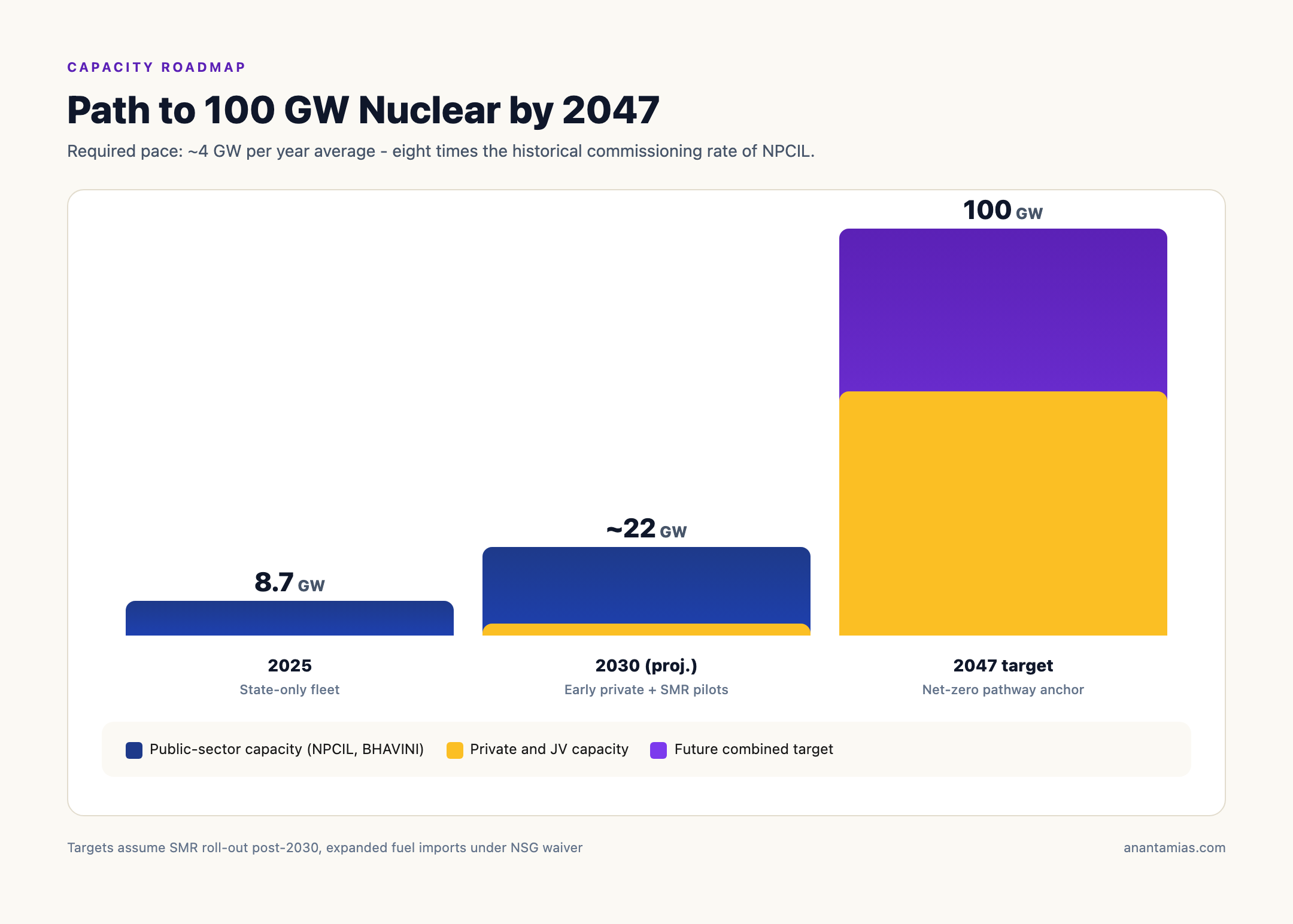
The 100 GW target by 2047 implies adding roughly 91 GW over 22 years, or about 4 GW of new capacity per year on average, with capacity additions back-loaded as SMRs reach commercial scale in the 2030s. The arithmetic is demanding. NPCIL has historically commissioned about 0.5 GW per year. The new framework has to deliver an eight-fold acceleration. It does so by parallelising: large gigawatt-class plants under public-private partnerships, fleet-mode commissioning of indigenous 700 MW PHWRs, multiple SMR clusters, and the Bharat Small Reactor for captive industrial supply.
Background on these factors is captured in the factors influencing nuclear power growth discussion. Fuel security stays in the public column. India’s domestic uranium reserves are limited; about 80 percent of fuel for the current fleet is imported. The Department of Atomic Energy continues to manage enrichment, reprocessing, and the closed-fuel-cycle path from uranium to plutonium-MOX to thorium that the three-stage programme has pursued for decades. Private operators buy fuel-cycle services from the public side, the way private thermal generators buy coal from Coal India.
Comparative Snapshot: India and Global Nuclear Policy
Looking outward, India’s reform is closest in spirit to the United States’ 2024 ADVANCE Act (which streamlined NRC licensing for advanced reactors), South Korea’s long-running model of state-led plus chaebol-built reactors, and France’s EDF-led centralised model with a separate independent regulator (ASN). It diverges from Japan’s post-Fukushima caution and from Germany’s complete phaseout. China’s largely state-driven build-out remains the world’s fastest, but its model is not exportable to a democratic system where private investment, regulatory transparency, and consent-based siting are constraints.
On the liability question, the SHANTI alignment with the CSC closes the longstanding gap between Indian law and the global norm. Indemnification, channelling, and supplier protection are now broadly in line with the United States’ Price-Anderson framework, France’s law, and Japan’s pre-Fukushima regime. This convergence is what makes large international financing newly possible.
Major Nuclear Accidents in World History
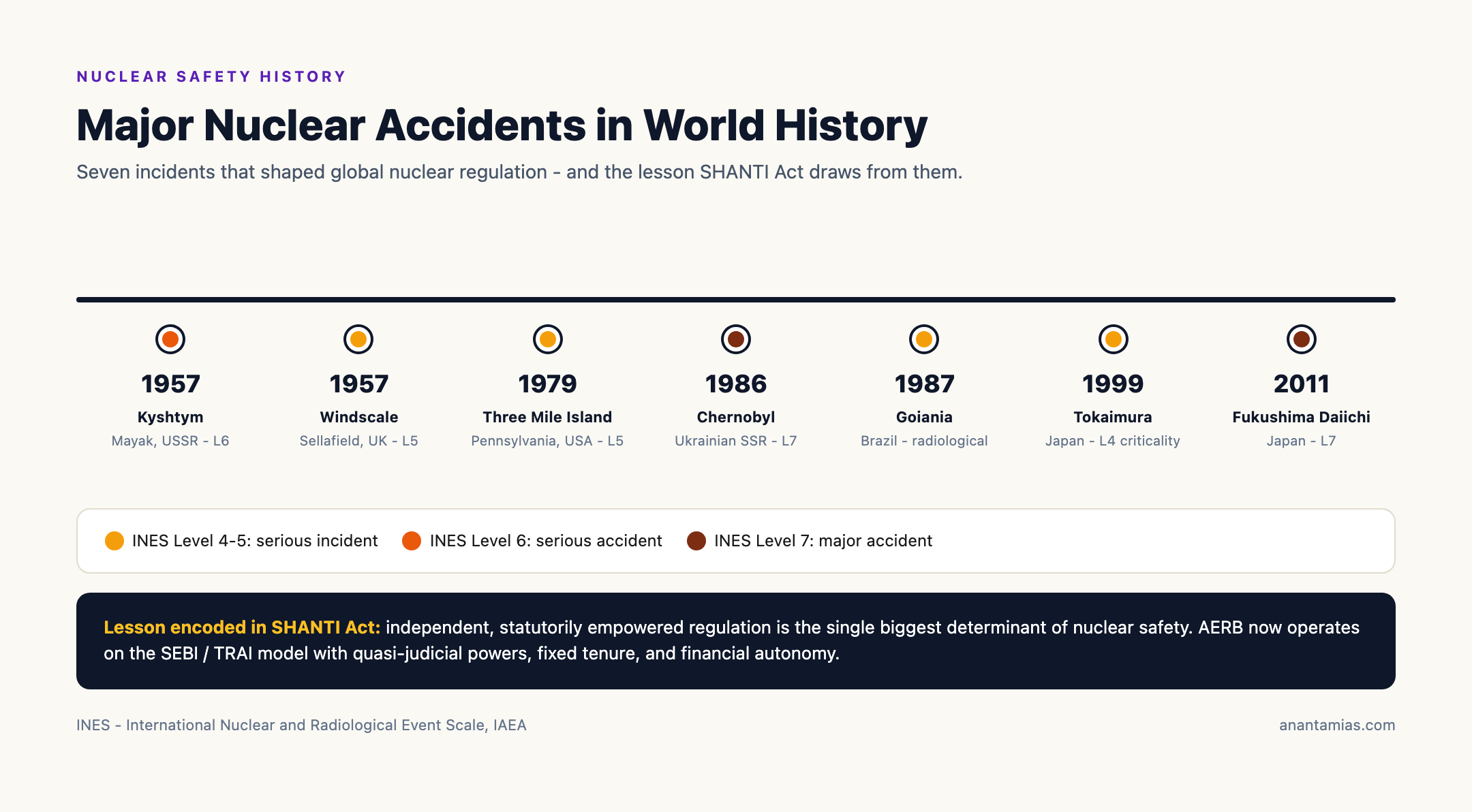
Public concern over nuclear power is anchored in a small set of high-consequence accidents whose details every aspirant should know. Kyshtym (1957), in the closed Soviet city of Mayak, was a chemical explosion in a high-level waste tank that contaminated a vast area; INES Level 6. Windscale (1957) in the UK was a graphite reactor fire releasing iodine-131 across northwest England; Level 5. Three Mile Island (1979) in Pennsylvania was a partial core meltdown contained inside the reactor vessel; Level 5. Chernobyl (1986) in the Ukrainian SSR was a runaway power excursion and fire that killed dozens directly and contaminated large areas of Europe; INES Level 7, the only one alongside Fukushima at the top of the scale. Goiania (1987) in Brazil was a radiological accident from an abandoned medical caesium source. Tokaimura (1999) in Japan was a criticality accident at a fuel-processing plant. Fukushima Daiichi (2011) in Japan was a tsunami-driven station blackout that caused three core meltdowns; INES Level 7.
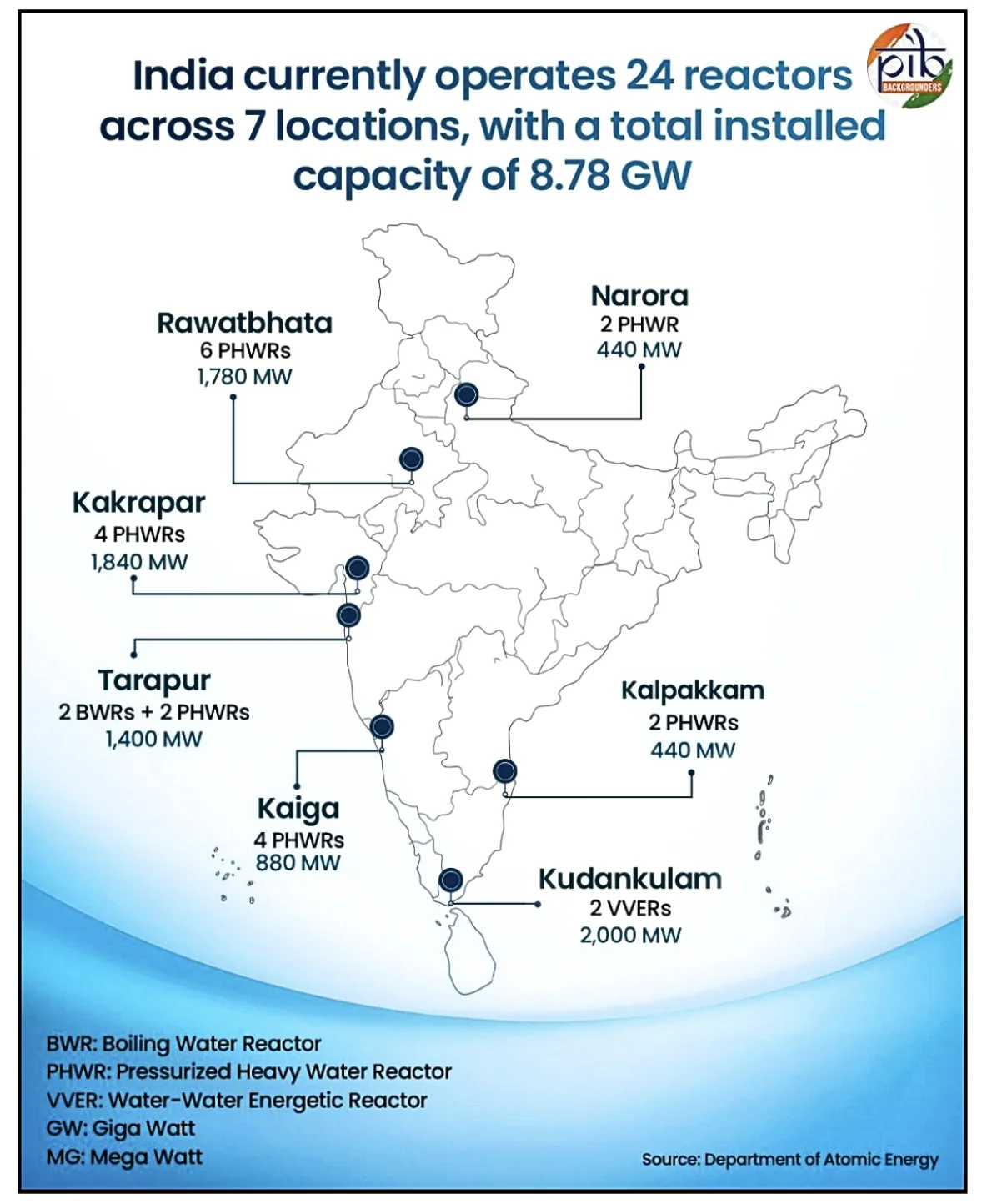
India’s existing reactor base operates within the framework of nuclear power plants in India, which lists the operating sites and reactor types now in commercial service. The lesson the SHANTI Act draws from this history is that strong, independent regulation is the single most important determinant of nuclear safety, which is why AERB’s statutory status was treated as non-negotiable in the drafting.
Challenges Ahead
Implementation is non-trivial. Capacity-building inside the AERB has to scale with the new licensing pipeline, and recruiting nuclear-grade inspectors competitive with public-sector salaries will test the autonomy framework. Land acquisition for greenfield sites remains politically sensitive; Jaitapur, Kovvada, and Mithivirdi all faced protests under the old regime. Public communication around SMRs will matter, since the technology is unfamiliar even to many policymakers.
Insurance pool capacity is another bottleneck. The Indian Nuclear Insurance Pool, set up in 2015, has limited reinsurance depth. The Act envisages expansion in line with global pools (the Mutual Atomic Energy Liability Underwriters in the US, ELINI in Europe), but the depth depends on private reinsurance appetite that is itself a function of operating record.
Fuel security is the long-run constraint. As capacity scales, India will need additional uranium imports under the NSG waiver (Australia, Kazakhstan, Canada, Namibia) and faster commissioning of the thorium-based three-stage path. Without that pipeline, generation grows but at rising fuel cost.
Prelims Pointers
- The SHANTI Act 2025 repeals the Atomic Energy Act 1962 and CLNDA 2010.
- AERB gets statutory status under the new Act, comparable to SEBI or TRAI.
- Section 17(b) of CLNDA, which gave operators recourse against suppliers, is removed.
- Strategic activities (enrichment, reprocessing) remain a central government monopoly.
- Capacity target: 100 GW by 2047, up from about 8.7 GW in 2025.
- Bharat Small Reactor (BSR) is the indigenous SMR variant for captive industrial use.
- India is a signatory to the Convention on Supplementary Compensation (CSC).
Mains Practice Questions
- “The SHANTI Act 2025 is as much a reform of the regulatory architecture as it is of the ownership framework.” Discuss with reference to the changes in liability, AERB’s status, and the SMR pathway. (250 words, GS-III)
- Examine the role of nuclear power in India’s pathway to net-zero by 2070, with reference to the changes introduced by the SHANTI Act. (250 words, GS-III)
- Critically evaluate the trade-offs between private participation and strategic control in India’s civilian nuclear sector after the SHANTI Act. (150 words, GS-II/III)
Way Forward
The Act’s success will be judged on three measurable outcomes by the early 2030s. First, capacity addition: whether new plants under the private framework actually break ground, with at least one major foreign-vendor project (likely Westinghouse-led at Kovvada or EDF-led at Jaitapur) reaching financial closure. Second, regulatory credibility: whether the AERB’s first major enforcement action (a penalty, a licence suspension, or a shutdown order) survives judicial review. Third, SMR roll-out: whether the first Bharat Small Reactor enters commercial operation by 2030 and whether at least one industrial customer signs a captive-supply agreement.
Beyond capacity, the deeper test is whether nuclear becomes a normalized part of the energy conversation, sitting alongside solar and wind in commercial planning rather than living in a separate strategic silo. The reform is designed to make exactly that shift possible.
Frequently Asked Questions
What is the full form of the SHANTI Act?
SHANTI stands for Sustainable Harnessing and Advancement of Nuclear Transforming India. The full title of the legislation enacted in 2025 is the Sustainable Harnessing and Advancement of Nuclear Transforming India Act.
Which laws does the SHANTI Act replace?
The Act repeals and replaces two earlier statutes: the Atomic Energy Act of 1962 (which established the central government’s monopoly over nuclear power) and the Civil Liability for Nuclear Damage Act of 2010 (which set the liability framework after the Indo-US nuclear deal).
Can private companies now build nuclear power plants in India?
Yes. The SHANTI Act allows licenced private companies, including joint ventures with foreign suppliers, to build and operate civilian nuclear power plants. They have to obtain a licence from the Atomic Energy Regulatory Board after technical and financial fitness review. Strategic activities like uranium enrichment and fuel reprocessing remain off-limits to the private sector.
What was the problem with CLNDA 2010 that the SHANTI Act fixes?
The 2010 law contained Section 17(b), which gave operators a right of recourse against suppliers for latent defects in equipment. International vendors interpreted this as unlimited supplier liability and largely refused to enter the Indian market. The SHANTI Act removes this clause, channels primary liability to the operator (with mandatory insurance and a state-backed pool), and aligns Indian law with the Convention on Supplementary Compensation.
What change does the Act make to the AERB?
The Atomic Energy Regulatory Board gets statutory status, similar to SEBI for capital markets or TRAI for telecom. It gains an independent appointment process, fixed tenure for the chairperson, financial autonomy, and quasi-judicial powers to levy penalties and suspend licences. Earlier, the AERB was a subordinate office under the Department of Atomic Energy, the same parent body whose units it was supposed to regulate.
What is a Small Modular Reactor and why does the Act emphasize it?
A Small Modular Reactor is a nuclear reactor with a typical electrical output of 50 to 300 megawatts, designed for factory production and on-site assembly. SMRs are faster to build, cheaper per unit, and suited for captive industrial use. The Act creates a dedicated framework for SMRs and the indigenous Bharat Small Reactor (BSR) variant because most new private interest is in this segment rather than gigawatt-class plants.
What is the 100 GW target and is it realistic?
The Act sets a target of 100 GW of installed nuclear capacity by 2047, up from about 8.7 GW in 2025. Reaching it requires roughly 4 GW of new capacity per year on average, an eight-fold acceleration over the historical pace. Whether the target is realistic depends on private participation, AERB’s licensing throughput, fuel availability, and the commercial maturity of SMRs. Most analysts treat it as ambitious but achievable in scenarios where SMR deployment scales after 2030.
Does the Act allow foreign companies to own Indian nuclear plants?
The Act allows foreign suppliers to participate through joint ventures with Indian operators and to provide equipment, fuel-cycle services, and technical support. Wholly-owned foreign ownership of operating reactors is not permitted; the operator of record has to be Indian. This mirrors most other large nuclear economies.
How does the SHANTI Act fit India’s net-zero commitment?
India committed to net-zero emissions by 2070 at COP26. Achieving that requires a much larger non-fossil baseload than current capacity provides. Nuclear is one of the few sources that delivers 24×7 low-carbon power at scale, complementing solar and wind. The SHANTI Act unlocks the financing and regulatory pathway needed for nuclear to grow from under 9 GW to the levels required by the net-zero trajectory.
Will the reform make electricity cheaper?
Not immediately. Nuclear capital costs are high; the benefit comes from low marginal generation cost and high capacity factor over a 60-80 year plant life. In the short run, tariffs from new private nuclear plants will sit above current grid averages. In the long run, as construction efficiency improves and SMRs reach commercial scale, the levelised cost is expected to converge with or undercut firm power from gas or storage-backed renewables.
Tell Google you want more of this.
Add Anantam IAS as a preferred sourceOne tap, and this site shows up more often in your own Top Stories, AI Overviews and AI Mode. Remove it any time.