UN Special Rapporteurs flag discrimination concerns in ECI’s SIR exercise
Why in News?
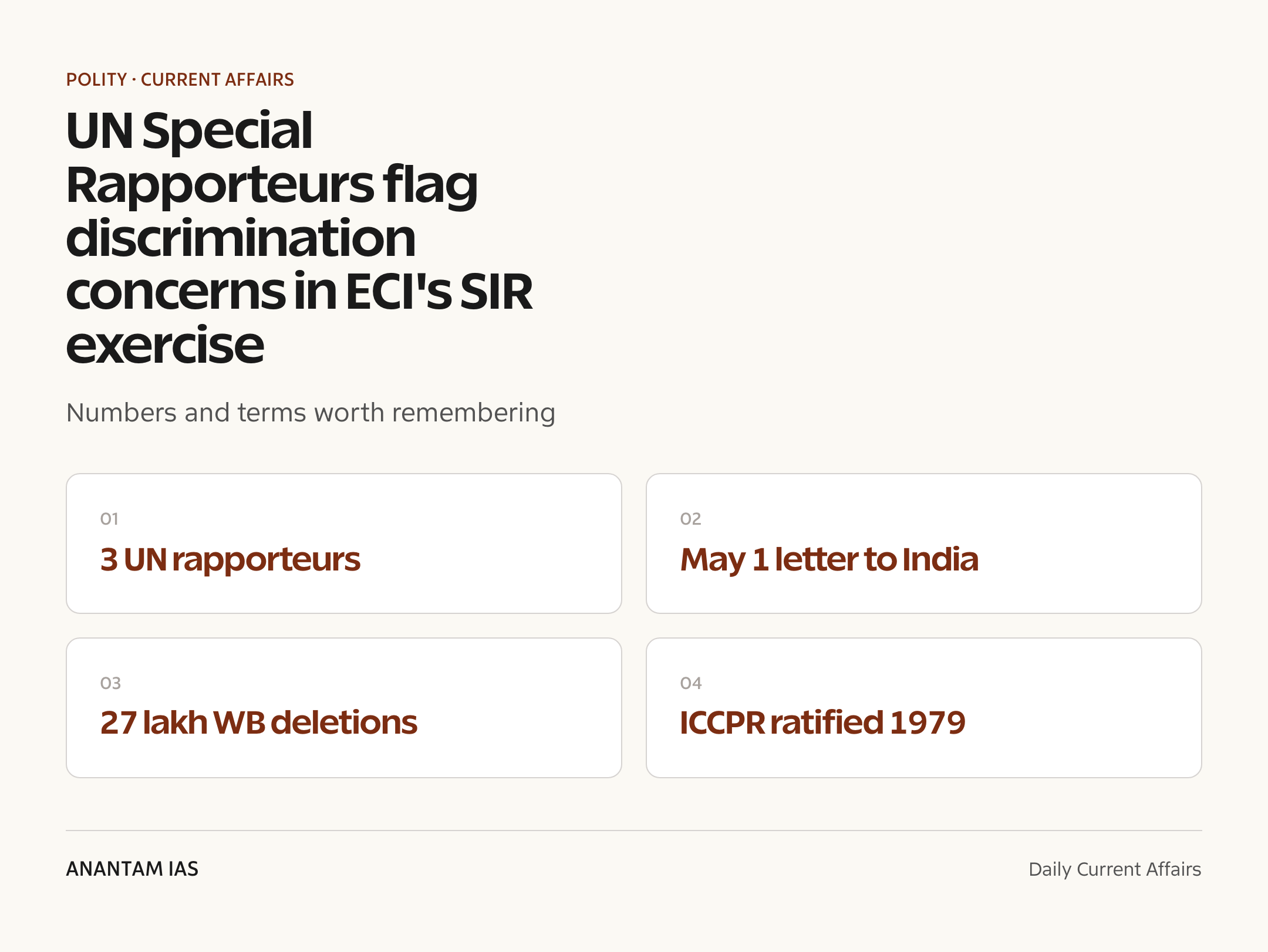
Three United Nations Special Rapporteurs have written to the Government of India expressing concern over alleged discrimination against minorities during the Election Commission of India’s (ECI) Special Intensive Revision (SIR) of electoral rolls, particularly in West Bengal. The Indian Express reported that the letter, dated May 1, 2026, was made public after the customary 60-day confidentiality window that UN Special Procedures observe.
The mandate holders sought the government’s comments on allegations that Bengali and Muslim electors were disproportionately affected by roll deletions, and asked what steps were taken to ensure eligible voters were not prevented from voting in the 2026 Assembly elections. The rapporteurs stated they “do not wish to prejudge the accuracy of these allegations”; emails to the Ministry of External Affairs and the ECI seeking a response went unanswered at the time of the report.
- The letter was signed by three mandate holders: Nicolas Levrat (Special Rapporteur on minority issues), Irene Khan (freedom of opinion and expression) and Nazila Ghanea (freedom of religion or belief).
- It followed complaints submitted to the Office of the UN High Commissioner for Human Rights (OHCHR) by the Independent Panel for Monitoring Indian Elections, a group of academics, in August 2025 and April 2026.
- The letter cites the reported removal of millions of voters’ names from rolls and alleges that minor spelling inconsistencies in documents were used as grounds for deletion.
- In West Bengal, about 27 lakh electors were deleted from the rolls after a series of steps the ECI took on Supreme Court orders, and they could not vote in the April 2026 Assembly polls while their appeals remained pending before tribunals.
- The rapporteurs flagged an alleged AI-driven system used to flag “irregularities” in voter data, raising questions of transparency, error and bias.
- They wrote that certain statements by senior government functionaries around the SIR could amount to incitement to discrimination within the meaning of the International Covenant on Civil and Political Rights (ICCPR), which India ratified in 1979.
The development matters in the context of:
- The communication tests how India engages the UN human-rights machinery on a matter it treats as a sovereign electoral process run by an independent constitutional body.
- It revives the classic GS2 tension between electoral-roll purity (no ineligible names) and universal adult franchise under Article 326 (no eligible voter left out).
- Special Procedures communications are non-binding — their weight is reputational and normative, which is why the government’s choice of response matters.
- The episode adds an international dimension to a debate the Supreme Court is already supervising domestically through SIR-related litigation.
UPSC Relevance
Prelims Relevance
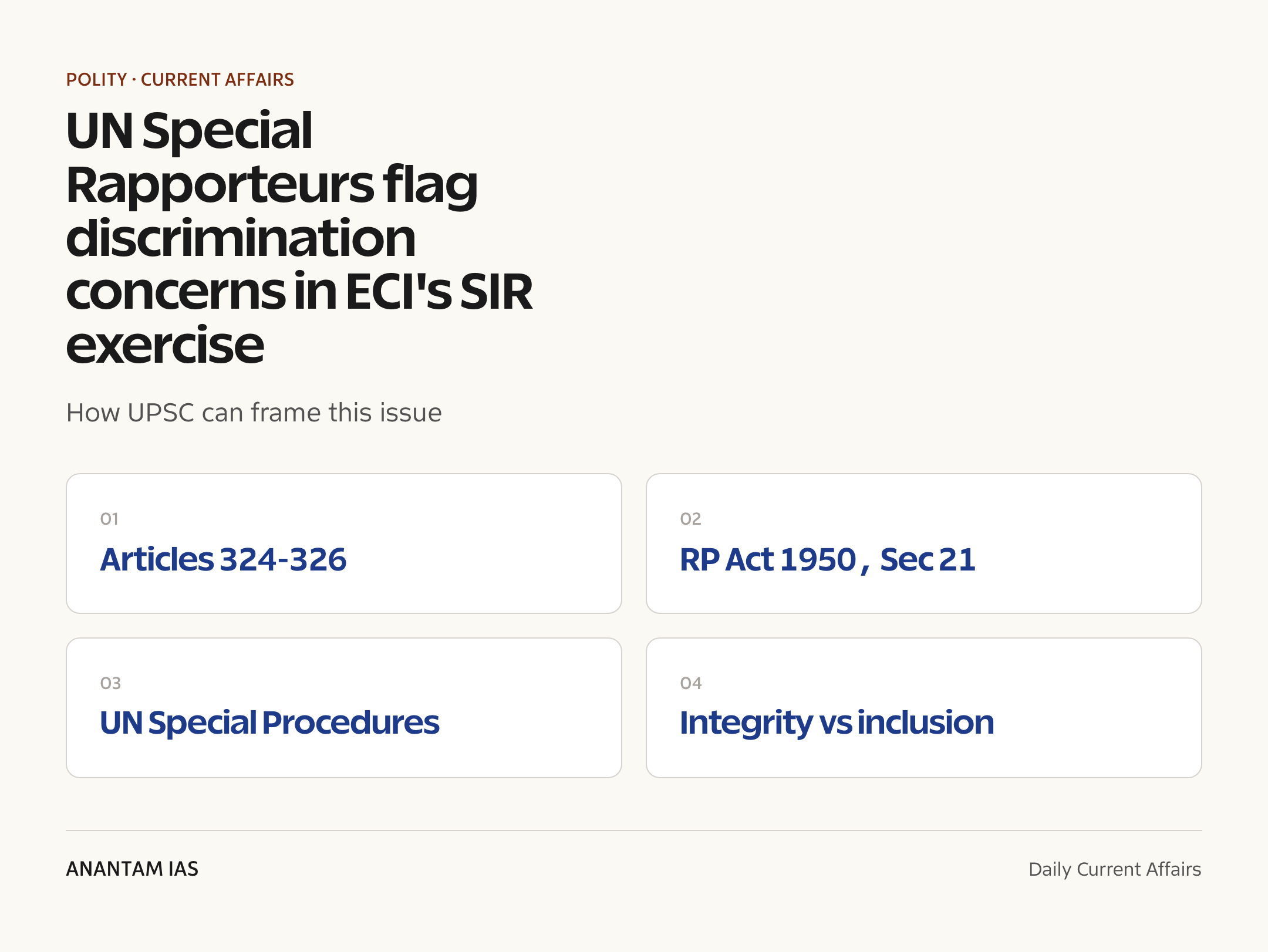
- Special Rapporteurs are independent experts appointed by the UN Human Rights Council under its Special Procedures system; they serve in a personal capacity and are not UN staff.
- Special Procedures mandate holders send communications (allegation letters and urgent appeals) to states; these are confidential for 60 days before publication, and state replies are voluntary.
- Article 324 vests superintendence, direction and control of elections in the ECI; Article 325 bars exclusion from electoral rolls on grounds of religion, race, caste or sex; Article 326 guarantees adult suffrage.
- Electoral rolls are prepared and revised under the Representation of the People Act, 1950 and the Registration of Electors Rules, 1960; Section 21 of the 1950 Act empowers special revision of rolls.
- The ICCPR — ratified by India in 1979 — protects the right to vote (Article 25) and non-discrimination (Article 26).
- The OHCHR, headquartered in Geneva, provides secretariat support to the Special Procedures system.
- The SIR began in Bihar in June 2025 and was extended to 10 states and 3 Union Territories, including West Bengal, from October 2025.
- The three signatory mandates: minority issues, freedom of opinion and expression, and freedom of religion or belief.
Mains Relevance
GS Paper 2
- ECI’s constitutional mandate under Articles 324–326 versus due-process concerns in mass roll revision — institutional safeguards for the right to vote.
- India’s engagement with UN human-rights mechanisms: sovereignty-based responses versus constructive engagement with Special Procedures.
- The balance between electoral integrity (removing ineligible entries) and inclusion (protecting eligible electors from wrongful deletion).
- Role of judicial oversight — the Supreme Court’s supervision of the SIR — as the domestic accountability channel.
GS Paper 1
- Communal and linguistic fault lines in citizenship-adjacent administrative exercises — society-level effects of documentation-heavy verification.
Essay
- The health of a democracy is measured at the margins of its voter list.
- Sovereignty and scrutiny: how mature democracies should respond to international human-rights questions.
Background and Context
What the Special Intensive Revision is
The SIR is the ECI’s most sweeping electoral-roll clean-up in decades, grounded in its statutory revision powers.
- A Special Intensive Revision is an intensive re-verification of the electoral roll — house-to-house enumeration and document checks — carried out under Section 21 of the Representation of the People Act, 1950, which lets the ECI direct a special revision of rolls for any constituency.
- The ECI’s stated objective is a roll free of dead, duplicate, shifted and ineligible entries, so that only citizens eligible under Article 326 remain enrolled. Read the fuller explainer on the Special Intensive Revision (SIR).
- The exercise began in Bihar in June 2025, ahead of that state’s Assembly election, and was extended from October 2025 to 10 states and 3 UTs, including West Bengal.
- Deleted electors have remedies: claims and objections before the Electoral Registration Officer, and appeals under the 1950 Act — in West Bengal, appeals of deleted electors were pending before tribunals when the April 2026 polls were held.
- The Indian Express reported that in West Bengal, steps taken by the ECI on Supreme Court orders resulted in about 27 lakh deletions, and those electors could not vote in the April 2026 Assembly election.
Who the Special Rapporteurs are
Special Rapporteurs sit within the UN Human Rights Council’s Special Procedures — the largest body of independent human-rights experts in the UN system.
- Special Procedures mandate holders are appointed by the UN Human Rights Council (which India has been elected to several times); they are independent experts who serve in a personal, unpaid capacity and do not speak for the UN as a whole.
- Mandates are either thematic (minority issues, freedom of religion, expression, and others) or country-specific; the OHCHR in Geneva provides secretariat support. See the primer on the United Nations system.
- Their main tool is the communication — a letter to a government seeking clarification on alleged violations. By practice it stays confidential for 60 days, then is published in the Special Procedures communications database whether or not the state replies.
- Communications are not judicial findings: the May 1 letter itself records that the experts “do not wish to prejudge the accuracy of these allegations.”
- The signatories were Nicolas Levrat (minority issues), Irene Khan (freedom of opinion and expression) and Nazila Ghanea (freedom of religion or belief).
What the letter alleges
The communication consolidates complaints about deletions, documentation, technology and rhetoric — while asking, not asserting.
- It flags the reported removal of millions of names, potentially affecting Muslims and persons of Bengali descent who, the letter says, risk wrongful exclusion because of their “historical and continuing treatment as foreigners and illegal immigrants,” notably in West Bengal.
- It alleges that minor spelling inconsistencies in documents — common across India for administrative reasons — were used as a pretext to delete names, and that people excluded in the second phase had furnished valid identification.
- On Bihar, it records alarm over potential large-scale disenfranchisement and denationalisation, and questions an alleged AI-driven system that flagged “irregularities” in voter data — raising transparency, error and bias concerns.
- It cites public statements by senior functionaries — including framing deletions as targeting “illegal Bangladeshi immigrants” and the formula “Detect, Delete and Deport” — which, the experts wrote, could amount to incitement to discrimination under the ICCPR.
- The experts also referenced a 2018 communication in which earlier rapporteurs had raised concerns over the National Register of Citizens (NRC) exercise.
The ECI's mandate and stated position
The Commission has consistently defended the SIR as a lawful, court-supervised clean-up that protects the integrity of the franchise.
- The ECI is a constitutional body under Article 324; the preparation of accurate rolls is central to its mandate, and Article 325 itself prohibits excluding anyone from a roll on grounds of religion, race, caste or sex. Background: Election Commission of India.
- The Commission has publicly maintained that the SIR targets ineligible entries — the dead, duplicates, permanently shifted electors and non-citizens — since only Indian citizens can be electors under Article 326 and the RP Act, 1950.
- The process design includes enumeration forms, published draft rolls, a claims-and-objections window, speaking orders by Electoral Registration Officers and statutory appeals — safeguards the ECI cites against the charge of arbitrary deletion.
- Key parts of the exercise have proceeded under the Supreme Court’s directions and continuing scrutiny — the Court, not an external body, is the operative check on the SIR’s legality.
- Neither the ECI nor the MEA had responded to the newspaper’s queries on the UN letter at the time of the report; the government’s formal reply, if any, would go through diplomatic channels in Geneva.
India and UN human-rights machinery
India engages the UN system selectively — cooperative in periodic reviews, resistant to what it sees as intrusion into sovereign processes.
- India participates in the Human Rights Council’s Universal Periodic Review (UPR) and responds to many Special Procedures communications, but has long held that elections are a sovereign, constitutionally regulated domain.
- Special Procedures communications create no legal obligation; their force is normative and reputational — non-response is itself recorded in the public database and can be cited in later reviews.
- India ratified the ICCPR in 1979: Article 25 protects the right to vote without unreasonable restrictions, Article 26 guarantees equality before the law, and Article 20(2) requires states to prohibit advocacy of hatred that incites discrimination.
- India has not accepted the ICCPR’s individual-complaints mechanism (First Optional Protocol), so international scrutiny works through reports, reviews and communications rather than adjudication.
- Domestically, the National Human Rights Commission and constitutional courts are the designated channels for rights grievances — see the note on the NHRC.
The integrity-versus-inclusion debate
The SIR controversy is at bottom a design question: how to purge ineligible names without shedding eligible ones.
- A padded roll invites impersonation and duplicate voting; an over-pruned roll produces wrongful disenfranchisement — both corrode electoral legitimacy, just from opposite ends.
- Documentation-heavy verification bears hardest on migrants, the poor and linguistic minorities, whose papers are most likely to carry the spelling variations and gaps the letter describes.
- The burden-of-proof question — whether the state must justify a deletion or the elector must prove eligibility — has been the central legal fault line in SIR litigation.
- Technology-assisted flagging speeds up screening but imports risks of opaque criteria and unexamined error; the UN letter’s AI concern mirrors domestic demands for explainable deletion lists.
- The deeper design principles are examined in Electoral Roll Integrity Cannot Become Voter Friction.
Way Forward
Transparent process data
- Publish constituency-wise deletion data with reasons, and machine-readable draft rolls, so claims of disproportionate impact can be tested against evidence rather than argued in the abstract.
- Disclose the criteria and audit results of any algorithmic flagging used in roll verification; a human ERO order should record independent application of mind for every deletion.
Strengthen remedies before polls
- Fast-track appellate tribunals so that no elector with a pending appeal faces an election day without a decision; provisional inclusion pending appeal is one option debated in litigation.
- Standardise a tolerant document-matching protocol — treating minor spelling variations as verification triggers, not deletion grounds.
Calibrated international engagement
- A reasoned, factual reply to the communication — documenting the SIR’s statutory basis, safeguards and judicial supervision — serves India better than silence, since the letter and any response both become part of the public UN record.
- Political messaging around roll revision should stay within the register of law and procedure; rhetoric that conflates citizens with foreigners hands external critics their strongest exhibit.
Conclusion
The May 1 communication doesn’t adjudicate anything — Special Rapporteurs ask questions; they don’t issue verdicts. But it internationalises a question the Supreme Court is already wrestling with at home: whether the Special Intensive Revision can deliver a clean roll without shaving off genuine electors at the margins, where the poorest and least-documented voters live.
For the exam, the episode is a two-in-one: a Polity case study on the ECI’s Article 324 mandate, roll-revision law and due process, and an IR case study on how India engages UN Special Procedures. The durable takeaway is institutional — electoral integrity and universal franchise are not rival goals but joint tests that any revision exercise must pass together.
UPSC Practice Questions
Prelims MCQ 1
With reference to the UN Special Procedures system, consider the following statements:
- Special Rapporteurs are appointed by the UN Human Rights Council and serve in an independent, personal capacity.
- Communications sent by Special Rapporteurs to governments are legally binding on the state concerned.
- By practice, such communications remain confidential for a period before being made public.
How many of the above statements are correct?
(a) Only one (b) Only two (c) All three (d) None
Answer: (b) Only two
Explanation:
Statements 1 and 3 are correct — mandate holders are independent experts appointed by the Human Rights Council, and their letters stay confidential for 60 days before publication. Statement 2 is wrong: communications seek a state’s response and carry normative weight only; they create no binding legal obligation.
Prelims MCQ 2
Which one of the following constitutional provisions prohibits a person from being excluded from an electoral roll on grounds only of religion, race, caste or sex?
(a) Article 324 (b) Article 325 (c) Article 326 (d) Article 329
Answer: (b) Article 325
Explanation:
Article 325 mandates one general electoral roll for every constituency and bars ineligibility on grounds only of religion, race, caste or sex. Article 324 vests superintendence of elections in the ECI, Article 326 provides adult suffrage, and Article 329 bars judicial interference in electoral matters except through election petitions.
UPSC Mains Questions
- The Special Intensive Revision of electoral rolls illustrates the tension between electoral-roll integrity and universal adult franchise. Examine this tension with reference to the constitutional and statutory framework governing electoral rolls in India, and suggest safeguards against wrongful deletion. (250 words)
- Communications from UN Special Procedures mandate holders are non-binding, yet they matter. Discuss how India should engage with UN human-rights machinery when questions are raised about sovereign domestic processes such as elections. (250 words)
Source: The Indian Express.
Frequently Asked Questions
What did the UN Special Rapporteurs’ letter say?
Three UN experts wrote to India on May 1, 2026, seeking its response to allegations that Bengali and Muslim electors were disproportionately deleted during the ECI’s Special Intensive Revision of electoral rolls, particularly in West Bengal. They asked what steps ensured eligible voters could vote in the 2026 Assembly polls, while clarifying they were not prejudging the allegations.
Who are UN Special Rapporteurs?
They are independent human-rights experts appointed by the UN Human Rights Council under its Special Procedures system. They serve in a personal, unpaid capacity, hold thematic or country-specific mandates, and send communications to governments seeking clarification on alleged violations. Their letters are confidential for 60 days, then published.
Is the UN communication binding on India?
No. Special Procedures communications create no legal obligation — states may reply or not. Their force is normative and reputational: the letter, and any government response, enter a public UN database and can be cited in later reviews like the Universal Periodic Review.
What is the Special Intensive Revision (SIR)?
It is an intensive re-verification of electoral rolls under Section 21 of the Representation of the People Act, 1950, involving enumeration and document checks. The ECI began it in Bihar in June 2025 and extended it to 10 states and 3 UTs, including West Bengal, from October 2025, to remove dead, duplicate, shifted and ineligible entries.
Which constitutional articles govern electoral rolls?
Article 324 vests superintendence, direction and control of elections in the Election Commission. Article 325 bars exclusion from the roll on grounds only of religion, race, caste or sex. Article 326 guarantees elections on the basis of universal adult suffrage for citizens aged 18 and above.
What is the ICCPR and India’s status under it?
The International Covenant on Civil and Political Rights is a core UN human-rights treaty India ratified in 1979. Article 25 protects the right to vote, Article 26 guarantees equality, and Article 20(2) requires prohibiting advocacy of hatred that incites discrimination. India has not accepted its individual-complaints protocol.