New Moth Genus in the Western Ghats: A Window into Hidden Biodiversity
Why in News?
As The Hindu (Science) reports, a research team has described a new genus and species of tiger moth from the southern Western Ghats, naming it Antaram idukki after Kerala’s Idukki district where it was found. The moth belongs to the tiger-moth subfamily Arctiinae (family Erebidae) and is so far known only from this one stretch of hills, a hallmark of the Ghats’ deep endemism.
The find matters less for the single insect than for what it signals: the Western Ghats, one of the world’s most-celebrated biodiversity hotspots, still hides whole genera that science has never catalogued. Each such description strengthens the case for taxonomy-led conservation in a landscape under steady pressure from plantations, roads, and a warming climate.
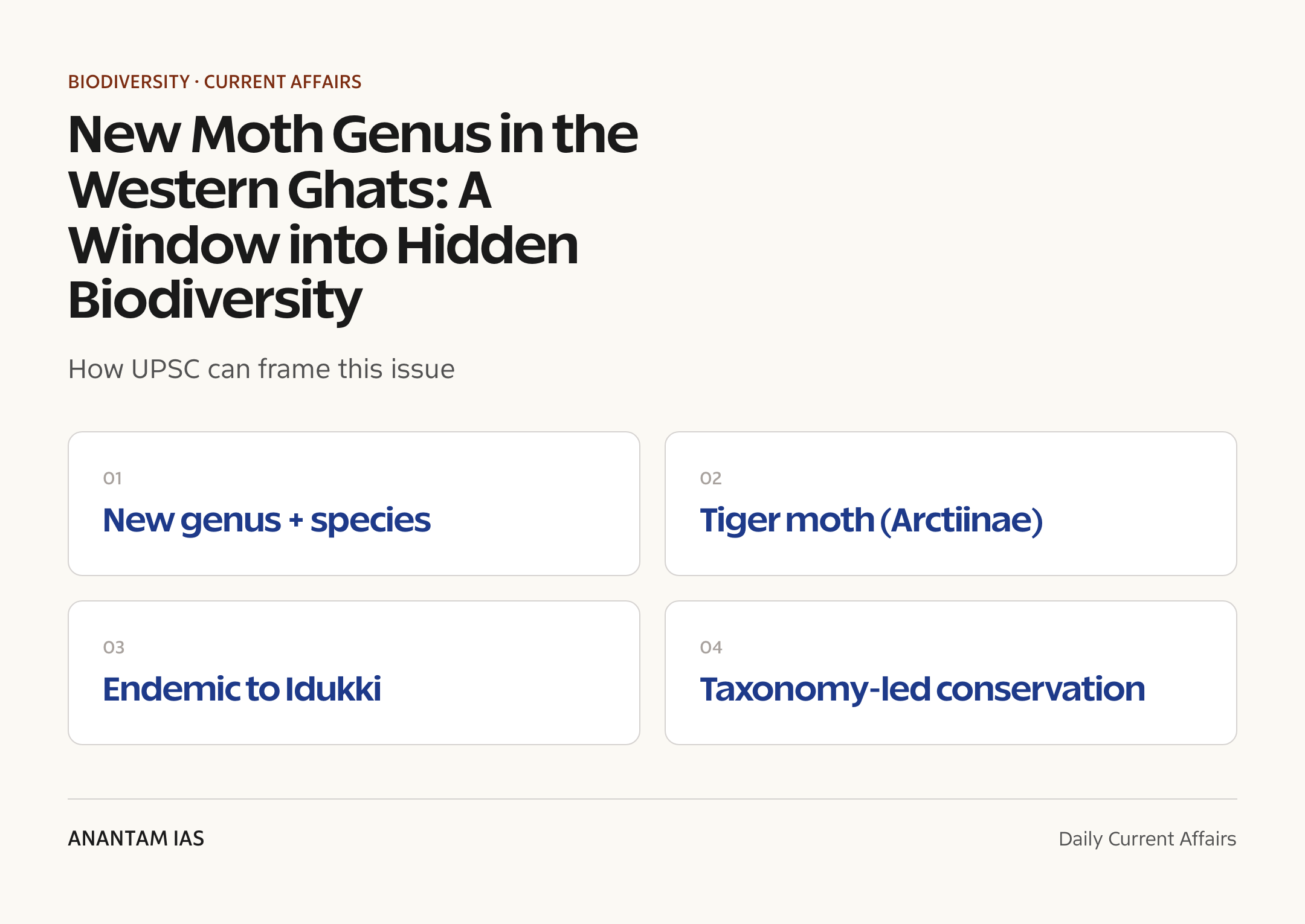
- New genus + species: Antaram idukki is described as both a new genus and a new species, not merely a new species in a known genus.
- Classification: a tiger moth in subfamily Arctiinae, family Erebidae, order Lepidoptera.
- Endemic range: currently known only from Idukki in the southern Western Ghats of Kerala.
- How it was distinguished: a unique combination of external wing features and genitalic morphology separates it from related genera.
- Why it counts: tiger moths act as night-time pollinators, prey for birds and bats, and indicator species for ecosystem health.
The development matters in the context of:
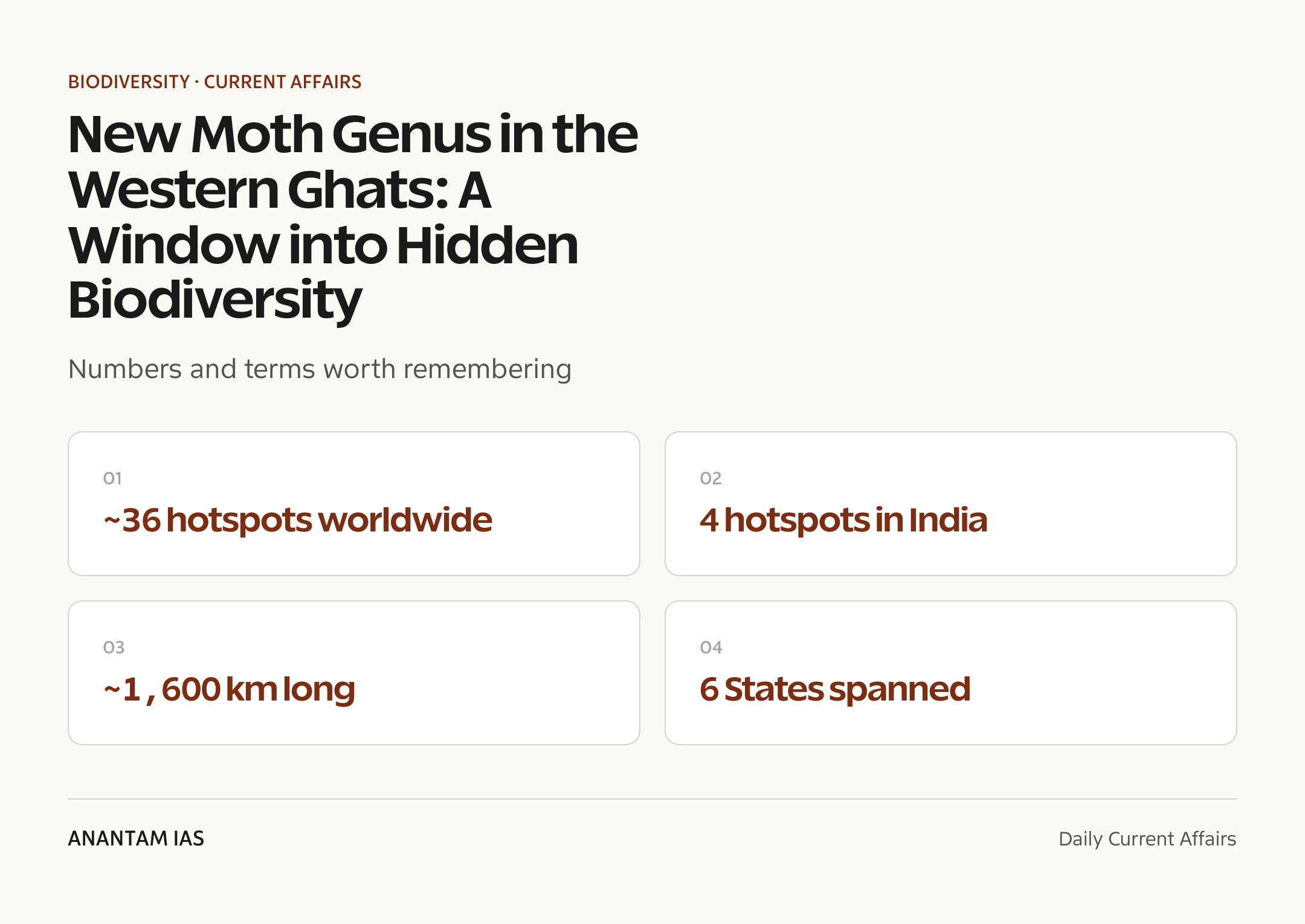
- The Western Ghats run roughly 1,600 km along India’s west coast across Gujarat, Maharashtra, Goa, Karnataka, Tamil Nadu, and Kerala, and are older than the Himalayas.
- They are recognised both as a global biodiversity hotspot and as a UNESCO World Heritage Site, with very high levels of species found nowhere else on Earth.
- Insect groups like moths are vastly under-described compared with birds or mammals, so most new discoveries in the Ghats are invertebrates.
- Conservation governance of the Ghats has been shaped by the Gadgil and Kasturirangan reports and the idea of Ecologically Sensitive Areas.
UPSC Relevance
Prelims Relevance
- The Western Ghats are one of the world’s recognised biodiversity hotspots and a UNESCO World Heritage Site (inscribed 2012).
- A biodiversity hotspot must meet two criteria: at least 1,500 endemic vascular plant species and loss of at least 70% of its original primary vegetation.
- There are around 36 biodiversity hotspots worldwide; India hosts four — the Western Ghats, the Eastern Himalaya, the Indo-Burma region, and the Sundaland (Nicobar Islands).
- The Western Ghats span six States and are geologically older than the Himalayas.
- Endemism means a species occurs naturally in only one defined area; Antaram idukki is so far endemic to Idukki, Kerala.
- A genus is a rank above species; a new genus implies a lineage distinct enough that no existing genus fits it.
- Tiger moths belong to subfamily Arctiinae, family Erebidae, order Lepidoptera.
- The Gadgil Committee (Western Ghats Ecology Expert Panel, 2011) and the Kasturirangan Committee (2013) advised on protecting the Ghats via Ecologically Sensitive Areas.
- Moths are indicator species — their presence or decline signals broader environmental change.
- Idukki, a high-range district of Kerala, is known for the Idukki dam, cardamom hills, and reserves such as Eravikulam National Park.
Mains Relevance
GS Paper 3
- Use the discovery to argue why species inventories and taxonomy are foundational to conservation: you cannot protect what you have not yet named.
- Examine the governance tension over the Western Ghats — Gadgil vs Kasturirangan recommendations, Ecologically Sensitive Areas, and the balance between ecology and local livelihoods.
Essay
- Themes on humanity’s relationship with nature, the value of the unseen and the unmeasured, and why knowledge precedes stewardship.
Background and Context
The discovery and why moths matter
A small insect carries an outsized scientific message.
- A research team described Antaram idukki as a new genus and species of tiger moth, reported by The Hindu‘s science desk.
- It sits in subfamily Arctiinae (family Erebidae) and is currently recorded only from Idukki in Kerala’s southern Western Ghats.
- Taxonomists separated it using external wing characters plus genitalic morphology — the fine structural details that reliably tell closely related moths apart.
- Moths are not just nuisance fliers: many are pollinators of night-blooming plants, working a niche bees and butterflies leave open after dark.
- They are a major food source for birds, bats, and other wildlife, so their abundance ripples up the food web.
- Sensitive to light, temperature, and habitat change, moths serve as practical indicator species for the health of a forest.
The Western Ghats as a biodiversity hotspot
A narrow green spine that punches far above its size.
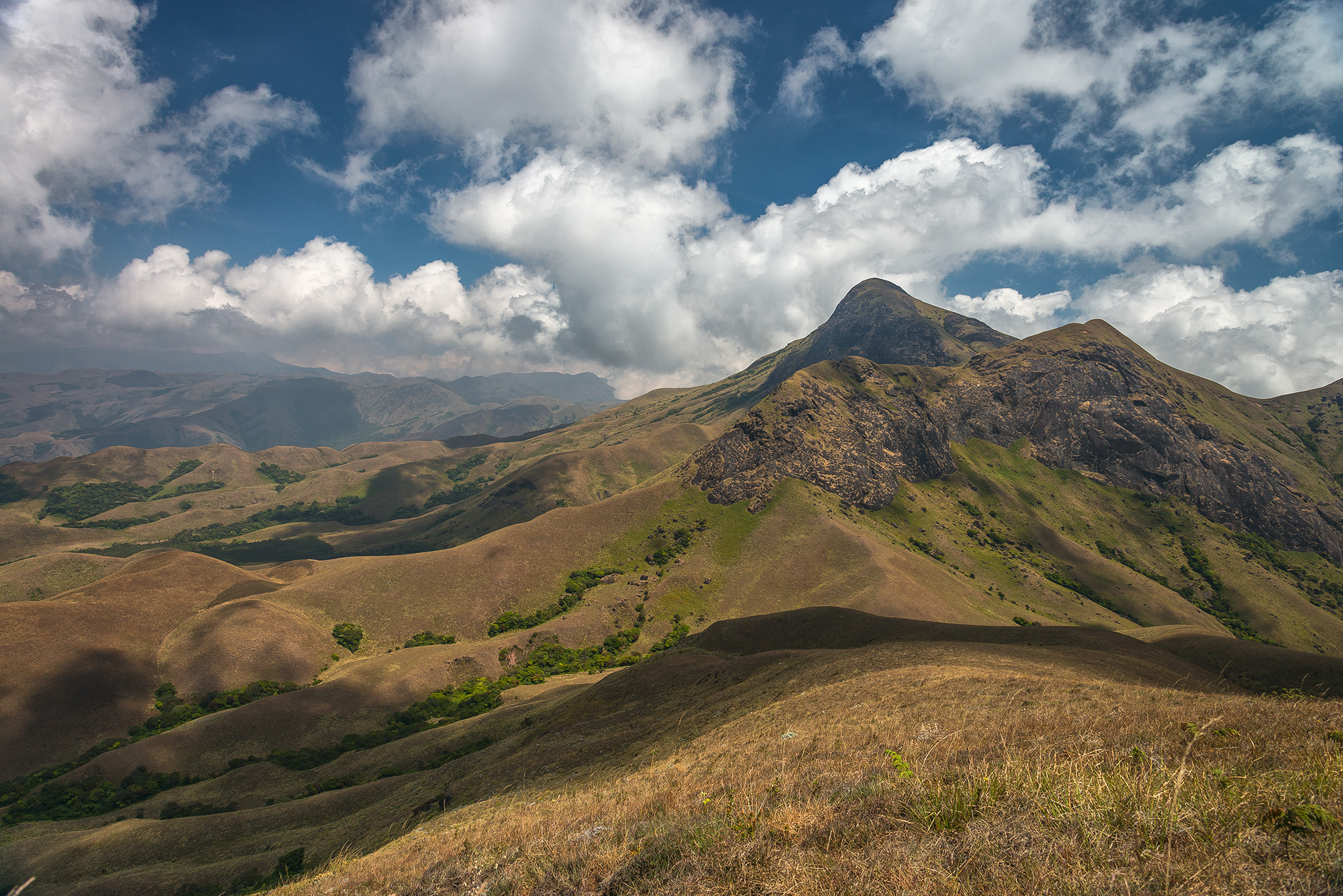
- The Western Ghats stretch about 1,600 km along the west coast through six States, intercepting the monsoon and shaping the rainfall of peninsular India.
- They are one of the world’s roughly 36 biodiversity hotspots — regions that are both exceptionally rich in endemic life and exceptionally threatened.
- The hotspot label requires two things: at least 1,500 endemic plant species and the loss of at least 70% of original natural vegetation.
- The Ghats clear both bars comfortably, hosting large numbers of endemic amphibians, fish, reptiles, plants, and invertebrates, alongside flagship endemics like the Malabar large-spotted civet.
- Their age — older than the Himalayas — and varied altitude and rainfall have let isolated lineages evolve in pockets, driving high endemism.
- Insects, especially moths, remain among the least-surveyed groups here, so the true species count is far above what is formally described.
UNESCO status and ecological importance
Global recognition for a region that waters and cools a subcontinent.
- The Western Ghats were inscribed as a UNESCO World Heritage Site in 2012, recognised for outstanding universal value in biodiversity.
- The inscription covers a serial set of protected areas — national parks, wildlife sanctuaries, and reserve forests — spread across the southern States.
- Ecologically, the Ghats are the catchment for major peninsular rivers, regulating water for millions downstream.
- Their forests store carbon, moderate the regional climate, and sustain the monsoon rhythm that agriculture depends on.
- Idukki itself anchors high-range habitats — shola-grassland mosaics and reserves like Eravikulam — that shelter narrow-range endemics.
- Discoveries like Antaram idukki add scientific weight to keeping these landscapes intact rather than fragmented.
Conservation governance: Gadgil vs Kasturirangan
Two reports, two visions, one unresolved debate.
- The Gadgil Committee (Western Ghats Ecology Expert Panel, 2011) proposed treating almost the entire Ghats as ecologically sensitive, graded into three zones with strong local-body (gram sabha) say.
- Critics, especially State governments and some farming communities, called it too restrictive for development and livelihoods.
- The Kasturirangan Committee (2013) scaled back the protected footprint to roughly 37% of the Ghats, focusing on relatively undisturbed ‘natural landscapes’.
- It recommended declaring these as Ecologically Sensitive Areas (ESAs) where polluting and high-impact activities would be curbed.
- Successive draft notifications on the ESA boundary have faced pushback from affected States, leaving the final demarcation long contested.
- The result is a governance gap: scientific value is clear, but the legal protection of much of the Ghats remains incomplete.
Threats and why taxonomy is the first line of defence
You cannot conserve what you have not named.
- The Ghats face habitat loss from plantations (tea, coffee, cardamom), encroachment, dams, mining, quarrying, and linear projects like roads.
- Climate change is shifting the cool, wet high-altitude zones that many endemics — including specialised moths — depend on.
- Fragmentation isolates small populations, raising the risk that a narrow-range species is lost before it is even described.
- Taxonomy — the work of formally describing and classifying species — turns an unknown insect into a documented, trackable unit of biodiversity.
- A named genus can be assessed for conservation status, mapped, and folded into impact assessments and frameworks like the Biodiversity Act, 2002.
- Each description like Antaram idukki makes the abstract case for protecting the Ghats concrete and defensible.
Way Forward
Invest in taxonomy and surveys
- Fund long-term moth and invertebrate inventories across the Ghats, with trained taxonomists and reference collections.
- Build digital, open biodiversity databases so new descriptions feed directly into conservation planning.
Settle the protection framework
- Finalise the Ecologically Sensitive Area boundaries with State consultation rather than indefinite drafts.
- Reconcile the Gadgil and Kasturirangan visions into a workable, livelihood-sensitive zoning that still safeguards core habitats.
Conserve habitats, not just species
- Protect shola-grassland and high-range mosaics in districts like Idukki where narrow-range endemics concentrate.
- Reduce light pollution, pesticide drift, and fragmentation that hit nocturnal pollinators such as moths hardest.
Engage local communities
- Involve gram sabhas and plantation communities as partners, with incentives for habitat-friendly practices.
- Support citizen-science moth monitoring to widen survey coverage and public ownership of the Ghats’ biodiversity.
Conclusion
A single tiger moth from Idukki will not change a balance sheet, but it reframes how we should read the Western Ghats. If a whole new genus could go unnoticed in one of the planet’s most-studied hotspots, the real biodiversity of the Ghats is larger, and more vulnerable, than our records admit.
The lesson for policy is plain. Taxonomy is not an academic luxury but the first step in conservation, and the long-stalled question of how strictly to protect the Ghats cannot wait for every species to be named. Antaram idukki is a small reminder that India is still discovering what it stands to lose.
UPSC Practice Questions
Prelims MCQ 1
With reference to the Western Ghats, consider the following statements:
- They are recognised as both a global biodiversity hotspot and a UNESCO World Heritage Site.
- They are geologically younger than the Himalayas.
- They extend across six Indian States.
How many of the above statements are correct?
(a) Only one (b) Only two (c) All three (d) None
Answer: (b) Only two
Explanation:
Statements 1 and 3 are correct. Statement 2 is wrong: the Western Ghats are older than the Himalayas, not younger.
Prelims MCQ 2
To qualify as a biodiversity hotspot under the standard global criteria, a region must:
(a) Contain at least 500 endemic plant species and any forest cover (b) Have at least 1,500 endemic vascular plant species and have lost at least 70% of its original vegetation (c) Lie entirely within a single country and be a World Heritage Site (d) Host at least 36 endemic mammal species
Answer: (b) Have at least 1,500 endemic vascular plant species and have lost at least 70% of its original vegetation
Explanation:
The two-part criterion combines exceptional endemism (1,500+ endemic vascular plants) with severe threat (70%+ loss of original natural vegetation).
UPSC Mains Questions
- “You cannot conserve what you have not named.” Discuss the role of taxonomy and species inventories in biodiversity conservation, using recent discoveries from the Western Ghats.
- Examine the debate over the conservation governance of the Western Ghats with reference to the Gadgil and Kasturirangan reports and the notification of Ecologically Sensitive Areas.
- How do biodiversity hotspots like the Western Ghats illustrate the link between endemism, ecological services, and conservation priority? Explain.
Source: The Hindu.
Frequently Asked Questions
What exactly was discovered?
A new genus and species of tiger moth, named Antaram idukki, from Kerala’s Idukki district in the southern Western Ghats. It belongs to subfamily Arctiinae in the family Erebidae and is so far known only from that area.
What is the difference between a new genus and a new species?
A species is a single kind of organism; a genus is the rank just above it, grouping closely related species. Describing a new genus means the lineage is distinct enough that no existing genus fits it, which makes the find more significant than a new species alone.
Why are moths ecologically important?
Many moths are pollinators of night-blooming plants, they are a key food source for birds and bats, and they act as indicator species whose decline signals wider environmental change.
Why are the Western Ghats called a biodiversity hotspot?
They meet the two global criteria: at least 1,500 endemic vascular plant species and the loss of at least 70% of their original vegetation. They are also a UNESCO World Heritage Site with very high endemism.
What were the Gadgil and Kasturirangan reports about?
Both advised on protecting the Western Ghats. The Gadgil report (2011) proposed strict protection across most of the range; the Kasturirangan report (2013) limited it to about 37%, recommending Ecologically Sensitive Areas. The final boundaries remain contested.
How does naming a new species help conservation?
A formally described species can be assessed for conservation status, mapped, tracked, and included in environmental impact assessments. Taxonomy turns an unknown organism into a documented unit that policy and law can protect.