

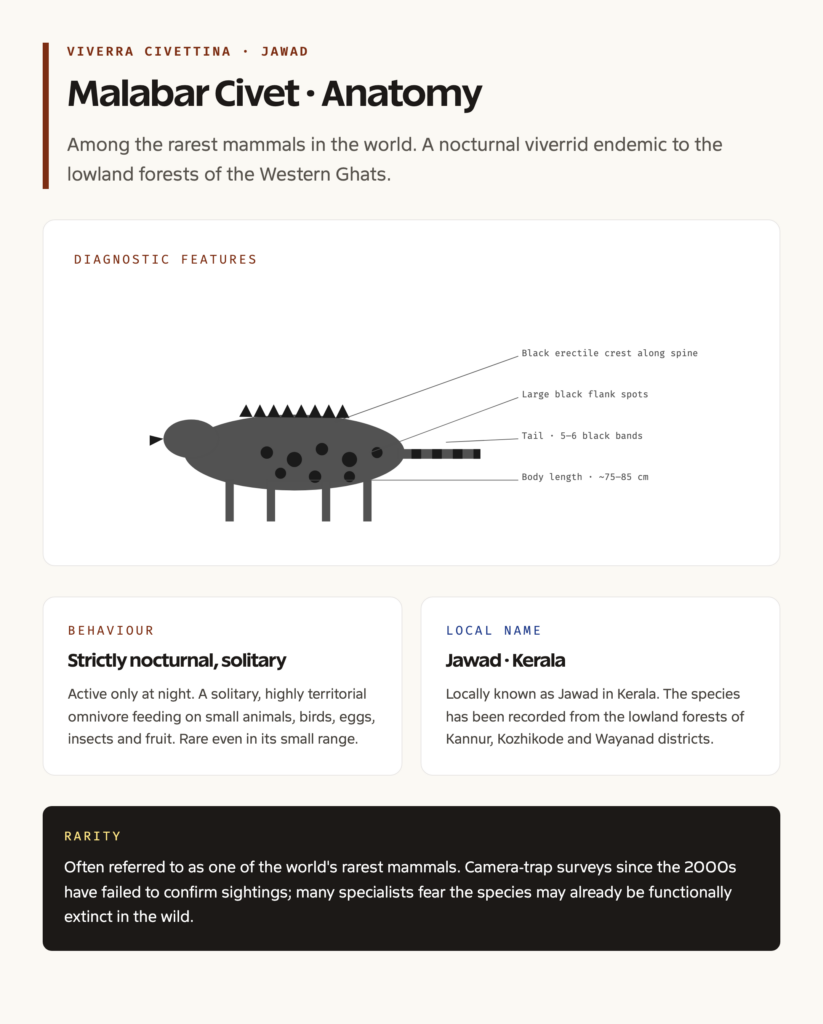
The Malabar large-spotted civet (Viverra civettina) is a Critically Endangered civet endemic to the Western Ghats of India, restricted to the coastal lowlands of Kerala and Karnataka and often described as one of the world’s rarest mammals. Locally known as Jawad, it is listed in Schedule I of the Wildlife Protection Act, 1972 and in CITES Appendix III, yet has almost no confirmed wild records in recent decades.
There are species in Indian biodiversity registers that are listed not because we know them well, but because we know almost nothing about them at all. The Malabar large-spotted civet is the most striking example. Viverra civettina, locally known as Jawad in coastal Kerala, is endemic to the Western Ghats of India, listed as critically endangered on the IUCN Red List, and frequently described in scientific literature as one of the rarest mammals in the world. Confirmed sightings in the past several decades number in the low double digits. There is no captive population. There is no recent verified photographic record from the wild. The species exists in conservation databases, on legal schedules, and in the memory of villagers along the Kerala-Karnataka coast, but its physical presence is barely traceable.
For UPSC, the Malabar civet is a useful case study in three different ways. It is a species whose ecology is shaped by lowland forest rather than the high-altitude Western Ghats most of us picture. It is a species whose decline tracks habitat conversion to cashew, rubber, and arecanut plantations rather than direct hunting. And it is a species whose listing under Schedule I of the Wildlife Protection Act, 1972 illustrates the limits of legal protection in the absence of habitat.
This guide walks through what the species is, where it lives or used to live, why it is on the brink, and what its conservation status implies for India’s protected-area system.
Quick Facts
- Scientific name: Viverra civettina
- Local name: Jawad (Kerala)
- Common English names: Malabar Large-Spotted Civet, Malabar Civet
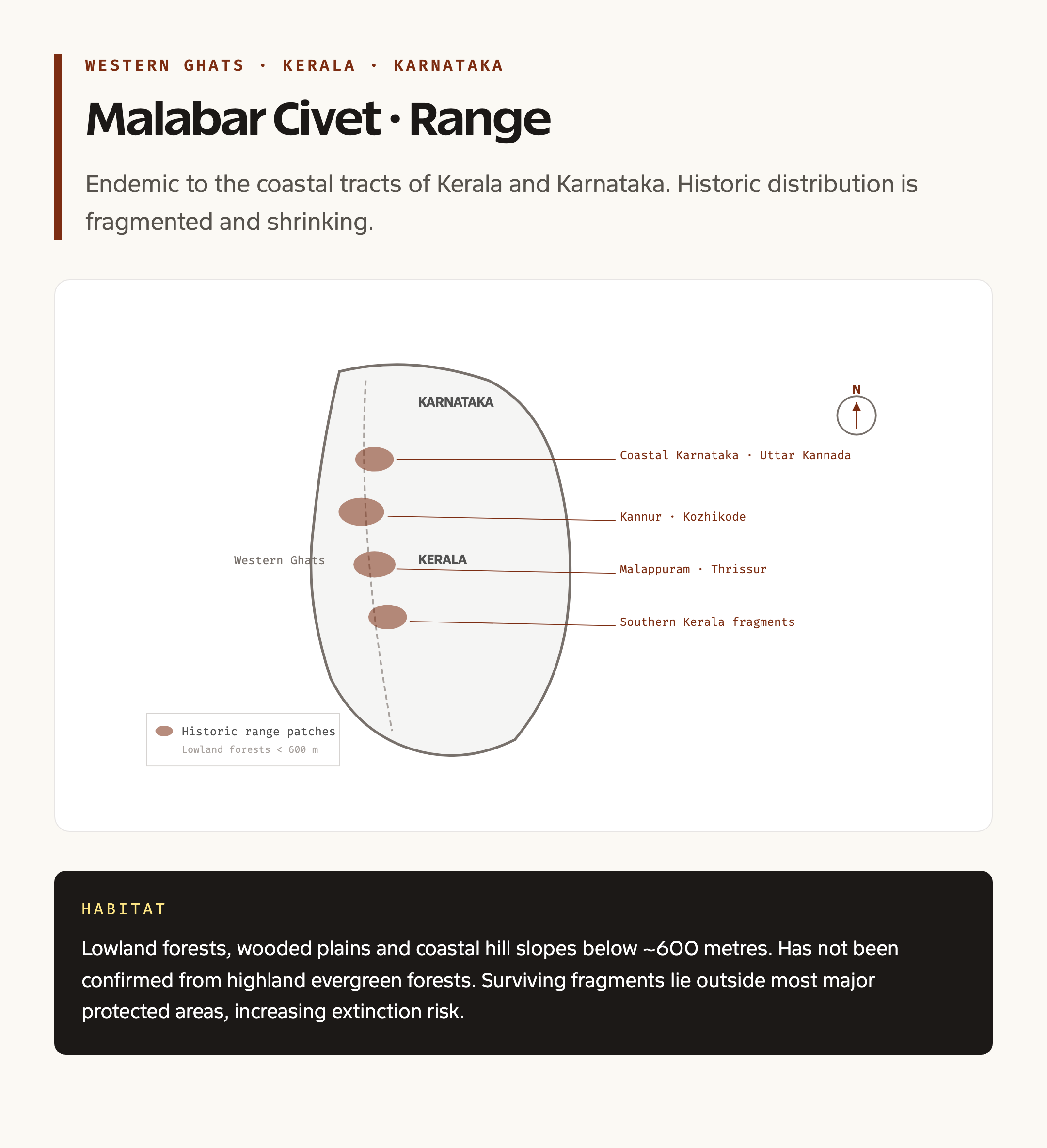
- Endemism: Endemic to the Western Ghats of India, with a distribution restricted to the coastal tracts of Kerala and Karnataka
- Status descriptor: Often referred to as one of the world’s rarest mammals
- Habitat (historical): Lowland forests, wooded plains, swampy thickets, coastal hill slopes
- Habitat (current): Cashew, rubber, and arecanut plantations with patches of secondary forest, along the Western Ghats foothills and coastal belt
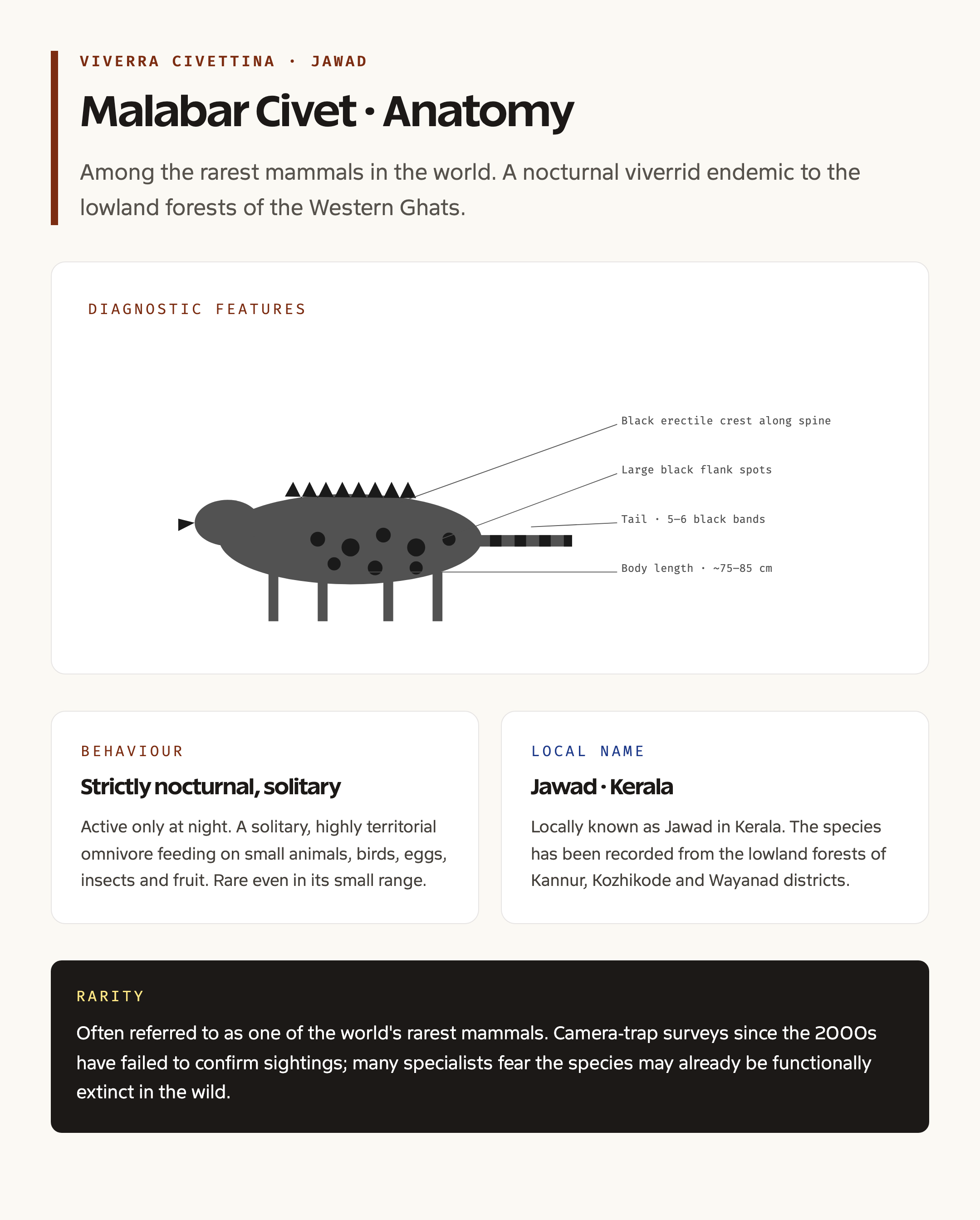
- Body length: Approximately 76 to 85 cm head and body, with a 30 to 40 cm tail
- Weight: Approximately 6 to 8 kg
- Coat: Dusky grey ground colour with large distinct black spots on the flanks
- Distinctive features: Prominent black crest of erectile hair running along the spine; black bands on the tail
- Behaviour: Strictly nocturnal, solitary, highly territorial
- Diet: Omnivorous; small mammals, birds, eggs, reptiles, insects, and fruit
- IUCN Red List: Critically Endangered (CR)
- Wildlife Protection Act, 1972: Schedule I (highest protection)
- CITES: Appendix III
- Last large-scale survey effort: Several through the 1990s and 2000s, with very few confirmed records
What Is the Malabar Civet
The Malabar civet is a medium-sized member of the family Viverridae, the civets and genets. It is closely related to the large Indian civet, Viverra zibetha, and the small Indian civet, Viverricula indica, but it is morphologically and ecologically distinct. The Malabar civet is somewhat larger and more robust than the small Indian civet, with a heavier build and a more strongly patterned coat.
Field identification depends on three features. The first is the dusky grey ground colour broken by large, separated black spots on the flanks, which are denser and more distinctly outlined than in the related civets. The second is the prominent dorsal crest of erectile black hair that runs along the back from neck to tail base, which the animal can raise as a threat display. The third is the pattern of black bands and rings on the tail, which differ in spacing and intensity from the small Indian civet’s tail pattern.
Behaviourally, the species is strictly nocturnal, beginning activity well after dusk and returning to dense cover before dawn. It is solitary outside the brief mating period and is highly territorial, with adult animals using anal-gland scent marking on rocks, logs, and trees to maintain spatial separation. Diet is broadly omnivorous, with small mammals, birds, eggs, reptiles, insects, and fruit in approximately variable proportions through the year.
Civets, including the Malabar civet, secrete a musky substance from perineal glands that historically had commercial value in the perfumery trade. The historical capture of related civet species for musk extraction is part of the broader pressure that has reshaped the family’s distribution.
Background and Historical Context
The Malabar civet was first described to Western science in the early nineteenth century from specimens collected along the Malabar coast. Through the colonial period, the species was reported in lowland forests and wooded plains across the western coast of peninsular India, from coastal Karnataka through the Kerala lowlands. It was treated as locally common in some districts well into the early twentieth century.
The decline begins with land-use change. The lowland forests of the Malabar coast were progressively cleared through the twentieth century for cashew plantations, rubber, arecanut, coconut, and rice cultivation. The high-canopy primary lowland forest that the civet evidently depended on was largely gone by the 1950s and 1960s in most districts. Secondary scrub and plantation cover replaced it.
By the 1970s, surveys reported the species as essentially absent from large parts of its historical range. Extensive field work in the 1980s, including by S. P. Goonatilake, S. R. Madhusudan, and successive teams from the Salim Ali Centre for Ornithology and Natural History, produced a small handful of confirmed records, mostly from cashew plantations interspersed with forest fragments in northern Kerala and coastal Karnataka. A live individual was caught in a snare in Elayur, Malappuram district, Kerala, in 1987 and photographed before being released. That photograph remains one of the few documented modern records.
Subsequent surveys through the 1990s and 2000s by the Bombay Natural History Society and academic researchers used camera trapping, scat analysis, and interview-based occupancy mapping. Confirmed records were extremely rare. There have been periodic reports based on tracks, scats, and indirect signs, but in many cases these have not been definitively distinguished from other civet species.
The species’ apparent persistence in plantation-dominated landscapes is itself ecologically significant. It suggests either that small remnant populations persist in marginal cover, or that the existing records reflect a relict distribution that may already have collapsed. The conservation literature has not resolved this question.
Key Provisions and Legal Status
The Malabar civet carries a strong legal framework that contrasts sharply with its operational vulnerability.
Domestically, it is listed in Schedule I of the Wildlife Protection Act, 1972, the highest schedule, which makes hunting an offence carrying severe penalties and provides for the protection of the species’ habitat. Schedule I status also makes the animal eligible for central government conservation programmes through the Project Critically Endangered Species framework, although no dedicated species recovery programme of the kind that exists for the great Indian bustard or the gharial has been formally launched for the Malabar civet.
Internationally, the species is listed in Appendix III of CITES under India’s nomination. Appendix III is the lowest level of CITES protection and applies to species protected within at least one country that has asked other parties to assist in controlling international trade. The IUCN Red List places the species in the Critically Endangered (CR) category.
Habitat protection is the gap. There is no notified national park or sanctuary in the historical lowland range of the species that has the Malabar civet as a target species. The lowland coastal forests of Kerala and Karnataka are largely unprotected at the level required for sustained habitat preservation. The species’ protected-area coverage is essentially incidental to other conservation priorities.
Why the Malabar Civet Matters
The species matters in several distinct ways.
Ecologically, it is the only large-spotted civet endemic to peninsular India. Its loss would extinguish a unique branch of the Viverra lineage and remove a mid-level mammalian predator from coastal lowland ecosystems where mid-level predators are already depleted.
Biogeographically, the Malabar civet is a flagship for lowland Western Ghats biodiversity. Most Indian conservation attention on the Western Ghats has focused on the higher-altitude protected areas, including Silent Valley, Periyar, Bandipur, and the Nilgiris. The lowland coastal forest belt, which historically held a distinctive set of species, has been largely overlooked. The Malabar civet is the most charismatic representative of this overlooked ecosystem.
Methodologically, it is a case study in what happens when a species’ habitat collapses faster than conservation infrastructure can respond. Schedule I listing did not save the Malabar civet, because Schedule I listing addresses hunting and persecution, not land-use change. The species’ fate has been determined by what was done with the lowland forest, not by what was done with the species itself.
Detailed Analysis
The conservation problem of the Malabar civet has several intertwined components.
The first is detectability. The species is nocturnal, secretive, and present in extremely low densities, if it is present at all. Camera trap surveys are limited by the cost of deploying enough cameras across enough plantation and forest fragments to generate a statistically meaningful sampling rate. Acoustic surveys are limited by the absence of a distinctive vocalisation. Genetic confirmation from scat samples requires comparison libraries that are themselves limited. The result is that the absence of recent records may reflect either genuine functional extinction or simply detection failure.
The second is habitat. The current land cover across the historical range is dominated by cashew, rubber, arecanut, coconut, and small-scale agriculture, with patches of secondary forest. Whether this matrix can support a viable population is unresolved. Civets in general can tolerate plantation matrices to some degree, but the Malabar civet’s apparent dependence on relatively dense cover suggests that the very large plantation blocks of the modern Malabar coast may be unsuitable.
The third is competition and persecution. Other civet species, including the small Indian civet and the brown palm civet, occur across the same landscape and may compete for resources. Domestic dogs, an under-recognised threat to mid-sized mammalian predators, are abundant in the plantation matrix. Snaring for bushmeat continues at low intensity in some districts.
The fourth is the absence of a charismatic-species programme. Critically endangered species like the gharial and the great Indian bustard have benefited from dedicated species recovery programmes with central funding, technical capacity, and institutional ownership. The Malabar civet has not, partly because of detection difficulty and partly because of the absence of a clear protected-area host.
The fifth is the question of reintroduction. With no captive population and no confirmed breeding population in the wild, reintroduction options are extremely limited. Any future programme would have to start with the question of whether founders can be located.
Comparative Snapshot
The Malabar civet sits in a distinctive niche among India’s critically endangered mammals.
Compared with the Hangul (Kashmir Stag), the Malabar civet is in a worse situation. The hangul has a viable, if small, population concentrated in a single national park. The Malabar civet has no confirmed viable population in any national park.
Compared with the gharial, which has a clear river-reserve home and a successful captive breeding pipeline, the Malabar civet has neither.
Compared with the great Indian bustard, which has multiple state-level conservation programmes and a captive breeding centre at Sam in Rajasthan, the Malabar civet has none.
Compared with the lion-tailed macaque, which is also endemic to the Western Ghats, the Malabar civet has dramatically fewer animals, much weaker protected-area coverage, and a much sparser scientific knowledge base.
These comparisons show why the Malabar civet is sometimes described as the rarest mammal in the world, even when other species have similar IUCN listings.
Challenges and Pressures
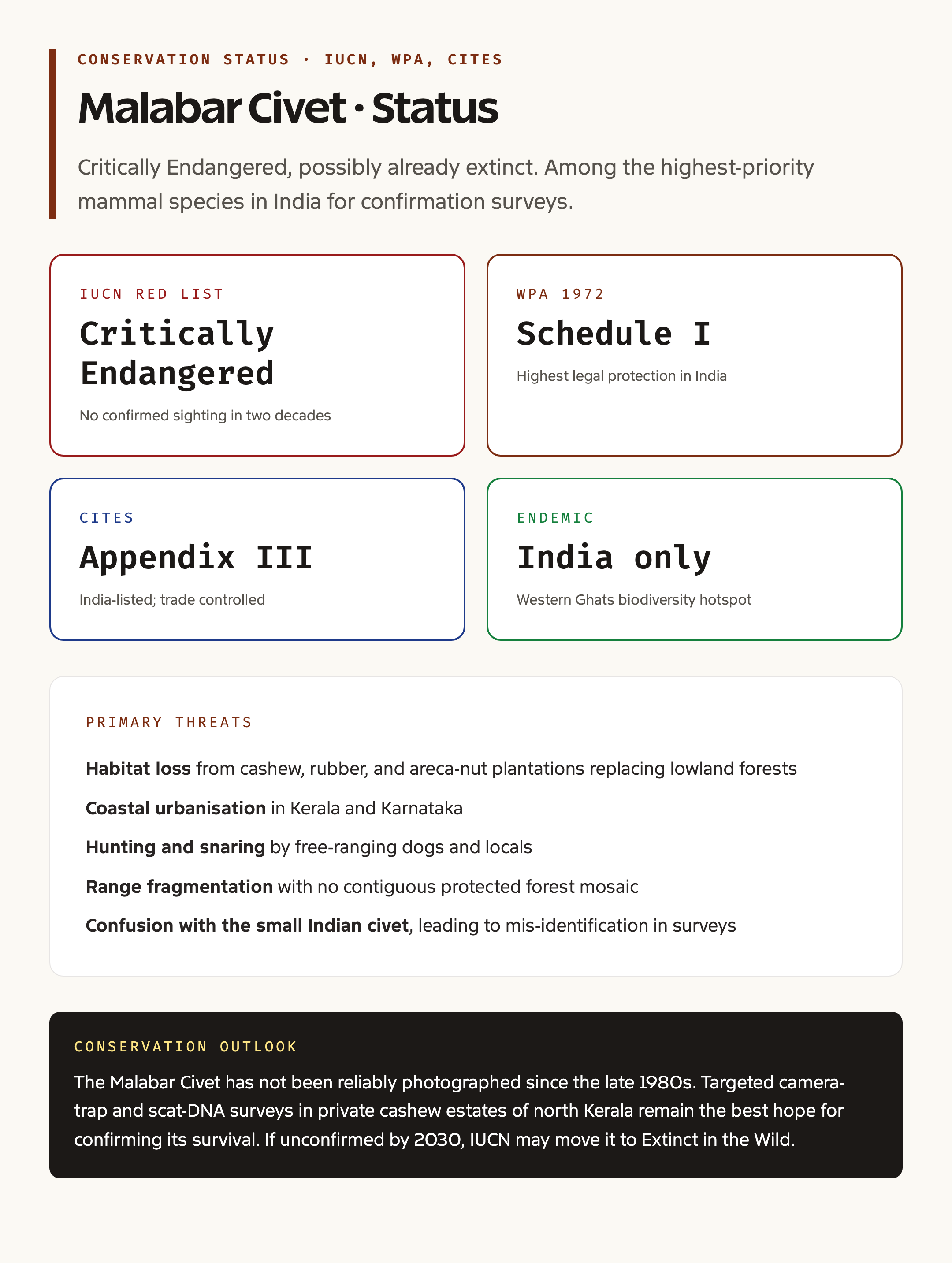
The pressures facing the Malabar civet are well documented in principle, even when the species itself is hard to find.
Habitat conversion remains the dominant pressure. The lowland forests of the Malabar coast continue to be replaced by plantations and small-scale agriculture, with limited statutory protection in the relevant land-use category.
Land-use intensification within plantations matters. The shift from older, structurally complex plantation systems with retained native trees to simplified monoculture plantations reduces the cover and prey base available to civets and other mid-sized mammals.
Domestic dog populations in the plantation and village matrix are a persistent threat to native mammals. Dogs harass, injure, and occasionally kill civets, and they spread diseases including canine distemper and rabies that can affect wildlife populations.
Road infrastructure across the coastal belt fragments connectivity. The Konkan railway, the national highway corridor, and the dense district road network all interrupt potential dispersal between forest fragments.
Climate change adds a layer of pressure on the lowland forest belt, with shifts in rainfall pattern likely to affect cashew, rubber, and natural forest cover in unpredictable ways.
Capacity is a challenge. The Kerala and Karnataka forest departments have limited specialist capacity for nocturnal mid-sized mammal surveys, and the academic community working on the species is small.
Prelims Pointers
- Scientific name of the Malabar large-spotted civet is Viverra civettina
- Local name in Kerala is Jawad
- The species is endemic to the Western Ghats of India
- Distribution is restricted to the coastal tracts of Kerala and Karnataka
- Historical habitat is lowland forests, wooded plains, and coastal hill slopes
- The animal is nocturnal, solitary, and territorial
- Diet is omnivorous, with small animals, eggs, reptiles, insects, and fruit
- Coat is dusky grey with large black spots on the flanks
- A black erectile crest runs along the spine; the tail carries black bands
- IUCN Red List status is Critically Endangered (CR)
- Listed in Schedule I of the Wildlife Protection Act, 1972
- Listed in CITES Appendix III under India’s nomination
- The species is often described as one of the world’s rarest mammals
Mains Practice Questions
- The Malabar large-spotted civet illustrates the limits of legal protection in the absence of habitat protection. Discuss with reference to Schedule I listing and the lowland Western Ghats. (15 marks)
- Examine the conservation challenges of nocturnal, secretive, and low-density mammals in India’s biodiversity policy framework. (10 marks)
- The lowland forests of the Western Ghats have received less conservation attention than the highland forests. Critically evaluate this gap. (15 marks)
- Discuss the relationship between plantation expansion and biodiversity loss in coastal peninsular India, with reference to at least one critically endangered species. (10 marks)
Way Forward
A credible conservation agenda for the Malabar civet has to start with detection. A coordinated camera-trap and scat-genetics programme across the historical range of the species, drawing on the Kerala and Karnataka forest departments, the Salim Ali Centre, the Bombay Natural History Society, and the Wildlife Institute of India, would establish whether viable populations persist and where. The deployment density needs to be high enough to overcome the species’ nocturnal and secretive behaviour.
Habitat protection in the lowland Western Ghats must follow. Specific lowland forest fragments along the Kerala-Karnataka coast that show repeated indirect evidence of civet presence should be prioritised for community reserve, conservation reserve, or sanctuary status under the Wildlife Protection Act, 1972.
A dedicated species recovery programme should be considered, modelled on the gharial and great Indian bustard programmes but adapted for the detection and habitat realities of the Malabar civet. The programme should integrate central funding, state-level operational ownership, and academic technical support.
Plantation management in the historical range should be aligned with biodiversity goals where possible, retaining native canopy trees, maintaining understorey cover, and reducing intensive chemical inputs.
Public communication needs to lift the species’ profile. The Malabar civet has not had the public visibility of the snow leopard or the lion-tailed macaque, partly because of its nocturnal habits and partly because of the absence of camera-trap photographs that can carry a campaign.
For wider context, see our guides on biodiversity in India, the Wildlife Protection Act, 1972, and environmental laws in India. For India’s protected-area framework, see our overview of the national parks of India.
Frequently Asked Questions
What is the Malabar large-spotted civet?
The Malabar large-spotted civet, Viverra civettina, is a medium-sized civet endemic to the Western Ghats of India. It is locally known as Jawad in Kerala and is one of the rarest mammals in the world. It is listed as Critically Endangered on the IUCN Red List and is in Schedule I of the Wildlife Protection Act, 1972.
Where is the Malabar civet found?
The species’ historical distribution is restricted to the coastal tracts of Kerala and Karnataka, in lowland forests, wooded plains, and coastal hill slopes. The current distribution is essentially within the same belt but is now dominated by cashew, rubber, and arecanut plantations with patches of secondary forest. Confirmed recent records are extremely rare.
Why is the Malabar civet so rare?
The decline is driven primarily by the conversion of lowland Western Ghats forest to plantations and agriculture through the twentieth century. Schedule I legal protection addresses hunting and persecution, but it does not protect the lowland forest habitat that the species depends on. Domestic dogs, road infrastructure, and intensification of plantation systems add further pressure.
What does the Malabar civet eat?
The species is omnivorous. Its diet includes small mammals, birds, eggs, reptiles, insects, and fruit. Diet composition probably varies seasonally with prey availability and fruiting phenology in the lowland forest matrix.
How is the Malabar civet identified in the field?
Identification depends on three features. The dusky grey coat is broken by large, distinct black spots on the flanks. A prominent erectile black crest runs along the spine from neck to tail base. The tail carries clear black bands and rings. The species is similar in size to the large Indian civet but is more strongly patterned and is restricted to the coastal Western Ghats.
Is the Malabar civet the same as the small Indian civet?
No. The small Indian civet, Viverricula indica, is a different species in a different genus. It is much more widespread across India and South Asia, occurs in the same landscape as the Malabar civet, and is sometimes confused with it in field reports. The Malabar civet is larger, more strongly patterned, and is restricted to the Western Ghats.
What legal protection does the Malabar civet have?
The species is listed in Schedule I of the Wildlife Protection Act, 1972, the highest schedule of domestic protection. It is also in Appendix III of CITES under India’s nomination. The IUCN Red List places it in the Critically Endangered category. Habitat protection in the form of dedicated national parks or sanctuaries in the historical range is, however, limited.
Why is musk historically associated with civets?
Civets, including the Malabar civet, secrete a strong-smelling substance from perineal glands. This musk has been valued in the perfumery trade for centuries, and several civet species have been captured for musk extraction. The Malabar civet itself has not been a major commercial source, but the broader pressure on civet populations from musk extraction has affected the family’s distribution and population dynamics.
Why is the Malabar civet called the world’s rarest mammal?
The description reflects the very small number of confirmed sightings in recent decades, the absence of a captive population, and the absence of a known viable wild population. Other critically endangered mammals share IUCN listings, but the Malabar civet’s combination of low detectability, inadequate habitat protection, and minimal recent records makes its status particularly precarious.
Can the Malabar civet still be saved?
The honest answer is that it depends on whether viable populations persist in the lowland Western Ghats. A coordinated detection programme, habitat protection in identified fragments, a dedicated species recovery programme, plantation management aligned with biodiversity goals, and increased public visibility together offer the best chance. None of these are simple, and time is short.
Tell Google you want more of this.
Add Anantam IAS as a preferred sourceOne tap, and this site shows up more often in your own Top Stories, AI Overviews and AI Mode. Remove it any time.






