Cyclones in India: Types, Impact & Disaster Management
Complete guide to cyclones in India — tropical cyclone formation, types, naming conventions, NDRF response, and disaster management for UPSC preparation.
Cyclones in India: Types, Impact & Disaster Management
Tropical cyclones are among the most devastating natural disasters affecting India, with both the Bay of Bengal and the Arabian Sea generating storms that strike the coastline. India faces an average of 4-5 cyclones annually, with the east coast being particularly vulnerable. For UPSC, cyclone formation, classification, naming conventions, India’s disaster management framework, and specific case studies are tested in Geography, Environment, and Disaster Management sections.
What Is a Tropical Cyclone?
A tropical cyclone is a rapidly rotating storm system characterised by a low-pressure centre, strong winds (exceeding 63 km/h), and heavy rainfall. It forms over warm tropical oceans where sea surface temperatures exceed 27°C.
Conditions for Cyclone Formation
| Condition | Detail |
|---|---|
| Sea Surface Temperature | >27°C to a depth of 60 m |
| Coriolis Force | Sufficient distance from Equator (>5° latitude) |
| Low Wind Shear | Minimal variation in wind speed/direction between surface and upper atmosphere |
| Moisture | High humidity in mid-troposphere |
| Pre-existing Disturbance | Low-pressure area or tropical wave |
| Upper-Level Divergence | Outflow mechanism at upper levels |
Cyclones don’t form at the Equator because the Coriolis force is zero there — the deflection needed to create rotation doesn’t exist.
Structure of a Cyclone
- Eye: Calm centre, 10-50 km diameter, clear skies, lowest pressure
- Eyewall: Ring of intense thunderstorms surrounding the eye; strongest winds and heaviest rainfall
- Rainbands: Spiral bands of clouds and rain extending outward; less intense than eyewall
- Direction of Rotation: Counter-clockwise in Northern Hemisphere; clockwise in Southern Hemisphere
Classification of Cyclones
By Intensity (IMD Classification)
The India Meteorological Department (IMD) classifies tropical cyclones based on sustained wind speed:
| Category | Wind Speed (km/h) | Description |
|---|---|---|
| Depression | 31-49 | Weak system; heavy rain |
| Deep Depression | 50-61 | Stronger; localised flooding |
| Cyclonic Storm | 62-88 | Named storm; significant wind damage |
| Severe Cyclonic Storm | 89-117 | Destructive winds; storm surge |
| Very Severe Cyclonic Storm | 118-166 | Major destruction; large storm surge |
| Extremely Severe Cyclonic Storm | 167-221 | Catastrophic damage |
| Super Cyclonic Storm | >222 | Rarest and most destructive category |
Comparison: Global Terminology
| Indian Ocean (IMD) | Atlantic/Pacific (Saffir-Simpson) | West Pacific |
|---|---|---|
| Cyclone | Hurricane | Typhoon |
| Super Cyclonic Storm | Category 5 Hurricane | Super Typhoon |
Cyclone Seasons in India
India experiences cyclones in two main seasons:
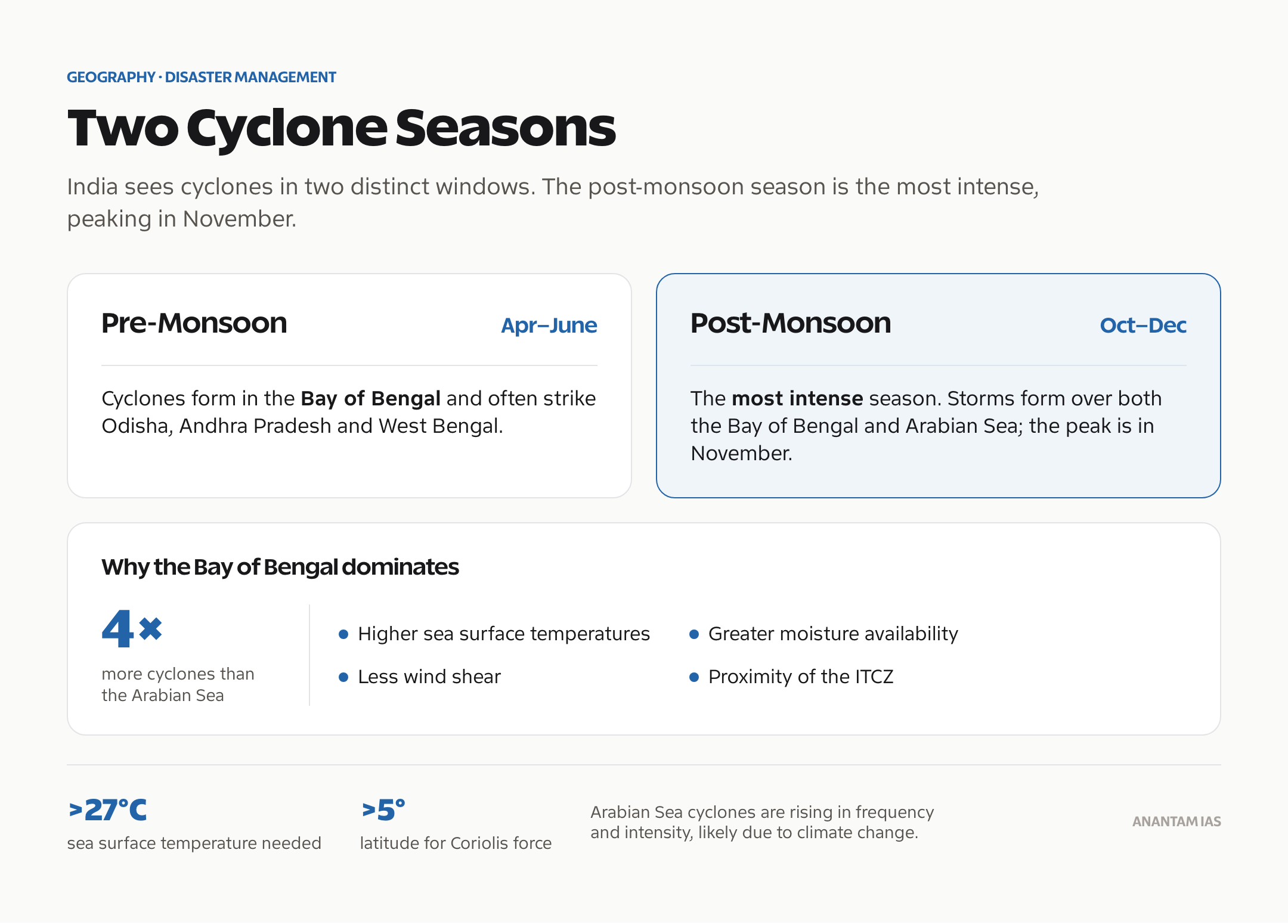
| Season | Months | Characteristics |
|---|---|---|
| Pre-Monsoon | April-June | Cyclones in Bay of Bengal; often strike Odisha, Andhra Pradesh, West Bengal |
| Post-Monsoon | October-December | Most intense season; Bay of Bengal and Arabian Sea; peak in November |
The Bay of Bengal generates roughly 4 times more cyclones than the Arabian Sea due to:
- Higher sea surface temperatures
- Greater moisture availability
- Less wind shear
- Proximity of the ITCZ
However, Arabian Sea cyclones have been increasing in frequency and intensity, likely due to climate change.
Cyclone Naming Convention
Tropical cyclones in the Indian Ocean are named by countries in the region through a process coordinated by the World Meteorological Organization (WMO) and IMD.
Current Naming System
In 2020, a new list of 169 names was adopted from 13 member countries of the WMO/ESCAP Panel on Tropical Cyclones. Names are used sequentially as storms form.
Recent notable cyclone names and origins:
| Cyclone | Year | Named By | Impact |
|---|---|---|---|
| Amphan | 2020 | Thailand | Super cyclone; devastated West Bengal; $13 billion damage |
| Tauktae | 2021 | Myanmar | Very severe; hit Gujarat coast |
| Yaas | 2021 | Oman | Severe; Odisha and West Bengal coast |
| Biparjoy | 2023 | Bangladesh | Very severe; Gujarat coast |
| Remal | 2024 | Oman | West Bengal and Bangladesh coast |
| Fengal | 2024 | Saudi Arabia | Tamil Nadu coast |
Retired names: Unlike Atlantic hurricanes, Indian Ocean cyclone names are not typically retired after devastating storms.
Major Cyclones in Indian History
| Cyclone | Year | Region | Key Impact |
|---|---|---|---|
| Bhola Cyclone | 1970 | East Pakistan (Bangladesh) | ~300,000-500,000 deaths; one of deadliest natural disasters ever |
| Super Cyclone | 1999 | Odisha | ~10,000 deaths; 260 km/h winds; led to creation of NDMA |
| Cyclone Nargis | 2008 | Myanmar (origin Bay of Bengal) | ~138,000 deaths |
| Cyclone Phailin | 2013 | Odisha | Massive evacuation (1 million people); only 45 deaths — disaster management success |
| Cyclone Hudhud | 2014 | Andhra Pradesh | ~124 deaths; devastated Visakhapatnam |
| Cyclone Fani | 2019 | Odisha | Extremely severe; 1.2 million evacuated; 89 deaths |
| Cyclone Amphan | 2020 | West Bengal | Super cyclone; $13 billion damage; 128 deaths |
The dramatic reduction in deaths from the 1999 Odisha Super Cyclone (~10,000) to Cyclone Fani in 2019 (~89 deaths) — despite similar intensity — demonstrates the effectiveness of India’s improved disaster management systems.
Impact of Cyclones
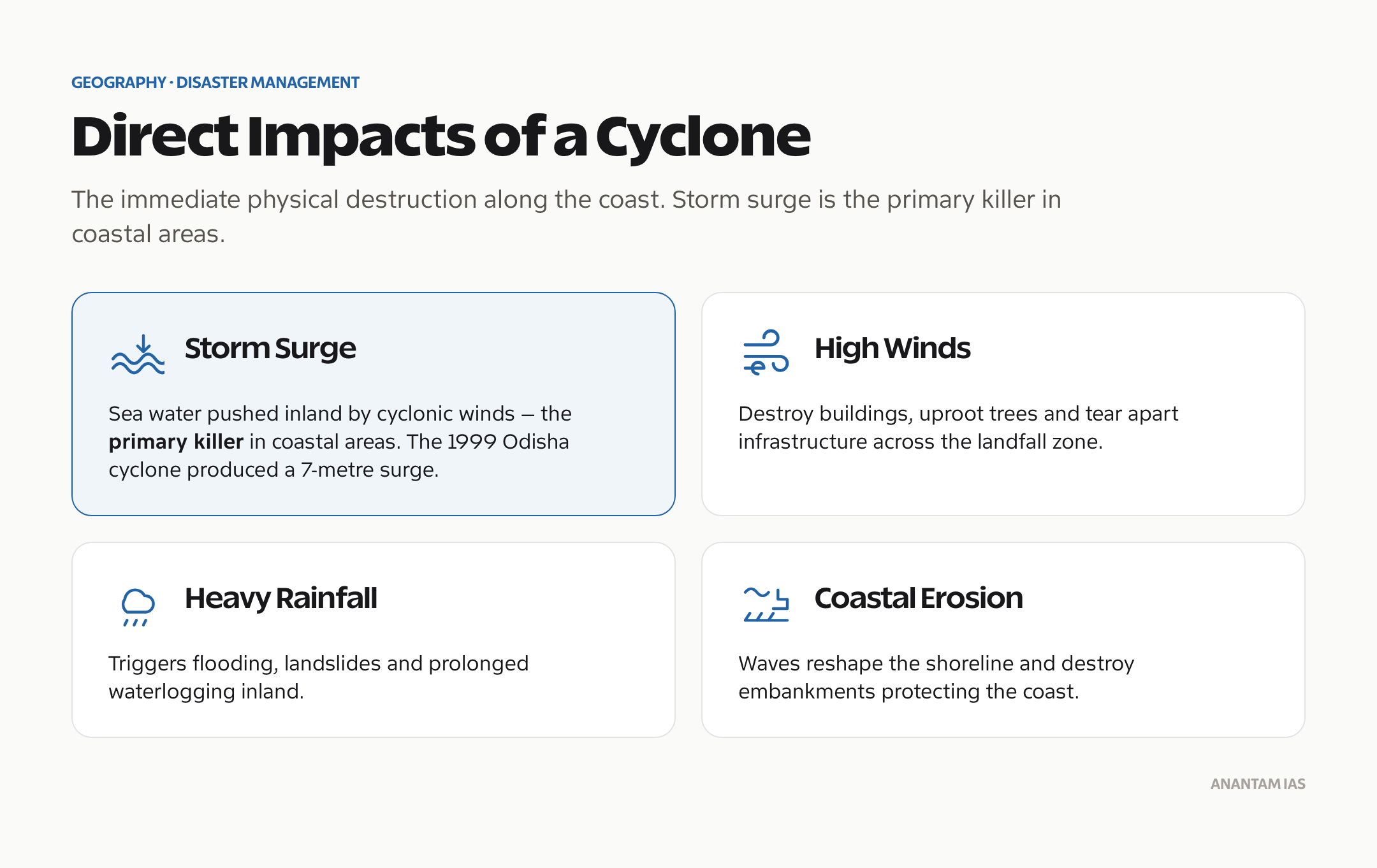
Direct Impacts
- Storm Surge: Sea water pushed inland by cyclonic winds; primary killer in coastal areas. The 1999 Odisha cyclone produced a 7-metre storm surge.
- High Winds: Destroy buildings, uproot trees, damage infrastructure
- Heavy Rainfall: Causes flooding, landslides, and waterlogging
- Coastal Erosion: Waves reshape shoreline; destroy embankments
Indirect Impacts
- Agriculture: Crop damage (paddy, cotton, horticulture); salinity intrusion in fields
- Fisheries: Boats destroyed; fishing suspended for weeks
- Infrastructure: Power lines, roads, bridges, communication systems damaged
- Health: Waterborne diseases, contaminated water supplies, vector-borne disease outbreaks
- Economy: Cyclone Amphan caused $13 billion in damage — the costliest cyclone in the Indian Ocean
Disaster Management Framework
Institutional Structure
| Organisation | Role |
|---|---|
| National Disaster Management Authority (NDMA) | Policy, planning, and coordination (chaired by PM) |
| State Disaster Management Authority (SDMA) | State-level planning and implementation |
| National Disaster Response Force (NDRF) | Specialised rescue and relief force (12 battalions) |
| India Meteorological Department (IMD) | Cyclone tracking, early warning, forecasting |
| Indian National Centre for Ocean Information Services (INCOIS) | Tsunami and storm surge warnings |
Early Warning Systems
IMD operates a sophisticated cyclone warning system:
- Doppler Weather Radars — 37 radar stations covering both coasts
- Satellite Imagery — INSAT series provides continuous monitoring
- Automated Weather Stations — real-time data from coastal areas
- Cyclone Warning Centres — at Chennai, Mumbai, Kolkata, and Bhubaneswar
- Multi-hazard warning system — colour-coded alerts (green, yellow, orange, red)
Evacuation Protocol
India’s cyclone evacuation model — particularly Odisha’s — is internationally recognised:
- IMD issues track forecast 72-48 hours before landfall
- SDMAs activate evacuation plans
- NDRF pre-positions teams in likely landfall areas
- Community volunteers go door-to-door in vulnerable zones
- Cyclone shelters accommodate evacuees
- Post-landfall: search and rescue, relief distribution, restoration
Odisha’s success in reducing cyclone deaths stems from investments in:
- Cyclone shelters: Over 900 multi-purpose cyclone shelters on the coast
- Early warning dissemination: Through SMS, TV, radio, sirens, and community volunteers
- Regular mock drills: State Disaster Management Authority conducts annual exercises
Earthquakes in India: Zones, History & Preparedness
Climate Change and Cyclones
Climate change is altering cyclone behaviour in the Indian Ocean:
- Intensification: Rapid intensification events (strength jumps in 24 hours) are becoming more common
- Arabian Sea Cyclones: Increasing in frequency due to warmer sea surface temperatures
- Extended Season: Cyclones occurring outside traditional seasons
- Storm Surge Risk: Sea-level rise amplifies storm surge impacts
- Rainfall Intensity: Warmer atmosphere holds more moisture, leading to heavier rainfall
The 2020 season saw record cyclones in the Indian Ocean, including Super Cyclone Amphan and Cyclone Nisarga (rare Arabian Sea cyclone hitting Maharashtra).
Frequently Asked Questions
Which coast of India is more prone to cyclones?
The east coast — particularly Odisha, Andhra Pradesh, West Bengal, and Tamil Nadu — is far more cyclone-prone than the west coast. The Bay of Bengal generates roughly four times more cyclones than the Arabian Sea due to warmer waters, higher moisture, and favourable atmospheric conditions. However, Arabian Sea cyclones are increasing.
How are cyclones named in the Indian Ocean?
A list of 169 names was compiled by 13 member countries of the WMO/ESCAP Panel on Tropical Cyclones. Names are used sequentially as cyclones form. India suggested names like Gati, Tej, Murasu, and Aag. The naming system aids communication and public awareness during warnings.
What was the 1999 Odisha Super Cyclone?
The 1999 Odisha Super Cyclone made landfall on 29 October with winds exceeding 260 km/h and a 7-metre storm surge. About 10,000 people died and 15 million were affected. This disaster directly led to the enactment of the Disaster Management Act, 2005 and the creation of NDMA and NDRF.
How has India improved cyclone disaster management?
India dramatically reduced cyclone fatalities through better IMD forecasting, NDRF pre-positioning, mass evacuations (1.2 million for Cyclone Fani), over 900 cyclone shelters on the Odisha coast, community-level early warning dissemination, and regular mock drills. The death toll from comparable storms has dropped from thousands to double digits.