Dadasaheb Phalke Award: India’s Highest Cinematic Honour Explained
Dadasaheb Phalke Award explained — established 1969 by MoIB, criteria, components (Swarna Kamal + ₹10 lakh), recent winners from Mithun Chakraborty to Rajinikanth, and UPSC relevance.
The Dadasaheb Phalke Award is the highest honour the Government of India confers in the field of cinema. It recognizes a lifetime of outstanding contribution to the growth and development of Indian cinema, and is presented every year at the National Film Awards ceremony. The award was instituted in 1969 by the Ministry of Information and Broadcasting to mark the birth centenary of Dhundiraj Govind Phalke, the man universally regarded as the Father of Indian Cinema.
Devika Rani was the first recipient in 1969. Since then, the list of winners reads as a who’s who of Indian cinema — directors, actors, singers, composers, cinematographers, producers, and screenwriters whose work shaped the moving image across multiple languages and decades. The 2022 award was conferred on actor Mithun Chakraborty, the 54th recipient, presented at the 70th National Film Awards ceremony.
This article walks through the origins of the Dadasaheb Phalke Award, its criteria and components, the life of Dadasaheb Phalke, recent winners, the selection process, and the award’s place in Indian cultural policy.
Quick Facts About the Dadasaheb Phalke Award
- Established: 1969 by the Ministry of Information and Broadcasting
- Awarding body: Government of India
- Inaugural recipient: Devika Rani (1969)
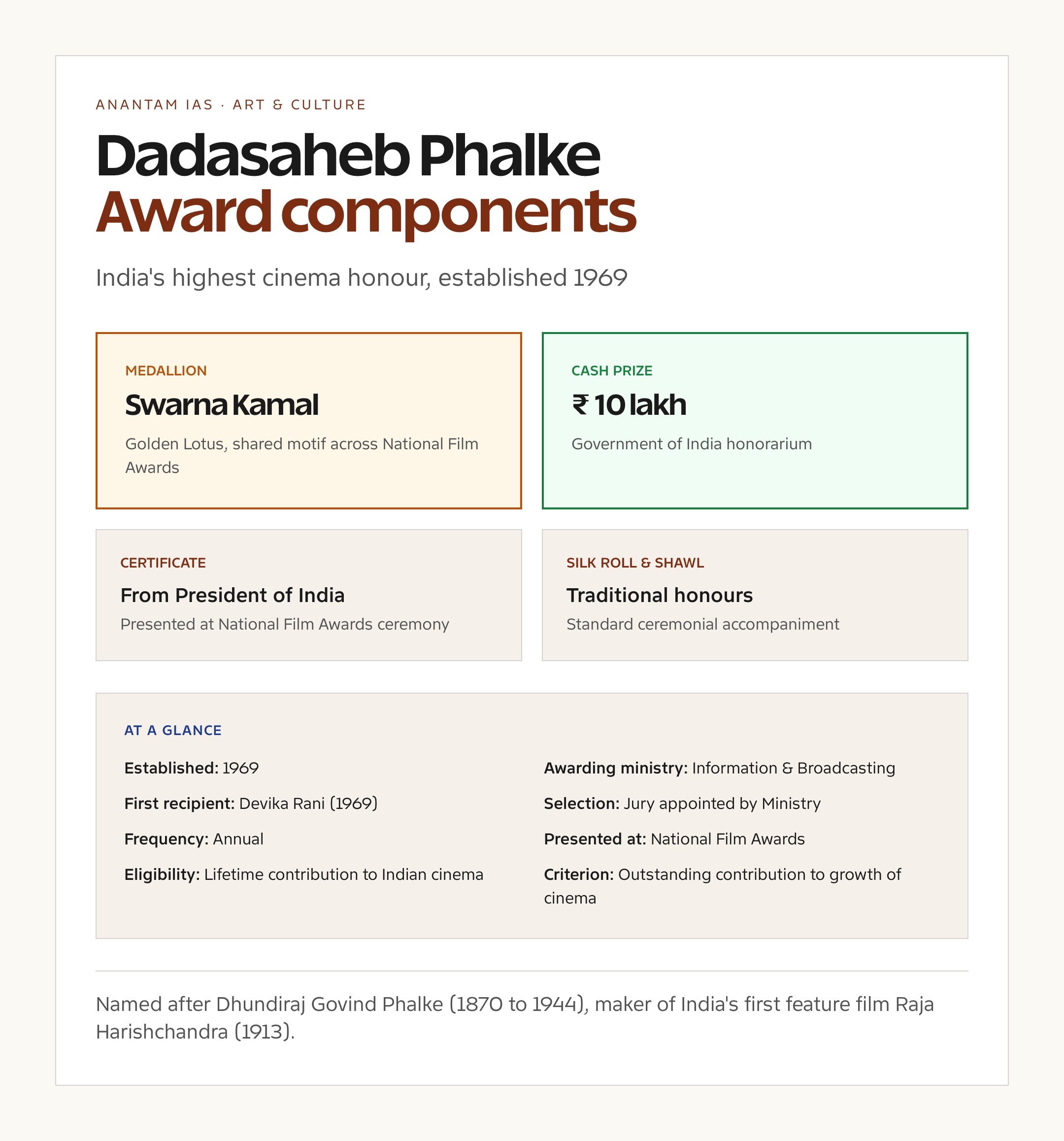
- Award components: Swarna Kamal (Golden Lotus) medallion, cash prize of ₹10 lakh, certificate, silk roll, and shawl
- Presented during: annual National Film Awards ceremony
- Most recent announced winner (as of 2026): Mithun Chakraborty for 2022 (54th recipient)
- Named after: Dhundiraj Govind Phalke (1870 to 1944), Father of Indian Cinema
- Eligibility: lifetime contribution to Indian cinema across any role — director, actor, producer, technician
Who Was Dadasaheb Phalke
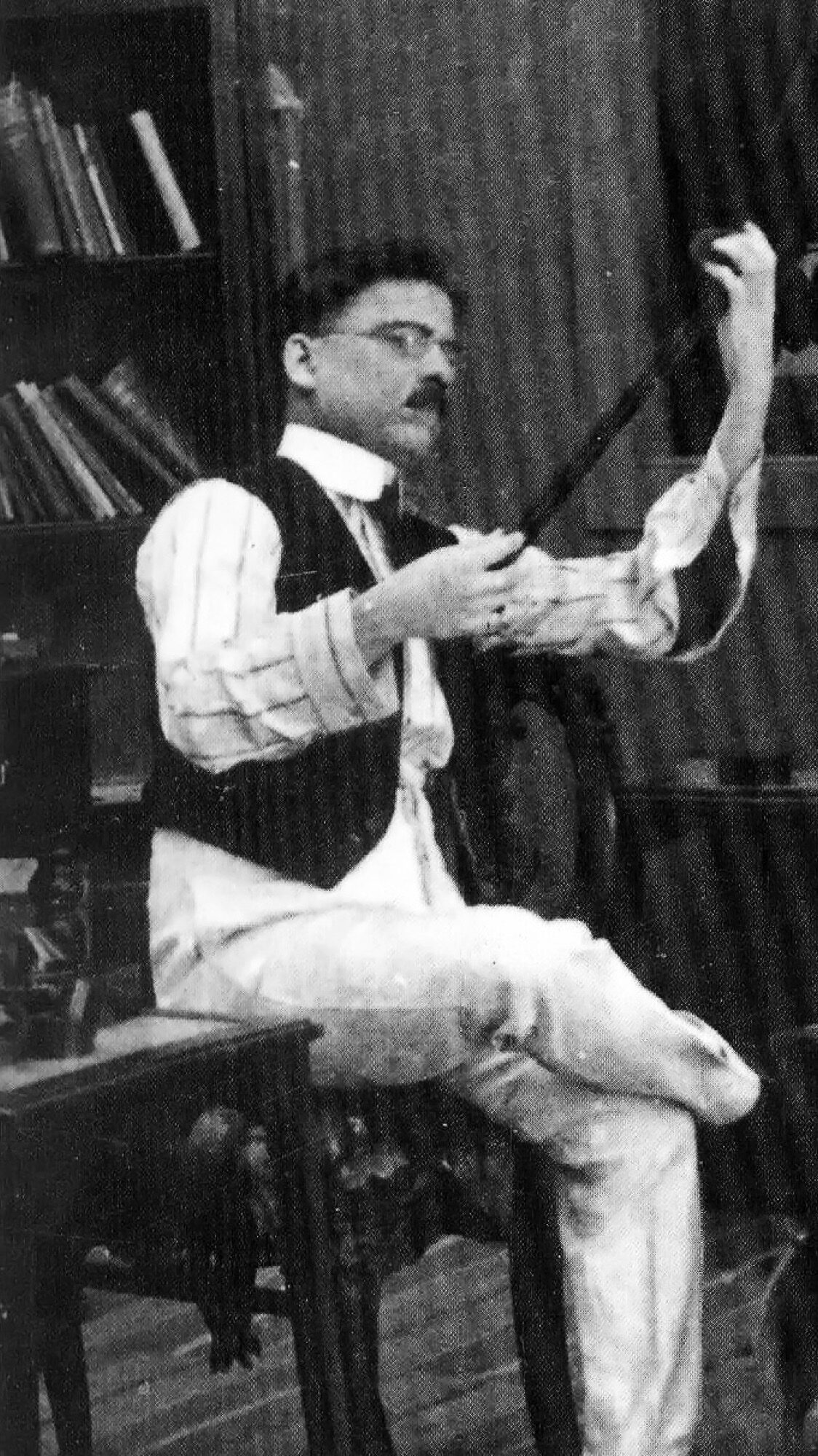
Dhundiraj Govind Phalke, popularly known as Dadasaheb Phalke, was born on 30 April 1870 in Trimbak, Maharashtra. He trained at Sir J.J. School of Art in Bombay and the Kala Bhavan in Baroda, learning drawing, photography, lithography, and stage craft. After working as a photographer, printer, and magician, he watched the 1910 silent film The Life of Christ in Bombay and decided that India must make its own films telling Indian stories.
Phalke travelled to London in 1912 to study cinematography and bought a Williamson camera. He returned to Bombay, set up Phalke Films Company, and produced India’s first full-length feature film, Raja Harishchandra, released on 3 May 1913 at Coronation Cinematograph in Bombay. The film, an adaptation of the Mahabharata episode of King Harishchandra, was a silent black-and-white production with title cards in Hindi and English. Phalke wrote, directed, produced, photographed, edited, and processed the film almost single-handedly, with his wife Saraswatibai handling the laboratory work and his son Bhalchandra acting in it.
Over the next two decades, Phalke produced around 95 feature films and 27 short films, including Mohini Bhasmasur (1913), Satyavan Savitri (1914), and Lanka Dahan (1917). He moved to Nashik in 1917 and continued making films until the early 1930s. The transition to sound cinema in 1931 with Alam Ara coincided with his decline. He made his last film, Setubandhan, in 1932 and died in Nashik on 16 February 1944, in modest circumstances.
The Dadasaheb Phalke Award was instituted twenty-five years after his death to honour his pioneering legacy and to anchor a national tradition of recognizing lifetime cinematic achievement.
Award Components and Presentation
The Dadasaheb Phalke Award is presented along with:
- A Swarna Kamal (Golden Lotus) medallion — the same iconic motif used across the National Film Awards
- A cash prize of ₹10 lakh
- A certificate of honour from the President of India or the Vice-President
- A silk roll (the traditional Indian scroll honour)
- A shawl
The award is presented at the National Film Awards ceremony, typically held in New Delhi, in the presence of the President of India and the Union Minister for Information and Broadcasting. The ceremony also confers the Swarna Kamal and Rajat Kamal awards across feature film, non-feature film, and writing categories.
Eligibility and Criteria
The award is granted for “outstanding contribution for the growth and development of Indian cinema.” It is open to artists, technicians, and producers from any branch of cinema — direction, acting, screenwriting, music composition, lyric writing, cinematography, editing, sound design, art direction, costume design, makeup, and production. Eligibility cuts across language, region, and genre. Winners have come from Hindi, Bengali, Tamil, Telugu, Marathi, Malayalam, and Kannada cinema.
Lifetime contribution is the central criterion. Most recipients have been in their seventies or older at the time of receipt, with bodies of work spanning four or more decades. There is no nomination by the public. The selection is made by a jury appointed by the Ministry of Information and Broadcasting.
Selection Process and Jury
The Directorate of Film Festivals, which administered the National Film Awards until its merger with the National Film Development Corporation in 2022, has historically managed the selection. The Dadasaheb Phalke Award jury is constituted separately from the feature and non-feature film juries. It consists of eminent personalities from the world of cinema — past awardees, senior critics, and producers. The jury reviews candidates’ lifetime work, deliberates, and submits a single name to the Ministry. The Government of India formally announces the recipient.
A separate, privately organized event known as the Dadasaheb Phalke International Film Festival Awards is sometimes confused with the official award. The two are distinct. The official Dadasaheb Phalke Award is the one conferred by the Government of India.
Recent Winners of the Dadasaheb Phalke Award
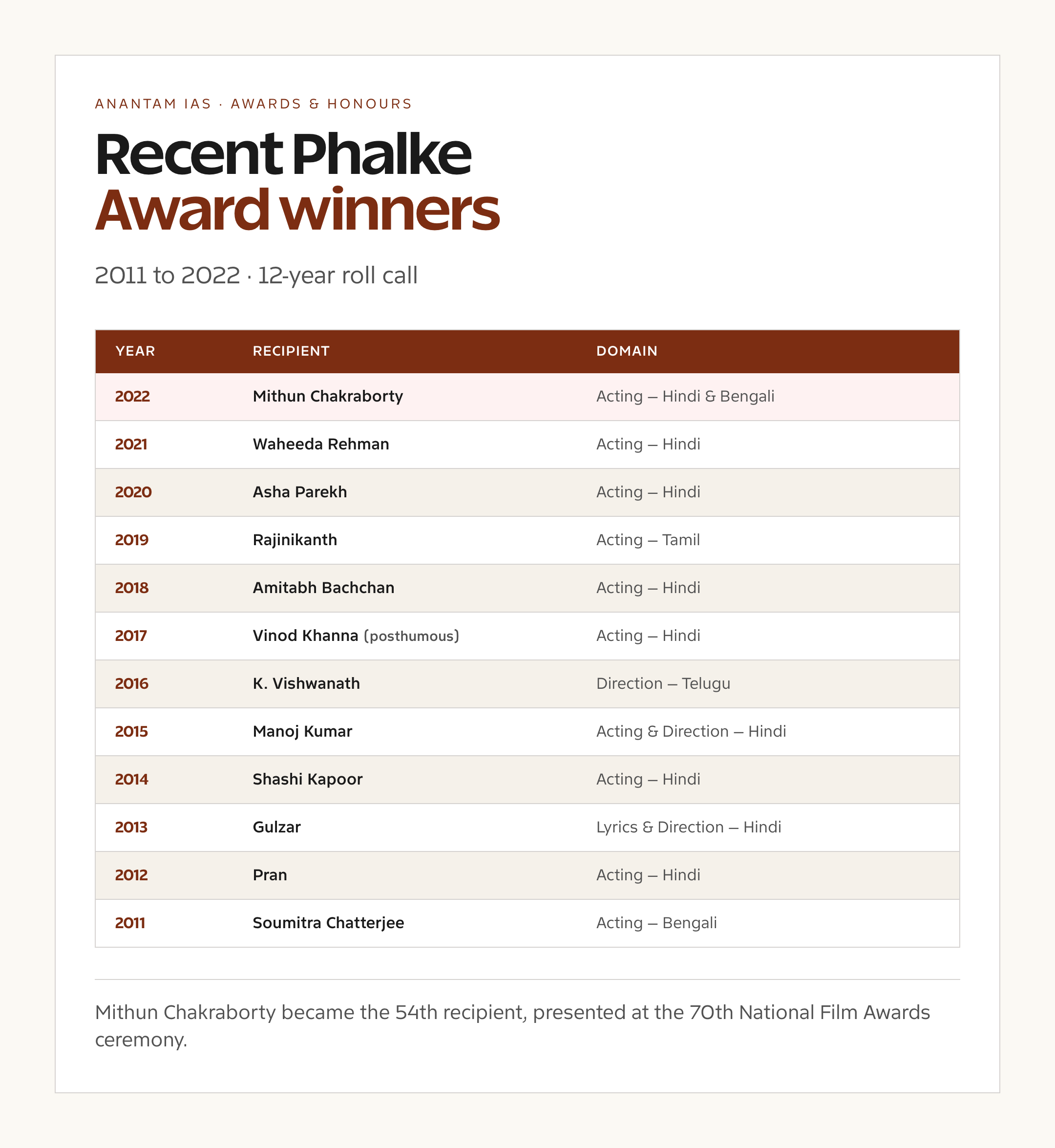
The following are the recent recipients of the Dadasaheb Phalke Award.
| Year | Recipient | Domain |
|---|---|---|
| 2022 | Mithun Chakraborty | Acting (Hindi and Bengali cinema) |
| 2021 | Waheeda Rehman | Acting (Hindi cinema) |
| 2020 | Asha Parekh | Acting (Hindi cinema) |
| 2019 | Rajinikanth | Acting (Tamil cinema) |
| 2018 | Amitabh Bachchan | Acting (Hindi cinema) |
| 2017 | Vinod Khanna (posthumous) | Acting (Hindi cinema) |
| 2016 | K. Vishwanath | Direction (Telugu cinema) |
| 2015 | Manoj Kumar | Acting and Direction (Hindi cinema) |
| 2014 | Shashi Kapoor | Acting (Hindi cinema) |
| 2013 | Gulzar | Lyrics and Direction (Hindi cinema) |
| 2012 | Pran | Acting (Hindi cinema) |
| 2011 | Soumitra Chatterjee | Acting (Bengali cinema) |
Mithun Chakraborty was announced as the 2022 recipient in September 2024 and formally received the award at the 70th National Film Awards ceremony. He became the 54th recipient. His five-decade career spans Mrigayaa (1976), for which he won his first National Film Award for Best Actor, the Disco Dancer phenomenon (1982) that made him an international star across the Soviet Union and beyond, and a sustained presence in Bengali and Hindi cinema. He also served as a Rajya Sabha Member of Parliament.
Notable Past Recipients
Devika Rani (1969)
The first recipient of the Dadasaheb Phalke Award. Known as the First Lady of Indian Cinema, she co-founded Bombay Talkies in 1934 with Himanshu Rai. Her films include Karma (1933) and Achhut Kanya (1936).
Satyajit Ray (1985)
The Bengali auteur who brought Indian cinema to global recognition through Pather Panchali (1955) and the Apu Trilogy. Ray also received the Bharat Ratna in 1992 and an honorary Academy Award the same year.
Lata Mangeshkar (1989)
The playback singer recorded thousands of songs across multiple Indian languages over a career that spanned more than seven decades. She received the Bharat Ratna in 2001.
Akkineni Nageswara Rao (1990)
The Telugu cinema legend with a six-decade career across mythological, devotional, and social films.
Yash Chopra (2001)
The director and producer who shaped the contemporary Hindi romance genre through films like Daag (1973), Silsila (1981), Chandni (1989), and Dilwale Dulhania Le Jayenge (1995, as producer).
A.R. Rahman did not receive the Dadasaheb Phalke Award but won two Oscars in 2009, reflecting that the award honours lifetime contribution rather than peak international recognition alone.
Dadasaheb Phalke and Indian Cinema’s Wider Story
The history of Indian cinema is inseparable from the broader trajectory of Indian art and culture. The Lumière Brothers’ first cinematograph screening in India took place in Bombay in July 1896, only seven months after the Paris debut. Indian filmmakers experimented through the 1900s, but it was Phalke’s Raja Harishchandra in 1913 that established the indigenous feature film tradition. The talkie era began with Alam Ara in 1931. Regional cinemas emerged through the 1930s — Bengali, Tamil, Telugu, and Marathi industries developed parallel canons. The 1950s and 60s saw the rise of the social realist and parallel cinema movements alongside the commercial mainstream. From the 1970s onwards, Hindi cinema globalized while regional cinemas — particularly Malayalam, Tamil, and Telugu — produced distinctive bodies of work.
For UPSC aspirants, the Dadasaheb Phalke Award sits within the wider examination of Indian art forms, popular culture, and soft power. Related themes include the history of theatre, the contribution of Indian classical languages to film dialogue and lyrics, the National Film Development Corporation, the National Film Archive of India, the Film and Television Institute of India in Pune, and the Satyajit Ray Film and Television Institute in Kolkata.
Controversies and Criticisms
The award has not been free of controversy. Critics have pointed to:
- Predominance of Hindi cinema among recipients, with Bengali, Tamil, and Telugu cinema represented but Malayalam and Kannada under-represented
- Limited representation of women — fewer than ten women have received the award in over five decades
- Limited recognition of below-the-line technicians (cinematographers, editors, sound designers) compared with actors and directors
- Delays in announcement and conferment, with some awards declared multiple years after the relevant year
- Confusion with privately organized awards using the Dadasaheb Phalke name
These critiques have shaped the conversation around the Ministry of Information and Broadcasting’s selection processes and the broader institutional support for cinema.
UPSC Relevance and Recurring Themes
The Dadasaheb Phalke Award appears regularly in UPSC Prelims through questions on awards, honours, and ceremony details. Recent winner names, year of establishment, awarding ministry, and award components are common factual hooks. Mains GS-I draws on the broader history of Indian art and cinema, the role of cinema in social reform and nation-building, and the cultural representation debates around regional cinemas. GS-II touches on the Ministry of Information and Broadcasting, broadcasting and film policy, and the consolidation of cinema institutions under the NFDC. Essay papers occasionally engage with cinema as a vehicle for social change and as a soft power tool of Indian foreign policy.
Key revision points: year of establishment (1969), award components (Swarna Kamal, ₹10 lakh, certificate, shawl, silk roll), inaugural recipient (Devika Rani 1969), recent recipients (Mithun Chakraborty 2022, Waheeda Rehman 2021, Asha Parekh 2020, Rajinikanth 2019, Amitabh Bachchan 2018), and the distinction between the official government award and the privately organized Dadasaheb Phalke International Film Festival Awards.
See also the list of Indian Nobel Prize winners and the contribution of freedom fighters for adjacent UPSC honour and recognition topics.
Frequently Asked Questions
When was the Dadasaheb Phalke Award established?
The Dadasaheb Phalke Award was established in 1969 by the Ministry of Information and Broadcasting, Government of India, to mark the birth centenary of Dhundiraj Govind Phalke, the Father of Indian Cinema. The first recipient was actor and producer Devika Rani.
Who received the Dadasaheb Phalke Award for 2022?
Actor Mithun Chakraborty received the Dadasaheb Phalke Award for 2022. He became the 54th recipient. The award was conferred at the 70th National Film Awards ceremony. His career spans nearly five decades across Bengali and Hindi cinema.
What does the Dadasaheb Phalke Award include?
The Dadasaheb Phalke Award includes a Swarna Kamal (Golden Lotus) medallion, a cash prize of ₹10 lakh, a certificate of honour, a silk roll, and a shawl. It is presented at the National Film Awards ceremony in the presence of the President of India and the Union Minister for Information and Broadcasting.
Why is Dadasaheb Phalke called the Father of Indian Cinema?
Dadasaheb Phalke is called the Father of Indian Cinema because he produced India’s first full-length indigenous feature film, Raja Harishchandra, released on 3 May 1913 in Bombay. He went on to produce around 95 feature films and 27 shorts, single-handedly building the technical, narrative, and business foundations of Indian cinema.
Who was the first woman to receive the Dadasaheb Phalke Award?
Devika Rani was the first recipient of the Dadasaheb Phalke Award in 1969, and also the first woman to receive it. Known as the First Lady of Indian Cinema, she co-founded Bombay Talkies in 1934 with Himanshu Rai.
Which ministry administers the Dadasaheb Phalke Award?
The Ministry of Information and Broadcasting, Government of India, administers the Dadasaheb Phalke Award. Selection is made by a jury constituted by the Ministry, and the award is presented at the annual National Film Awards ceremony.