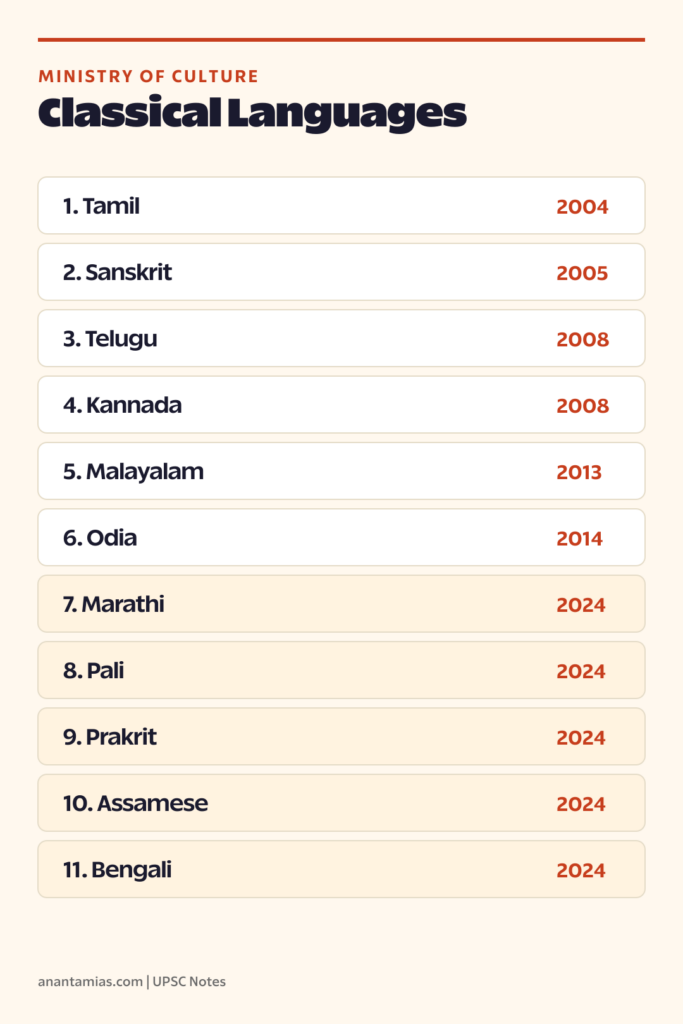
Classical languages of India now stand at eleven after the Union Cabinet decision of 3 October 2024 added five more tongues to the list. The category sits inside the Ministry of Culture and carries dedicated funding, a Centre of Excellence, and two annual international awards for scholars working on the language. It is a status conferred on languages judged to have a literary tradition deep enough, original enough, and continuous enough to belong to a separate civilisational shelf. The classical languages of India are now Tamil, Sanskrit, Telugu, Kannada, Malayalam, Odia, Marathi, Pali, Prakrit, Assamese, and Bengali.
The classification began in 2004 when Tamil became the first Indian language declared classical, after a long campaign rooted in Sangam-age literature. Sanskrit followed in 2005. Telugu and Kannada were added in 2008, Malayalam in 2013, Odia in 2014, and then a decade-long gap ended with the 2024 expansion that brought in Marathi, Pali, Prakrit, Assamese, and Bengali in a single Cabinet decision. Each of these additions came after the Linguistic Experts Committee under the Sahitya Akademi cleared the language on revised criteria.
This explainer lays out the revised 2024 criteria, walks through the full list with dates, and maps the policy stakes, including the difference between classical status and Eighth Schedule status, the funding architecture, and the political economy of recognition demands now pending from Bhojpuri, Maithili, and others.
What classical status actually means
Classical status is an administrative recognition, not a constitutional one. It does not appear in the Constitution. It is granted by a Cabinet decision on the recommendation of the Ministry of Culture, which acts on advice from the Linguistic Experts Committee constituted under the Sahitya Akademi.
A classical language gets four entitlements:
- Two international awards each year for scholars of eminence working on the language
- A Centre of Excellence for the study of the language, set up under the Ministry of Culture
- A request to the University Grants Commission to create chairs in central universities for the language
- Project-based research grants for preservation, digitisation, and critical editions of literary works
The funding sits separately from the budget for Eighth Schedule languages, which is routed through the Ministry of Home Affairs and the Department of Official Language. The two streams are independent.
The revised 2024 criteria
The Linguistic Experts Committee revised the criteria for classical status in July 2024, and the revised yardsticks were used to clear Marathi, Pali, Prakrit, Assamese, and Bengali in October that year. The earlier criteria, framed in 2004 and amended in 2005, had three core requirements built around antiquity, a literary tradition, and original literature distinct from later forms.
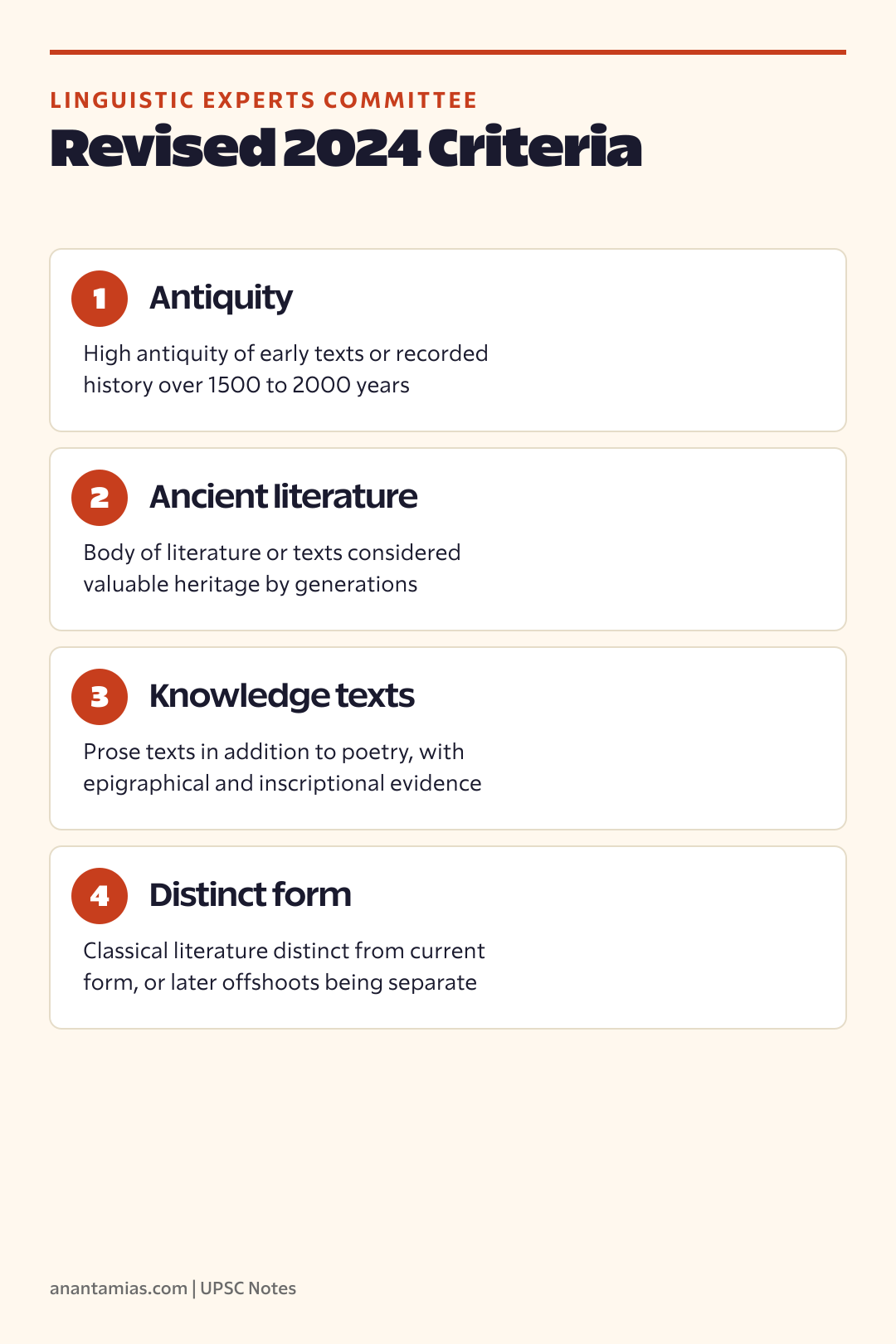
The revised criteria, as notified by the Ministry of Culture, are:
- High antiquity of early texts or recorded history over a period of 1500 to 2000 years
- A body of ancient literature or texts considered a valuable heritage by generations of speakers
- Knowledge texts, especially prose texts, in addition to poetry, with epigraphical and inscriptional evidence
- The classical language and literature being distinct from its current form, or the literature of its later offshoots being separate
The deletion of the earlier requirement that the classical tradition be original and not borrowed from another speech community was the key change in 2024. That single change opened the door for languages whose classical traditions interleave with Sanskrit, Pali, and Prakrit, including Marathi, Assamese, and Bengali.
The Sahitya Akademi committee
The Linguistic Experts Committee functions under the Sahitya Akademi. It is chaired by a Union government nominee and includes specialists in linguistics, literature, history, and epigraphy. The committee evaluates dossiers submitted by state governments or language bodies. Its recommendations are not binding on the Cabinet, but in practice every classical language declaration since 2004 has followed an affirmative committee report.
The full list of classical languages of India
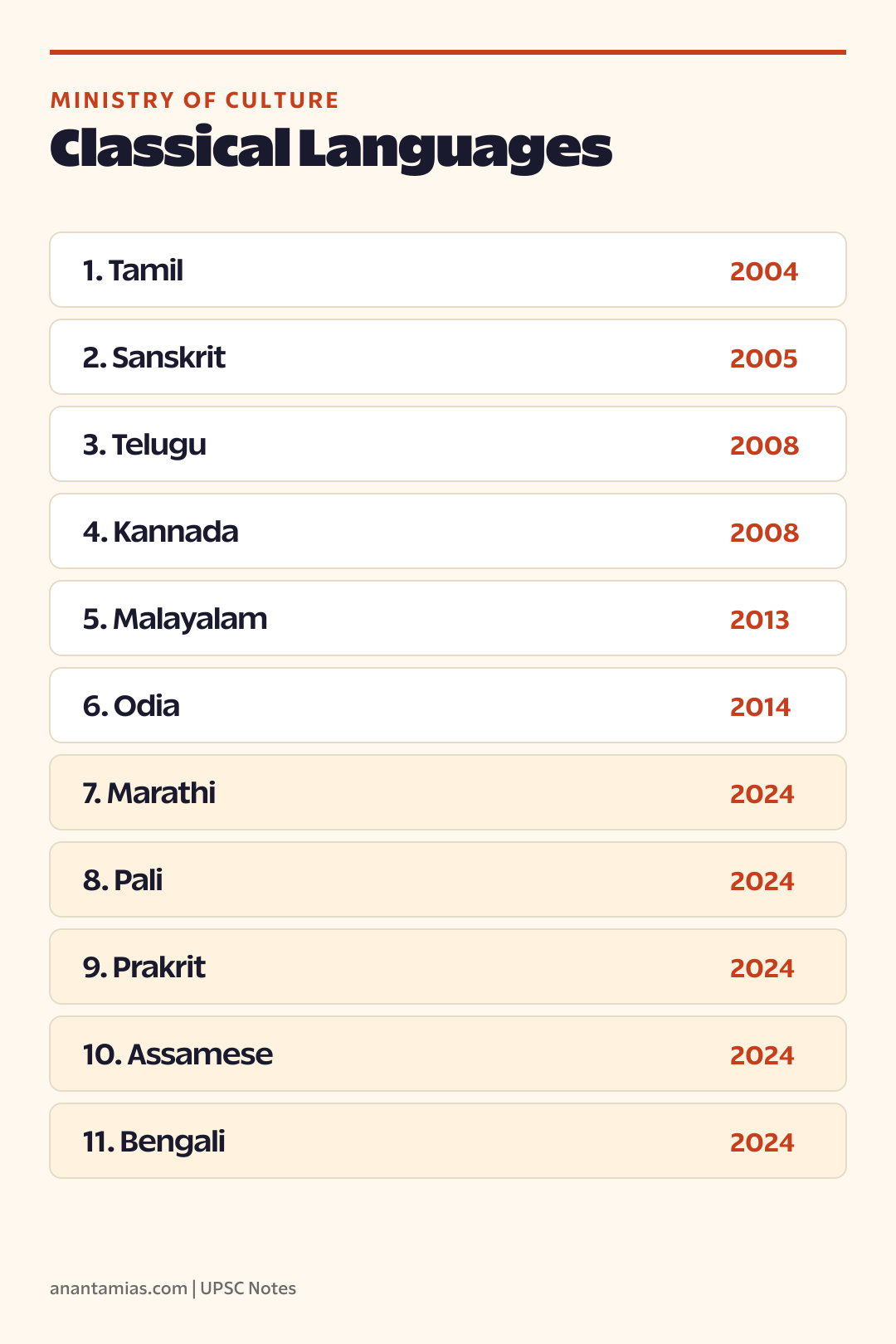
The eleven classical languages of India, with the year they were declared, are:
- Tamil, declared in 2004
- Sanskrit, declared in 2005
- Telugu, declared in 2008
- Kannada, declared in 2008
- Malayalam, declared in 2013
- Odia, declared in 2014
- Marathi, declared in 2024
- Pali, declared in 2024
- Prakrit, declared in 2024
- Assamese, declared in 2024
- Bengali, declared in 2024
Each was added by a Cabinet decision after the relevant state government submitted a memorandum and the Linguistic Experts Committee returned a favourable opinion.
Tamil and the 2004 precedent
Tamil was the first language declared classical. The decision drew on Sangam literature, dated by mainstream Tamil scholarship to between 300 BCE and 300 CE, and on the Tolkappiyam, the oldest extant grammar of Tamil. The classification followed sustained political demand from Tamil Nadu and was announced in October 2004. The 2004 decision set the institutional template that has been used since.
Sanskrit, Telugu, Kannada, Malayalam, Odia
Sanskrit was declared classical in 2005, with reference to the Rigvedic corpus, the grammarian Panini, and the post-Vedic literary tradition. Telugu and Kannada were notified together in October 2008. Malayalam followed in May 2013, based largely on the Sangam-period Cheraman tradition and the later Kerala literary corpus. Odia became the sixth classical language in February 2014, with reference to the Charyapada and a literary tradition traced to the seventh century CE.
The 2024 quintet
The October 2024 Cabinet decision added five languages in one move, the largest single expansion in the history of the scheme. Marathi recognition drew on the Leelacharitra, the thirteenth-century Mahanubhava Sampradaya text, and on early inscriptions. Bengali drew on the Charyapada, the early Buddhist mystic songs from the eighth to twelfth centuries. Assamese recognition cited the Charyapada as well, alongside the Kamarupa inscriptions and the early Vaishnavite literature of Sankardev. Pali, the canonical language of the Theravada Buddhist tradition, and Prakrit, the family of Middle Indo-Aryan languages used in Jain canonical texts and early epigraphy including the Ashokan edicts, completed the list.
Classical status versus Eighth Schedule status
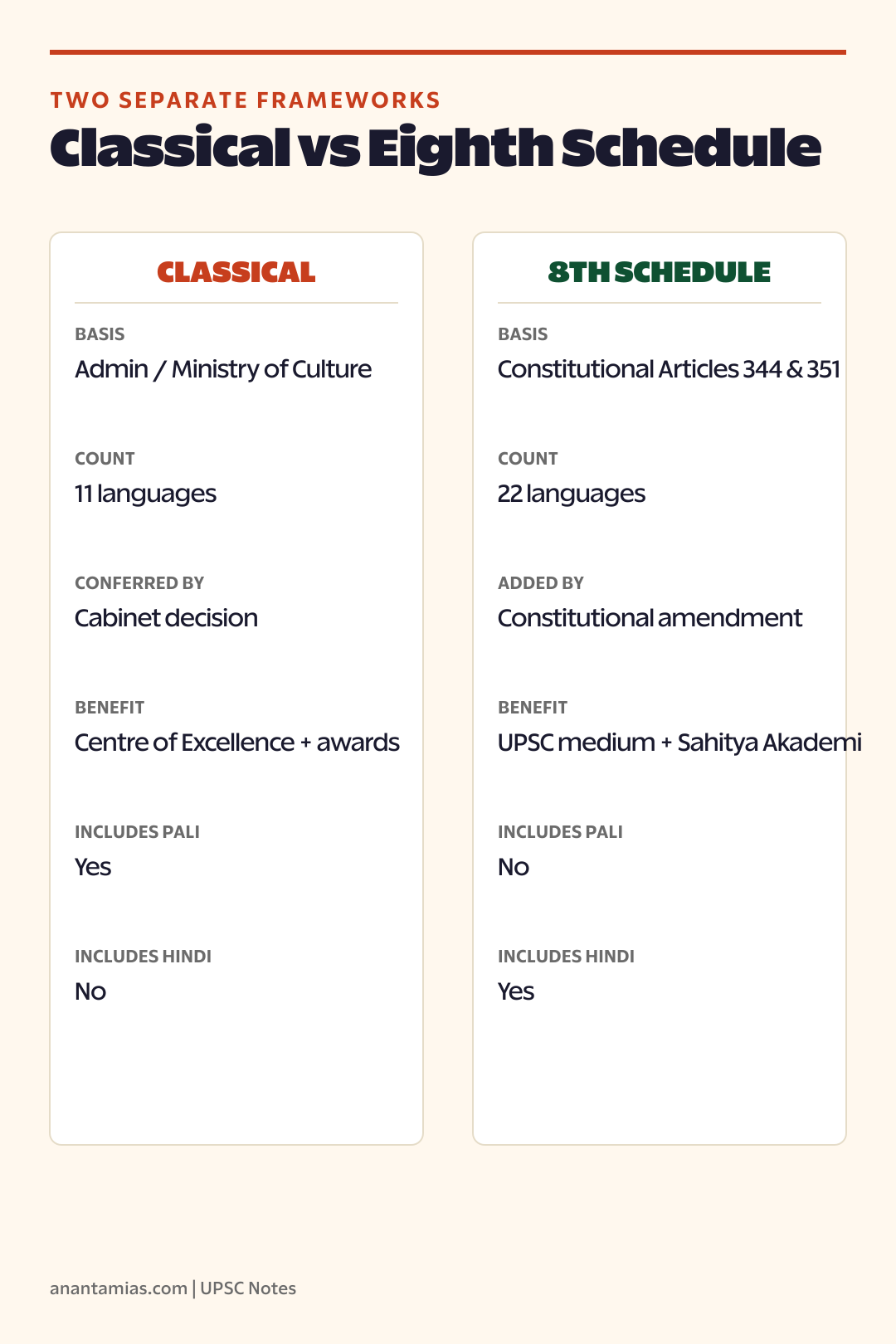
These are two different recognitions that often get conflated. The Eighth Schedule of the Constitution, framed under Articles 344 and 351, lists 22 languages. Membership of the Eighth Schedule triggers obligations on the Union, including consultation with the Official Languages Commission and a duty to develop Hindi by drawing on these languages. Classical status carries cultural and academic funding, but no constitutional consequence.
Not every classical language is in the Eighth Schedule, and not every Eighth Schedule language is classical. Pali and Prakrit are classical but not in the Eighth Schedule. Hindi, Urdu, Punjabi, Gujarati, and seventeen others are in the Eighth Schedule but are not classical. The overlap between the two lists currently runs to nine languages: Tamil, Sanskrit, Telugu, Kannada, Malayalam, Odia, Marathi, Assamese, and Bengali.
For UPSC, the distinction matters. The Eighth Schedule languages post tracks the 22-language list and its constitutional architecture in detail. The one nation one language post covers the Hindi-imposition debate that often gets entangled with classical-status politics.
Pending demands and the politics of recognition
Several languages have active classical-status demands at various stages of evaluation. The principal ones are Bhojpuri, Maithili, Magahi, Awadhi, Brij Bhasha, Khasi, Mizo, and Sindhi. Bhojpuri carries the strongest political weight given speaker numbers across eastern Uttar Pradesh, western Bihar, and the Bhojpuri diaspora in Mauritius, Fiji, and Suriname. Maithili already sits in the Eighth Schedule but does not have classical status. Sindhi has a documented pre-Partition literary corpus and a long-standing demand from the Sindhi diaspora.
The political economy works in two directions. State governments push for recognition to flow research and academic funding to home universities. The Union government uses the timing of recognitions to signal cultural attention to specific linguistic constituencies. The October 2024 expansion, which covered Marathi and Bengali among others, came months ahead of the Maharashtra assembly election and weeks before West Bengal political mobilisation around language identity.
Implications for funding and research
Each classical language receives funding through three channels:
- A Centre of Excellence for the language, hosted by a central university or research body
- The President’s Certificate of Honour and Maharshi Badrayan Vyas Samman, the latter being a separate Sanskrit-specific award
- Two international awards instituted by the Ministry of Culture for scholars of eminence
The Central Institute of Classical Tamil at Chennai was the first such body, set up in 2008. The Central Institute of Classical Kannada at Mysuru and the Centre of Excellence for Studies in Classical Telugu at Nellore followed. Similar bodies are being set up or scaled up for Marathi, Pali, Prakrit, Assamese, and Bengali after the 2024 expansion.
University Grants Commission chairs have been requested in eleven central universities for the original six classical languages. The 2024 expansion will trigger fresh requests for the new five.
UPSC angles to track
For prelims, the testable facts are the year of declaration, the criteria, and the difference between classical and Eighth Schedule status. The most common confusion in question banks is treating classical and scheduled as the same thing. They are not.
For mains, the relevant ground is the GS-I culture paper and the GS-II governance paper. The culture angle covers the literary corpus, the philological evidence, and the question of how the Sangam, Charyapada, and Mahanubhava traditions relate to one another. The governance angle covers the political economy of recognition, the Centre-state dimension, and the design of the linguistic experts mechanism.
The essay paper has used language and identity as a theme before. The 2024 expansion gives a fresh contemporary anchor.
Frequently Asked Questions
How many classical languages are there in India in 2026?
There are eleven classical languages of India in 2026. The list comprises Tamil, Sanskrit, Telugu, Kannada, Malayalam, Odia, Marathi, Pali, Prakrit, Assamese, and Bengali. The eleventh, twelfth, thirteenth, fourteenth, and fifteenth recognitions all came together on 3 October 2024 in a single Cabinet decision.
Which was the first classical language of India?
Tamil was the first classical language of India, declared in October 2004. The decision rested on the antiquity of Sangam literature and the Tolkappiyam grammar, and it set the institutional template followed for all later declarations.
What is the difference between classical and Eighth Schedule languages?
Classical status is an administrative recognition by the Ministry of Culture that carries funding for academic study. Eighth Schedule status is constitutional and triggers obligations under Articles 344 and 351 on the Union to consult the Official Languages Commission and develop Hindi by drawing on these languages. The two lists overlap on nine languages and differ on the rest.
Are Pali and Prakrit in the Eighth Schedule?
No. Pali and Prakrit are classical languages of India under the 2024 declaration, but neither is listed in the Eighth Schedule of the Constitution. Both are canonical languages of religious traditions, Pali for Theravada Buddhism and Prakrit for Jainism and early Ashokan epigraphy.
Who decides classical language status?
The Union Cabinet takes the formal decision. The Cabinet acts on a recommendation from the Ministry of Culture, which in turn relies on the Linguistic Experts Committee constituted under the Sahitya Akademi. The committee evaluates the dossier submitted by the state government or language body.
What changed in the 2024 criteria?
The Linguistic Experts Committee dropped the earlier requirement that the classical tradition be original and not borrowed from another speech community. That change opened the route for languages whose classical traditions interleave with Sanskrit, Pali, and Prakrit, including Marathi, Assamese, and Bengali.
Which languages have pending classical-status demands?
Bhojpuri, Maithili, Magahi, Awadhi, Brij Bhasha, Khasi, Mizo, and Sindhi have active demands at various stages. Bhojpuri and Maithili carry the strongest political weight; Sindhi has a long-standing diaspora-led demand.
What funding does a classical language receive?
Each classical language receives a Centre of Excellence under the Ministry of Culture, two international awards annually for scholars of eminence, project-based research grants, and a request to the University Grants Commission to create chairs in central universities. The funding sits separately from Eighth Schedule funding routed through the Department of Official Language.
Is Hindi a classical language?
No. Hindi is the Official Language of the Union under Article 343 and is listed in the Eighth Schedule, but it does not have classical status. Hindi as a standardised literary language is too recent to meet the antiquity criterion.
How does classical status help UPSC preparation?
Classical status is testable in prelims as a factual list and in mains under GS-I culture and GS-II governance. The 2024 expansion is the most contemporary anchor available for a language-and-identity question, including in the essay paper.
Tell Google you want more of this.
Add Anantam IAS as a preferred sourceOne tap, and this site shows up more often in your own Top Stories, AI Overviews and AI Mode. Remove it any time.