Delimitation and the North-South Divide: One-Person-One-Vote vs Federal Fairness
A UPSC Mains editorial on delimitation, the lapsing 1971 seat freeze, and the defeated 131st Amendment Bill, weighing one-person-one-vote against federal fairness.
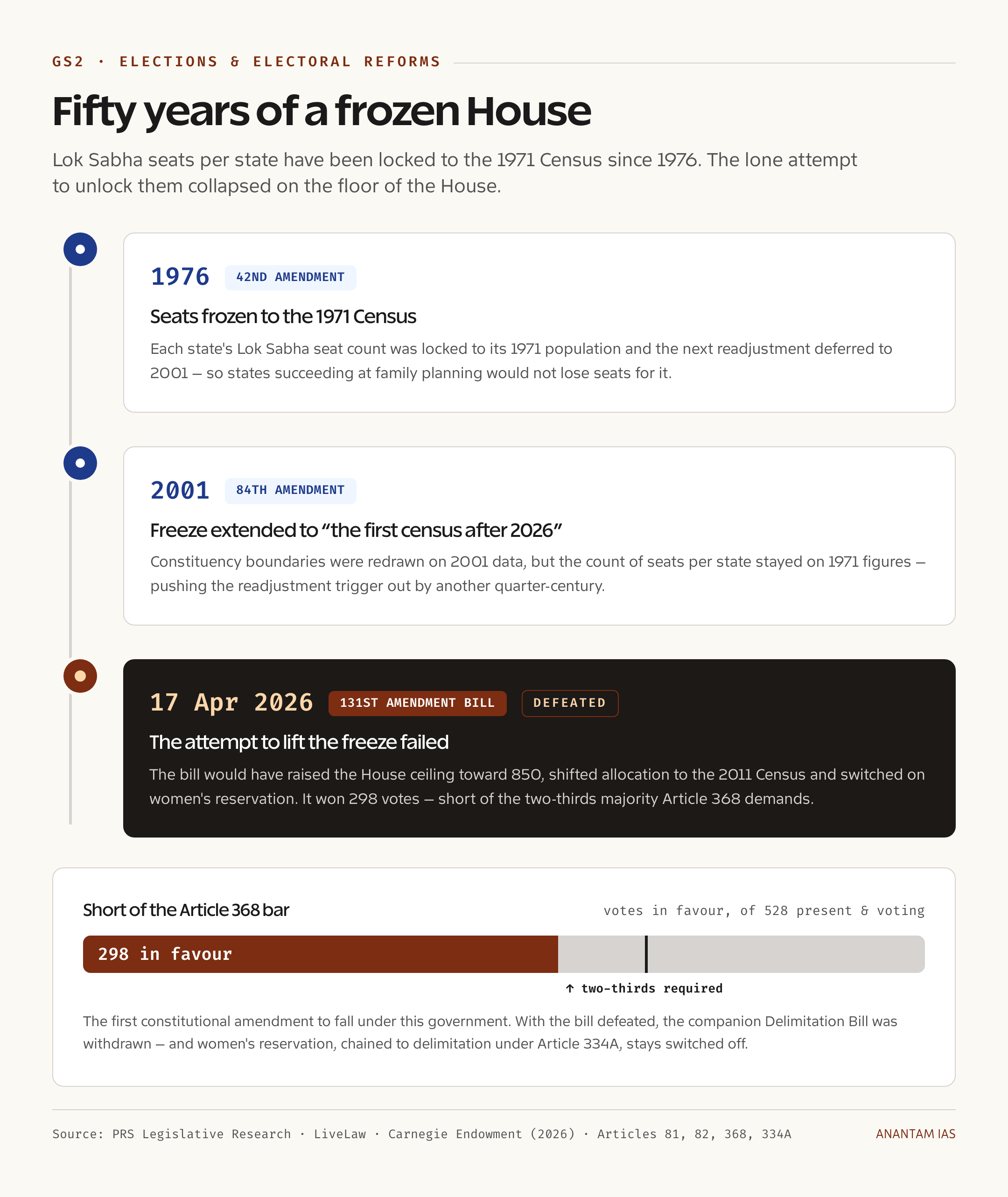
On 17 April 2026, something happened in the Lok Sabha that hadn’t happened to the Modi government in eleven years. A constitutional amendment it brought failed. The Constitution (131st Amendment) Bill, 2026 would have raised the Lok Sabha’s ceiling, shifted seat allocation to the 2011 Census, and finally switched on women’s reservation. It got 298 votes in favour, short of the two-thirds majority that Article 368 demands for any change to the Constitution. So the bill fell, the companion Delimitation Bill was withdrawn, and a question the country has dodged for fifty years sat back down in the room, unanswered.
That question is the cleanest constitutional dilemma you’ll study this year. One side says every Indian’s vote should weigh the same, so seats must follow population. The other side says states that controlled their numbers shouldn’t be politically punished for it, so the current balance must be protected. Both sides are right. That’s what makes this a genuine dilemma and not a debate with an obvious good guy and a villain.
The Issue, Framed
Start with the word itself, because half the confusion around this topic comes from people who use it loosely. Delimitation is the exercise of fixing the number of seats each state gets in the Lok Sabha and in its own assembly, and then drawing the boundaries of those constituencies, on the basis of the latest Census. Population goes up, the maths gets redone, seats move. That’s the design.
Except the maths hasn’t been redone for fifty years. Here’s why. The Constitution’s original logic was simple and is spelled out in three Articles. Article 81 says Lok Sabha seats are allotted to each state in proportion to its population, so that the ratio of seats to people is as far as practicable the same everywhere. Article 82 says that after every Census, Parliament passes a Delimitation Act and readjusts the seats. And Article 170 carries the same rule down to the state legislative assemblies. Census, then readjustment. That was meant to be automatic.
Then the seat freeze broke the loop. The 42nd Amendment in 1976 froze each state’s Lok Sabha seat count to the 1971 Census and deferred the next readjustment to 2001. The reason was a fairness worry, not a clerical one. The Centre was pushing family planning hard, southern states were responding faster, and a state that brought its birth rate down would have seen its population share fall and its seats shrink. Nobody wanted to tell a state that succeeding at a national goal would cost it political power. So the freeze bought time.
The 84th Amendment in 2001 extended that freeze. It pushed the readjustment of seat numbers out to “the first census taken after 2026.” Constituency boundaries did get redrawn on 2001 Census data, but the count of seats per state stayed locked on 1971 figures. And that’s exactly where we still are. The present 543 elected Lok Sabha seats are distributed across states using a population picture from 1971, while the people who fill those constituencies are counted at 2001 levels. So the freeze isn’t ancient history finally lapsing. It’s the live constitutional fact the 131st Amendment tried, and failed, to resolve.
The clock matters here. “The first census after 2026” is the legal trigger, and it’s now arriving. So this isn’t a seminar topic anymore. It’s a deadline.
What the Data Says
The numbers tell you why one side feels cheated right now. Under a frozen 1971 allocation, a state that grew fast is under-represented and a state that grew slowly is over-represented, full stop. The Carnegie Endowment’s May 2026 analysis by Louise Tillin, Milan Vaishnav and Andy Robaina puts the scale of the distortion at roughly 8 percent of Lok Sabha representation misallocated across states, about 44 of the 543 seats sitting in the wrong place.
Look at who’s on each side of that gap. Since 1971, Bihar’s population grew about 215 percent while Kerala’s grew about 70 percent. An Indian MP represents around 2.5 million citizens on average, but that average hides the spread: roughly 3 million people per MP in Uttar Pradesh against about 1.75 million per MP in Kerala. So a vote in Kerala simply carries more weight in the House than a vote in UP. That’s the malapportionment the case-for side wants fixed.
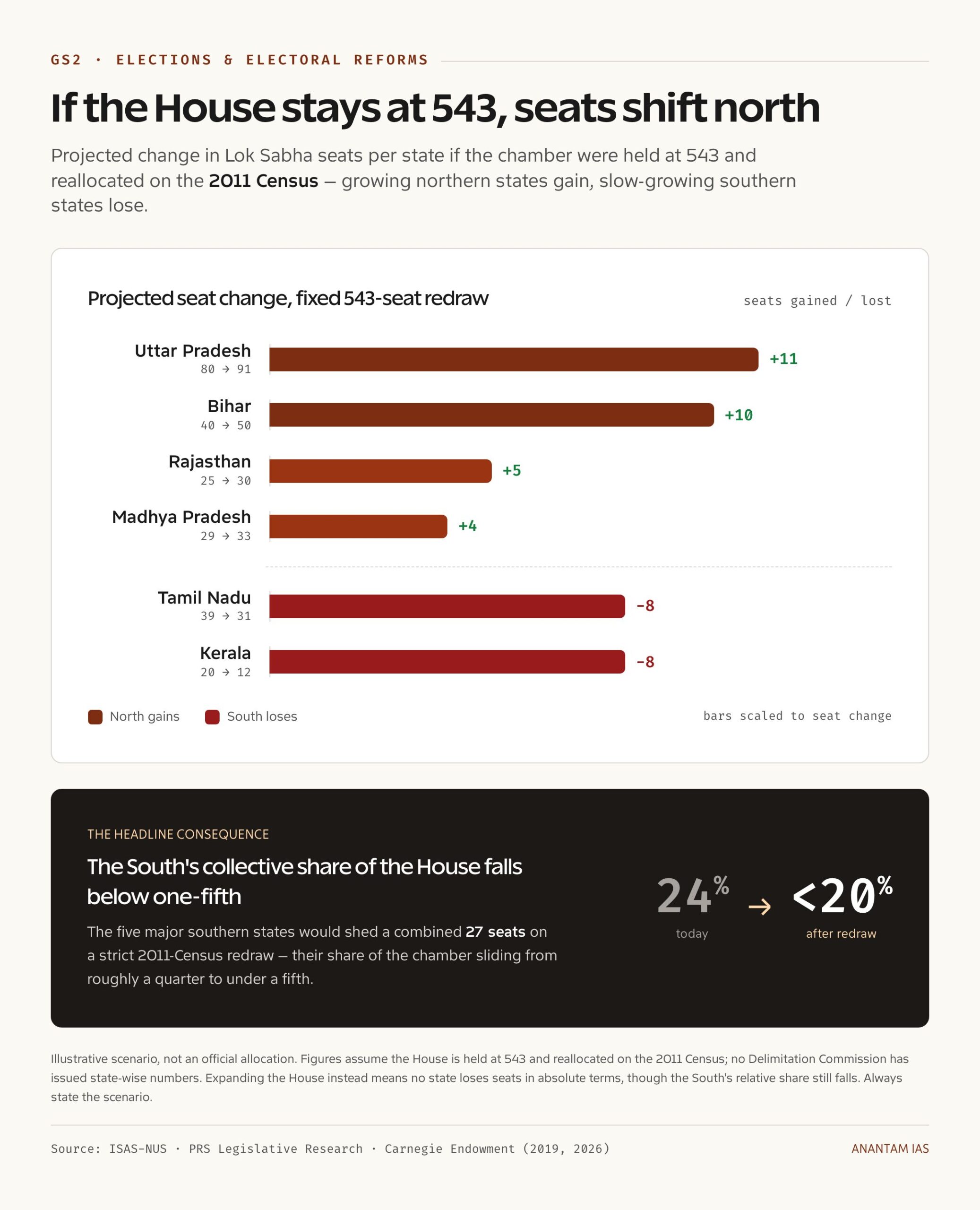
Now the projections, and you have to label these carefully because they’re scholarly estimates, not a Delimitation Commission‘s verdict. If the House were kept at 543 and seats reallocated on the 2011 Census, PRS Legislative Research’s reading of the 131st Amendment Bill’s logic has Uttar Pradesh rising 80 to 89 and Bihar 40 to 46, while Tamil Nadu falls 39 to 32 and Kerala 20 to 15. Read at the individual-state level, that’s roughly UP +11 and Bihar +10 on one widely cited fixed-543 reckoning, against Tamil Nadu −8 and Kerala −8. The southern bloc as a whole would shed a collective 27 seats on a strict 2011 redraw. And the south’s overall share of the House would slide from roughly 24 percent to under 20 percent.
One caution before you quote any of this in an exam. These figures move with the scenario. Hold the House at 543 and you get the brutal version above, where the south loses seats outright. Expand the House instead, and no state loses in absolute terms even though the south’s relative share still drops. So always say which scenario you mean.
The Case For
The case for population-based delimitation is the constitutional default, and it’s strong enough that you should state it at full force before you reach for any counter.
One person, one vote, one value. That’s the principle Article 81 was built on, that seats should track population so each citizen’s vote weighs the same. The 1971 freeze was never meant to be permanent. It was an explicit, time-bound exception, and that exception is now expiring on schedule. So restoring proportional seats isn’t a radical northern demand. It’s the Constitution’s own rule switching back on after a fifty-year pause.
The distortion is real and it’s measurable, not a grievance someone invented. When UP voters are packed three million to an MP while Kerala voters sit at 1.75 million, the under-represented citizen’s vote is literally worth less in the chamber that makes national law. A democracy that lets that gap widen for five decades and calls it fairness has redefined the word.
And the gap only grows the longer you wait. Freezing 1971 ratios forever means every new birth in a fast-growing state adds a citizen who is, by design, under-weighted. Time doesn’t heal this distortion. Time is what causes it. So “extend the freeze” isn’t a neutral hold. It’s a choice to keep enlarging the very inequality the freeze was supposed to manage.
Then there’s the hostage. The Constitution (106th Amendment) Act of 2023, the Nari Shakti Vandan Adhiniyam, reserves a third of Lok Sabha and assembly seats for women. But Article 334A makes that reservation operative only after a delimitation based on the first Census after 2026. So as long as delimitation stays frozen, the women’s quota stays switched off. The Lok Sabha passed that amendment 454 to 2 in 2023, near-unanimous, and yet it can’t begin. Defer delimitation indefinitely and you defer women’s reservation indefinitely. That’s not a side effect. For the case-for side, it’s a reason the deadlock can’t just be left alone.
The Case Against
Here’s what the equality argument walks past. People aren’t interchangeable units of population. They’re citizens of states that made policy choices, and some of those choices are exactly why the numbers now diverge.
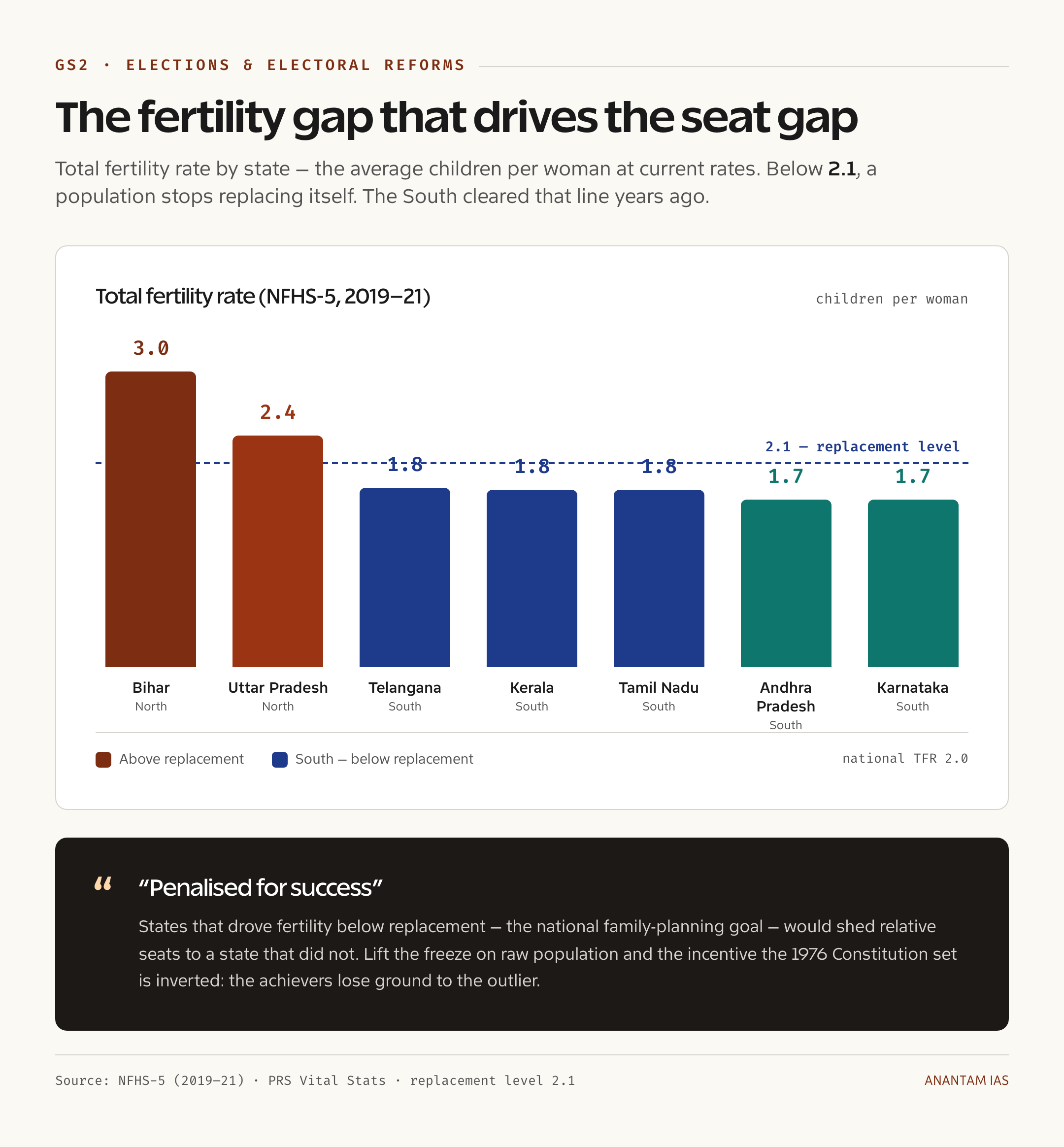
Start with the sentence that animates the whole southern position: penalised for success. Kerala and Tamil Nadu sit at a total fertility rate of 1.8, with Andhra Pradesh and Karnataka at 1.7, all well below the 2.1 replacement level, while Bihar is at 3.0, the only major state above replacement. Total fertility rate, just so the term is clean, is the average number of children a woman would have over her lifetime at current rates; below 2.1, a population stops replacing itself. The south hit that target. The 1976 freeze promised them they wouldn’t lose seats for it. Lift the freeze on pure population and you hand seats from the states that controlled their numbers to the state that didn’t. To the south, that inverts the incentive the Constitution itself set.
The federal balance is the deeper fear. A large northward shift wouldn’t just rearrange seats. It could let the northern states pass ordinary laws, and on a bad day even constitutional amendments, without needing southern consent. Southern leaders have called that prospect a Damocles’ sword hanging over their bargaining power, and the phrase isn’t pure theatre. In a federation, the minority region’s veto is part of the deal that holds the union together.
The grievance compounds when you add money. Southern and western states already argue they put more into the national fiscal pool than they draw out, while devolution increasingly rewards population size. So losing seats and tax share at once, both flowing from the same demographic logic, is the combined fear. And underneath the fiscal maths runs language and culture, where reduced southern weight in Parliament feeds old anxieties about Hindi imposition and the three-language formula, turning a technical seat-counting exercise into an identity question.
The Carnegie team puts the balance point neutrally, and it’s worth holding both halves in your head. Restoring one person, one vote “would not satisfy the southern states that wish to preserve their disproportionate political influence in recognition of their contribution to a federal union”. Both clauses are true at once. That’s the dilemma in a single sentence.
The Deeper Structural Read
Step back from the seat counts and the real fault line shows. This isn’t a fight about a number. It’s a clash between two legitimate theories of what a vote represents, and the Constitution carries both inside it at the same time.
One theory says representation tracks people. A vote is a person, and equal people deserve equal weight, so the House should mirror the population. That’s the majoritarian, one-person-one-vote logic, and Article 81 is its home. The other theory says representation also tracks communities. A federation isn’t just a heap of individuals; it’s a union of states, and a state has an interest in not being permanently outvoted by larger states, however the headcount falls. That’s the federal logic, and it’s why the Rajya Sabha exists at all and why the 1976 freeze was tolerated for so long. India never chose between these two. It built a Lok Sabha on the first and a federal structure on the second, and the freeze let the country avoid noticing they pull in opposite directions.
The 131st Amendment’s defeat is what happens when you finally make the country notice. The government’s own design was actually the cautious middle option. It proposed lifting the ceiling from 550 toward 850 and expanding roughly 50 percent across the board, so that UP would go 80 to 120 and Tamil Nadu 39 to 59, every state gaining seats in absolute terms even as the south’s share fell. That’s about as gentle as proportional delimitation gets. And it still couldn’t clear two-thirds. So the lesson isn’t that one design was clumsy. It’s that no purely numerical fix commands consensus, because the objection was never to the arithmetic. It was to the shift in relative power the arithmetic produces.
There’s a layer below that should bother you as a future administrator. The strongest argument for finally acting, that frozen representation is undemocratic over time, runs straight into the strongest argument for caution, that a federation needs its regions to consent to their own demotion. Neither side is being unreasonable. The Carnegie authors land exactly here: any future redraw “will require a broader and more durable political consensus” than a single government can supply by majority. So the 17 April vote wasn’t really a defeat of a bill. It was the system reporting that the consensus doesn’t exist yet, and that no amount of clever seat-formula engineering substitutes for building it.
Which reframes the whole problem. The hard part of delimitation was never going to be the spreadsheet. It was always going to be the trust.
What Should Be Done
So what does a defensible path look like? Not “extend the freeze and pray,” and not “redistribute on raw population and dare the south to object.” Both are abdications. Here’s a sequenced answer, and notice that every step is about manufacturing consent, not just shuffling numbers.
- Expand the House so no state loses a seat in absolute terms. This is the floor of any workable deal. Milan Vaishnav and Jamie Hintson calculated in 2019 that a Lok Sabha of about 848 members could restore proportionality without a single state losing seats, which is essentially what the defeated bill’s 850 ceiling aimed at. A growing state gains, a slow-growing state holds steady, and the fight narrows from “who loses seats” to “who gains fewer,” a far more solvable argument. Pair it honestly with the women’s reservation timeline, since the 33 percent quota can’t begin until this is settled.
- Use degressive proportionality, not strict per-capita parity. Borrow the European Parliament’s idea: more populous states get more seats, but with diminishing returns, so that smaller states stay over-represented by design rather than by accident. Degressive proportionality, in plain terms, means a bigger state gains seats sub-linearly, never one-for-one with its extra millions. The Carnegie authors float exactly this, alongside a floor-plus-proportionality model that guarantees every state a baseline before distributing the rest by population. It’s the formula that lets you honour Article 81 without flattening the federation.
- Rebalance through the Rajya Sabha. If the lower house must move toward population, then strengthen the upper house as a genuinely federal chamber, closer to the US Senate’s equalised state representation, as a structural counterweight. A Lok Sabha that mirrors people and a Rajya Sabha that protects states together honour both theories of representation this whole dispute is stuck between. Read it next to the federalism balance and it’s the cleanest constitutional offset on the table.
- Offset the fiscal grievance through the Finance Commission. Since the seat fear and the tax-share fear flow from the same demographic source, treat them together. Weight devolution criteria to reward “demographic performance,” so a state that controlled its population doesn’t lose both seats and central transfers in the same decade. Solving the money worry takes a lot of heat out of the seat worry.
- Make the Delimitation Commission visibly inclusive. Bring regional parties and civil society into the process, not just the technocrats, so the redraw can’t be framed as a centrally engineered carve-up. The April defeat already proved that legitimacy, not arithmetic, is the binding constraint. So build the legitimacy into the machinery from day one.
- Sequence it, and be patient. Treat the “first census after 2026” as the start of a negotiation, not the firing of a starting gun. Carnegie’s own conclusion is that a durable settlement needs broad consensus. So the honest way forward accepts that this is a multi-year political project, and that a hurried majority push, exactly the one that just failed, sets the cause back rather than forward.
For Your Mains Answer
This is a GS2 set-piece. It sits at the intersection of the Constitution, federalism, Parliament’s structure, fiscal devolution, and women’s representation, which means one well-built answer can be redeployed across several question types.
GS paper mapping: GS2: Indian Constitution, features, significant provisions and amendments; functions and responsibilities of the Union and States, and challenges of the federal structure; Parliament, its structure and functioning; devolution of powers and finances.
Likely question frames:
- “Population-based delimitation and federal balance are both constitutional values that can pull against each other.” Examine in light of the defeat of the Constitution (131st Amendment) Bill, 2026.
- The 1971 seat freeze was a temporary fix that became a structural feature. Critically analyse the case for and against lifting it.
- Discuss how the linkage between delimitation and women’s reservation under Article 334A complicates the representation debate.
Quotable data points:
- 543 elected Lok Sabha seats are still distributed on the 1971 Census, frozen by the 42nd Amendment (1976) and extended by the 84th (2001) to “the first census after 2026”.
- About 8 percent of Lok Sabha representation, roughly 44 of 543 seats, is currently misallocated across states.
- An MP represents about 3 million people in UP against about 1.75 million in Kerala.
- On a fixed 543-seat, 2011-Census redraw: UP +11, Bihar +10, Tamil Nadu −8, Kerala −8; the southern bloc loses a collective 27 seats.
- The south’s House share would fall from roughly 24 percent to under 20 percent.
- TFR gap: Bihar 3.0 against Kerala and Tamil Nadu 1.8, Andhra and Karnataka 1.7; national TFR 2.0, below the 2.1 replacement level.
- The Constitution (131st Amendment) Bill, 2026 was defeated on 17 April 2026 with 298 in favour, short of the Article 368 two-thirds bar, the first such amendment to fail under this government.
- The 33 percent women’s reservation (106th Amendment, 2023) can’t take effect until a post-2026-Census delimitation occurs, under Article 334A.
Keywords to use: one person one vote one value, malapportionment, seat freeze, Article 81, Article 82, Article 170, Article 334A, Article 368, degressive proportionality, floor-plus-proportionality, federal fairness, demographic performance.
Syllabus linkages: salient features and amendments of the Constitution; Parliament and state legislatures; federalism and Centre-state relations; devolution of finances and the Finance Commission; representation of women.
Balanced conclusion line: A frozen House quietly disenfranchises the citizen who happens to live in a fast-growing state, but a redraw forced through without the south’s consent disenfranchises a region of the union; the constitutional task is to honour both the equal vote and the federal compact at once, which is why the answer lies in House expansion, degressive formulae and a stronger Rajya Sabha rather than in a single triumphant majority.
How to Build the Answer
Open on the value clash, not a definition. The first sentence should signal that you’ve seen both goods, equal votes and federal fairness, are in genuine tension. Define delimitation and the seat freeze in the second sentence, once the examiner already knows you understand the stakes. A glossary opening tells the examiner you’ve memorised; a tension opening tells them you’ve understood.
Bring data in early but keep it disciplined. One strong body paragraph can carry three figures, the 8 percent misallocation, the 3-million-versus-1.75-million MP ratio, and one seat projection, and then say what they prove. The number is the anchor; the inference is the mark.
Steelman whichever side you don’t ultimately favour. If you back delimitation, first explain why the south’s “penalised for success” fear is legitimate, using the TFR gap. If you back caution, first concede that frozen representation under-weights real citizens. That’s what makes an answer read balanced rather than evasive.
Group the way forward; don’t scatter it. Cluster the reforms into House expansion, a degressive or floor-plus formula, Rajya Sabha rebalancing, and Finance Commission offset, then attach an actor to each. Use the topic’s own vocabulary, Article 81, Article 334A, degressive proportionality, so the answer sounds like constitutional analysis and not a news recap.
Common Mistakes to Avoid
- Don’t pick a hero. This topic punishes one-sided answers. The marks are in holding both the equal-vote and the federal claim as legitimate.
- Don’t quote “UP +21” as a UP-alone figure. That number is UP and Bihar combined in the press. Use “UP +11, Bihar +10” if you mean per state.
- Don’t state projections as decisions. No Delimitation Commission has issued state-wise numbers. Every seat figure is a scholarly or press projection, so attribute it as one.
- Don’t forget women’s reservation. Many candidates miss that Article 334A chains the 33 percent quota to delimitation. Naming that linkage shows range.
- Don’t end on a slogan. Close on a constitutional principle, the dual mandate of equal vote plus federal compact, not a flourish.
A Compact Answer Spine
- Introduction: Open with the equal-vote-versus-federal-fairness tension; define delimitation and the 1971 freeze in the next line.
- Evidence: Use two or three attributed figures, the 8 percent misallocation, the MP-per-capita gap, one seat projection, each tied to an implication.
- Arguments: The case for population-based delimitation (Article 81 default, real distortion, women’s reservation hostage), then the case for protecting federal balance (penalised for success, federal veto, fiscal grievance).
- Structural diagnosis: Two theories of representation, people versus communities, both inside one Constitution; the real constraint is consensus, not arithmetic.
- Way forward: House expansion so no state loses, degressive or floor-plus proportionality, Rajya Sabha rebalancing, Finance Commission offset, an inclusive Delimitation Commission.
- Conclusion: Adapt the balanced conclusion line to the exact question wording.
Diagram or Flowchart Idea
For a 15-marker, draw the causal chain: 1971 Census freeze (42nd, 84th Amendments) → divergent population growth (Bihar +215%, Kerala +70%) → malapportionment (~44 seats, UP 3m vs Kerala 1.75m per MP) → proposed redraw → north gains, south’s share falls → federal resistance → 131st Amendment defeated. The examiner reads the whole logic in one pass.
For a 10-marker, skip the chain and use a two-column table: “Equal vote (Article 81)” against “Federal fairness (1971 freeze rationale),” with two rows each. Faster to evaluate, and it shows the balance instantly.
Ethics and Governance Angle
Add one line on who carries the cost, even in a GS2 answer. Here there are two faces, not one: the under-represented voter in a UP or Bihar constituency whose ballot weighs less, and the southern citizen who fears her region’s bargaining power being voted away. A mature answer names both rather than choosing a victim.
Then convert the empathy into design. Don’t just say “balance the interests.” Say how: expand the House so the loss is relative and not absolute, offset the fiscal hit through devolution weights, and build regional parties into the Delimitation Commission so the process feels owned, not imposed. That’s the move from moral language to administrative maturity.
A sentence pattern that travels well here: “The objective is constitutionally sound, but its legitimacy depends on consensus, sequencing and federal trust.” It accepts that delimitation must eventually happen without handing the Centre a blank cheque to force it.
How to Use Data Without Sounding Mechanical
Use fewer numbers than you know. Lead with one scale figure (8 percent of seats misallocated), one contrast (3 million per MP in UP against 1.75 million in Kerala), and one projection (the south losing a collective 27 seats), and explain each. One scale, one contrast, one consequence is usually enough.
Never leave a statistic standing alone. Follow each with “this means” or “the implication is.” A bare figure is a fact sheet; a figure plus its inference is analysis. And always state the scenario behind a seat projection, because the same redraw looks brutal at 543 seats and gentle at 850.
Finish with one test: can a tired examiner follow this in a single read? Short introduction, data early, both sides marked cleanly, a grouped way forward. For UPSC, clarity is how depth becomes visible. Cut any sentence that sounds impressive but proves nothing, and replace it with a fact, a cause, or a reform.
FAQ
What is delimitation, in one line?
Delimitation is the exercise of redistributing Lok Sabha and assembly seats among states and redrawing constituency boundaries on the basis of the latest Census, under Articles 81, 82 and 170. Population shifts, seats are reallocated.
Why are Lok Sabha seats still frozen on the 1971 Census?
The 42nd Amendment of 1976 froze each state’s seat count to the 1971 Census so that states succeeding at family planning wouldn’t lose seats, and the 84th Amendment of 2001 extended that freeze to “the first census after 2026.” So inter-state seat numbers have stayed on 1971 figures even as boundaries were redrawn on 2001 data.
Why did the 131st Amendment Bill fail in April 2026?
It got 298 votes in favour, short of the two-thirds majority that Article 368 requires for a constitutional amendment, the first time a Modi-government amendment failed. The bill would have raised the Lok Sabha ceiling toward 850, shifted allocation to the 2011 Census and switched on women’s reservation, but the relative power shift toward the north meant the consensus wasn’t there.
How is women’s reservation connected to delimitation?
The 106th Amendment of 2023 reserves a third of Lok Sabha and assembly seats for women, but Article 334A makes that quota operative only after a delimitation based on the first Census after 2026. So as long as delimitation stays frozen, the 33 percent women’s reservation can’t begin.