Dramatic Performances Act, 1876: Colonial Theatre Censorship, Nil Darpan, and the Long Road to Repeal
Dramatic Performances Act 1876 explained: Lord Lytton's response to Nil Darpan, key provisions, the State of UP v. Baboo Lal verdict of 1956, Article 19 and Article 372 issues, and the formal repeal of 2018.
The Dramatic Performances Act of 1876 has a peculiar afterlife. Most colonial laws either survived independence and were quietly assimilated into the post-1950 legal order, or were rapidly repealed by Parliament in the early years of the Republic. The 1876 Act did neither. It was struck down by High Courts within ten years of independence, became a dead letter in most of the country by the late 1950s, and yet remained on the statute book for another six decades. It was formally repealed only in 2018. The Prime Minister recently cited the Act as a textbook example of the “colonial baggage” that the Indian state has been clearing from its shelves.
The Act is interesting because it sits at the intersection of three large legal stories. The first is the colonial fear of nationalist theatre, captured in the legislative response to plays like Nil Darpan and the Gajadananda satire of 1875. The second is the post-independence transformation of Indian fundamental rights jurisprudence, which used Article 19 to dismantle pre-constitutional restrictions on speech. The third is the long process of statutory house-cleaning that finally pulled hundreds of obsolete colonial laws off the books in the 2010s and 2020s.
This guide walks through the historical context that produced the Act, the trigger plays of the 1860s and 1870s, the legislative architecture under Lord Lytton, the operational provisions of search, seizure and ban, the post-independence challenge in State of UP v. Baboo Lal in 1956, the role of the Indian People’s Theatre Association, the Article 372 continuance question, the 2018 repeal, and the way the successor provisions in the Bharatiya Nyaya Sanhita treat performances today.
Quick Facts on the Dramatic Performances Act, 1876
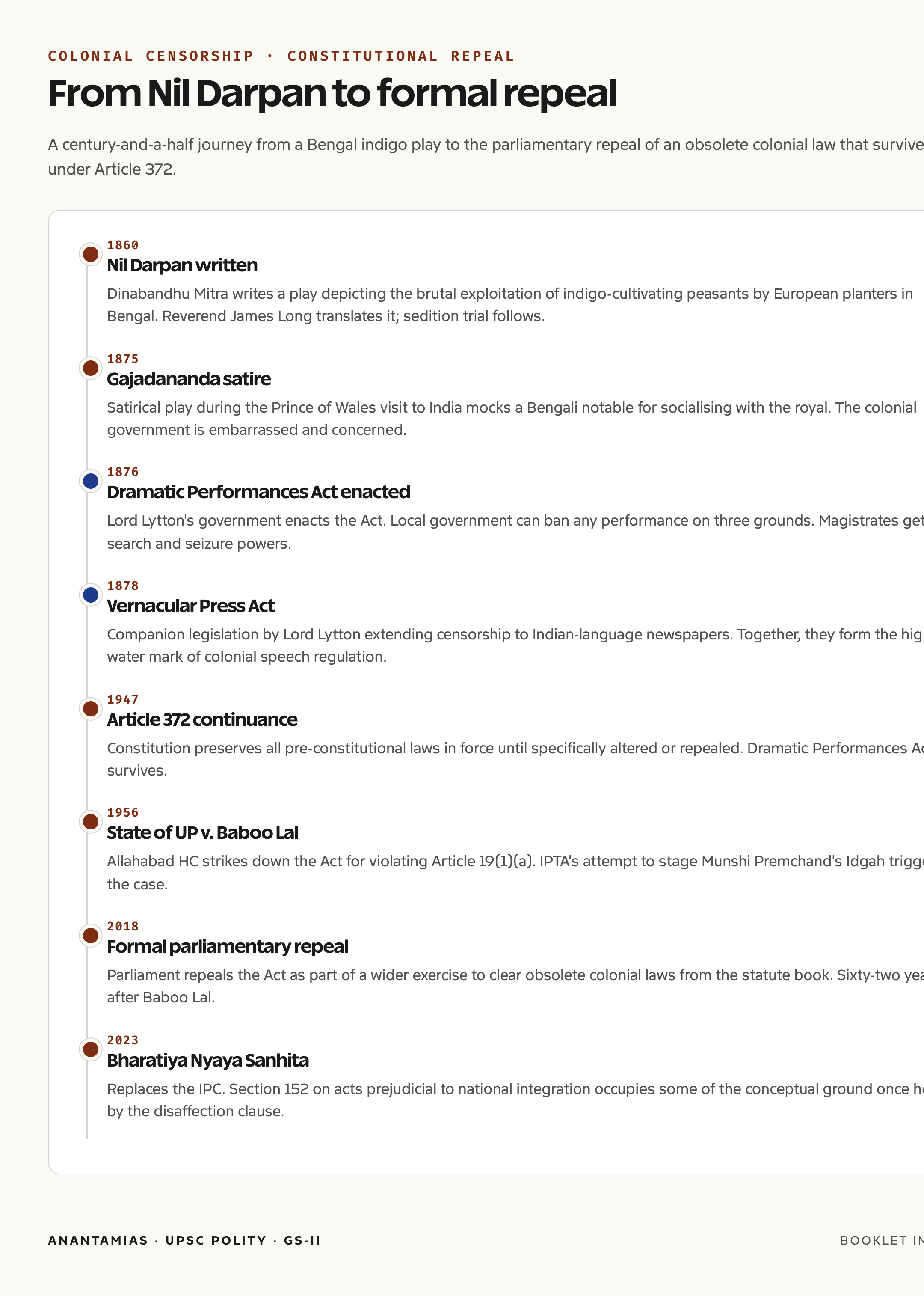
The Dramatic Performances Act was enacted in 1876 during the Viceroyalty of Lord Lytton. The Act empowered local governments to prohibit any public dramatic performance on three grounds: that it was scandalous or defamatory, likely to excite feelings of disaffection toward the government, or likely to deprave and corrupt persons. Magistrates were authorised to enter, search and seize venues hosting suspected performances. The ban could be imposed on the basis of the government’s opinion, without prior judicial proof. The Act was challenged after independence and was declared unconstitutional by the Allahabad High Court in State of UP v. Baboo Lal in 1956 for violating Article 19(1)(a) of the Constitution. The case involved an Indian People’s Theatre Association attempt to stage a play based on Munshi Premchand’s story Idgah. The Act remained on the statute book through Article 372’s continuance clause until it was formally repealed by Parliament in 2018 as part of a wider repeal of obsolete laws. Successor provisions, particularly Section 152 of the Bharatiya Nyaya Sanhita, 2023, deal with acts prejudicial to national integration and can in theory cover seditious performances.
What the Dramatic Performances Act Was
The Act was a content-control statute aimed specifically at the live performance medium. It came at a time when theatre, jatra, nautanki and other public performance forms were the principal vehicles for political communication in colonial India. Newspapers reached only a literate urban readership. Films did not yet exist. The stage was where political ideas, satire and protest reached the widest audience.
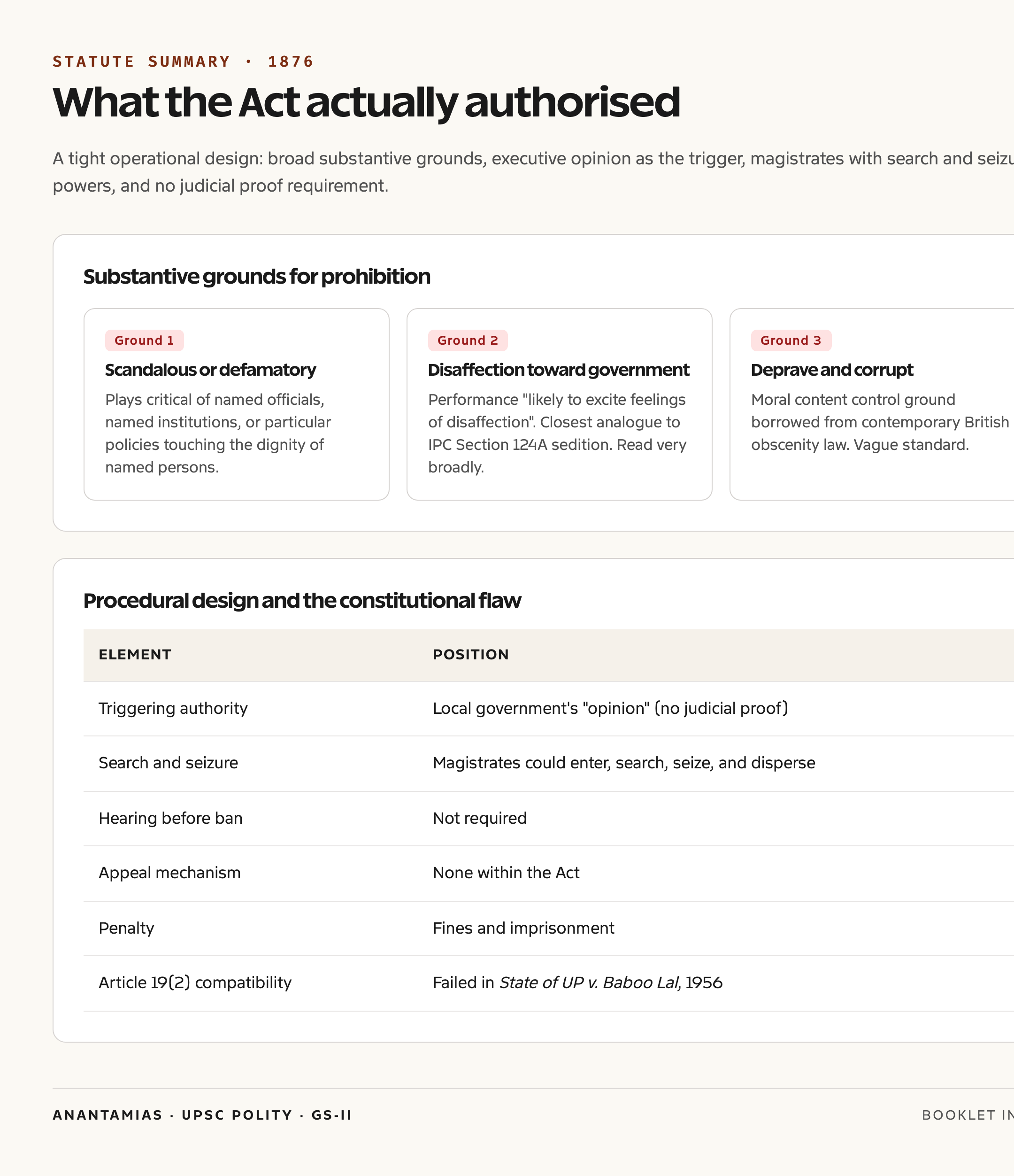
The Act did three things. It gave the local government a broad power to prohibit any performance that fell within one of three statutory grounds. It gave magistrates the operational power to search venues, seize materials, and disperse performances. And it shifted the standard from prior judicial evaluation to administrative opinion. The local government could form an opinion that a performance was likely to fall within the prohibited grounds, and the ban could follow without a court-style hearing. The procedural design made the Act a powerful instrument of political censorship.
Background and Historical Context
The legislative trigger came from two specific plays. The first was Nil Darpan, written in 1860 by Dinabandhu Mitra. The play depicted the brutal exploitation of indigo-cultivating peasants by European planters in Bengal. The English translation, made by Reverend James Long, was widely circulated and led to a sedition trial against Long himself. Nil Darpan stayed in popular memory through the 1860s and 1870s as a symbol of theatrical political protest.
The second trigger was a satire titled Gajadananda and the Prince, staged in 1875 during the visit of the Prince of Wales to India. The satire mocked a Bengali notable who had socialised with the visiting royal. The performance caused the colonial government considerable embarrassment and confirmed an emerging concern that nationalist sentiment was finding effective expression on the stage.
The Viceroy at the time was Lord Lytton, whose tenure is also remembered for the Vernacular Press Act of 1878, an explicit attempt to muzzle Indian-language newspapers. The Dramatic Performances Act of 1876 fits the same legislative philosophy: extend government control over the principal channels of political communication available to colonised Indians. The Act was not the first colonial law on speech. The 1860 Indian Penal Code already contained the sedition provision in Section 124A. The Dramatic Performances Act added a stage-specific layer of control that allowed the government to act before a performance happened, not after.
Key Provisions of the Act
The Act had a tight operational structure. The local government, defined as the provincial administration, could pass an order prohibiting any public dramatic performance if it was of the opinion that the performance fell within one of three grounds.
The first ground was that the performance was of a scandalous or defamatory nature. The phrase was capacious enough to cover plays critical of named officials, named institutions, or even particular policies that touched on the dignity of named individuals.
The second ground was that the performance was likely to excite feelings of disaffection toward the government established by law in British India. This was the closest analogue to the sedition clause in the IPC. Disaffection was read broadly to include criticism, hostility, ridicule and contempt directed at the government as a whole or its principal functionaries.
The third ground was that the performance was likely to deprave and corrupt persons present at the performance. This was a moral content control ground that drew from the British obscenity law of the time.
The procedural design vested significant power in district magistrates. A magistrate could enter and search any place suspected of being used for a prohibited performance, seize any properties connected with the performance, and disperse the audience. The magistrate did not need a judicial warrant if there was reasonable belief that an offence was being committed. The penalties included fines and imprisonment.
Why the Act Matters Even Today
The Act matters because it remains the cleanest example in Indian legal history of a pre-constitutional, executive-driven censorship statute aimed at a specific medium. Three reasons keep the Act in the modern conversation.
The first is the Article 19 jurisprudence. The post-independence challenge to the Act in State of UP v. Baboo Lal in 1956 was an early test case in which the Allahabad High Court applied Article 19(1)(a) and Article 19(2) to a colonial statute and struck it down. The case is part of the foundational case law on freedom of expression in India and is regularly cited in every textbook account of Indian constitutional history.
The second is the long survival under Article 372. The Act remained formally on the statute book until 2018 even though it had been struck down by High Courts and was practically unenforceable. The continued shelf life illustrates how Article 372’s continuance clause kept colonial laws notionally alive, depending on Parliament to repeal each one specifically.
The third is the comparison with current speech and content regulation. The successor provisions, including Section 152 of the Bharatiya Nyaya Sanhita, 2023 on acts prejudicial to national integration, the Cinematograph Act of 1952, the Information Technology Act of 2000 and the IT Rules of 2021, occupy the same conceptual ground but with significantly different procedural safeguards. Comparing the 1876 Act with these instruments helps highlight how the Indian legal architecture has shifted from administrative bans to certified review, judicial appeal, and constitutional review.
Detailed Analysis: The Baboo Lal Verdict and Article 19
State of UP v. Baboo Lal, decided by the Allahabad High Court in 1956, was the watershed moment for the Act. The case arose from an attempt by the Indian People’s Theatre Association, IPTA, to stage a play based on Munshi Premchand’s story Idgah at a public venue in Uttar Pradesh. The local government invoked the Dramatic Performances Act to ban the performance. IPTA challenged the ban under Article 19(1)(a) of the Constitution, which guarantees the right to freedom of speech and expression.
The Allahabad High Court read Article 19(2), which lists the permitted grounds of restriction on free speech, in conjunction with the substantive grounds of the 1876 Act. The Court held that the Act’s grounds were impermissibly wider than the Article 19(2) restrictions. The phrase “likely to excite feelings of disaffection” went beyond what Article 19(2) allows in the name of public order or sovereignty and integrity of India. The phrase “likely to deprave and corrupt persons” was also held to be vague.
Crucially, the Court found that the Act vested unguided discretion in the local government. The ban turned on the government’s “opinion”, with no objective standard, no prior hearing, and no procedure for appeal that could meaningfully test the opinion. The Court held that this kind of administrative censorship without procedural safeguards is unconstitutional. The Act was struck down to the extent of the unconstitutional provisions, which were the operational core of the statute.
Several other High Courts followed Baboo Lal in subsequent decades. The result was a patchwork in which the Act was unenforceable in most states but continued to appear on the central statute book. The 2018 repeal closed this gap. The Bharatiya Nyaya Sanhita, 2023 has now replaced the IPC, and Section 152 on acts prejudicial to national integration covers some of the conceptual ground that the 1876 Act once occupied.
Comparative Frame: Censorship Architecture Across Mediums
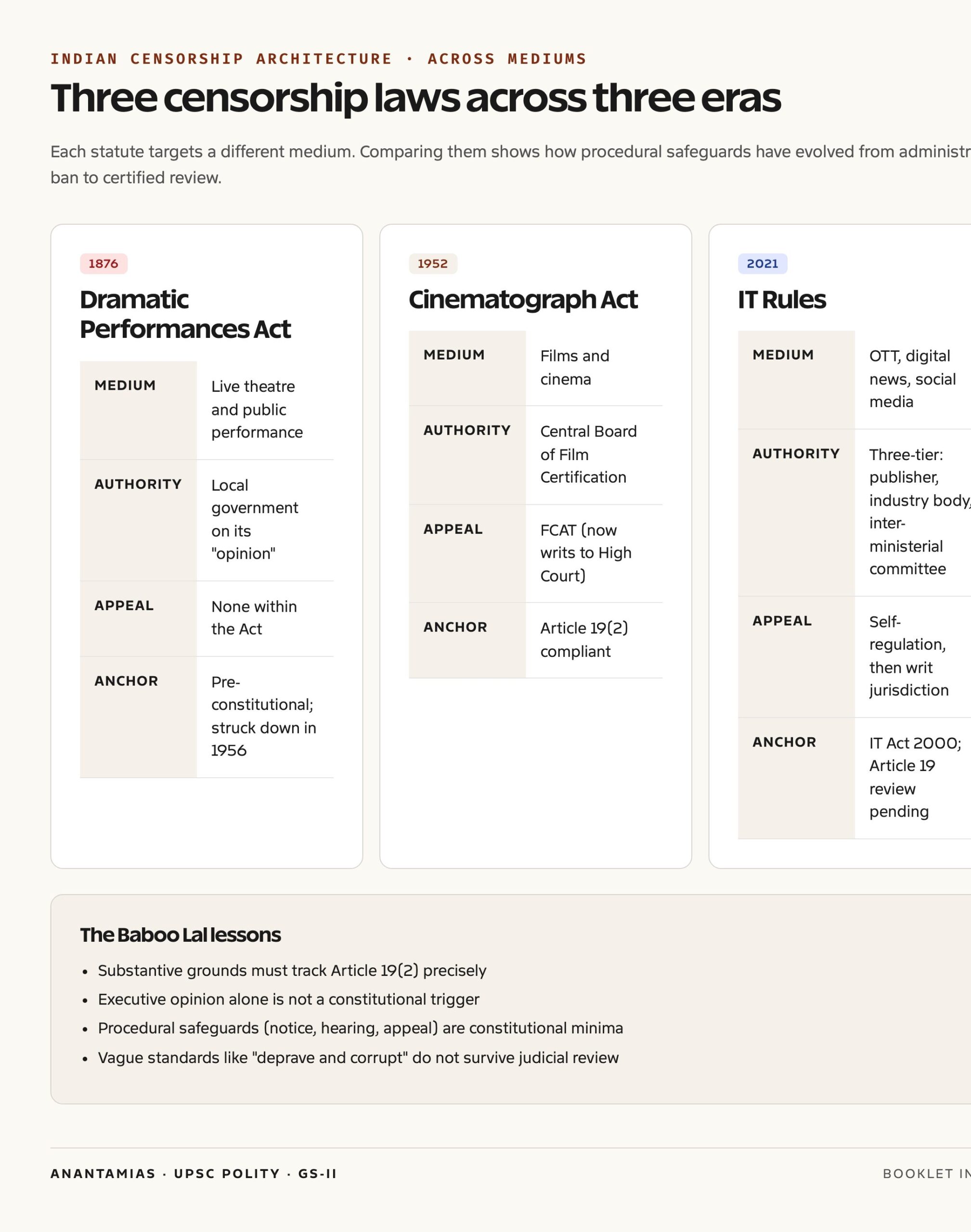
A short comparative scan helps locate the 1876 Act among other Indian censorship laws. The Cinematograph Act of 1952 created the Central Board of Film Certification with statutory authority to certify films for public exhibition. The Act provides for an appellate tribunal and judicial review under Article 226. The procedural architecture is significantly tighter than the 1876 Act, with named bodies, defined procedures, and statutory appeals.
The Information Technology Act of 2000, read with the IT Rules of 2021, regulates digital content through intermediaries and now extends to OTT platforms and digital news. The architecture relies on self-regulation at the publisher level, an industry body at the second tier, and an inter-ministerial committee at the third tier. Procedural safeguards are stronger than in the 1876 Act, but critics of the 2021 Rules argue that the inter-ministerial committee mechanism can compromise independence. The recent debate around it-intermediary-guidelines-and-digital-media-ethics-code-amendment-rules-2025 and the broader online-content-regulation-ott-digital-news framework reflect the continued effort to design content regulation that survives Article 19 review.
The Bharatiya Nyaya Sanhita, 2023 retains a sedition-adjacent offence in Section 152, which deals with acts prejudicial to national integration. The Section is narrower than the IPC’s Section 124A and is meant to address the constitutional concerns that animated the prolonged challenge to sedition law in India.
Challenges and Open Questions
Three challenges remain even after the 2018 repeal. The first is the statutory survival question for other colonial laws. Hundreds of pre-1950 statutes are still on the books, even if many are dormant. The repeal exercise is iterative, and each repeal Bill needs careful scrutiny to ensure that repeal does not create unintended legal vacuums.
The second is the substantive question of how performance regulation should work in 2026. Live theatre is a small share of the public discourse today, but stand-up comedy, street performance and digital live performance are growing forms. The current legal architecture for these forms is patchy. The Bharatiya Nyaya Sanhita, the Cinematograph Act, the IT Rules and various state laws on cabarets and public performance overlap unevenly. A coherent design would benefit from a Law Commission review.
The third is the constitutional caution that the Baboo Lal case stands for. The 1876 Act failed because it gave the executive unguided discretion, used vague substantive grounds, and lacked procedural safeguards. Each new content regulation should be tested against these three lessons.
Prelims Pointers
The Dramatic Performances Act was enacted in 1876 during Lord Lytton’s Viceroyalty. The trigger plays were Nil Darpan by Dinabandhu Mitra (1860) and Gajadananda and the Prince (1875). The grounds for prohibition were performances that were scandalous or defamatory, likely to excite disaffection, or likely to deprave and corrupt persons. Magistrates had powers of search, seizure and dispersal. The Act was held unconstitutional by the Allahabad High Court in State of UP v. Baboo Lal in 1956 for violating Article 19(1)(a). The case involved IPTA’s attempt to stage Idgah by Munshi Premchand. The Act survived on the statute book under Article 372’s continuance clause until its formal repeal by Parliament in 2018. The Bharatiya Nyaya Sanhita, 2023 covers some of the conceptual ground through Section 152 on acts prejudicial to national integration. The Cinematograph Act, 1952 and the IT Rules, 2021 are the principal current censorship statutes for films and digital content respectively.
Mains Practice Questions
A standard question is: “The Dramatic Performances Act, 1876 is often cited as a textbook example of colonial censorship law. Critically examine the constitutional flaws that led to its judicial striking-down in 1956 and its eventual repeal in 2018.” A second variant is comparative: “Compare the procedural safeguards in the Dramatic Performances Act, 1876 with the Cinematograph Act, 1952 and the IT Rules, 2021. Identify the principles that distinguish acceptable content regulation from unconstitutional censorship under Article 19(2).” A third option is institutional: “The continued statutory survival of the Dramatic Performances Act for over six decades after it was held unconstitutional illustrates the limits of Article 372’s continuance clause. Discuss the legislative response and the case for periodic repeal exercises in India.”
Way Forward
The repeal of the Act has closed a particular chapter, but the larger task of cleaning up colonial-era statutes is ongoing. Three priorities deserve attention. The first is a periodic, calendarised repeal exercise, similar to the United Kingdom’s Statute Law Repeals process, in which the Law Commission identifies obsolete laws and Parliament repeals them in batches. The second is an Article 372 audit project that maps every continued pre-constitutional law against current constitutional law and identifies the ones that need updating, replacing or repealing. The third is a coherent design philosophy for content regulation that integrates the lessons from Baboo Lal: clear substantive grounds tied to Article 19(2), defined procedural safeguards including notice, hearing and appeal, and judicial review at the apex of the architecture.
The 1876 Act is gone, but the constitutional question it raised remains live. The line between protected expression and regulated content is constantly being redrawn. The Allahabad High Court’s reasoning in 1956 still reads like a working manual for that drawing. Vague grounds, executive opinion, and weak procedure produce censorship laws that do not survive constitutional scrutiny. Sharp grounds, neutral arbiters, and strong procedural safeguards produce content regulation that does.
Frequently Asked Questions
What was the Dramatic Performances Act, 1876?
The Dramatic Performances Act, 1876 was a colonial-era statute that empowered the local government to prohibit any public dramatic performance on three grounds: scandalous or defamatory content, content likely to excite disaffection toward the government, or content likely to deprave and corrupt persons. Magistrates were given powers of search, seizure and dispersal. The Act was the principal stage-censorship instrument of the British Indian government.
Why was the Act enacted in 1876?
The Act was enacted in response to the rising use of theatre as a vehicle of nationalist political communication. The immediate triggers were Dinabandhu Mitra’s Nil Darpan (1860), which exposed indigo planter exploitation, and a satirical play titled Gajadananda and the Prince (1875), which mocked a Bengali notable who had socialised with the visiting Prince of Wales. The Viceroy at the time was Lord Lytton.
Who was Lord Lytton?
Lord Lytton was the Viceroy of India from 1876 to 1880. His tenure is associated with several centralising and censorship measures, including the Dramatic Performances Act, 1876, the Vernacular Press Act, 1878, and the conduct of the Second Anglo-Afghan War. The Dramatic Performances Act and the Vernacular Press Act together form the legislative high-water mark of colonial-era control over Indian political communication.
What did the Allahabad High Court rule in State of UP v. Baboo Lal?
The Allahabad High Court ruled in 1956 that the Dramatic Performances Act, 1876 violated Article 19(1)(a) of the Constitution, which guarantees freedom of speech and expression. The Court held that the Act’s grounds for prohibition were impermissibly wider than the Article 19(2) restrictions, that the discretion vested in the local government was unguided, and that the procedural safeguards were inadequate. The case arose from an Indian People’s Theatre Association attempt to stage a play based on Munshi Premchand’s story Idgah.
Why did the Act remain on the statute book until 2018?
The Act survived on the statute book under Article 372 of the Constitution, which continues all pre-constitutional laws in force until they are altered, repealed or amended by competent legislature. Even though several High Courts had held parts of the Act unconstitutional, formal repeal required parliamentary action. Parliament repealed the Act in 2018 as part of a wider exercise to clear obsolete colonial-era laws from the statute book.
Is theatre regulated in India today?
Live theatre is largely subject to general law in India today. Performances must comply with the Indian Penal Code and now the Bharatiya Nyaya Sanhita, 2023, including Section 152 on acts prejudicial to national integration. Films are certified under the Cinematograph Act, 1952 by the Central Board of Film Certification. Digital and OTT content is covered by the IT Act, 2000 and the IT Rules, 2021. Some states have local public performance licensing rules administered by district authorities.
What is the connection between the 1876 Act and the Vernacular Press Act?
Both Acts were enacted during Lord Lytton’s Viceroyalty and shared the same legislative philosophy: extending government control over the principal channels of political communication available to colonised Indians. The Dramatic Performances Act targeted live performance, the Vernacular Press Act targeted Indian-language newspapers. Both were broadly criticised by Indian nationalists at the time and are remembered as prime examples of colonial censorship.
What is the Indian People’s Theatre Association?
The Indian People’s Theatre Association, IPTA, is a national cultural organisation founded in 1943 in Bombay. IPTA is associated with progressive theatre and political activism through performance. The 1956 case before the Allahabad High Court arose from an IPTA attempt to stage a play based on Munshi Premchand’s story Idgah. IPTA continues to function across multiple state branches.
Has the Bharatiya Nyaya Sanhita replaced the 1876 Act’s substantive grounds?
The Bharatiya Nyaya Sanhita, 2023 has replaced the Indian Penal Code, 1860. Section 152 of the BNS, on acts prejudicial to the national integration of India, covers some of the conceptual ground occupied by the disaffection clause of the 1876 Act. The BNS does not have a stage-specific provision. Performances are addressed through the general criminal law and the medium-specific statutes for films and digital content.
Why is the 1876 Act still cited in policy debates?
The Act is cited in debates about colonial-era statutes that survived independence, about the proper procedural design of censorship laws under Article 19, and about the broader cultural politics of Indian nationalism. The Prime Minister’s recent reference to the Act as u0022colonial baggageu0022 is part of a larger political project of repealing obsolete colonial laws and recasting the legal heritage of the Indian state.