Drone Technology: Regulations & Applications in India
Comprehensive guide to drone technology in India — Drone Rules 2021, PLI scheme, applications in agriculture, defence, delivery, and UPSC Science & Tech notes.
Drone Technology: Regulations & Applications in India
Drone technology — covering Unmanned Aerial Vehicles (UAVs), Remotely Piloted Aircraft Systems (RPAS), and autonomous flying platforms — has emerged as a transformative technology for agriculture, logistics, surveillance, disaster response, and infrastructure inspection. India’s Drone Rules 2021 created a liberalized regulatory framework, while the PLI scheme for drones (Rs 120 crore) and the Drone Shakti initiative aim to make India a global drone manufacturing hub. For UPSC, drones appear under Science and Technology, Internal Security, and Governance.
What Are Drones?
A drone is an unmanned aircraft operated remotely or autonomously using software-controlled flight plans and GPS. The term covers everything from small consumer quadcopters to military-grade UAVs.
Classification of Drones by Weight
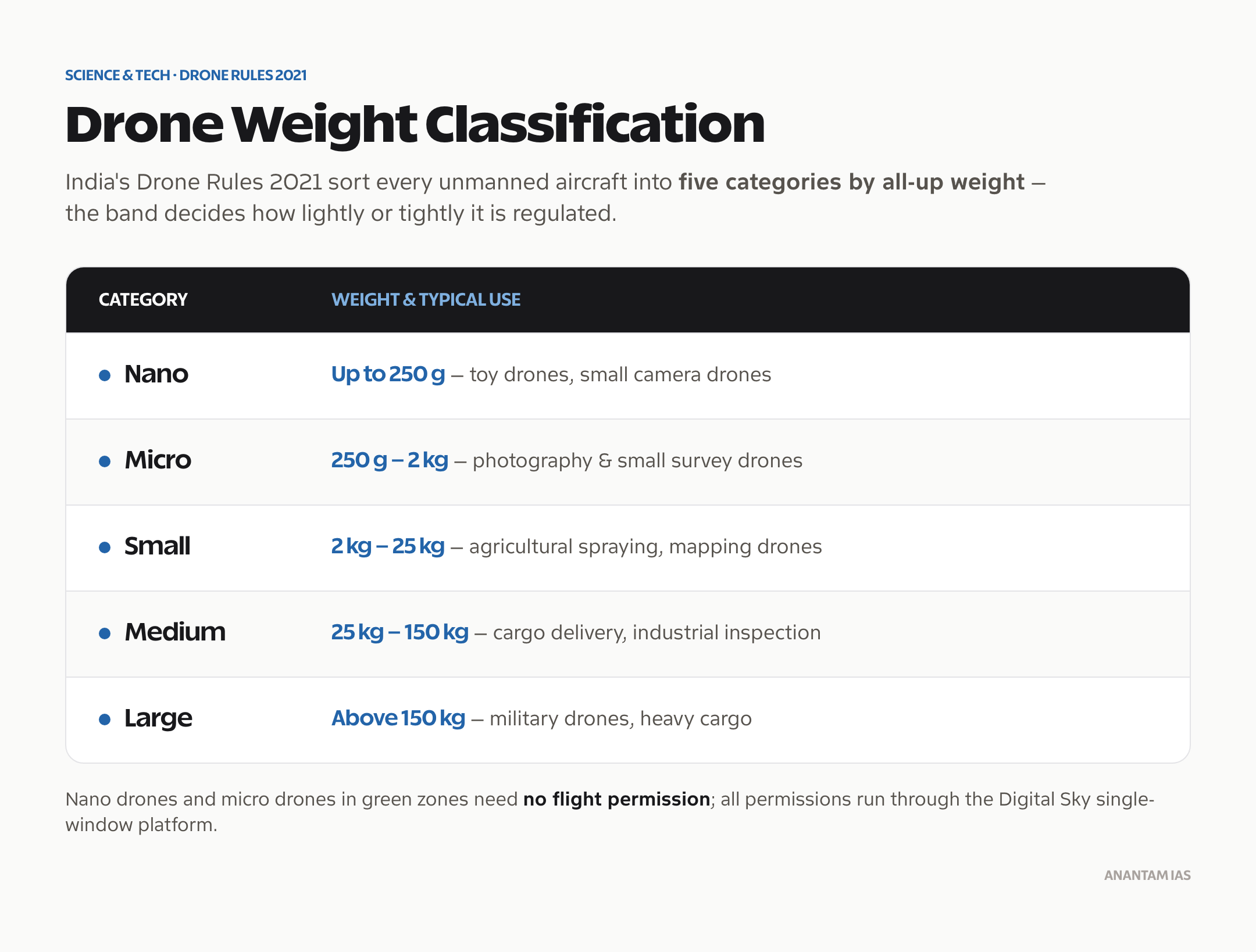
India’s Drone Rules 2021 classify drones into five categories:
| Category | Weight | Examples |
|---|---|---|
| Nano | Up to 250 g | Toy drones, small camera drones |
| Micro | 250 g to 2 kg | Photography drones, small survey drones |
| Small | 2 kg to 25 kg | Agricultural spraying, mapping drones |
| Medium | 25 kg to 150 kg | Cargo delivery, industrial inspection |
| Large | Above 150 kg | Military drones, heavy cargo |
Types by Function
- Fixed-wing drones: Longer range and endurance, used for mapping and surveillance
- Multirotor drones: Vertical takeoff/landing, hovering capability — most common commercial type
- Hybrid VTOL: Combine fixed-wing efficiency with vertical takeoff capability
- Single-rotor drones: Resemble small helicopters, higher payload capacity
- Autonomous underwater vehicles (AUVs): Underwater drones for marine applications
India’s Drone Policy Framework
India has moved from restrictive drone regulations to a liberalized framework designed to encourage domestic manufacturing and deployment.
Drone Rules 2021
The Drone Rules 2021, notified on 25 August 2021, replaced the restrictive UAS Rules 2021 with a significantly simplified framework:
Key Provisions:
- Reduced the number of forms from 25 to 5
- Abolished the requirement for security clearance before registration
- No flight permission needed for nano drones (below 250 g) and micro drones in green zones
- Digital Sky Platform as single-window online system for permissions
- No restriction on foreign ownership of Indian drone companies
- Import of drone components freely allowed
- Coverage for drone corridors for cargo deliveries
Drone Airspace Classification
| Zone | Description | Permission |
|---|---|---|
| Green Zone | Up to 400 feet in uncontrolled airspace, up to 200 feet in areas between 8-12 km from airport | No permission needed |
| Yellow Zone | Controlled airspace, areas between 45 km from airport perimeter | Permission required from ATC |
| Red Zone | Within airport boundary, near military installations, near international borders | No operations allowed (except with special permission) |
| No-drone Zone | Strategic locations, Vijay Chowk, Parliament | Completely restricted |
PLI Scheme for Drones (2021)
The Production Linked Incentive scheme for drones and drone components was announced in September 2021:
- Total outlay: Rs 120 crore over 3 years
- Incentive: 20% of value addition
- Coverage: Drone manufacturers and component makers
- Objective: Make India a global drone manufacturing hub
- Components covered: Airframe, propulsion, batteries, cameras, sensors, navigation systems
Other Policy Initiatives
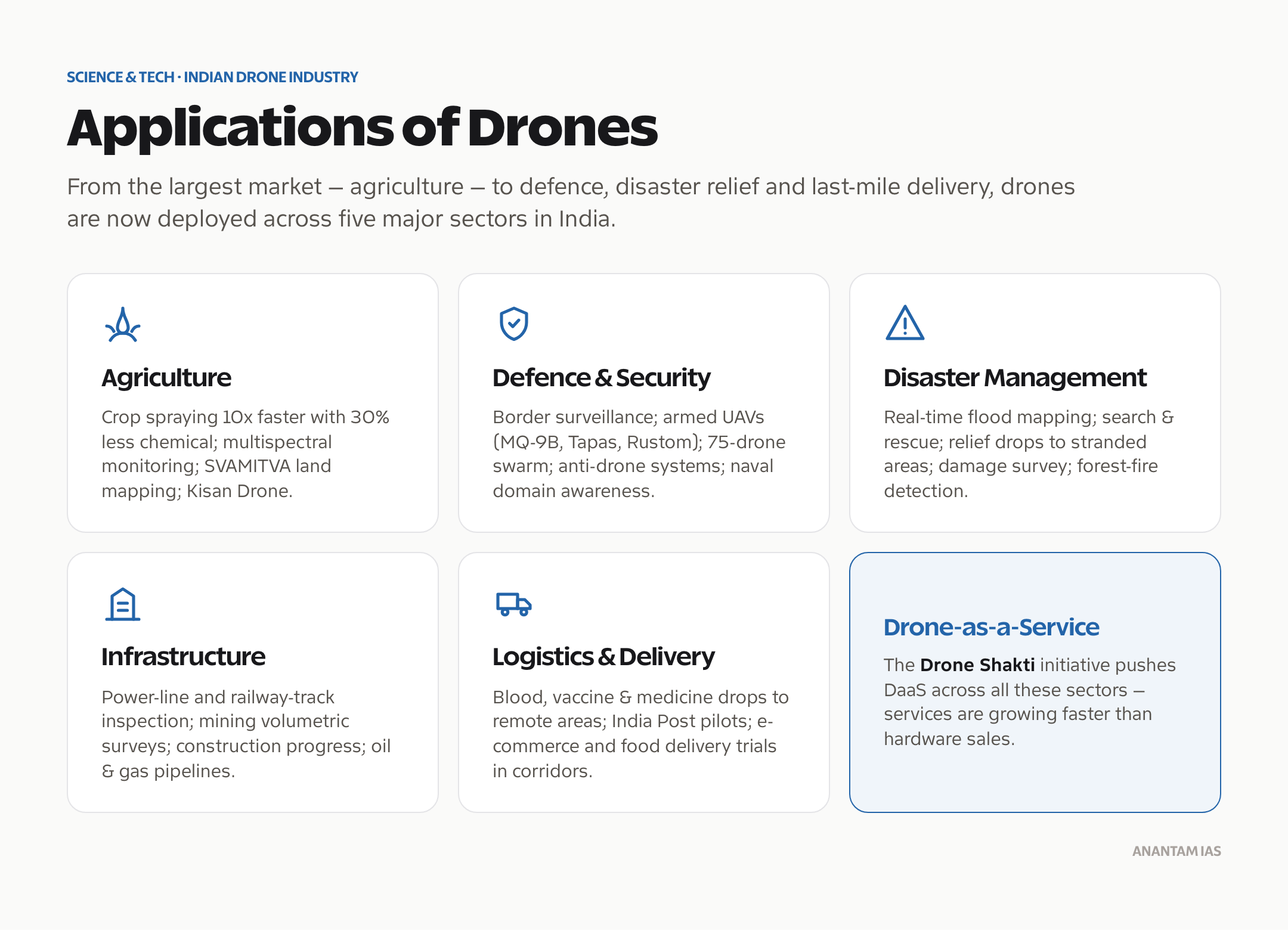
- Drone Shakti (Budget 2022-23): Facilitating drone-as-a-service (DaaS) in multiple sectors
- Kisan Drone: Subsidized drones for farmers under crop assessment, spraying, and land record digitization
- Liberalized Remote Pilot Certificate: Simplified training and licensing through DGCA-approved training schools
- Type Certification: Quality and safety certification framework for drone manufacturers
Applications of Drones in India
Agriculture
Agriculture is the largest potential market for drones in India.
- Crop spraying: Drones spray pesticides and fertilizers 10x faster than manual methods with 30% less chemical usage
- Crop monitoring: Multispectral cameras detect crop stress, disease, and nutrient deficiencies
- Precision farming: Variable-rate application of inputs based on drone-collected field data
- Land records digitization: SVAMITVA scheme uses drones to map rural residential properties
- Crop insurance: PMFBY uses drone imagery for crop damage assessment
- Kisan Drone subsidy: Government provides subsidies to FPOs, CHCs, and agricultural institutions for drone purchase
Defence and Security
- Surveillance: Border patrol along India’s international borders with China and Pakistan
- Anti-drone systems: India has developed counter-drone technology following drone attacks on Jammu Air Force Station (2021)
- Armed drones: India has acquired and is developing armed UAVs (MQ-9B SeaGuardian from the US, indigenous DRDO Tapas and Rustom)
- Swarm drones: DRDO demonstrated a swarm of 75 autonomous drones on Republic Day 2022
- Maritime surveillance: Indian Navy uses drones for maritime domain awareness in the Indian Ocean
Disaster Management
- Flood mapping: Real-time aerial assessment of flood-affected areas
- Search and rescue: Locating survivors in disaster zones where ground access is impossible
- Relief delivery: Dropping essential supplies to stranded populations
- Damage assessment: Post-disaster infrastructure damage survey
- Fire detection: Forest fire monitoring and firefighting coordination
Infrastructure and Industry
- Power line inspection: Drones inspect transmission lines, reducing risk to human workers
- Railway track monitoring: Automated inspection of thousands of kilometres of track
- Mining surveys: Volumetric mapping of mining sites for quantity estimation
- Construction monitoring: Progress tracking on large infrastructure projects
- Oil and gas: Pipeline and refinery inspection in hazardous environments
Logistics and Delivery
- Medical supply delivery: Delivering blood samples, vaccines, and medicines to remote areas
- E-commerce delivery: Experimental drone deliveries by companies in designated corridors
- Postal delivery: India Post has piloted drone-based mail delivery in remote areas
- Food delivery: Urban drone delivery trials (regulatory approvals pending at scale)
Indian Drone Industry
Key Players
| Category | Companies |
|---|---|
| Manufacturing | ideaForge, Garuda Aerospace, Dhaksha, Throttle Aerospace, Asteria Aerospace |
| Defence drones | DRDO (Rustom, Tapas), HAL (CATS Warrior), Adani Defence |
| Delivery/logistics | Skye Air, TechEagle, Zipline (partnership in India) |
| Agriculture | Garuda Aerospace, IoTechWorld, General Aeronautics |
| Software/mapping | Skylark Drones, Indrones Solutions |
Market Size
- India’s drone market is projected to reach $4.5 billion by 2026-27
- Agricultural drones represent the largest segment
- Defence drones account for significant government procurement
- Drone services (DaaS) growing faster than hardware sales
Security Concerns and Counter-Drone Technology
The June 2021 drone attack on Jammu Air Force Station highlighted the security threat posed by rogue drones.
Threats
- Terrorism: Weaponized drones carrying explosives
- Smuggling: Drug and weapon smuggling across borders (frequent along Punjab border)
- Espionage: Surveillance drones over military installations
- Privacy invasion: Unauthorized surveillance of individuals and properties
- Airspace intrusion: Near-miss incidents with commercial aircraft
Counter-Drone Measures
| Technology | Method | Indian Systems |
|---|---|---|
| Radar detection | Radio frequency scanning | DRDO anti-drone system |
| RF jamming | Disrupting drone communication | DRDO Counter-Drone Suite |
| Laser systems | High-energy directed energy weapons | Under development |
| Net capture | Physical capture using interceptor drones | IIT-developed systems |
| Cyber takeover | Hacking drone control systems | DRDO and private sector |
UPSC Relevance
Prelims Focus
- Drone classification (weight categories)
- Drone Rules 2021 key provisions
- Digital Sky Platform
- PLI scheme for drones
- Defence drone programmes (Tapas, Rustom, MQ-9B)
Mains Relevance
- GS Paper III (Science & Tech): Drone technology applications and policy
- GS Paper III (Internal Security): Drone threats, counter-drone measures, border security
- GS Paper II (Governance): Drone regulations, balancing innovation with security
- GS Paper III (Agriculture): Kisan Drone and precision agriculture
Artificial Intelligence in India: Policy & UPSC Notes
Space Technology: Satellites, Rockets & India’s Role
5G Technology in India: Impact & Applications
Frequently Asked Questions
Do drones need registration in India?
All drones except nano drones (below 250 g) must be registered on the Digital Sky Platform operated by DGCA. Operators must obtain a Unique Identification Number (UIN) for the drone and a Remote Pilot Certificate for flying micro and above category drones.
What is the Digital Sky Platform?
Digital Sky is the DGCA-operated online platform that serves as a single-window system for drone registration, pilot licensing, flight permissions, and airspace management. The platform enforces u0022No Permission No Takeoffu0022 (NPNT) — drones must receive digital authorization before each flight.
Can farmers get subsidies for drones?
Yes, the government provides subsidies for agricultural drones under the Kisan Drone initiative. Farmer Producer Organizations (FPOs), Custom Hiring Centres, and agricultural institutions can receive subsidies up to 100% of the drone cost. Individual farmers from SC/ST and small/marginal categories also receive higher subsidies.
What was the Jammu drone attack and why is it significant?
On 27 June 2021, two explosive-laden drones targeted the Indian Air Force station in Jammu, marking the first confirmed drone attack on an Indian military installation. The incident prompted India to fast-track counter-drone technology development and deploy anti-drone systems at critical military and civilian infrastructure.