Eco-Sensitive Zones (ESZ): Notification, Activities, and India’s Buffer Conservation
A complete UPSC GS-III guide to Eco-Sensitive Zones in India. Covers the legal basis under the Environment (Protection) Act 1986, the National Wildlife Action Plan origin, the 10-km rule, prohibited and regulated activities, and the Supreme Court's intervention.
Eco-Sensitive Zones, almost always shortened to ESZ in policy circles, are the buffer rings the Centre draws around national parks and wildlife sanctuaries to act as shock absorbers between strict protection zones and the busy human-use landscapes that surround them. The rules that govern what farmers, hoteliers, and infrastructure agencies can do inside an ESZ are issued under the Environment (Protection) Act, 1986, and they have become one of the most frequently litigated areas of Indian environmental law.
For a UPSC aspirant, ESZs sit at the meeting point of three things — wildlife conservation, federal coordination, and the Supreme Court’s evolving role in environmental governance. The 2022 directions of the Supreme Court, which initially imposed a uniform one-kilometre ESZ around every protected area in the country, and the subsequent partial relaxation in April 2023, have made the topic a moving target. The institutional foundations, however, remain stable, and that is what this article focuses on.
Quick Facts on Eco-Sensitive Zones
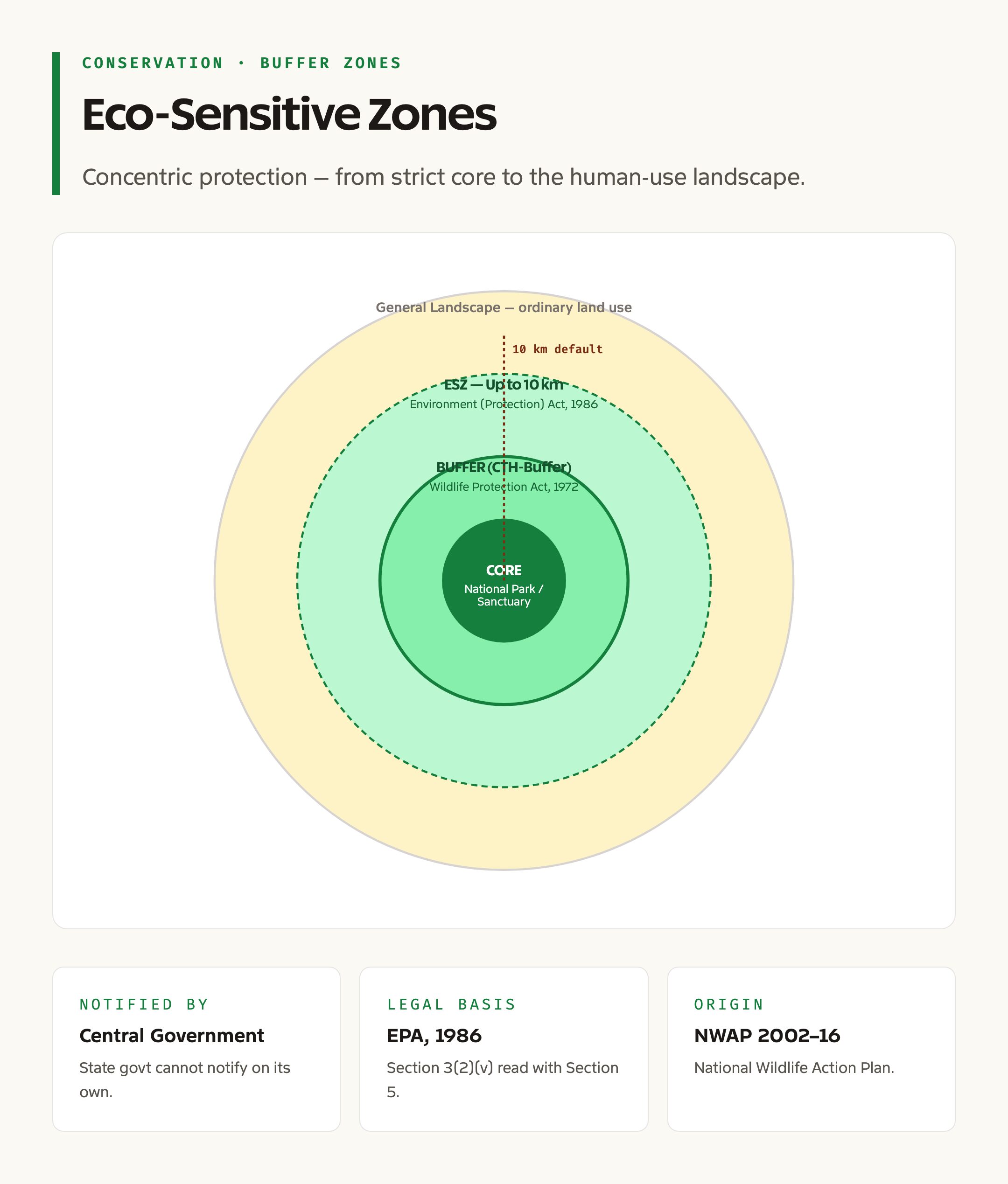
ESZs are notified by the Central Government, not by the State Government, even though the protected areas they surround are typically managed by State Forest Departments. The notification is issued under Section 3(2)(v) and Section 5 of the Environment (Protection) Act, 1986, which give the Centre the power to take measures to protect and improve environmental quality. The nodal ministry is the Ministry of Environment, Forest and Climate Change.
The general rule, which dates from the original guidelines of 2002 and 2011, is that the ESZ extends up to ten kilometres from the boundary of a national park or wildlife sanctuary. The rule is not a fixed distance — it can be less than ten kilometres or more than ten kilometres depending on the ecological importance of the surrounding landscape, the presence of corridors, and the density of human settlement.
What Eco-Sensitive Zones Actually Are
An ESZ is a transition zone, a buffer that prevents activities outside a protected area from leaching back into it. The legal logic is simple. A national park is the core of strict protection where no commercial activity is permitted. An ESZ is the surrounding buffer where some activities are prohibited, others are regulated, and a third category is permitted. Beyond the ESZ lies the general landscape, where ordinary land-use rules apply.
Without an ESZ, a stone crusher, a brick kiln, or a polluting industry could legally operate right up to the boundary fence of a tiger reserve. The dust, noise, and effluent would still reach the protected area even if the activity itself stayed outside. The ESZ gives the regulator a legal handle to push these activities further away.
Background and Historical Context
The idea of a statutory buffer around protected areas was first articulated in the National Wildlife Action Plan, 2002 to 2016. The plan recommended that areas of land within ten kilometres of a national park or sanctuary be declared an ESZ to prevent the gradual erosion of habitat integrity by pollution, encroachment, and incompatible land use. The MoEFCC followed this up with guidelines in 2011 that laid down the procedure for notification — a state-level proposal, a Zonal Master Plan, public consultation, and a final central notification.
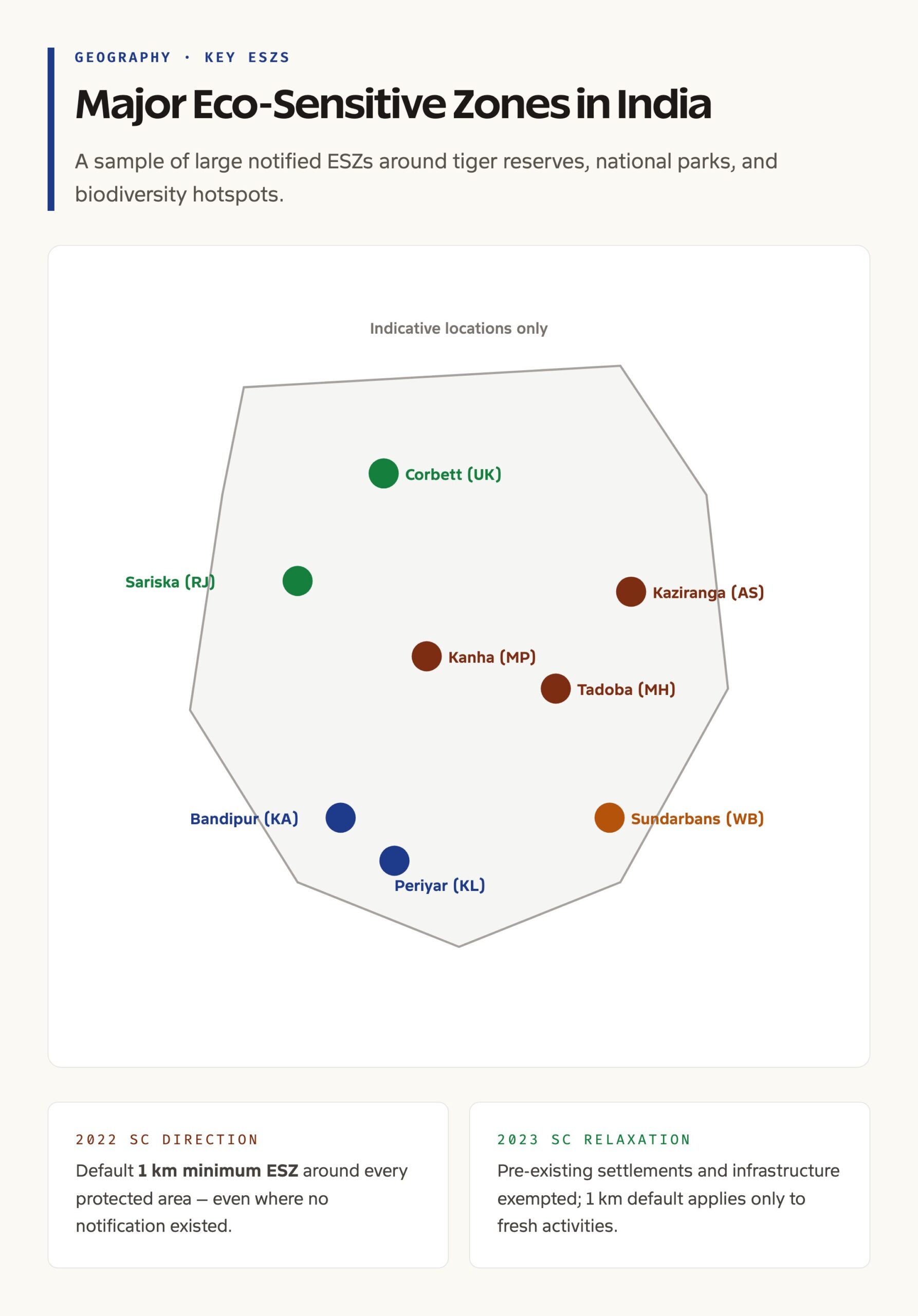
The pace of notification was slow, however. Many states delayed the submission of proposals because ESZs were politically unpopular with industry, real estate, and tourism interests. By the time the Supreme Court took up the matter in T.N. Godavarman and other related cases, hundreds of protected areas in the country still had no notified ESZ. In June 2022 the Court, frustrated by the slow pace, directed that every protected area in the country must have a default ESZ of at least one kilometre, applicable irrespective of whether a notification had been issued.
The June 2022 direction triggered an immediate political reaction. State Governments argued that a uniform one-kilometre rule was unworkable in densely populated states like Kerala, Goa, and parts of the Western Ghats, where existing settlements and even municipal areas would suddenly fall inside an ESZ. In April 2023 the Supreme Court relaxed the order, exempting human settlements and infrastructure that pre-dated the relevant notification, and clarifying that the one-kilometre default would apply only to fresh activities. This intersects with the broader system of tiger reserves in India, national parks of India, and biosphere reserves in India.
Why ESZs Matter
The case for ESZs rests on the science of edge effects. Ecologists have long observed that the ecological condition inside a protected area degrades within a measurable distance of its boundary because of light, noise, dust, invasive species, and human disturbance leaking in. A buffer that absorbs these effects reduces the rate of edge degradation and improves the long-term viability of the protected core.
The case also rests on the practical reality of corridors. Tigers, elephants, and most large mammals use corridors that pass through unprotected forest, agricultural land, and even urban fringes. These corridors are rarely declared protected areas in their own right because that would require massive displacement of existing land use. ESZs offer a middle path — they retain agriculture and traditional livelihoods while keeping out heavy industry and large infrastructure that would sever the corridor.
Detailed Analysis of Activities in ESZs
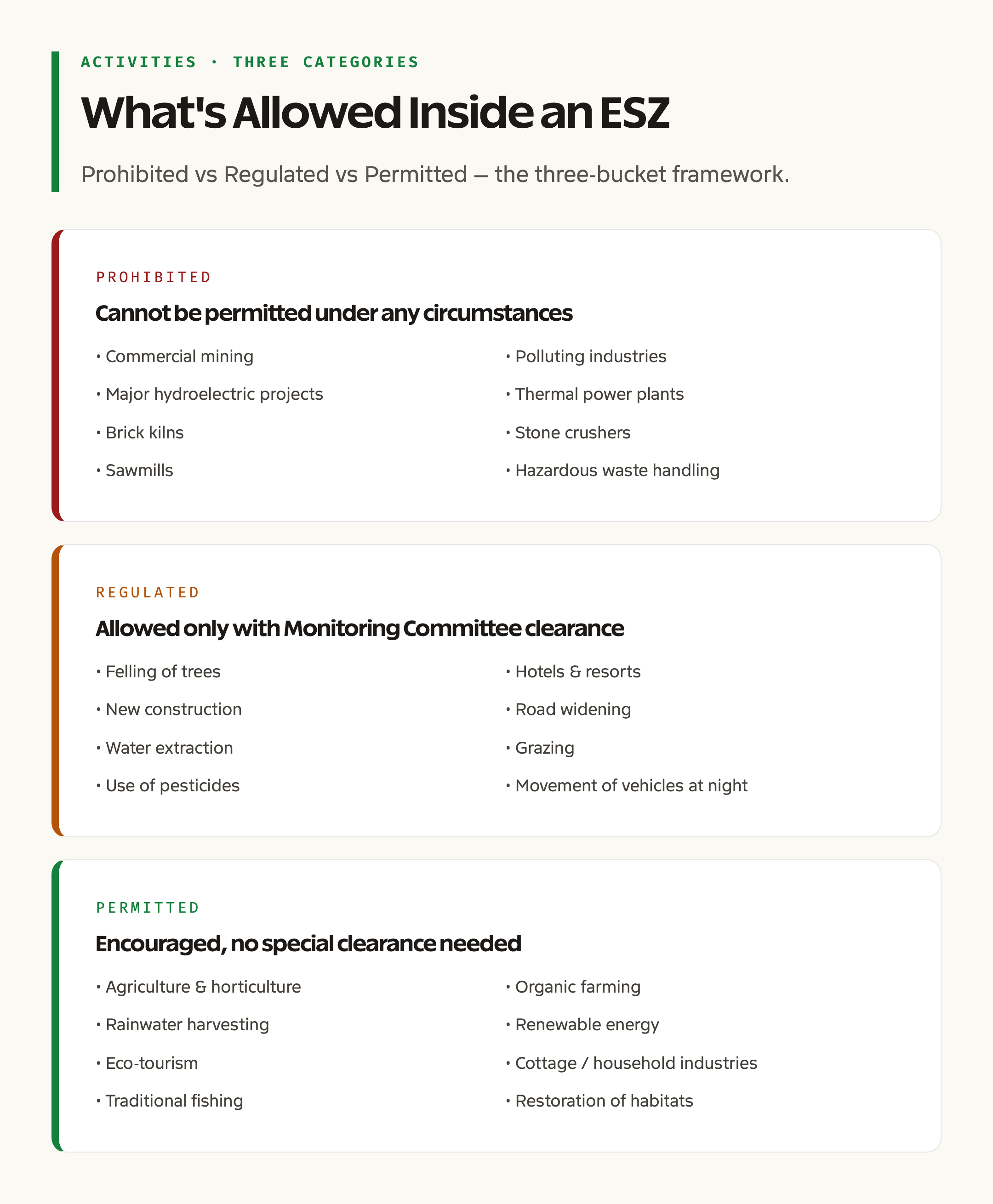
The MoEFCC framework divides activities in an ESZ into three categories. The categorization tries to balance conservation imperatives with the legitimate livelihood and development needs of communities living in or near the buffer.
| Prohibited | Regulated | Permitted |
|---|---|---|
| Commercial mining | Felling of trees | Agriculture and horticulture |
| Polluting industries | Hotels and resorts | Organic farming |
| Major hydroelectric projects | New construction | Rainwater harvesting |
| Thermal power plants | Road widening | Renewable energy |
| Brick kilns | Water extraction beyond limits | Eco-tourism |
| Stone crushers | Grazing | Cottage and household industries |
| Sawmills | Use of pesticides | Traditional fishing |
Note three things. First, the categorization is indicative — each individual ESZ notification adapts the list to local conditions. Second, the prohibited list is non-negotiable and cannot be over-ridden by local committees. Third, the regulated list is administered through a Monitoring Committee chaired by a senior State Government official, which has to clear individual proposals before they proceed.
Comparative Look: ESZs and Other Buffer Mechanisms
ESZs are sometimes confused with the buffer zones declared under the Wild Life (Protection) Act, 1972, particularly around tiger reserves. They are not the same. A tiger reserve is itself made up of a core, also known as a critical tiger habitat, and a buffer, which is part of the reserve and managed under the Wildlife Protection regime. An ESZ is an additional ring around the entire reserve, including the buffer, and is regulated under the Environment Protection Act. So a single tiger reserve can have a core, a Wildlife Protection Act buffer, and an outer Environment Protection Act ESZ.
The Coastal Regulation Zone, the Ramsar designation around wetlands, and biosphere reserves under the UNESCO Man and Biosphere Programme all operate through similar logic — they impose graded restrictions on a series of concentric zones — but each has its own legal basis and administering authority. Read this together with biodiversity in India for the broader policy ecosystem.
Challenges in Implementation
The first challenge is the sheer slowness of notification. Even after the Supreme Court’s intervention, many proposals are stuck at the state level because of pushback from real estate, mining, and tourism lobbies. The second challenge is enforcement. A notified ESZ requires a Monitoring Committee, a Zonal Master Plan, and a clear inventory of existing activities. Many notified ESZs have neither a functional committee nor a current master plan, which means that the regulation exists on paper alone.
A third challenge is the political reality of dense human habitation. India is not a country of empty buffers around its protected areas. Towns, villages, religious sites, defence installations, and even city outskirts often sit within ten kilometres of a sanctuary boundary. A literal application of the ten-kilometre rule would sweep all of this into the ESZ regime, which is neither workable nor fair to existing residents.
A fourth challenge is the trade-off with renewable energy. The Western Ghats, Kutch, and parts of the Eastern Ghats are simultaneously biodiversity hotspots and prime sites for solar and wind generation. ESZ notifications around protected areas in these regions can constrain the location of renewable energy projects, which complicates the country’s climate commitments.
Prelims Pointers
ESZs are notified by the Central Government under the Environment (Protection) Act, 1986, specifically Section 3(2)(v) read with Section 5. The State Government cannot notify an ESZ on its own. The general default radius is up to ten kilometres around a protected area, but it is not a fixed figure. The concept originates in the National Wildlife Action Plan 2002 to 2016.
Eco-Sensitive Zones are not declared under the Wild Life (Protection) Act, 1972, despite the close functional connection. The purpose of an ESZ is to act as a shock absorber and not to prohibit all human activity. Aspirants should remember that agriculture, organic farming, and traditional fishing are typically permitted, while commercial mining, polluting industries, and thermal power plants are prohibited.
Mains Questions on Eco-Sensitive Zones
Discuss the role of Eco-Sensitive Zones in conserving India’s biodiversity, with reference to the recent directions of the Supreme Court. Examine the federal tensions involved in the notification and enforcement of ESZs. Evaluate the trade-offs between strict ESZ regulation and the legitimate development needs of local communities living within the buffer.
A solid answer would track the legal evolution from the 2002 plan to the 2011 guidelines to the 2022 and 2023 Supreme Court directions, weigh the ecological case for buffers against the political reality of densely populated landscapes, and offer a layered solution that distinguishes between protected areas in different bio-geographic settings.
Way Forward
A workable framework needs four reforms. The first is a clear, science-based calibration of buffer width that varies with the type of ecosystem, the density of surrounding human use, and the presence of corridors. A blanket ten-kilometre or one-kilometre rule cannot survive the diversity of Indian landscapes. The second is faster, time-bound notification with deemed approval if states fail to submit proposals within a specified period. The third is a national online registry of ESZs, master plans, and monitoring committee decisions to enable public scrutiny.
The fourth is a stronger link between ESZ regulation and the broader environmental laws in India, so that the ESZ becomes part of an integrated landscape-level approach rather than an isolated buffer. Where possible, ESZs should be aligned with elephant corridors, wildlife crossings, and water catchments, so that the buffer protects not just the named sanctuary but the wider connectivity that sustains it.
Frequently Asked Questions
Who notifies an Eco-Sensitive Zone?
The Central Government, through the Ministry of Environment, Forest and Climate Change, issues the notification under the Environment (Protection) Act, 1986. State Governments propose the notification but cannot finalize it themselves.
What is the standard radius of an ESZ?
The general default is up to ten kilometres from the boundary of a national park or wildlife sanctuary. The actual notified width can be less than or more than ten kilometres depending on the ecological context.
Are all human activities banned inside an ESZ?
No. The rules divide activities into prohibited, regulated, and permitted categories. Commercial mining and polluting industries are prohibited, hotels and major construction are regulated, and agriculture, organic farming, traditional fishing, and renewable energy are permitted.
What did the Supreme Court direct in 2022?
In June 2022 the Court directed that every protected area in the country must have a default minimum ESZ of one kilometre, even where no notification existed. In April 2023 the Court relaxed the order to exempt pre-existing settlements and infrastructure.
How does an ESZ differ from a tiger reserve buffer?
A tiger reserve buffer is part of the reserve itself and is governed under the Wild Life (Protection) Act, 1972. An ESZ is an additional ring around the entire reserve, governed under the Environment (Protection) Act, 1986. The two can overlap geographically but they are distinct in law.
Can an ESZ be declared around a Ramsar site?
ESZs as currently notified apply to national parks and wildlife sanctuaries. Wetland protection has its own framework under the Wetlands (Conservation and Management) Rules, 2017, although in practice many Ramsar sites also fall within ESZs of nearby sanctuaries.
Do Gram Sabhas have a role in ESZ governance?
Each notified ESZ has a Monitoring Committee that includes representatives of local communities. Gram Sabhas in Scheduled Areas have additional rights under the Forest Rights Act, 2006, which the Monitoring Committee is expected to respect.
What happens to existing industries inside an ESZ at the time of notification?
Existing industries are typically allowed to continue their operations at the same level but cannot expand. New units of prohibited categories cannot be set up. Each notification specifies a transition arrangement based on the local context.