Endemic Species in India: Meaning, Examples & Conservation
Learn what endemic species are, India's key endemic flora and fauna, conservation threats, and UPSC Prelims/Mains relevance in this complete guide.
Introduction
Endemic species are plants and animals found naturally in a single geographical region and nowhere else on Earth. India, with its extraordinary biogeographic diversity — from the Himalayas to the Western Ghats and Andaman & Nicobar Islands — hosts a very high share of endemic life. Understanding endemism is essential for UPSC aspirants because conservation policy, biodiversity hotspots, and protected area notifications repeatedly appear in Prelims and GS Paper III.
This guide explains what endemism means, India's major endemic species, causes behind high endemism, threats, and the conservation framework.
What Are Endemic Species
Endemic species are restricted in distribution to a specific area, which may be an island, a mountain range, a lake, a country, or a biogeographic zone. The term comes from the Greek en (in) and demos (people), signifying "native to a place."
Endemism is typically classified by scale:
- Paleoendemic — ancient species that were once widespread but now survive only in relict areas (example: Nepenthes khasiana pitcher plant of Meghalaya).
- Neoendemic — recently evolved species that have not yet dispersed beyond their origin.
- Narrow endemic — confined to a very small area, often a single valley or island.
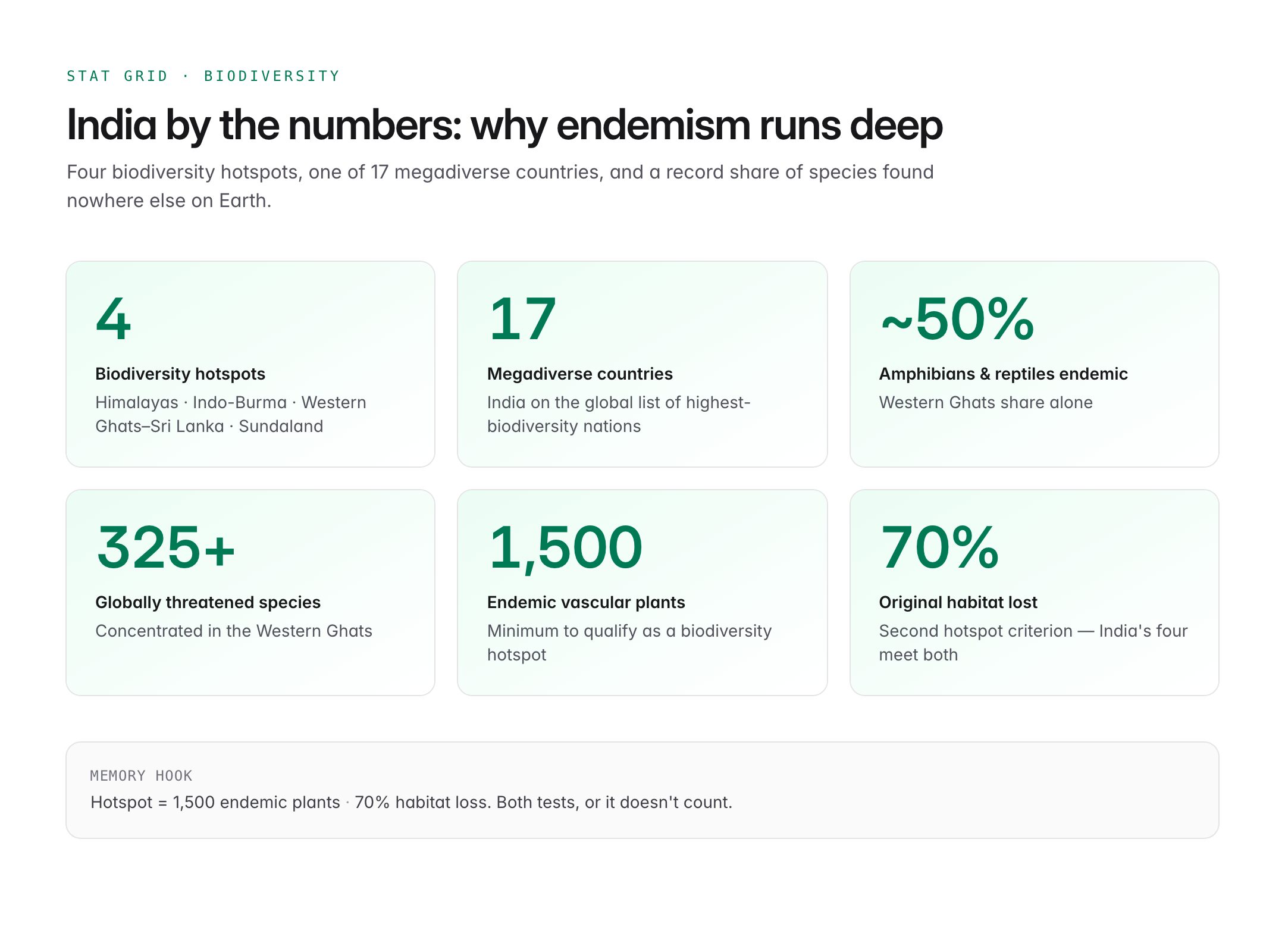
India is classified among the 17 megadiverse countries and contains four of the world's 36 biodiversity hotspots: the Himalayas, Indo-Burma, Western Ghats–Sri Lanka, and Sundaland (Nicobar Islands).
Why India Has High Endemism
Several geographical and evolutionary factors contribute to India's endemism:
- Geological isolation of the Indian plate during its northward drift allowed unique evolutionary lineages (especially in the Western Ghats).
- Altitudinal gradients in the Himalayas create micro-climates that support localised speciation.
- Island biogeography in the Andaman & Nicobar group fosters isolation-driven endemism.
- Monsoon-driven climatic zones produce sharply differentiated habitats over short distances.
Major Endemic Species of India
| Group | Examples | Region |
|---|---|---|
| Mammals | Lion-tailed macaque, Nilgiri tahr, Nilgiri langur, Malabar civet | Western Ghats |
| Mammals | Kashmir stag (Hangul), Namdapha flying squirrel | Himalayas / NE India |
| Birds | Forest owlet, Nilgiri flycatcher, Jerdon's courser | Peninsular India |
| Reptiles | Gharial, Indian star tortoise, king cobra | South Asia / Ghats |
| Amphibians | Purple frog (Nasikabatrachus) | Western Ghats |
| Plants | Rafflesia, Nepenthes khasiana, Musa nagalandiana | NE India / Ghats |
The Western Ghats alone host over 325 globally threatened species and roughly 50% of India's amphibians and reptiles are endemic to this range.
Flagship Endemic Animals
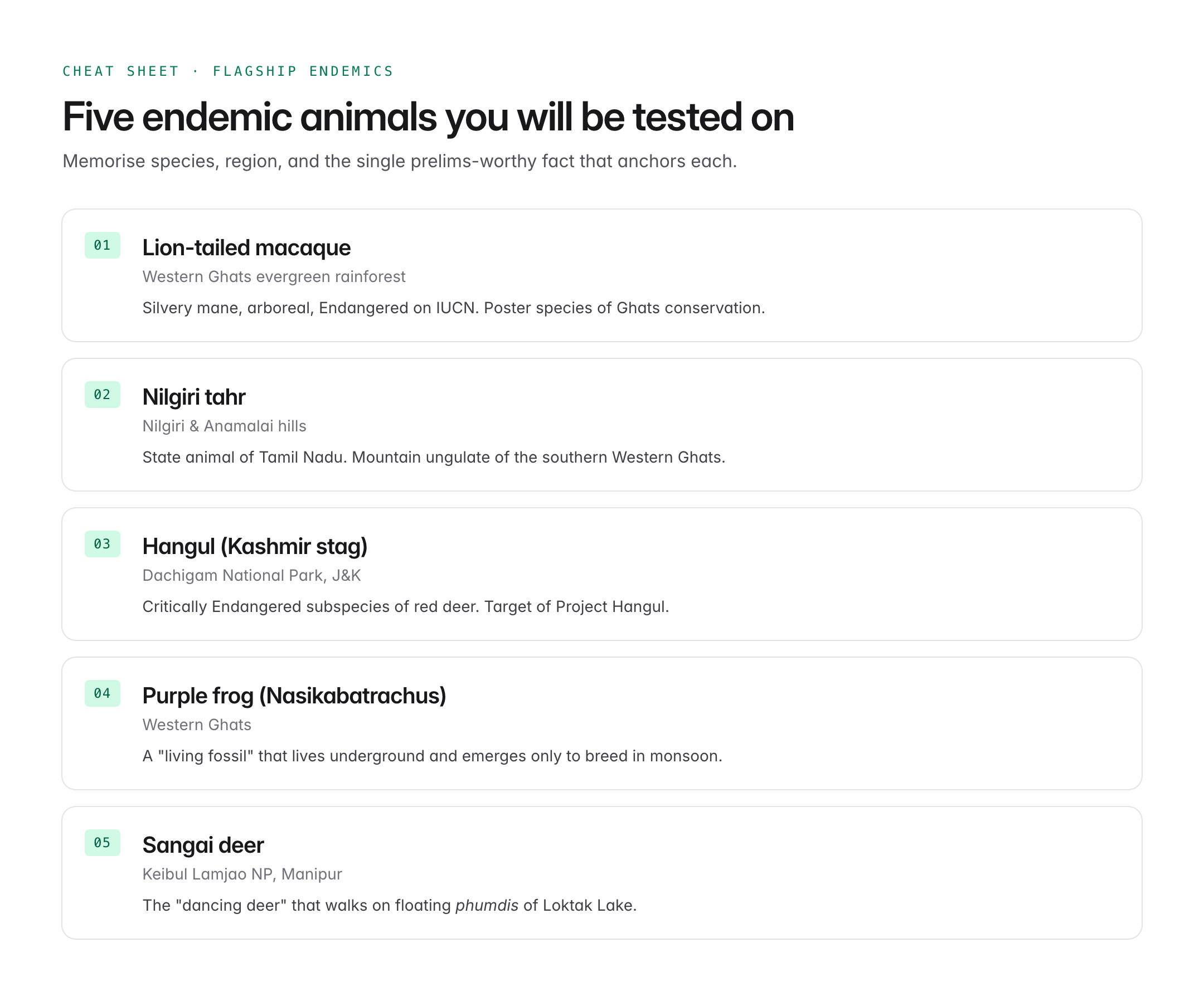
- Lion-tailed macaque — silvery-maned primate found only in evergreen rainforests of the Western Ghats.
- Nilgiri tahr — mountain ungulate restricted to the Nilgiri and Anamalai hills; state animal of Tamil Nadu.
- Hangul (Kashmir stag) — Critically Endangered subspecies of red deer confined mainly to Dachigam National Park.
- Purple frog — a "living fossil" that spends most of its life underground and emerges only during monsoon to breed.
- Sangai deer — the dancing deer of Loktak Lake, endemic to the floating phumdis of Keibul Lamjao National Park, Manipur.
Threats to Endemic Species
Endemic species are particularly vulnerable because their small ranges leave no alternative habitat if conditions change. Major threats include:
- Habitat loss and fragmentation from agriculture, plantations, roads, and hydropower projects.
- Invasive alien species such as Lantana camara and Prosopis juliflora that outcompete native flora.
- Climate change shifting temperature and rainfall bands faster than species can migrate.
- Poaching and illegal wildlife trade, especially of reptiles, pangolins, and orchids.
- Pollution from pesticides, mining runoff, and plastic waste in island ecosystems.
Conservation Framework

India's conservation response combines legal, institutional, and international measures.
Domestic legislation:
- Wild Life (Protection) Act, 1972 — Schedule I protects most endemic vertebrates.
- Biological Diversity Act, 2002 and its 2023 Amendment — regulate access, benefit-sharing, and conservation of biological resources.
- Forest (Conservation) Act, 1980 — controls diversion of forest land.
Protected area network: National parks, wildlife sanctuaries, conservation reserves, community reserves, and biosphere reserves such as Nilgiri, Nanda Devi, and Great Nicobar.
Species-specific programmes: Project Tiger, Project Elephant, Project Hangul, Project Great Indian Bustard, and the Hoolock Gibbon Conservation Action Plan.
International commitments: CBD, CITES, Ramsar Convention, and the Kunming-Montreal Global Biodiversity Framework (2022).
Endemism and Biodiversity Hotspots
A region qualifies as a biodiversity hotspot if it has at least 1,500 endemic vascular plant species and has lost at least 70% of its original habitat. India's four hotspots meet both criteria, making endemic species an indicator of ecological richness as well as ecological stress.
UPSC Relevance
Prelims angle: Expect direct questions on which species are endemic to which region, hotspot criteria, and protected area notifications. Memorise state animals, Schedule I species, and IUCN Red List categories for flagship endemics.
Mains GS III angle: Use endemic species in answers on biodiversity conservation, EIA weaknesses, climate-change adaptation, and human–wildlife conflict. Link endemism to ecosystem services, indigenous rights under FRA 2006, and India's Updated NBSAP.
PYQ angle:
- "Which of the following are in Agasthyamala Biosphere Reserve?" (Prelims 2019) — tests Western Ghats endemism.
- "Discuss the causes of depletion of mangroves and explain their importance in maintaining coastal ecology." (Mains 2019) — hooks to endemic mangrove-dependent species.
- Regular Prelims MCQs on the purple frog, Hangul, and Jerdon's courser.
A strong grasp of endemism gives aspirants a ready analytical frame for any question on Indian biodiversity.