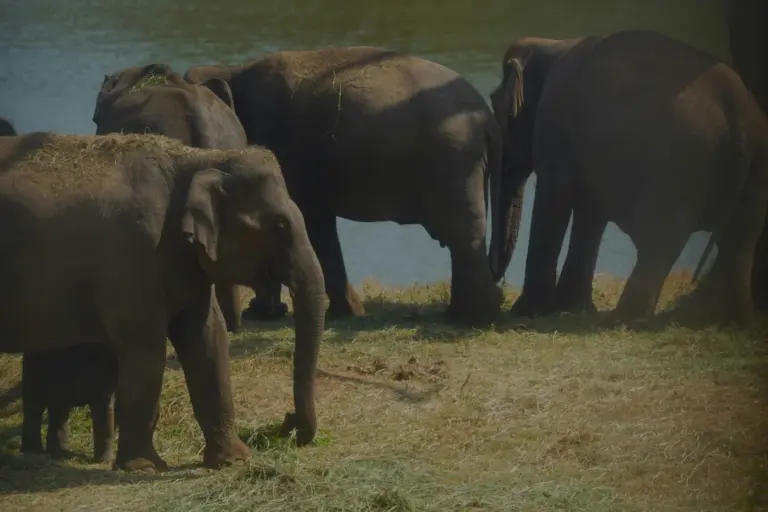
The hangul is the kind of species that focuses an entire conservation system around a single geography. It is endemic to India, restricted in its surviving distribution to a single national park near Srinagar, and listed by the IUCN as critically endangered. It is also the state animal of the Union Territory of Jammu and Kashmir, a position that gives it cultural significance well beyond the count of animals on the ground. For UPSC, the hangul is the textbook example of a species whose conservation is a function of one protected area, one specialist project, and one fragile mountain landscape.
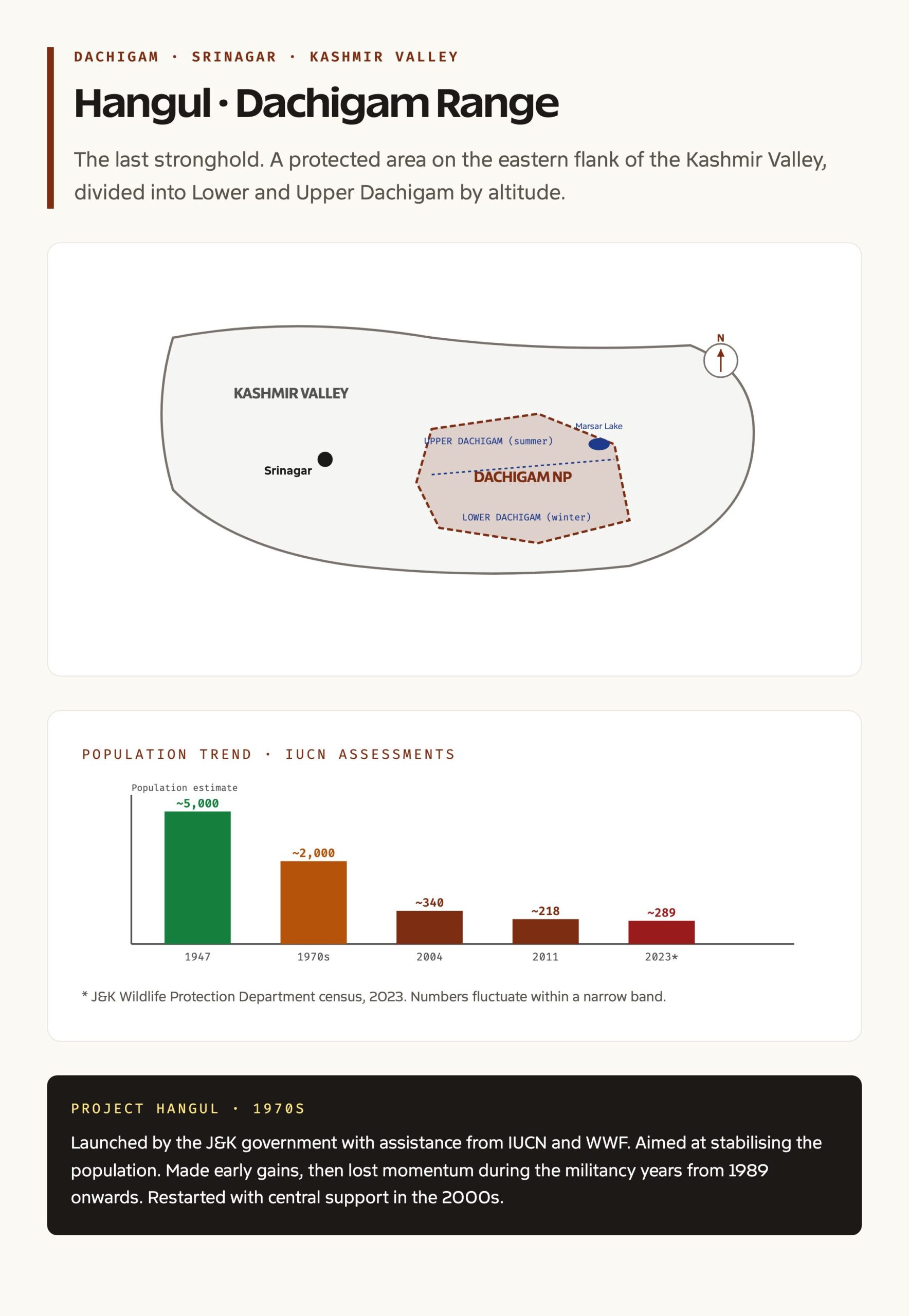
Cervus hanglu hanglu, to use its scientific name, is a subspecies of the Central Asian red deer. Its closest relatives sit far away on the steppes of Central Asia and the Caucasus. The hangul itself is the only red deer subspecies present in the Indian subcontinent. Its current distribution centres on Dachigam National Park, a compact mountain landscape that climbs from about 1,700 metres on the Srinagar side to over 4,000 metres on the upper ridges. From a peak population of perhaps 5,000 animals in the early twentieth century, the species declined precipitously through the second half of the century. Recent census exercises have placed the population in a low band, holding tenuously rather than recovering robustly.
This guide walks through what the hangul is, how it lives, why its numbers crashed, what Project Hangul tried to do, and how the species currently sits in the matrix of legal protection, scientific work, and political context.
Quick Facts
- Scientific name: Cervus hanglu hanglu
- Local name: Hangul
- English names: Kashmir Stag, Kashmiri Red Deer
- Status: Subspecies of the Central Asian Red Deer; endemic to India
- Sole protected stronghold: Dachigam National Park, near Srinagar
- Surrounding context: Some sightings continue in adjoining areas of the Wangat-Sind, Overa-Aru, and Tral landscape, but the bulk of the population is in Dachigam
- State animal: Union Territory of Jammu and Kashmir
- IUCN Red List: Critically Endangered (CR)
- Wildlife Protection Act, 1972: Schedule I
- CITES: Appendix I
- CMS (Convention on Migratory Species): Appendix I
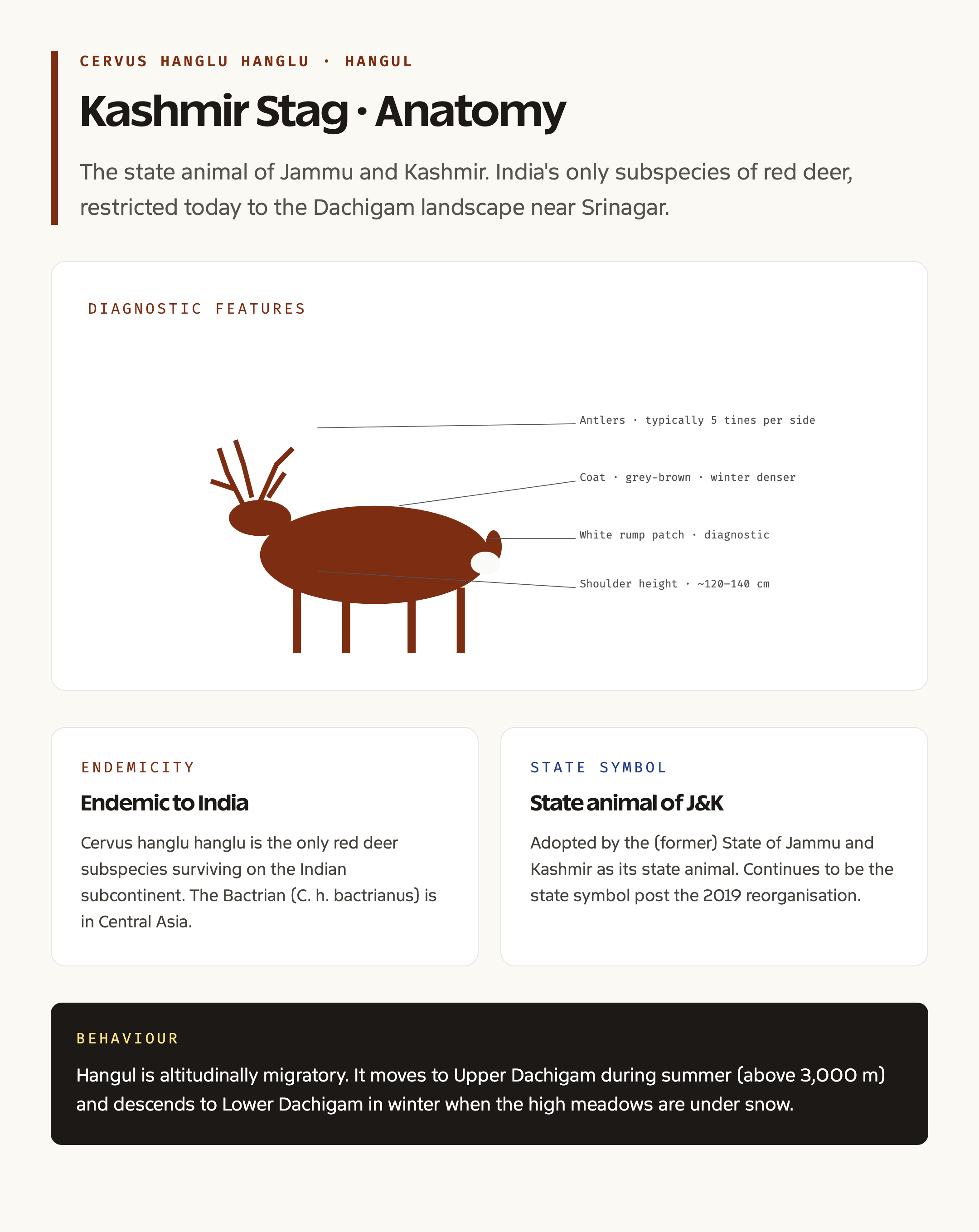
- Migration pattern: Altitudinal migrant, summer in Upper Dachigam, winter in Lower Dachigam
- Diet: Grass, leaves, herbs, tree bark, lichens
- Antlers: Up to 5 tines per antler in mature stags, shed and regrown annually
- Coat: Dark brown coat with light rump patch
- Mating season: Autumn rut, September to October
- Calving: Late spring, May to June
- Conservation programme: Project Hangul, launched in the 1970s
What Is the Hangul
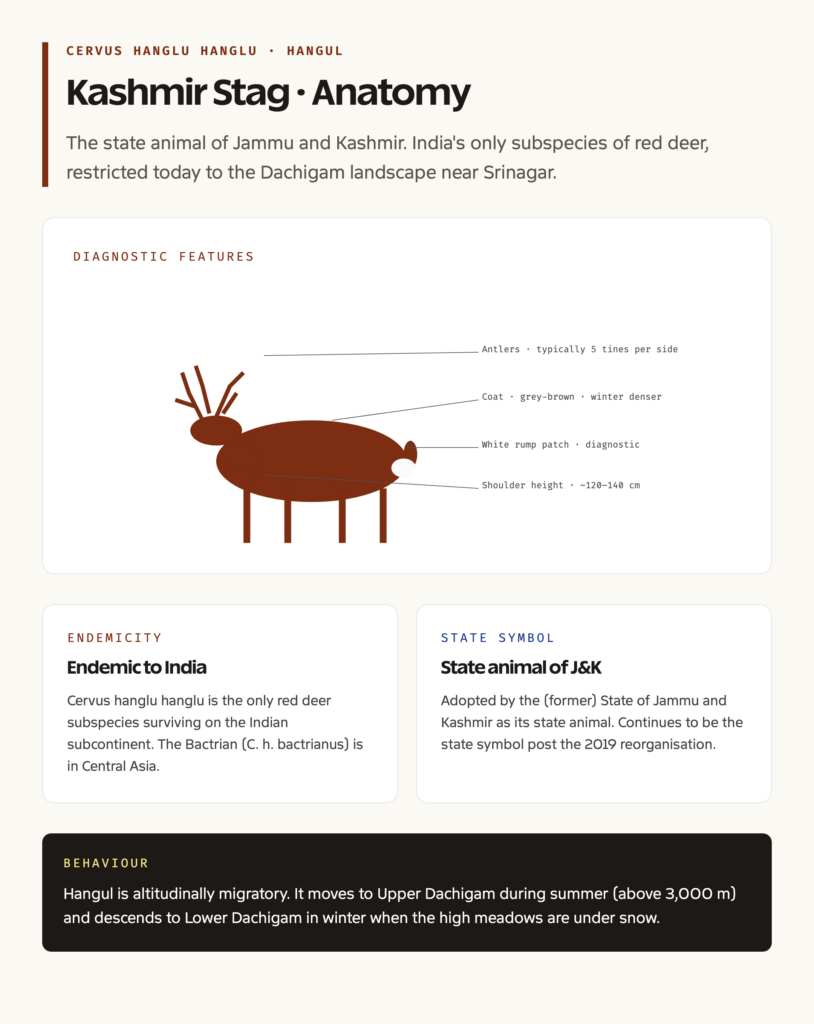
The hangul is a deer of medium-large build, with mature stags standing about 1.3 metres at the shoulder and weighing between 180 and 240 kilograms. The coat is a dark brown with a contrasting cream rump patch, paler in summer and darker in winter. Mature males carry impressive branching antlers, typically with five points per side, that are shed and regrown each year. Hinds are smaller, lighter, and antlerless.
Behaviourally, the species is gregarious for most of the year, with hinds and calves forming small herds and mature stags moving in bachelor groups outside the rut. During the autumn rut, mature stags hold harems and engage in the loud, drawn-out roar that gives the hangul its acoustic signature in the Dachigam valleys.
Diet is mixed, with both grazing and browsing components. The shifts in elevation over the year are partly driven by forage availability. In summer, the open meadows of upper Dachigam and the adjoining alpine pasture carry rich grass cover that supports calves and lactating hinds. In winter, the lower Dachigam scrub and oak forest provides shelter from snow and access to browse, including bark and lichen, when grasses are buried.
Predators of the hangul include the leopard and the Asiatic black bear, both of which take calves and occasionally adult animals. The leopard is the more sustained predation pressure; the bear is opportunistic.
Background and Historical Context
The hangul has been a recognised animal in Kashmiri ecology for centuries. The Mughal hunting records of the late sixteenth and seventeenth centuries refer to the deer of the Dachigam forests, and the area was a hunting reserve under the Maharaja of Jammu and Kashmir from the late nineteenth century. The Maharaja’s gamekeepers operated a relatively strict access regime that kept the population at viable levels through the colonial period.
Population estimates in the 1940s and early 1950s placed the species in the low thousands, possibly as high as 5,000 across the wider Kashmir landscape. The decades that followed saw a sharp decline. Several factors compounded each other. Habitat conversion for orchards and grazing reduced the lower Dachigam wintering ground. Livestock grazing inside the protected area pushed wild ungulates higher up earlier in the season and exposed calves to weather. Poaching for antlers and meat continued sporadically. The expansion of the road network around Srinagar fragmented connectivity to the adjoining Sind valley populations.
By the late 1960s, ad-hoc estimates put the surviving population at a few hundred animals concentrated almost entirely in Dachigam. In response, the Government of Jammu and Kashmir, working with the IUCN and the World Wildlife Fund, launched Project Hangul in the early 1970s. The objective was to stabilise the population, protect the breeding habitat, and reverse the decline.
Project Hangul achieved a partial recovery through the 1970s. Population estimates improved to several hundred animals. From the late 1980s, however, the project ran into difficulties. The militancy in Kashmir from 1989 onward severely disrupted field operations, made systematic census work hazardous, and reduced enforcement against poaching. By the 2000s, the surviving population was again in three-figure territory, and the species was reclassified as critically endangered.
Recent census work, drawing on improved transect-and-block methodology, has documented a population that sits in the low to mid hundreds. The most recent published estimates report a holding pattern rather than a recovery. The species is far from secure.
Key Provisions and Legal Status
The hangul carries the strongest available legal protection at every level.
Domestically, it is listed in Schedule I of the Wildlife Protection Act, 1972, the highest schedule, which makes hunting an offence carrying severe penalties and treats the animal as fully protected. Schedule I status also allows the central government to support state-level conservation programmes for the species.
Dachigam National Park itself, which holds essentially the entire surviving population, is notified under the Wildlife Protection Act, 1972 as a national park, the highest category of terrestrial protected area available under Indian law.
Internationally, the hangul is listed in CITES Appendix I, which prohibits commercial international trade in the species or its parts. It is also listed in Appendix I of the Convention on Migratory Species (CMS), which obliges parties to provide strict habitat protection for the species. The IUCN Red List places it in the Critically Endangered (CR) category, which signals an extremely high risk of extinction in the wild.
Project Hangul, launched in the early 1970s under the J&K Department of Wildlife with technical support from IUCN and WWF, remains the species-specific programme of record. It has gone through phases of effective implementation, partial collapse during the militancy years, and recent revival.
Why the Hangul Matters
The hangul matters in three distinct registers.
Ecologically, it is the only red deer subspecies in the Indian subcontinent. Its loss would extinguish a unique branch of the Cervus hanglu lineage and remove a flagship herbivore from the Kashmir Himalaya. Its place as a primary prey species also matters for the population dynamics of the leopard and the Asiatic black bear in Dachigam.
Culturally, it is the state animal of the Union Territory of Jammu and Kashmir. That status carries weight in school textbooks, government publications, tourism imagery, and public memory in the valley. For a population of fewer than five hundred animals to occupy the role of state symbol is a useful reminder of how thin some species are in their last refuges.
Strategically, the hangul is a test case for whether single-park conservation can hold a critically endangered species over decades of political instability. The trajectory through the militancy years, the recent revival, and the persistent vulnerability of the population all speak to the limits and possibilities of that model.
Detailed Analysis
The science of hangul conservation rests on a few well-defined problems.
The first is sex ratio. Recent census work has documented a heavily skewed sex ratio, with hinds significantly outnumbering stags, especially mature breeding stags. This is partly a legacy of selective poaching for antlers and partly a consequence of demographic chance in a small population. A skewed ratio reduces effective breeding population and lowers the genetic diversity of subsequent cohorts.
The second is calf survival. Calf survival in Dachigam has been variable, with weather, predation, and disturbance all contributing to year-on-year fluctuations. Stable calf survival in the 25 to 30 per cent band would be needed to lift the population trend, and that has not been consistently achieved.
The third is grazing competition. The lower Dachigam wintering ground and the broader buffer carry significant livestock grazing pressure from Bakarwal and Gujjar communities and from Srinagar-adjacent dairying. Competition with domestic livestock for forage reduces the carrying capacity of the wintering ground and exposes the deer to disease spillover, including foot and mouth disease and respiratory infections.
The fourth is habitat connectivity. Historically, the hangul population was distributed across Dachigam, the Sind valley, the Tral forests, and parts of the Pir Panjal range. The current population is functionally restricted to Dachigam. Restoring connectivity to the satellite landscapes of Wangat-Sind, Overa-Aru, and Tral would give the population a meta-population structure and reduce its vulnerability to a single catastrophic event.
The fifth is captive breeding. A small captive breeding centre operates at Shikargah within Dachigam. Its function is precautionary, holding founder animals for potential reintroduction, rather than primary recovery. The central population recovery depends on in-situ work rather than captive breeding.
Comparative Snapshot
Among Indian critically endangered mammals, the hangul sits in a distinctive niche.
Compared with the great Indian bustard, also CR, the hangul has a single-park concentration that simplifies operational protection but increases catastrophic-event risk. The bustard is spread across multiple states but in very thin populations.
Compared with the gharial, the hangul depends on terrestrial habitat protection rather than river protection, with a different stakeholder map.
Compared with the snow leopard, which is also a Himalayan species, the hangul has far fewer animals and a much smaller range, but it is also far better positioned for intensive single-site management. The snow leopard is a landscape species. The hangul is, for now, a single-reserve species.
These comparisons help locate the hangul in the broader spectrum of Indian endangered species management.
Challenges and Pressures
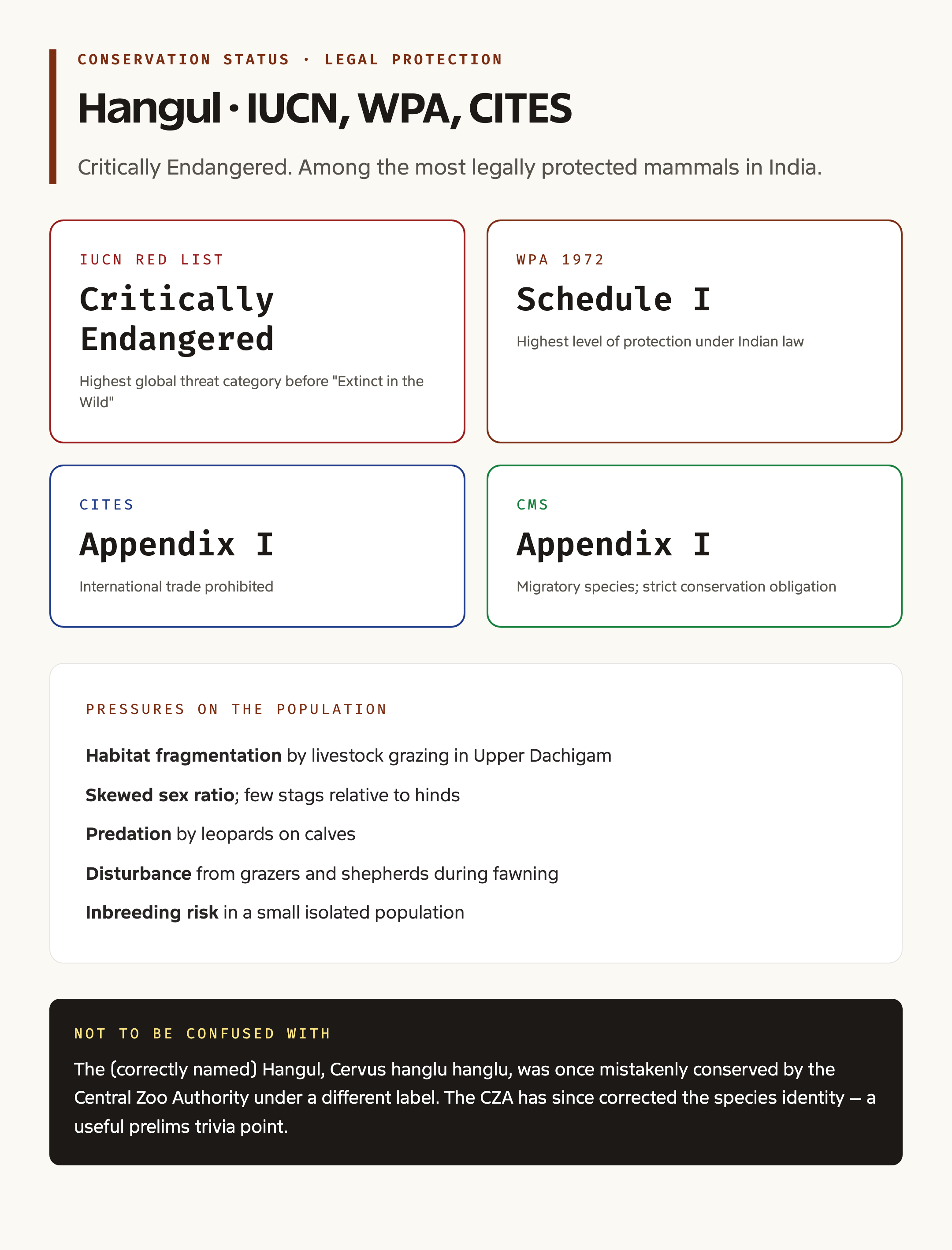
The pressures on hangul recovery are well documented.
Habitat loss and degradation outside Dachigam continue. The wider Kashmir landscape has seen orchard expansion, infrastructure development, and military and security infrastructure that has reduced available habitat in the Sind valley and the Tral forests.
Livestock grazing inside and around Dachigam, particularly in the lower park during winter, competes with hangul for forage and brings disease risk.
Predation pressure, especially from leopards in the lower park, has been periodically high. Leopard populations are not declining in the area, and calf predation by leopards has been a persistent factor in low calf survival cohorts.
Disturbance from infrastructure, including roads and high-tension power lines on the periphery, fragments the daily and seasonal movement of hangul herds.
Climate variability is changing snowfall patterns in upper Dachigam. Heavier or more erratic snowfall affects calf survival and stag condition through winter.
Field staff capacity continues to be a constraint. The wildlife department has limited frontline strength relative to the size and difficulty of the terrain.
Prelims Pointers
- Scientific name of the hangul is Cervus hanglu hanglu
- The hangul is a subspecies of the Central Asian Red Deer
- It is endemic to India
- It is the state animal of the Union Territory of Jammu and Kashmir
- The species is largely restricted to Dachigam National Park near Srinagar
- It is an altitudinal migrant; summer in Upper Dachigam, winter in Lower Dachigam
- IUCN Red List status is Critically Endangered (CR)
- It is in Schedule I of the Wildlife Protection Act, 1972
- It is in Appendix I of CITES, prohibiting commercial international trade
- It is in Appendix I of the Convention on Migratory Species (CMS)
- Project Hangul was launched in the early 1970s by the J&K government with IUCN and WWF support
- Mature stag antlers can carry up to five tines per side
Mains Practice Questions
- The conservation of the Kashmir Stag (Hangul) illustrates the strengths and limits of single-park species recovery. Discuss with reference to Project Hangul. (15 marks)
- Examine how political instability and security conditions can affect long-term species conservation programmes, with reference to the hangul. (10 marks)
- Critically evaluate the role of Schedule I listing under the Wildlife Protection Act, 1972 in the protection of critically endangered Himalayan mammals. (10 marks)
- Discuss the role of habitat connectivity, sex ratio, and calf survival in the recovery trajectory of small endangered ungulate populations. (15 marks)
Way Forward
A credible recovery agenda for the hangul has several non-negotiable elements. The Dachigam landscape needs strict protection of both upper and lower zones, with a clear seasonal grazing protocol that excludes domestic livestock from key calving and wintering habitat. Long-term monitoring of population, sex ratio, and calf survival should use camera traps, dung-genetics, and standardised block counts so that trends are statistically defensible. Connectivity to the Wangat-Sind, Overa-Aru, and Tral satellite landscapes should be assessed and, where feasible, restored, so that the population over time has a meta-population structure rather than a single-reserve dependence.
Captive breeding at the Shikargah centre should remain a precautionary insurance policy, supplying founders for any future reintroduction, rather than the main route to recovery. Community engagement with Bakarwal and Gujjar herders, and with the orchard economy of the Srinagar fringe, must be the political backbone of the conservation programme. And the central government’s role under Project Hangul should be sustained, both technically and financially, through changes in the political environment.
For wider context, see our guides on biodiversity in India, the Wildlife Protection Act, 1972, national parks of India, and environmental laws in India.
Frequently Asked Questions
What is the hangul?
The hangul, Cervus hanglu hanglu, is a subspecies of the Central Asian red deer. It is endemic to India and is the only red deer subspecies present in the Indian subcontinent. It is the state animal of the Union Territory of Jammu and Kashmir.
Where is the hangul found today?
The bulk of the surviving hangul population lives in Dachigam National Park, a compact protected area near Srinagar. Sporadic sightings continue in adjoining areas including the Sind valley, Wangat, Overa-Aru, and parts of the Tral landscape, but Dachigam holds essentially the entire viable population.
Why is the hangul critically endangered?
The species declined sharply through the second half of the twentieth century because of habitat loss, livestock grazing pressure, poaching, disturbance from infrastructure, and the disruption of conservation programmes during the militancy years in Kashmir. The current population sits in the low to mid hundreds, with a skewed sex ratio and variable calf survival.
What is Project Hangul?
Project Hangul was launched in the early 1970s by the Government of Jammu and Kashmir, with technical support from the IUCN and the World Wildlife Fund. Its objective was to stabilise the hangul population, protect the breeding habitat in Dachigam, and reverse the decline. The project achieved partial recovery through the 1970s but was severely disrupted from 1989 onward.
What legal protection does the hangul have?
The hangul is listed in Schedule I of the Wildlife Protection Act, 1972, the highest schedule of domestic protection. It is in CITES Appendix I and in Appendix I of the Convention on Migratory Species. Dachigam National Park, which holds the surviving population, is itself notified as a national park under the same Act.
How does the hangul migrate within Dachigam?
The hangul is an altitudinal migrant. In summer, the herds move to Upper Dachigam, where alpine meadows offer rich forage for hinds and calves. In winter, when snowfall covers the upper grasslands, the herds descend to Lower Dachigam, where scrub and oak forest provide shelter and access to browse.
What does the hangul look like?
The hangul is a medium-large deer, with mature stags standing about 1.3 metres at the shoulder and weighing 180 to 240 kilograms. The coat is dark brown with a contrasting cream rump patch. Mature males carry branching antlers with up to five tines per side, shed and regrown annually. Hinds are smaller and antlerless.
What does the hangul eat?
The hangul is a mixed feeder, both grazing on grasses and browsing on leaves, herbs, and tree bark. In summer it relies on alpine grasses and herbs in the upper park; in winter it shifts to bark, lichens, and oak browse in the lower park.
Are there hangul outside India?
The hangul subspecies is endemic to India. Other subspecies of the Central Asian red deer occur in parts of Central Asia, the Caucasus, and parts of southern Russia. The Indian hangul is a geographically and morphologically distinct population.
What can be done to recover the hangul?
A credible recovery requires strict habitat protection in Dachigam, controlled livestock grazing in the buffer, sustained census and monitoring, restoration of connectivity to satellite landscapes, sustained funding under Project Hangul, and continuing community engagement with Bakarwal and Gujjar herders. Captive breeding at the Shikargah centre operates as a precautionary insurance policy rather than the primary recovery route.
Tell Google you want more of this.
Add Anantam IAS as a preferred sourceOne tap, and this site shows up more often in your own Top Stories, AI Overviews and AI Mode. Remove it any time.