Translation in UPSC English Compulsory: Hindi ↔ English
Master 40-mark UPSC translation with a two-pass method, worked Hindi↔English examples, common pitfalls, idiom mapping, and a 30-day drill.
Translation in UPSC English Compulsory carries 40 marks — two passages of roughly 150 words each, one from English to an Indian language and the other from an Indian language to English. Candidates choose the language at the time of filling the Mains form. Translation rewards precision over beauty: literal accuracy, grammatical correctness, and idiomatic target-language usage.
Language Options and Rules
You may choose from any of the 22 scheduled languages listed in the Eighth Schedule of the Constitution — Hindi, Bengali, Tamil, Telugu, Kannada, Malayalam, Marathi, Gujarati, Punjabi, Urdu, Assamese, Odia, and others. Once chosen in the Mains form, the language cannot be changed.
What Examiners Look For
- Fidelity to meaning — no additions, no omissions
- Correct grammar in the target language
- Natural idiom — not word-for-word literal translation
- Preservation of register (formal passage stays formal)
- Consistent terminology across the passage
The Two-Pass Method
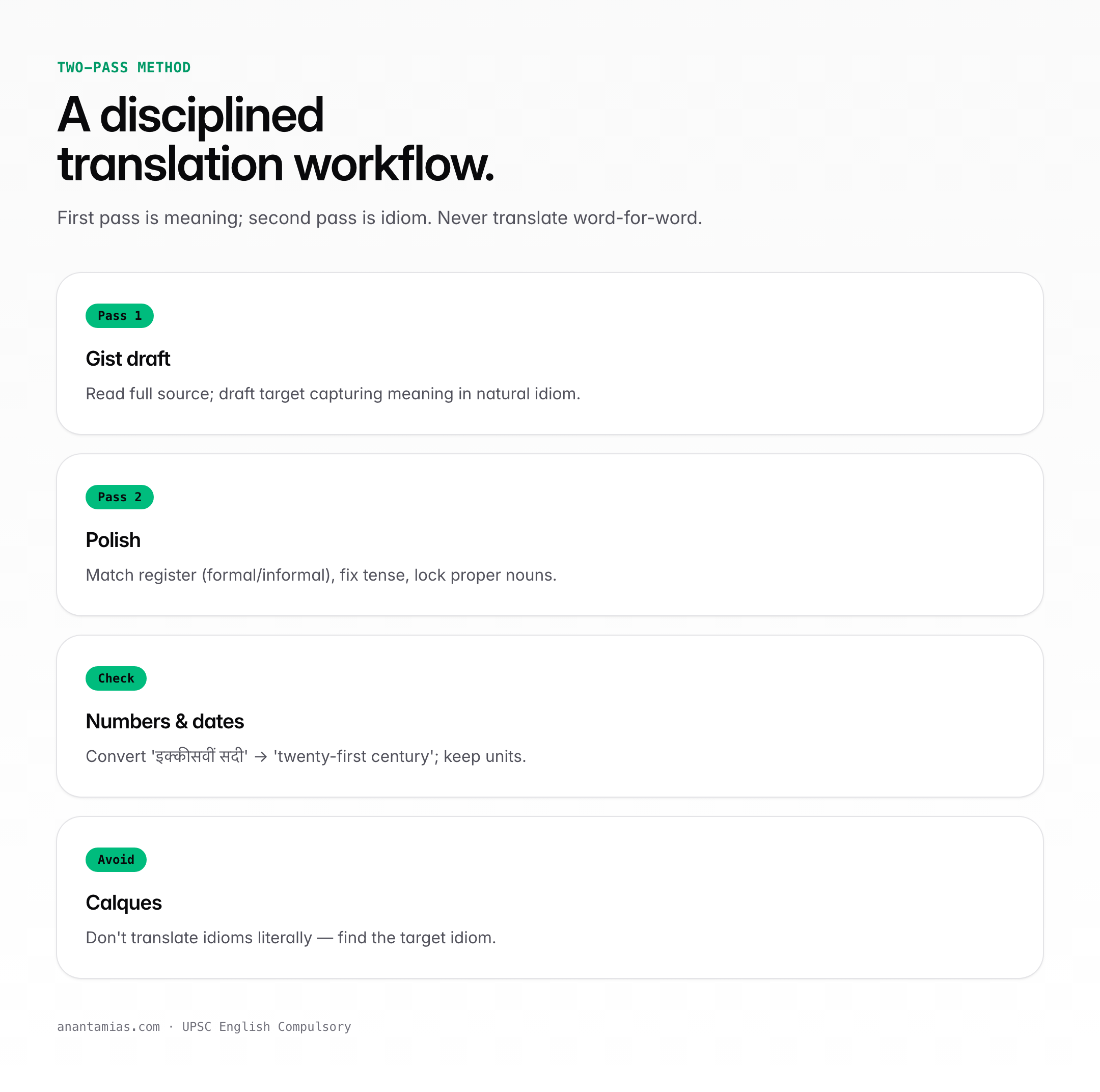
- First pass — literal: translate sentence by sentence without worrying about elegance. Preserve every noun and verb.
- Second pass — natural: rewrite for idiom. Adjust word order to target-language syntax. Replace English idioms with Indian-language equivalents.
Worked Example: Hindi to English
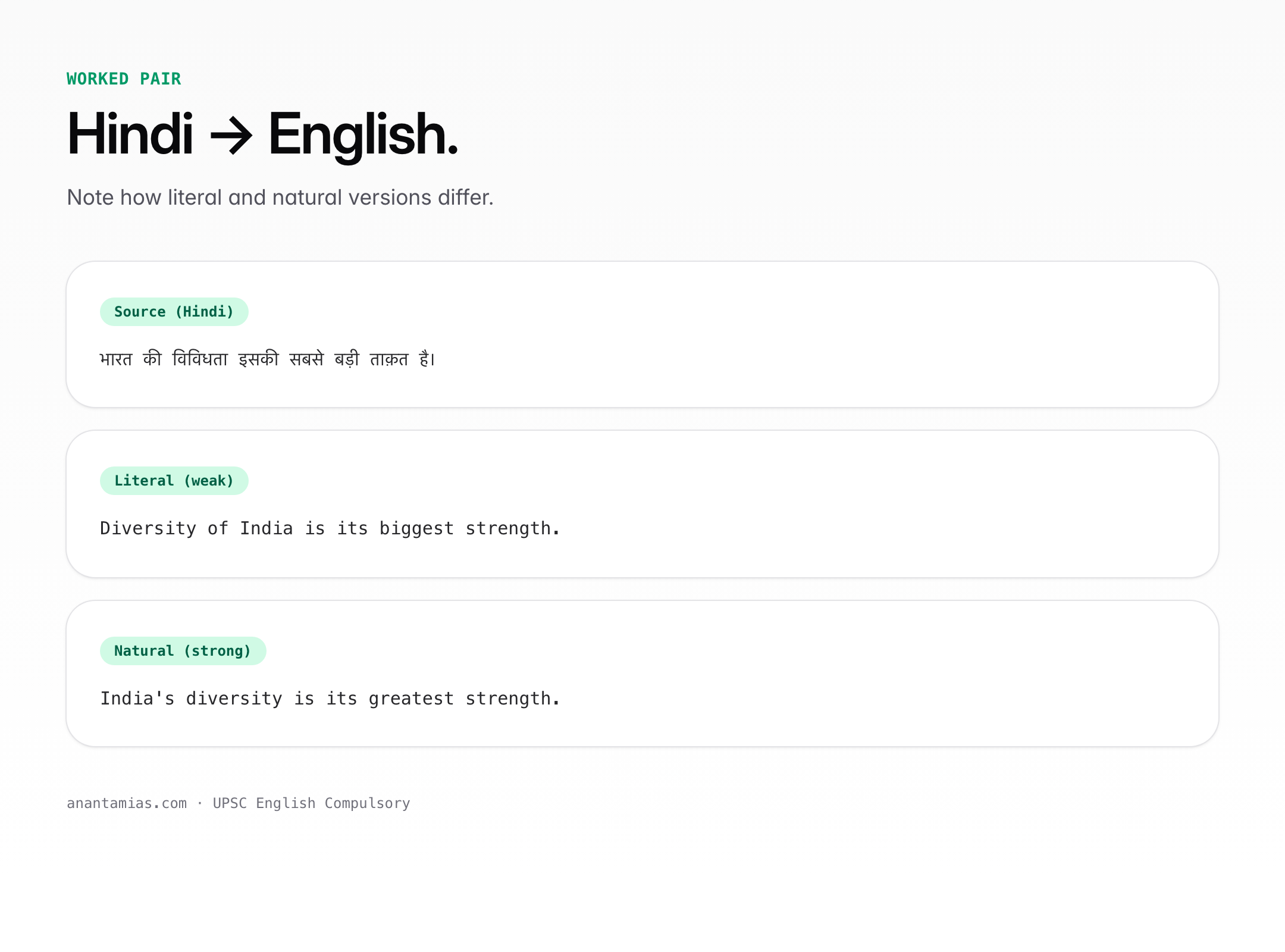
Hindi passage (abridged)
“भारत की सबसे बड़ी चुनौती शिक्षा की गुणवत्ता है। आज देश के सरकारी स्कूलों में लगभग 25 करोड़ बच्चे पढ़ते हैं, परंतु शिक्षा की गुणवत्ता असमान है। शहरों और गांवों के बीच अंतर बहुत बड़ा है। यदि हम अगले दशक में विश्व की तीसरी सबसे बड़ी अर्थव्यवस्था बनना चाहते हैं, तो शिक्षा में निवेश अनिवार्य है।”
Model English translation
India’s greatest challenge is the quality of its education. Today, nearly 250 million children study in the country’s government schools, but the quality of education is uneven. The gap between cities and villages is vast. If we wish to become the world’s third-largest economy in the coming decade, investment in education is indispensable.
Worked Example: English to Hindi
English passage
“Climate change is no longer a distant threat. Rising sea levels, erratic monsoons, and melting Himalayan glaciers already affect millions of Indians. Adaptation must begin now, not in a future decade.”
Model Hindi translation
जलवायु परिवर्तन अब कोई दूर का खतरा नहीं रह गया है। समुद्र के बढ़ते स्तर, अनियमित मानसून और पिघलते हिमालयी हिमनद पहले ही करोड़ों भारतीयों को प्रभावित कर रहे हैं। अनुकूलन अभी शुरू होना चाहिए, भविष्य के किसी दशक में नहीं।
Common Translation Pitfalls
| Pitfall | Example | Fix |
|---|---|---|
| Word-by-word literalness | “It is raining cats and dogs” → cats and dogs in target | Use target idiom for heavy rain |
| Losing the register | Formal English rendered in colloquial Hindi | Match formality level |
| Tense mismatch | English present perfect → Hindi simple past | Use Hindi ‘chuka hai’ for perfect aspect |
| Transliteration instead of translation | “Parliament” kept as “पार्लियामेंट” | Use ‘संसद’ unless proper noun |
| Skipping hard sentences | Omitting a complex clause | Full penalty — translate every word |
Numbers, Dates, and Proper Nouns
Numbers should be rendered in the target language’s script when small (< 100); for large numbers, keep Arabic numerals with target-language units (e.g., 25 करोड़). Proper nouns — names of people, places, and organisations — should be transliterated, not translated. Parliament of India becomes भारत की संसद, but Narendra Modi remains नरेंद्र मोदी, not translated.
Idioms Across Languages
- Raining cats and dogs → मूसलाधार बारिश हो रही है
- A piece of cake → बाएँ हाथ का खेल
- To add fuel to the fire → आग में घी डालना
- Kill two birds with one stone → एक पंथ दो काज
30-Day Translation Drill
- Week 1: Translate one 150-word newspaper paragraph each way, daily.
- Week 2: Add vocabulary journal — 20 new words a day.
- Week 3: Translate past 5 years’ UPSC passages.
- Week 4: Timed practice — 25 minutes for both passages combined.
Frequently Asked Questions
Which Indian languages are allowed for translation?
Any of the 22 scheduled languages — Hindi, Bengali, Tamil, Telugu, Kannada, Malayalam, Marathi, Gujarati, Punjabi, Urdu, Assamese, Odia, and others.
Can I change my translation language later?
No. Once chosen in the Mains application form, the language is locked.
Is word-for-word translation acceptable?
No. Literal translation distorts meaning. Aim for fidelity to sense and natural idiom in the target language.
Should I translate proper nouns?
No. Transliterate personal names; translate institutional names only if a standard translation exists (e.g., ‘Parliament’ → ‘संसद’).
How much time should translation take?
About 25 minutes for both passages combined — 12 minutes each, 1 minute to cross-check.
How is translation graded?
On accuracy of meaning, grammatical correctness in the target language, naturalness of idiom, and completeness. Partial translations are penalised.