Himalayan Musk Deer (Moschus leucogaster): UPSC Guide to India’s Endangered Alpine Survivor
A complete UPSC GS-III guide to the Himalayan musk deer. Covers biology, the musk pod controversy, IUCN Endangered status, Schedule I protection, CITES Appendix I listing, distribution across Uttarakhand, Sikkim, and Arunachal Pradesh, and the threats from poaching and habitat loss.
The Himalayan musk deer, Moschus leucogaster, is a small, secretive herbivore that lives at the upper edge of the alpine zone in the Indian Himalaya. It looks nothing like the spotted deer of the lowlands. It has no antlers, it has long, downward-curving canine tusks in the males, it stands less than a metre at the shoulder, and it survives on lichens, mosses, and dwarf rhododendron at altitudes between 3,000 and 4,500 metres. For UPSC prelims and GS-III mains, it sits at the intersection of three high-frequency themes: endangered species classification, the Wildlife Protection Act schedule list, and CITES trade regulation.
The species is also a textbook case of how a single body part can drive a species toward extinction. The musk pod, a glandular sac present only in adult males, secretes a waxy substance that has been used in luxury perfumery and traditional medicine for more than a thousand years. A single pod weighs around 25 grams and historically fetched several times the price of gold per gram on the international market. That economic incentive, combined with poor enforcement in remote alpine valleys, drove decades of poaching that the IUCN and India’s enforcement agencies are still trying to contain.
Quick Facts on the Himalayan Musk Deer
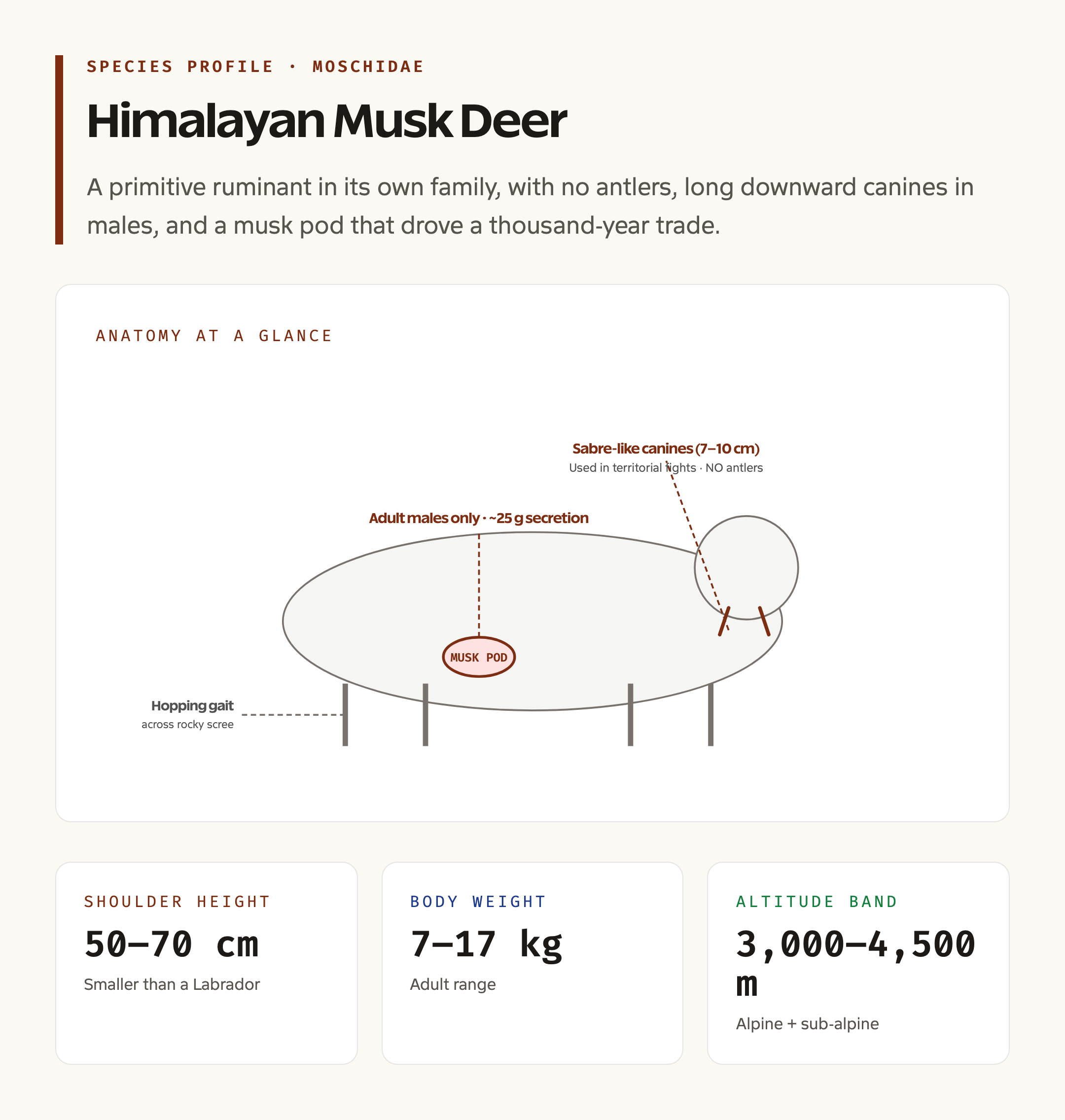
The Himalayan musk deer is one of seven living musk deer species in the genus Moschus. Adults stand 50 to 70 centimetres at the shoulder and weigh 7 to 17 kilograms, smaller than a Labrador. Males carry sabre-like upper canines that protrude downward by 7 to 10 centimetres and are used in territorial fights, since the species has no antlers. The fur is grizzled grey-brown, with juveniles showing pale spots that fade by their first winter. Lifespan in the wild is around 10 to 14 years.
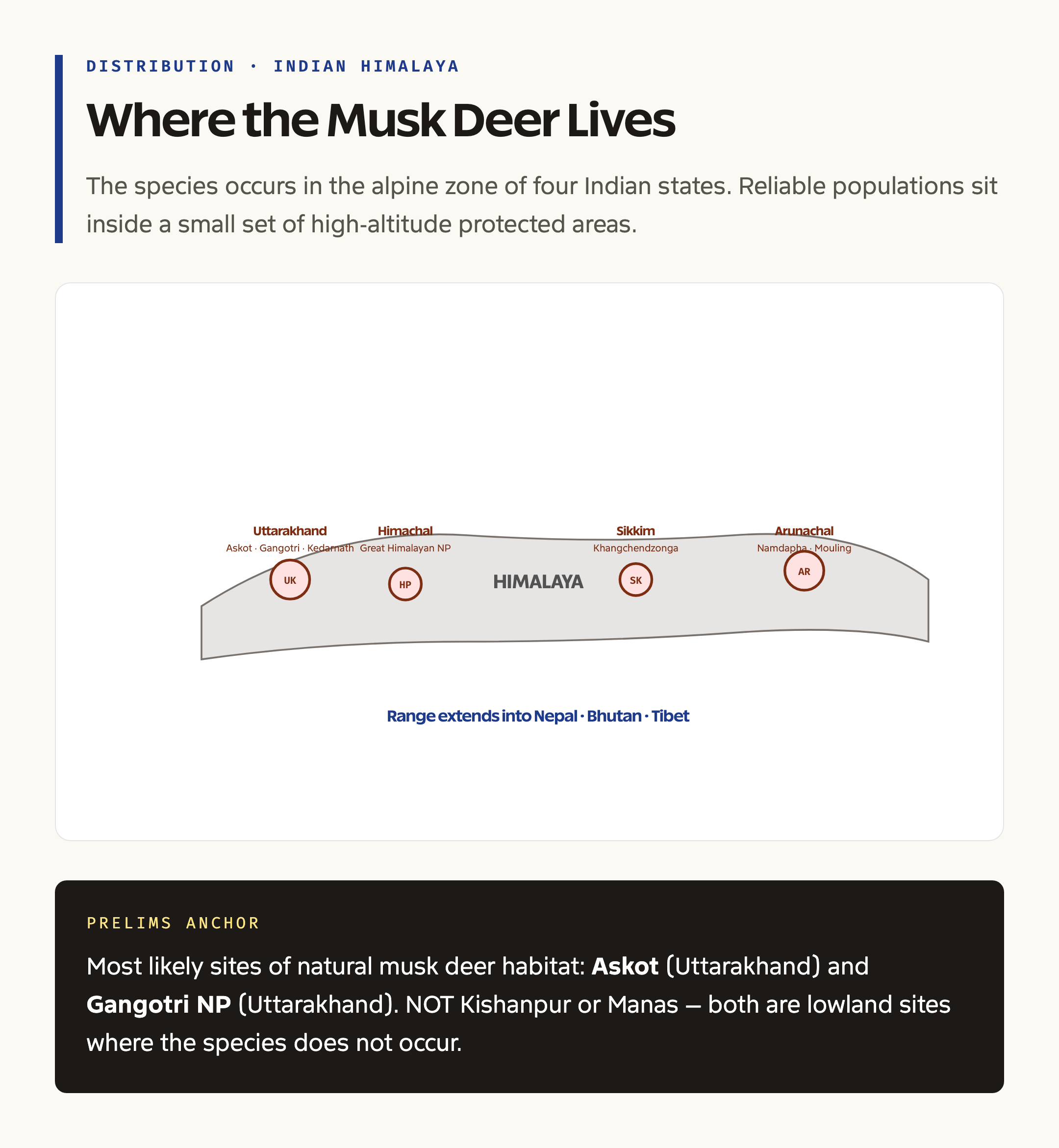
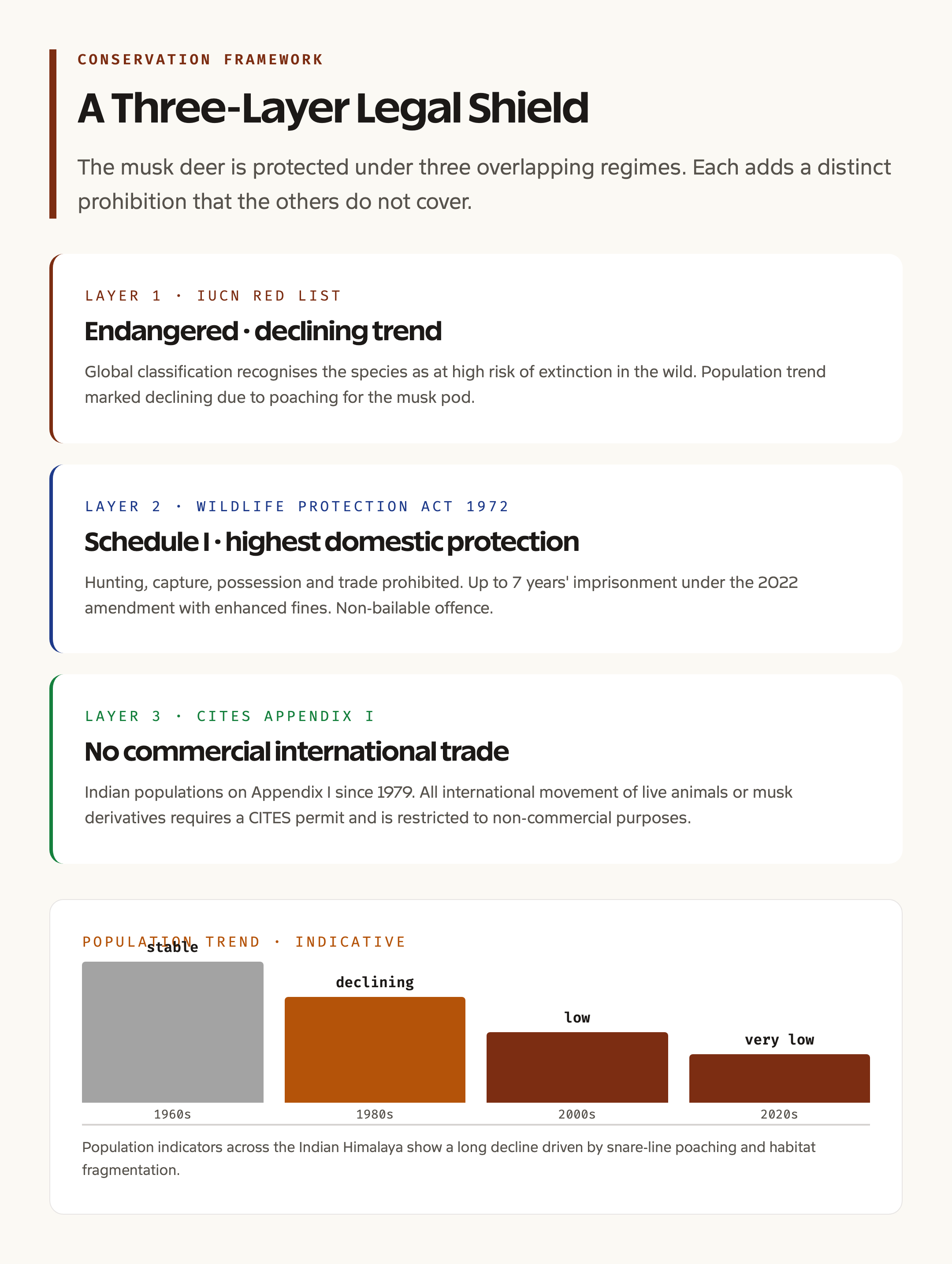
Conservation status is a complete legal kit. The IUCN Red List classifies the species as Endangered with a declining population trend. Schedule I of the Wildlife Protection Act, 1972 gives it the highest possible protection in India. CITES Appendix I bans all international commercial trade, and Indian populations are explicitly listed there since 1979. Distribution covers the high-altitude belt of Uttarakhand, Himachal Pradesh, Sikkim, and Arunachal Pradesh, with the species also extending into Nepal, Bhutan, and the Tibetan Autonomous Region of China.
What the Himalayan Musk Deer Is
The Himalayan musk deer is a primitive ruminant that diverged from true deer around 35 million years ago. Taxonomists place it in its own family, Moschidae, separate from Cervidae, and the differences are easy to read on the body. Musk deer have no antlers, they have a gallbladder which true deer lack, they have only one pair of teats instead of four, and the males carry the long downward canine tusks that give the species its distinctive profile. The animal is built for cold and crag. It has a coarse, hollow-haired coat that traps heat and a stiff, kangaroo-like hopping gait that lets it bound across rocky scree and fallen timber where larger ungulates cannot follow.
The musk gland sits in a small abdominal sac in adult males, between the navel and the genitals. It produces a brown, waxy secretion with a complex aroma that becomes pleasant only on dilution. In nature, the secretion is used to mark territory and to signal reproductive readiness during the autumn rut. In human commerce, it has been the most valuable animal product by weight in the perfume trade for centuries. Synthetic substitutes have been available since the 1970s, but a residual demand persists in traditional Chinese medicine and in some niche perfumery, and that demand keeps the poaching pressure alive.
Background and Historical Context
Records of musk trade in the Himalaya go back to the seventh century, with Chinese imperial pharmacies sourcing pods through Tibet. By the Mughal era, musk had become a regular item in the long-distance Silk Road trade. Colonial-era hunting accounts treat the species as a prize, and the early decades after independence saw the trade move into the hands of organised poaching networks operating along the Indo-Nepal and Indo-Tibet borders.
The first serious legal response came with the Wildlife Protection Act of 1972, which placed the species on Schedule I, banned hunting outright, and made the trade in any musk deer body part a non-bailable offence. CITES Appendix I followed in 1979, closing the international trade route. India then moved to set up captive breeding stations, the most prominent being the Kanchula Kharak Musk Deer Breeding Centre in Uttarakhand, with the goal of producing musk through extraction from live captive males rather than killing wild animals. The breeding programme has had patchy success, and natural recovery in the wild remains the more promising long-term path.
Key Provisions of Musk Deer Conservation
The musk deer’s protection in India sits on three legal pillars. The first is Schedule I of the Wildlife Protection Act, which prohibits hunting, capture, possession, and trade in any form, with penalties of up to seven years’ imprisonment and fines up to 25,000 rupees, raised significantly under the 2022 amendment. The second is CITES Appendix I, which bans all international commercial trade and tightly regulates non-commercial movement of the species and its derivatives. The third is in-situ protection through a network of national parks and sanctuaries that cover most of the species’ Indian range.
Key protected areas with confirmed musk deer populations include Gangotri National Park, Askot Musk Deer Sanctuary, Kedarnath Wildlife Sanctuary, and Govind Pashu Vihar in Uttarakhand, Khangchendzonga National Park in Sikkim, and Namdapha and Mouling National Parks in Arunachal Pradesh. The Forest Rights Act 2006 and joint forest management arrangements add a community-engagement layer in the buffer areas of these parks. For the broader picture of how this fits into the country’s protected-area architecture, read the parent guide on national parks of India and the layered framework in environmental laws in India.
Why the Himalayan Musk Deer Matters
The musk deer matters first as an indicator of high-altitude forest health. The species needs dense undergrowth, broken rocky ground, and undisturbed alpine meadows. Where it persists, the forest is functioning. Where it disappears, the forest has usually lost canopy cover, ground vegetation, or both. Long-term presence-absence data for musk deer is one of the simplest field signals of habitat change above the tree line.
It matters second as a flagship for alpine biodiversity. Conservation funding for the high Himalaya has historically lagged behind the tiger landscape and the elephant landscape, and the musk deer is one of the few species that can carry public attention to the problems of glacial retreat, treeline shift, and overgrazing of alpine pastures. The species shares its range with the snow leopard, the Himalayan tahr, and the Himalayan monal, and protection that benefits the musk deer benefits this entire community.
It matters third as a case study in trade-driven extinction risk. Unlike the tiger or the elephant, the musk deer is killed almost exclusively for one product. That makes the economics simple, the enforcement target clear, and the policy choices stark. The International Big Cat Alliance and similar single-species frameworks now exist for charismatic predators. The musk deer is the textbook example of why a similar dedicated mechanism for traded ungulates would matter.
Detailed Analysis: Biology and Behaviour
The musk deer is solitary outside the rut. Adults of both sexes hold individual home ranges, typically 10 to 30 hectares, marked by latrine sites and gland-rubbing on prominent rocks and tree trunks. Males defend a territory that overlaps with several female ranges and use the canine tusks rather than antlers to settle disputes, with most fights ending after a brief slashing exchange and one male withdrawing. The tusks grow continuously and can become substantial weapons in old males.
The diet is unusual for a ruminant of its size. Musk deer feed selectively on lichens, mosses, ferns, dwarf rhododendron, dwarf willow leaves, and birch bark in winter, switching to herbaceous plants and dwarf bamboo in summer. The species is crepuscular and nocturnal, feeding mainly at dawn and dusk and resting during daylight in dense cover. Its digestive system is adapted to extract nutrients from low-quality forage, an essential trait for surviving the long alpine winter.
Reproduction is seasonal. The rut runs from November through January. Females produce a single fawn, occasionally twins, after a gestation of 185 to 195 days, with births timed to coincide with spring vegetation flush. Fawns are precocial, hidden in dense cover for the first weeks, and weaned at three to four months. Sexual maturity is reached at 16 to 18 months, and reproductive lifespan is short, typically four to six years in the wild.
Threats Facing the Himalayan Musk Deer
The single largest threat is poaching for the musk pod. Snares set across game trails are the dominant method, since they are cheap, indiscriminate, and almost invisible to forest patrols. A snare line of 50 traps can catch four or five animals per season, and only adult males carry the pod, so the bycatch of females and juveniles is enormous. A 2017 review in TRAFFIC estimated that for every adult male killed for its pod, three to four other musk deer die in incidental snare mortality.
Habitat loss is the second pressure. Pastoral grazing pushes higher each summer as lower pastures get exhausted, and the species’ undergrowth retreats with it. Construction of border roads, hydropower projects, and pilgrimage infrastructure has fragmented mid-altitude forest, cutting once-continuous populations into small, demographically vulnerable groups. Climate change adds a slow background driver. Treeline shift, snow regime change, and drying of mid-altitude springs all reduce the suitable area for the species.
The third pressure is illegal trade in skin and bone. The species shares aspects of its supply chain with the snow leopard and red panda, and seizures along the Nepal and Bhutan borders frequently include musk pods alongside other wildlife products. The Wildlife Crime Control Bureau treats musk as one of its priority commodities, but the small package size and high price per unit make detection difficult.
How the Musk Deer Compares With True Deer
The most common confusion in UPSC preparation is between musk deer and other small Himalayan ungulates such as the barking deer or the goral. The differences are clear once you know what to look for. Musk deer have no antlers at any stage. True deer such as the sambar, chital, and barking deer have annually shed antlers in males. Musk deer have long downward canines in males. True deer do not. Musk deer have a gallbladder. True deer do not. Musk deer have a single pair of teats. True deer have two pairs.
Behaviourally, the musk deer is solitary and crepuscular. The chital is gregarious and largely diurnal. The musk deer hops and bounds across rough ground. The chital trots and gallops on open grassland. The musk deer feeds on lichens and dwarf vegetation. The chital is a bulk grazer of grasses. These differences are not cosmetic. They reflect 35 million years of separate evolution in different ecological niches and they justify the placement of musk deer in their own family, Moschidae.
Captive Breeding and the Kanchula Kharak Experiment
The Kanchula Kharak Musk Deer Breeding Centre in Uttarakhand, set up in 1982, is the most prominent attempt to produce musk through captive breeding. The idea is straightforward. Adult males in a controlled enclosure can have musk extracted from the pod under sedation without killing the animal, and the supply can substitute for poached wild musk in the legitimate market. Forty years on, the experience is mixed. Mortality of captive animals has been higher than expected, the musk yield per male is lower than from wild specimens, and the centre has not produced commercially significant volumes.
The lesson is that a species adapted to wide ranges of cold alpine forest does not adjust easily to small enclosures. A more promising direction has been semi-captive breeding in larger fenced areas with natural vegetation, and reintroduction of captive-bred animals into protected areas where wild populations have declined. Pilot work in Khangchendzonga and Govind Pashu Vihar is at an early stage but is being watched closely as a template for other endangered Himalayan ungulates.
Connections With Related UPSC Topics
The musk deer story connects with several other recurring UPSC themes. It connects with biodiversity in India as a case study of the Western Himalaya endemic group. It connects with tiger reserves in India and the broader protected-area network, since several musk deer ranges overlap with tiger landscapes in the lower Himalaya. It connects with the State of India Environment 2026 report where alpine biodiversity gets new attention, and with the Synchronous All India Elephant Estimation 2021-25 as a model for what a parallel pan-Himalayan ungulate census would look like.
For prelims, remember the four anchor facts. First, the species is on Schedule I of the Wildlife Protection Act. Second, it is on CITES Appendix I. Third, it is IUCN Endangered. Fourth, the four Indian range states are Uttarakhand, Himachal Pradesh, Sikkim, and Arunachal Pradesh, with confirmed populations in Askot, Gangotri, Kedarnath, Govind, Khangchendzonga, Namdapha, and Mouling. The MCQ in the source PYQ asks which sites in the list are most likely to host musk deer in their natural habitat, and Askot and Gangotri are the correct answers because they sit in the alpine zone of Uttarakhand, while Kishanpur and Manas are lowland sites where the species does not occur.
Frequently Asked Questions
What is the scientific name of the Himalayan musk deer?
The Himalayan musk deer is scientifically Moschus leucogaster, a member of the family Moschidae which is separate from the true-deer family Cervidae. The species was earlier lumped with the alpine musk deer Moschus chrysogaster, but molecular and morphological work since the 1990s has confirmed Moschus leucogaster as a distinct species restricted to the southern slopes of the Himalaya.
Why is the musk deer endangered?
The species is endangered primarily because of poaching for the musk pod. Only adult males carry the pod, so even small offtake from a population disrupts the sex ratio and reproductive output. Habitat loss from grazing, road building, and hydropower adds a second pressure, and the species’ slow reproduction and small home ranges leave little buffer for population recovery.
What is musk used for?
Musk is the brown, waxy secretion of the musk gland in adult males. It has historically been used as a fixative in luxury perfumery and as an ingredient in traditional Chinese medicine. Synthetic musks have been available since the 1970s and now dominate the perfumery market, but a residual natural-musk demand persists in niche segments.
Where can the Himalayan musk deer be seen in India?
The species occurs in the alpine zone of Uttarakhand, Himachal Pradesh, Sikkim, and Arunachal Pradesh. The most reliable Indian protected areas are Askot Musk Deer Sanctuary, Gangotri National Park, Kedarnath Wildlife Sanctuary, and Khangchendzonga National Park. Sightings are rare even within these areas because of the species’ shy, crepuscular habits.
Is musk deer protected under CITES?
Yes. The Himalayan musk deer is listed in Appendix I of CITES, the strictest category, which prohibits all international commercial trade. Indian populations have been on Appendix I since 1979. This complements Schedule I status under the Indian Wildlife Protection Act, which makes domestic hunting and trade equally illegal.
What is the difference between musk deer and other deer?
Musk deer have no antlers, carry long downward canine tusks in males, possess a gallbladder, and have a single pair of teats. True deer have annually shed antlers in males, no canines or only short ones, no gallbladder, and two pairs of teats. The two groups diverged about 35 million years ago and are now placed in separate families, Moschidae and Cervidae.