How to Write UPSC Essay: Structure & Strategy
Step-by-step guide to writing UPSC essays with structure templates, section-wise approach, common mistakes, and tips to score 130+ in the essay paper.
How to Write UPSC Essay: Structure & Strategy
A well-written UPSC essay follows a clear structure: a compelling introduction, multi-dimensional body paragraphs with evidence, a counter-argument, and a forward-looking conclusion — all within 1000–1200 words. The essay paper carries 250 marks (two essays of 125 each), and scoring 130+ requires both content depth and structural discipline. Most candidates lose marks not because they lack knowledge, but because they lack a repeatable essay framework.
The UPSC essay isn’t a school composition. It’s a test of analytical thinking, breadth of perspective, and the ability to present a coherent argument under time pressure.
The Universal Essay Structure
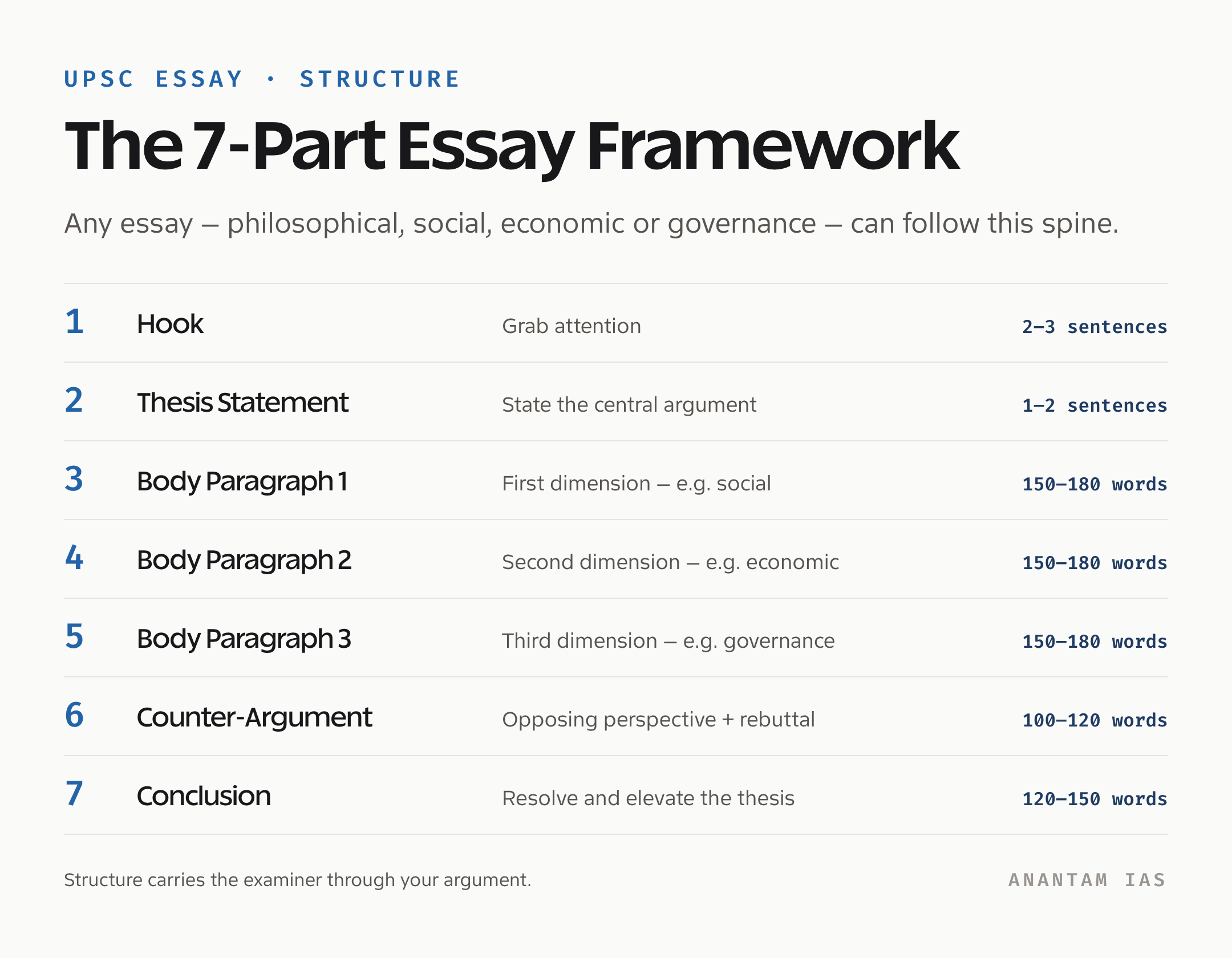
The 7-Part Framework
Every UPSC essay — whether philosophical, social, economic, or governance-themed — can follow this structure:
| Part | Function | Length |
|---|---|---|
| 1. Hook | Grab attention | 2–3 sentences |
| 2. Thesis Statement | State the central argument | 1–2 sentences |
| 3. Body Paragraph 1 | First dimension (e.g., social) | 150–180 words |
| 4. Body Paragraph 2 | Second dimension (e.g., economic) | 150–180 words |
| 5. Body Paragraph 3 | Third dimension (e.g., political/governance) | 150–180 words |
| 6. Counter-Argument | Opposing perspective + rebuttal | 100–120 words |
| 7. Conclusion | Synthesis + vision | 80–100 words |
Total: 1000–1200 words in approximately 80–85 minutes of writing time.
Why Structure Matters More Than Content
An examiner reading the 200th essay of the day notices structure first, content second. A clearly organized essay with average content scores higher than a brilliant but rambling piece. Structure signals clarity of thought — exactly what the UPSC is evaluating.
Part 1: Writing the Introduction
The Hook
The first 2–3 sentences determine whether the examiner reads with interest or fatigue. Effective hooks include:
| Hook Type | Example (Topic: “Technology and Democracy”) |
|---|---|
| Anecdote | “When Estonia held the world’s first internet election in 2005, it demonstrated that technology could deepen democratic participation.” |
| Data | “India’s Aadhaar system — covering 1.3 billion people — represents history’s largest digital identity project, transforming citizen-state interaction.” |
| Quote | “As Marshall McLuhan predicted, ‘the medium is the message’ — and today’s medium is digital, reshaping democratic discourse.” |
| Paradox | “The same technology that enables millions to participate in democracy also enables the spread of disinformation that undermines it.” |
| Historical | “The printing press democratized knowledge in the 15th century. The internet is doing something far more radical in the 21st.” |
The Thesis Statement
After the hook, state the central argument clearly. This tells the examiner what the essay will argue.
Weak thesis: “Technology has both good and bad effects on democracy.” Strong thesis: “Technology has fundamentally expanded democratic participation while simultaneously creating new threats to democratic deliberation — and navigating this paradox requires institutional innovation, not technological retreat.”
What to Avoid in the Introduction
- Dictionary definitions (“According to Oxford Dictionary, democracy means…”)
- Generic statements (“Since ancient times, technology has been evolving…”)
- Overly long introductions (more than 80–100 words)
- Multiple quotes stacked together
Essay Writing for UPSC: Strategy & Previous Papers
Part 2: Writing Body Paragraphs
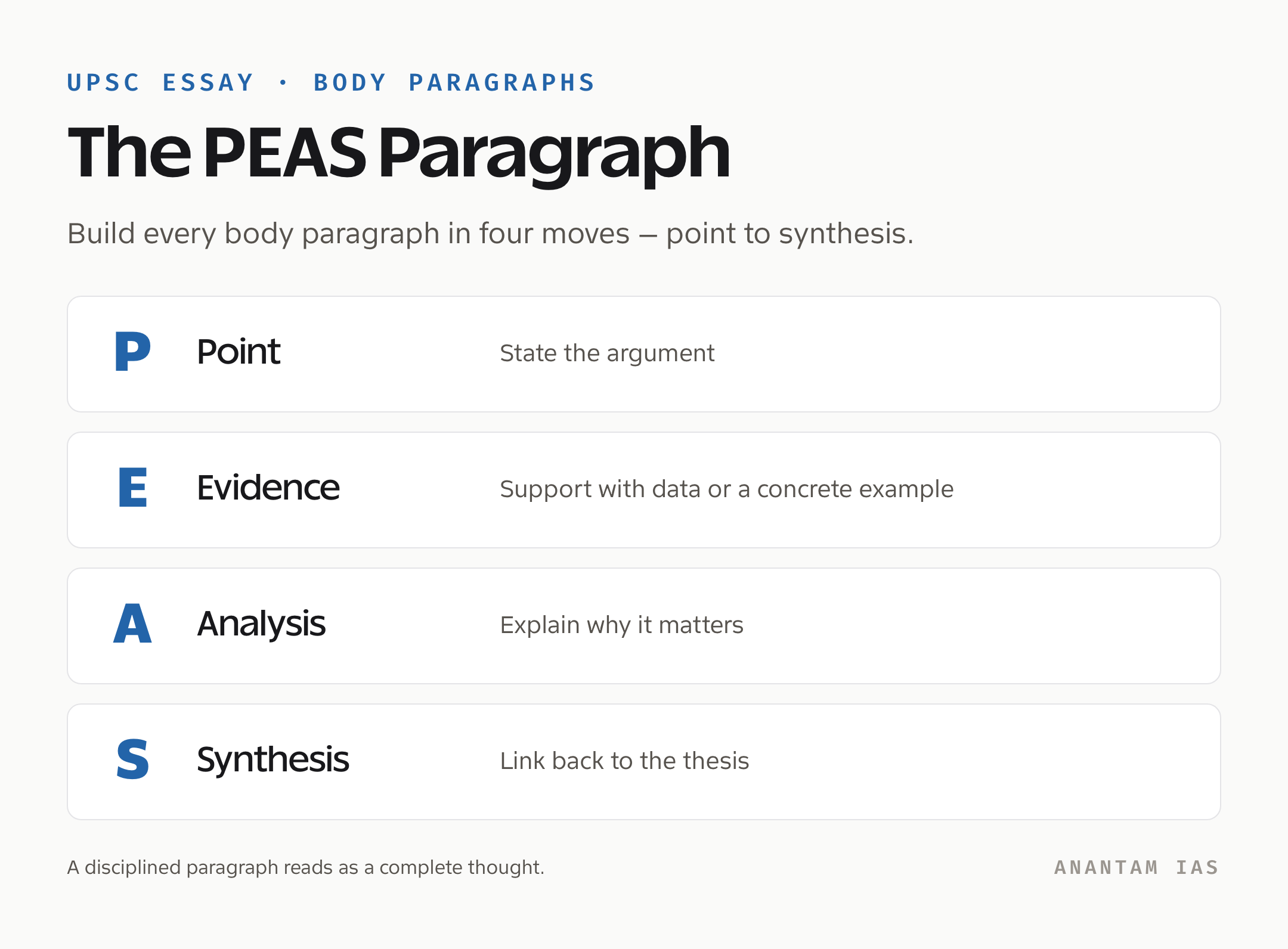
The PEAS Structure for Each Paragraph
| Element | Role | Example |
|---|---|---|
| Point | State the argument | “Technology has democratized access to governance information.” |
| Evidence | Support with data/example | “The RTI portal received 2.3 million applications in 2024; PRS Legislative makes bill analysis accessible to every citizen.” |
| Analysis | Explain significance | “This transparency shifts power from institutions to citizens, enabling informed participation that was previously limited to elites.” |
| Synthesis | Link back to thesis | “Such access strengthens the deliberative quality of democracy, directly addressing the information asymmetry that plagued earlier governance models.” |
Covering Multiple Dimensions
The strongest essays cover 4–6 distinct dimensions. For any topic, consider:
| Dimension | Questions to Answer |
|---|---|
| Social | How does it affect different social groups? |
| Economic | What are the financial/resource implications? |
| Political/Governance | How does it impact institutions and power? |
| Environmental | What’s the ecological connection? |
| Ethical/Philosophical | What moral questions arise? |
| International | How does India compare globally? |
| Historical | What historical parallels exist? |
| Technological | What role does technology play? |
Select 4–5 most relevant dimensions for each essay. Not every dimension applies to every topic.
Transition Sentences
Body paragraphs shouldn’t exist in isolation. Connect them with transition sentences:
- “While the economic dimension is significant, the social implications are equally profound…”
- “This political transformation, however, brings environmental consequences that demand attention…”
- “Beyond domestic considerations, the international dimension adds another layer of complexity…”
Part 3: The Counter-Argument
Why It’s Essential
An essay without a counter-argument appears intellectually rigid. UPSC wants balanced thinking, not propaganda. Dedicate one paragraph (100–120 words) to acknowledging the strongest objection to the main thesis — then respond to it.
Example (Topic: “Universal Basic Income“): “Critics argue that UBI creates dependency and disincentivizes work — a concern supported by some pilot studies showing marginal reductions in labor force participation. However, India’s own UBI experiments in Madhya Pradesh (SEWA pilot) showed that recipients invested in education and micro-enterprise rather than reducing effort. The dependency argument assumes a static view of human motivation; evidence increasingly supports a more nuanced reality.”
Part 4: Writing the Conclusion
What the Conclusion Must Do
- Synthesize — Pull together the key threads from body paragraphs
- Elevate — Move from the specific to the broader significance
- Project forward — Offer a vision or call to action
- Don’t repeat — The conclusion is not a summary
Conclusion Templates
| Approach | Structure |
|---|---|
| Vision-based | “As India moves toward [future milestone], the challenge lies in [balancing X and Y]. The path forward demands [specific approach].” |
| Synthesis | “The intersection of [dimension 1], [dimension 2], and [dimension 3] reveals that [insight]. This understanding must guide [policy/action].” |
| Quote-based | “Gandhi’s observation that ‘[relevant quote]’ remains as relevant today as when it was written. The task is to [action].” |
| Challenge-based | “The real question isn’t whether [topic] matters — it’s whether institutions can adapt fast enough to harness its potential while mitigating its risks.” |
Time Management for Two Essays
The 90-Minute Per Essay Plan
| Activity | Time | Purpose |
|---|---|---|
| Read all topics | 3 min | — |
| Choose topic | 2 min | Select based on comfort + example availability |
| Brainstorm | 5 min | Jot down ideas, examples, quotes, dimensions |
| Outline | 5 min | Create the 7-part structure |
| Write introduction | 8 min | Hook + thesis |
| Write body paragraphs | 50 min | 4–5 paragraphs |
| Write counter-argument | 8 min | 1 paragraph |
| Write conclusion | 5 min | Synthesis + vision |
| Review | 4 min | Check flow, fix errors |
| Total | 90 min | — |
Common Time Traps
- Spending 15+ minutes choosing a topic (limit to 5)
- Writing a 200-word introduction (limit to 80–100)
- Getting stuck on one body paragraph (set a 10-minute maximum per paragraph)
- Not leaving time for the second essay (check time at the halfway mark)
UPSC Mains Answer Writing: Format & Tips
Section A vs Section B: Approach Differences
Section A (Philosophical/Abstract Topics)
Characteristics: Abstract themes, value-based, require personal reflection Approach:
- Open with a philosophical framing or historical quote
- Use thinkers (Gandhi, Tagore, Ambedkar, Aristotle, Kant)
- Draw from personal observation and social dynamics
- Include governance applications of philosophical ideas
- Use literary and cultural references
Section B (Governance/Economy/Science Topics)
Characteristics: Policy-oriented, data-heavy, require factual knowledge Approach:
- Open with data or a recent development
- Cite government schemes, reports, institutional frameworks
- Use international comparisons
- Reference the Economic Survey, NITI Aayog data
- Discuss implementation challenges alongside policy descriptions
Choosing Between Sections
Read all 8 topics. For each, quickly assess:
- Can three distinct dimensions be covered?
- Are 4–5 specific examples available?
- Is there enough content for 1000+ words?
- Does a clear thesis come to mind?
Pick one from each section where the answer to all four is “yes.”
Building an Essay Content Bank
Organized by Theme
Maintain running notes on these themes throughout preparation:
| Theme | Content to Collect |
|---|---|
| Democracy & Governance | Reforms, SC judgments, international models |
| Society & Culture | Social indicators, reform movements, diversity data |
| Economy & Development | Growth data, scheme outcomes, global comparisons |
| Science & Technology | Innovations, ethical dilemmas, policy frameworks |
| Environment | Climate data, conservation successes, international agreements |
| Philosophy & Ethics | Thinker quotes, ethical frameworks, value debates |
Frequently Asked Questions
What score is considered good in the UPSC essay paper?
Scores above 130 out of 250 are considered good; above 140 is very good; above 150 is exceptional. The average score for successful candidates is around 110–125. Scoring well requires both structural discipline (clear framework) and content depth (relevant examples and multi-dimensional analysis).
Should both essays be equal in quality?
Aim for balance. A 70-mark essay paired with a 55-mark essay gives 125 — the same as two 62.5-mark essays. But in practice, candidates who invest heavily in one essay at the expense of the other usually score lower overall. Split time equally: 90 minutes per essay.
How many quotes should an essay contain?
Two to three well-placed quotes are optimal. One in the introduction (hook), one in the body (supporting a key argument), and optionally one in the conclusion. More than four quotes makes the essay feel like a quotation compilation rather than original analysis.
Is it necessary to write exactly 1000–1200 words?
The word count is a guideline, not a rule. Examiners don’t count words. However, significantly shorter essays (below 800 words) suggest insufficient depth, while significantly longer ones (above 1400 words) suggest poor editing and time management. Practise until 1000–1200 words feels natural within 80 minutes of writing.
How to improve essay writing speed?
Speed comes from three practices: brainstorming quickly (5 minutes to outline), writing without pausing to perfect sentences (editing comes in review), and having a pre-built content bank (so examples don’t require in-exam recall). Weekly timed essay practice over 8–10 weeks typically doubles writing speed.