
Disclosure: this guide contains Amazon affiliate links. As an Amazon Associate, Anantam IAS earns from qualifying purchases — at no extra cost to you.
UPSC Mains Answer Writing: Format & Tips
Answer writing is the single most important skill for UPSC Mains — and the one most aspirants develop too late. The difference between a 95 and a 120 in a GS paper isn’t knowledge; it’s the ability to present that knowledge in a structured, analytical, and examiner-friendly format within strict time constraints. Starting answer writing practice early and refining the technique through feedback is non-negotiable for serious candidates.
UPSC Mains has 20 questions per GS paper in 3 hours — averaging 9 minutes per question. There’s no room for lengthy introductions, repetitive points, or off-topic digressions. Every sentence must earn its place.
Understanding UPSC Mains Question Types
Directive Words and What They Mean
| Directive Word | What UPSC Expects |
|---|---|
| Discuss | Present multiple perspectives on the topic |
| Examine | Investigate the topic in detail; present evidence |
| Critically examine | Same as examine, but include evaluation of strengths and weaknesses |
| Analyse | Break down the topic into components; study each part |
| Critically analyse | Analyse plus evaluate merit and limitations |
| Comment | Give your opinion backed by evidence |
| Evaluate | Assess the value/effectiveness of something |
| Justify | Provide arguments supporting a position |
| Differentiate/Distinguish | Highlight differences (and sometimes similarities) |
| Enumerate | List points systematically |
| Elucidate | Explain and make clear with examples |
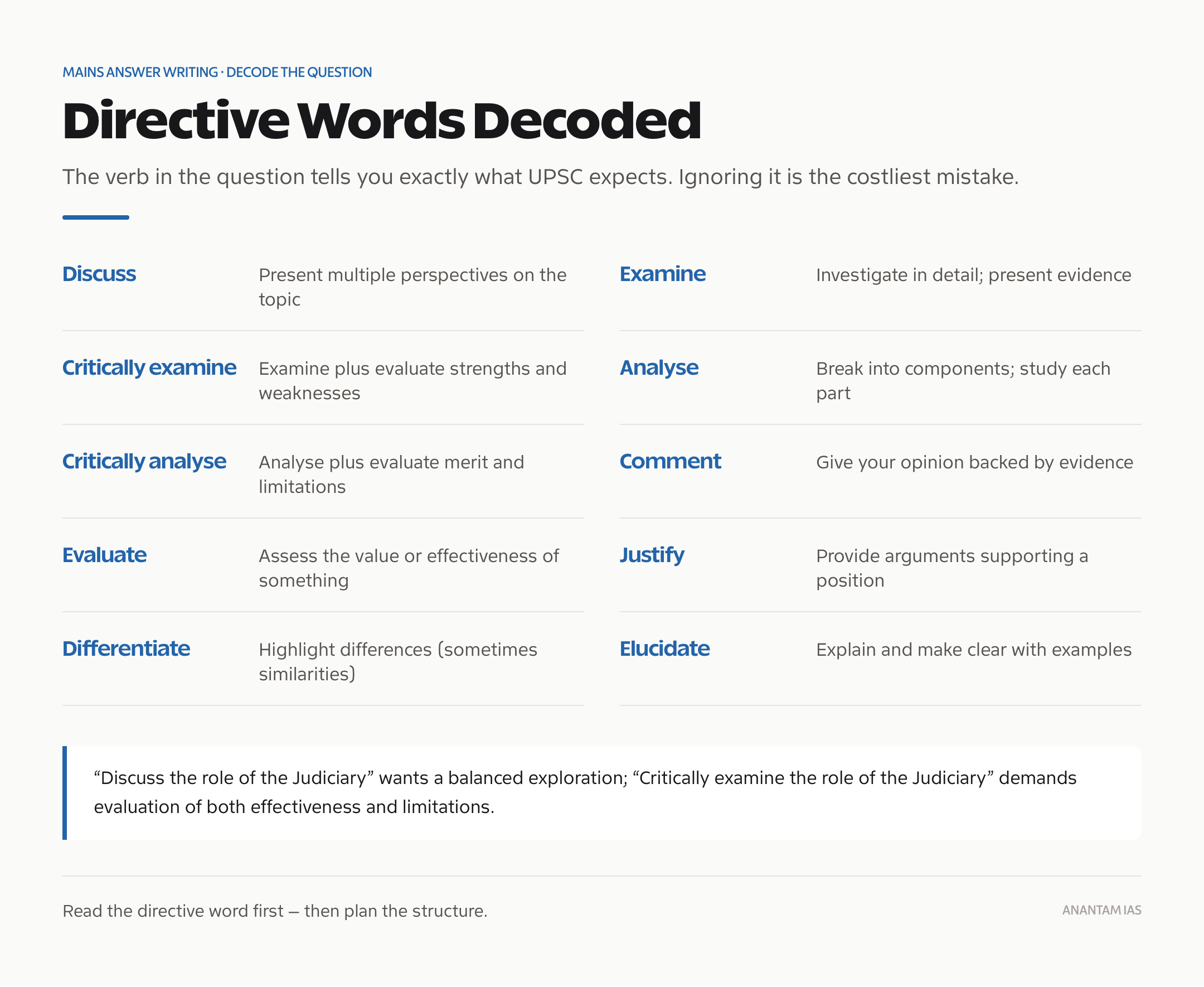
Ignoring the directive word is one of the costliest mistakes. “Discuss the role of Judiciary” requires a balanced exploration; “Critically examine the role of Judiciary” demands evaluation of both effectiveness and limitations.
Question Mark Distribution
| Question Type | Marks | Expected Word Count | Time Allocation |
|---|---|---|---|
| Short answer | 10 | ~150 words | 7 minutes |
| Long answer | 15 | ~250 words | 12 minutes |
Most GS papers have roughly 10 questions of 10 marks and 10 questions of 15 marks, totalling 250 marks.
The Answer Writing Format
For 10-Mark Questions (150 Words)
Structure:
- Introduction (1–2 sentences): Define the concept or provide context
- Body (3–4 points): Core content with brief explanations
- Conclusion (1–2 sentences): Synthesis or forward-looking statement
Time allocation: 1 minute thinking + 5 minutes writing + 1 minute review = 7 minutes
Example Question: “Discuss the significance of Fundamental Duties in the Indian Constitution.” (10 marks)
Model Structure:
- Introduction: Fundamental Duties under Article 51A were added by the 42nd Amendment (1976) based on the Swaran Singh Committee recommendation.
- Point 1: Serve as a reminder of civic obligations alongside rights
- Point 2: Strengthen democratic fabric by promoting national unity, scientific temper, and environmental protection
- Point 3: Though non-justiciable, courts have used them to interpret laws (Ranganath Misra case, AIIMS Students Union case)
- Point 4: Balance the rights-heavy constitutional framework with civic responsibility
- Conclusion: Making select duties justiciable could enhance their effectiveness without compromising individual freedoms.
For 15-Mark Questions (250 Words)
Structure:
- Introduction (2–3 sentences): Context, definition, relevance
- Body (5–6 substantive points): Detailed analysis with examples, data, or case studies
- Counter-perspective (1 paragraph): Acknowledge limitations or opposing views
- Conclusion (2–3 sentences): Balanced synthesis, recommendation, or way forward
Time allocation: 2 minutes thinking + 9 minutes writing + 1 minute review = 12 minutes
UPSC Mains GS 2 Strategy: Governance & Polity
Answer Writing Techniques That Score High
Technique 1: Introduction Variety
Don’t start every answer the same way. Rotate between:
- Contextual: “The 2023 Supreme Court judgment on same-sex marriage reignited the debate on…”
- Data-driven: “With 68% of India’s workforce in agriculture contributing only 17% of GDP…”
- Constitutional: “Article 21’s expansive interpretation by the judiciary has transformed…”
- Quote-based (sparingly): “Ambedkar warned that ‘constitutional morality is not a natural sentiment’…”
- Direct definition: “Cooperative federalism refers to the collaborative relationship between…”
Technique 2: Use of Diagrams, Flowcharts, and Maps
Visual elements make answers stand out. Use them for:
- Geography: Maps showing distribution of resources, climate patterns, river systems
- Economy: Flowcharts for monetary policy transmission, GST structure
- Polity: Organizational charts for constitutional bodies
- Environment: Diagrams of ecological processes, biodiversity hotspot maps
- Comparison: Tables for comparing two concepts, policies, or institutions
A well-drawn diagram can replace 30–40 words of text and scores additional marks for presentation.
Technique 3: Multi-Dimensional Analysis
UPSC rewards answers that cover multiple dimensions:
| Dimension | Example Application |
|---|---|
| Political | How does the issue affect governance and power structures? |
| Economic | What are the financial implications? |
| Social | How are different social groups affected? |
| Environmental | What’s the ecological impact? |
| Ethical | What moral questions does it raise? |
| International | How does it compare globally? |
| Constitutional | What do constitutional provisions say? |
Not every answer needs all dimensions, but covering 3–4 relevant dimensions for 15-mark questions elevates the score.
Technique 4: Evidence-Based Writing
| Type of Evidence | Example |
|---|---|
| Data | “India’s renewable energy capacity crossed 180 GW in 2025” |
| Supreme Court Judgment | “The Puttaswamy judgment (2017) declared privacy a fundamental right” |
| Committee Report | “The Second ARC recommended implementing citizen’s charters in all departments” |
| Government Scheme | “PM-JAY covers 50 crore beneficiaries across 10.74 crore families” |
| International Example | “Finland’s education model demonstrates that…” |
Technique 5: The Way Forward Conclusion
Strong conclusions go beyond summary. They suggest:
- Policy recommendations
- Institutional reforms
- Balancing competing interests
- Implementation strategies
- Constitutional or legal amendments needed
Weak conclusion: “Thus, judicial activism is important for democracy.” Strong conclusion: “Establishing clear guidelines through a judicial standards bill, coupled with internal accountability mechanisms, can preserve judicial activism’s benefits while preventing overreach.”
Time Management Strategy
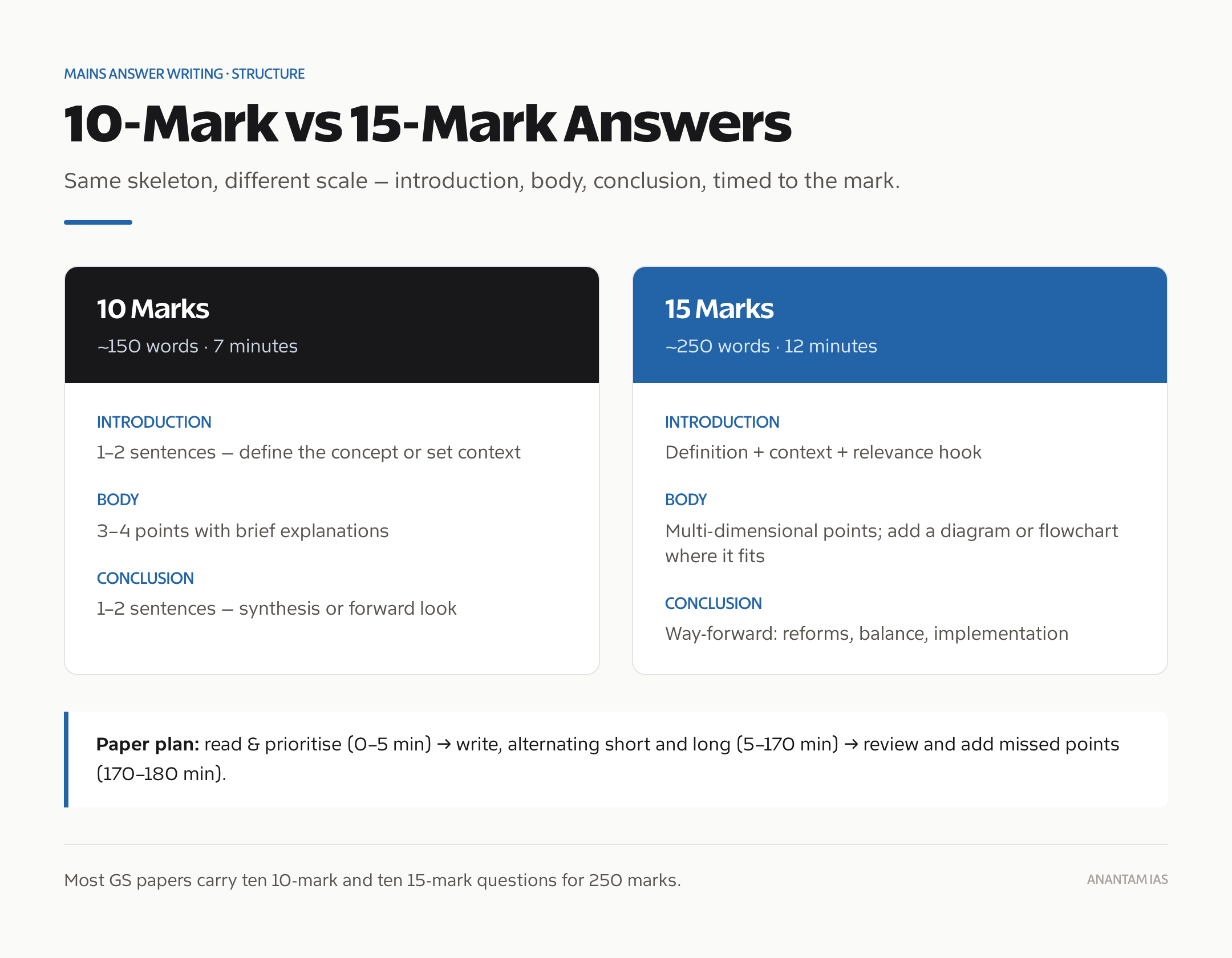
The 3-Hour Paper Plan
| Phase | Time | Activity |
|---|---|---|
| Phase 1 | 0–5 min | Read all questions; prioritize; plan answer order |
| Phase 2 | 5–170 min | Write answers (alternating short and long) |
| Phase 3 | 170–180 min | Review; add missed points; check for errors |
Answer Order Strategy
Don’t answer questions sequentially. Instead:
- Start with the question you know best (confidence builder)
- Alternate between 10-mark and 15-mark questions (prevents fatigue)
- Attempt all questions — leaving any question unanswered loses guaranteed marks
- Save tricky questions for last but don’t skip them entirely
The 80% Rule
Spend 80% of time on the 80% of questions you’re confident about. Don’t chase perfection on one answer at the cost of not attempting others. A decent attempt at all 20 questions consistently outscores brilliant attempts at 16 questions.
UPSC Study Plan: 12-Month Preparation Strategy
Common Answer Writing Mistakes
| Mistake | Impact | Fix |
|---|---|---|
| Lengthy introduction | Wastes word count on low-value content | Limit to 2 sentences max |
| Listing without analysis | Shows knowledge but not understanding | Add “why it matters” after each point |
| Ignoring directive word | Answer doesn’t match what’s asked | Underline the directive word; calibrate response |
| No examples or data | Generic answer that could apply to anything | Include 2–3 specific examples per answer |
| Repetition | Same point in different words | Outline before writing |
| Poor conclusion | Abrupt ending | Always end with a way forward |
| Writing beyond word limit | Time management breakdown | Practice counting words; develop a feel for 150 and 250 words |
| No diagrams for geography | Missing easy presentation marks | Practice drawing maps and flowcharts |
How to Practice Answer Writing

amblitz A4 Answer-Writing Notebook — 200 pages
- A4 spiral-bound, 200 pages, 70 GSM paper
- Pre-printed margins laid out like the Mains answer booklet
- Room for a 250-word answer, headings and a diagram on a spread
Phase 1: Learning the Format (Weeks 1–4)
- Write 1–2 answers daily (not timed)
- Focus on structure: intro → body → conclusion
- Compare with model answers
- Get feedback from peers or evaluators
Phase 2: Building Speed (Weeks 5–12)
- Write 3–4 answers daily (timed)
- Mix 10-mark and 15-mark questions
- Practice with previous year questions
- Time each answer strictly
Phase 3: Full Paper Simulation (Weeks 13–20)
- Write full question papers under 3-hour time pressure
- Attempt all 20 questions
- Get evaluation for at least 2 full papers monthly
- Analyze where marks are lost
Phase 4: Pre-Exam Polish (Last 4 Weeks)
- Daily full-length answer writing (any one GS paper)
- Focus on presentation: headings, underlining, diagrams
- Review feedback from all previous evaluations
- Develop signature templates for common question types
How to Write UPSC Essay: Structure & Strategy
Frequently Asked Questions
How many words should a UPSC Mains answer actually be?
UPSC specifies approximately 150 words for 10-mark questions and 250 words for 15-mark questions. These are guidelines, not strict limits. Going 10–15% over is acceptable; exceeding by 30%+ wastes time. The quality of content matters more than hitting an exact word count. Develop a feel for how much handwritten text fills the allotted space.
Is point-wise or paragraph-wise format better?
A hybrid approach works best. Use short paragraphs for analytical content and numbered points for lists or comparisons. Pure bullet-point answers lack analysis; pure paragraphs lack structure. The ideal answer has 1–2 line introduction, 4–5 points (each 2–3 lines with analysis), and a 2-line conclusion.
When should answer writing practice start in the preparation journey?
Start basic answer writing by Month 3–4 of preparation. Initial practice doesn’t require deep knowledge — it builds the structural habit. By Month 6, move to timed practice. By Month 8, simulate full paper conditions. Starting late (after Prelims) leaves too little time to develop the skill.
How important is handwriting in UPSC Mains?
Legibility matters significantly. Examiners evaluate hundreds of scripts under time pressure. Illegible handwriting causes fatigue and unconscious bias. Practice writing neatly at speed — not calligraphy, but clean, consistent handwriting. Using a good pen, proper spacing, and clear paragraph breaks improves readability.
Should answers include headings and subheadings?
Yes, especially for 15-mark questions. Clear headings help the examiner identify the structure immediately. Underline headings or use a different pen. For 10-mark questions, a simple u0022Introduction → Points → Conclusionu0022 flow without formal headings works fine.
Tell Google you want more of this.
Add Anantam IAS as a preferred sourceOne tap, and this site shows up more often in your own Top Stories, AI Overviews and AI Mode. Remove it any time.