
Essay Writing for UPSC: Strategy & Previous Papers
The UPSC essay paper carries 250 marks and requires candidates to write two essays — one from each section — in three hours. A well-structured essay with clear arguments, relevant examples, and balanced analysis can push the total Mains score significantly higher. Many toppers credit their essay marks as the decisive factor in securing a top rank.
The essay paper tests analytical thinking, breadth of knowledge, and the ability to present ideas in a coherent, persuasive manner. Unlike GS papers, there’s no fixed syllabus — making essay writing both an opportunity and a challenge.
Understanding the UPSC Essay Paper Format
The Union Public Service Commission divides the essay paper into two sections (Section A and Section B), each containing four topics. Candidates must choose one topic from each section and write approximately 1000–1200 words per essay.
Key Paper Details
| Aspect | Detail |
|---|---|
| Total Marks | 250 (125 per essay) |
| Number of Essays | 2 (one from each section) |
| Time Allotted | 3 hours |
| Word Limit (Approx.) | 1000–1200 per essay |
| Section A Themes | Philosophical, abstract, social |
| Section B Themes | Economic, political, science & tech |
Section A typically features philosophical or abstract topics (“Wisdom finds truth” type), while Section B leans toward governance, economy, technology, and current affairs. Choosing the right topic is itself a strategic decision.
How UPSC Evaluates Essays
Examiners at the UPSC look for several qualities: clarity of thought, logical structure, substantive content, and original analysis. Merely filling pages doesn’t help. An essay scoring 60+ per piece demonstrates depth, uses multi-dimensional arguments, and avoids one-sided narratives.
UPSC Mains Answer Writing: Format & Tips
UPSC Essay Previous Year Paper Analysis (2019–2025)
Studying previous year essay topics reveals recurring themes and helps predict the direction of future papers.
Recurring Theme Categories
| Theme | Example Topics | Frequency |
|---|---|---|
| Philosophy & Values | “Wisdom finds truth,” “Thinking is like a game” | High |
| Governance & Democracy | “Cooperative federalism,” “Accountability in democracy” | High |
| Science & Technology | “Technology as the 4th pillar,” “Data is the new oil” | Medium |
| Social Issues | “Women empowerment,” “Education and equality” | High |
| Environment | “Climate change,” “Sustainable development” | Medium |
| Economy | “Inclusive growth,” “Globalization” | Medium |
Trends Observed from PYQ Analysis
The UPSC has increasingly favoured multidimensional topics that require candidates to blend philosophical reasoning with practical examples. Between 2020 and 2025, at least one topic per section touched on India’s constitutional values or governance challenges. The Niti Aayog‘s reports, Supreme Court judgments, and Economic Survey data frequently serve as relevant reference points.
Abstract topics have also grown more nuanced. Instead of simple one-liners, recent papers present paradoxes or dual-sided statements that demand balanced argumentation.
UPSC Prelims Previous Year Papers: Analysis & Trends
Step-by-Step Essay Writing Strategy
Step 1: Choose the Right Topic (First 5 Minutes)
Don’t rush. Read all eight topics carefully. Pick the one where three conditions meet: comfort with the subject, ability to provide diverse examples, and enough content for 1000+ words. Avoid topics that seem easy but are one-dimensional.
Step 2: Brainstorm and Create a Framework (10 Minutes)
On the rough sheet, jot down every idea, example, quote, data point, and counter-argument related to the topic. Then organize them into a rough outline:
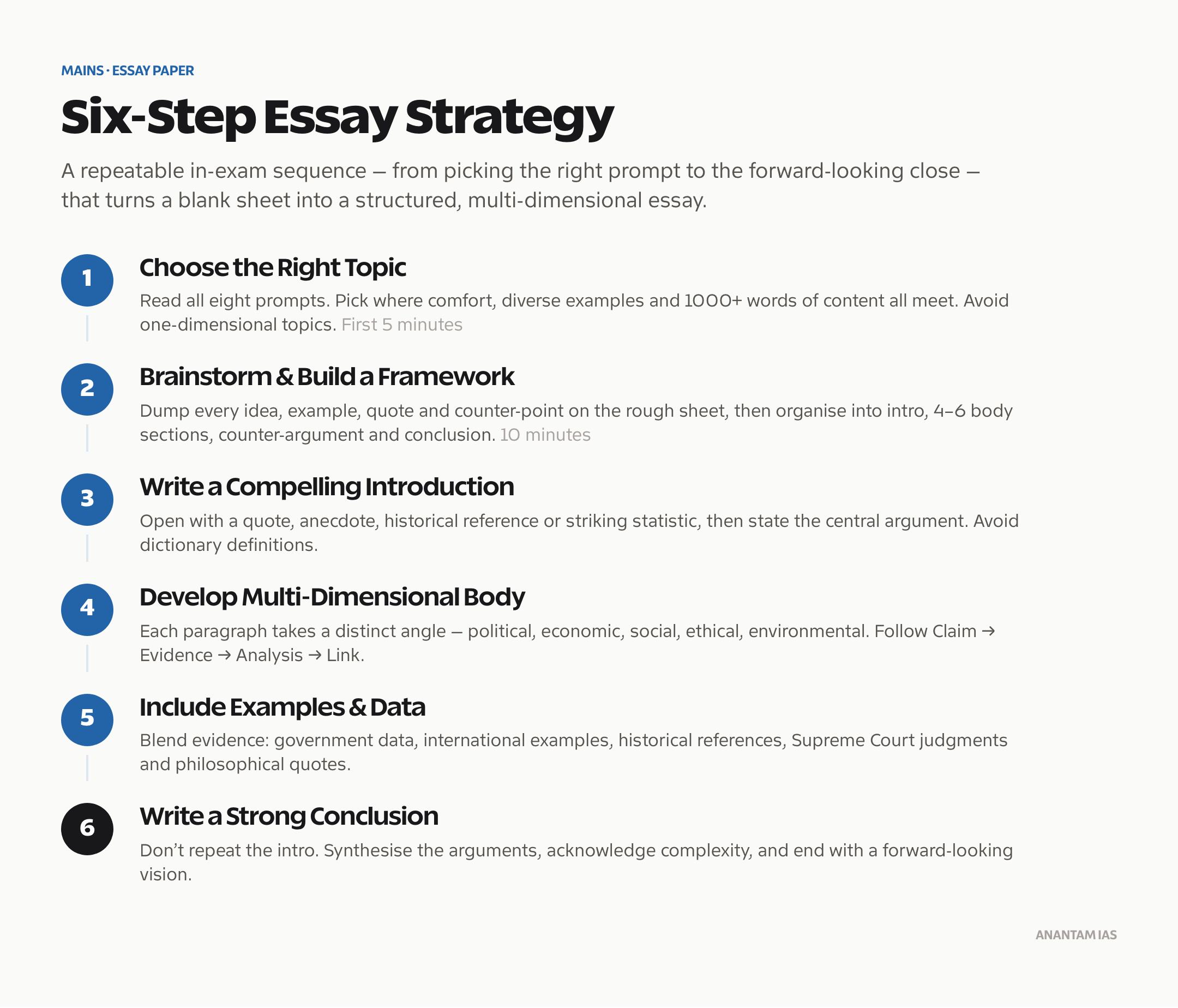
- Introduction — Hook + thesis statement
- Body paragraphs — 4 to 6 sections, each covering a distinct dimension
- Counterarguments — At least one paragraph acknowledging the other side
- Conclusion — Synthesis + forward-looking statement
Step 3: Write a Compelling Introduction
The introduction sets the examiner’s first impression. Open with a relevant quote, anecdote, historical reference, or a striking statistic. Then state the central argument clearly. Avoid dictionary definitions — they signal a lack of original thinking.
Example for “Technology as the 4th pillar of democracy”: > “When the Aadhaar system brought 1.3 billion Indians onto a single digital identity platform, it didn’t just streamline governance — it redefined the citizen-state relationship.”
Step 4: Develop Multi-Dimensional Body Paragraphs
Each body paragraph should cover a distinct angle — political, economic, social, ethical, environmental, or international. The UPSC rewards breadth of perspective.
For every argument, follow this structure:
- Claim — State the point
- Evidence — Data, example, case study, or quote
- Analysis — Explain why it matters
- Link — Connect back to the thesis
Step 5: Include Relevant Examples and Data
Strong essays blend different types of evidence:
| Type | Example |
|---|---|
| Indian Government Data | Economic Survey, NITI Aayog reports |
| International Examples | Nordic model, Singapore governance |
| Historical References | Constituent Assembly debates, freedom movement |
| Supreme Court Judgments | Puttaswamy (privacy), Vishaka (workplace safety) |
| Philosophical Quotes | Gandhi, Ambedkar, Kautilya, Tagore |
Step 6: Write a Strong Conclusion
The conclusion shouldn’t merely repeat the introduction. Synthesize key arguments, acknowledge complexity, and end with a forward-looking vision. A good conclusion leaves the examiner thinking.
How to Write UPSC Essay: Structure & Strategy
Common Mistakes in UPSC Essay Writing
Mistake 1: One-Dimensional Analysis
Writing only about the economic aspect of “Inclusive Growth” while ignoring social, environmental, and governance dimensions guarantees an average score. UPSC essays demand 360-degree treatment.
Mistake 2: Poor Time Management
Spending 100 minutes on the first essay and only 80 on the second creates an imbalance. Allocate 90 minutes per essay — 10 for planning, 70 for writing, 10 for review.
Mistake 3: Quoting Without Context
Dropping quotes without connecting them to the argument adds no value. Every quote must serve a purpose and be followed by analysis.
Mistake 4: Extreme Positions
Taking an absolute stance (all technology is good, all globalization is bad) signals intellectual rigidity. Nuance wins marks.
Mistake 5: Ignoring the Counter-Argument
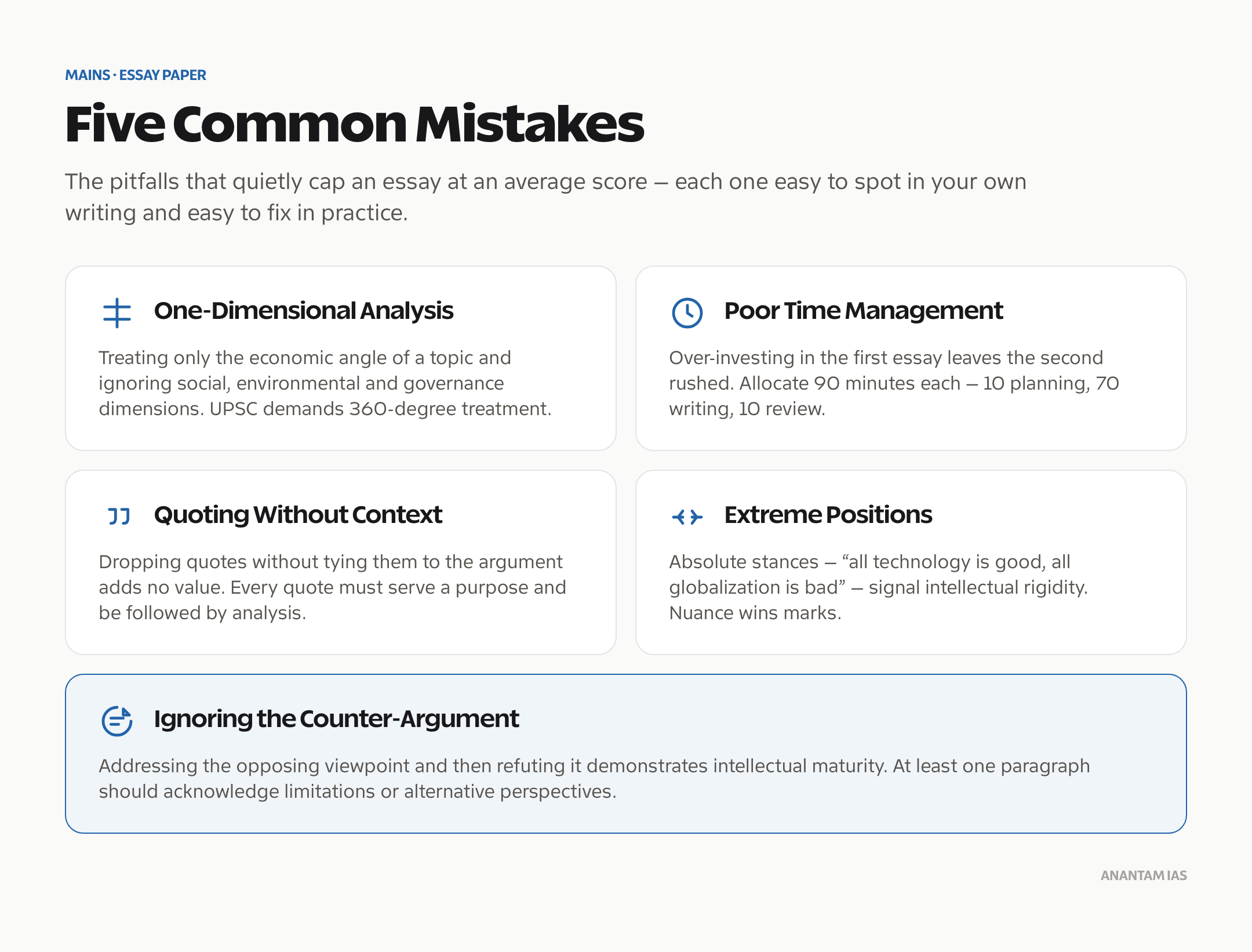
Addressing the opposing viewpoint and then refuting it demonstrates intellectual maturity. At least one paragraph should acknowledge limitations or alternative perspectives.
How to Practise Essay Writing for UPSC
Weekly Practice Schedule
Serious aspirants should write at least one full-length essay per week from 8–10 months before the Mains examination. Here’s a phased approach:
| Phase | Duration | Focus |
|---|---|---|
| Phase 1 | Months 1–3 | Read widely; practise brainstorming frameworks |
| Phase 2 | Months 4–6 | Write one essay per week; get feedback |
| Phase 3 | Months 7–9 | Timed practice (90 min per essay); refine structure |
| Phase 4 | Last month | Full mock tests; review and polish style |
Building a Content Bank
Maintain a running notebook (physical or digital) organized by themes:
- Governance — Key schemes, Supreme Court orders, committee reports
- Society — Census data, social indicators, case studies
- Philosophy — Thinkers and their key ideas (Rawls, Amartya Sen, Gandhi, Ambedkar)
- Economy — GDP trends, employment data, policy milestones
- Environment — Paris Agreement targets, India’s NDCs, disaster data
- Technology — Digital India metrics, AI policy, cybersecurity concerns
This content bank becomes the ammunition for essays on exam day.
Getting Feedback
Self-evaluation has limits. Peer review or mentorship from experienced faculty helps identify blind spots. Focus feedback on:
- Logical flow between paragraphs
- Quality and relevance of examples
- Balance of perspectives
- Clarity of the thesis statement
UPSC Mains GS 4 Strategy: Ethics, Integrity & Aptitude
Section A vs Section B: Strategy Differences
Section A (Philosophical/Abstract)
These topics require deeper thinking and personal reflection. The approach should be:
- Open with a philosophical framing
- Use thinkers’ quotes and ideas liberally
- Draw from Indian heritage, constitutional values, and contemporary society
- Include anecdotes and real-world applications
Section B (Governance/Economy/Science)
These topics demand more data and policy knowledge:
- Cite specific government schemes, Acts, and institutional frameworks
- Use data from the Economic Survey, NITI Aayog, or World Bank
- Reference international best practices
- Discuss implementation challenges alongside policy objectives
Choosing one topic from each section that complements the other can create a balanced paper — one philosophical, one practical.
High-Scoring Essay Checklist
Before submitting the paper, mentally check these points:
- Clear thesis stated in the introduction
- At least 5 distinct dimensions covered
- Minimum 4–5 concrete examples per essay
- At least 1 counter-argument addressed
- Relevant data points and statistics used
- Logical transition between paragraphs
- Forward-looking conclusion (not just a summary)
- Clean handwriting and readable presentation
- No spelling or grammatical errors
- Word count approximately 1000–1200
Frequently Asked Questions
How many marks should a UPSC aspirant target in the essay paper?
Serious aspirants should target 130+ out of 250. Scoring above 140 is exceptional and typically requires strong content, clear structure, and original thinking. The average score hovers around 100–110, so even a 20-mark improvement significantly boosts rank.
Can coaching help with UPSC essay writing?
Coaching provides frameworks, topic banks, and evaluation — all of which help. However, the actual skill develops through consistent practice and reading. Self-study aspirants can achieve similar results by practising weekly, reading diverse sources, and seeking peer feedback.
Should quotes be memorized for the essay paper?
Memorizing 30–40 versatile quotes from thinkers like Gandhi, Ambedkar, Tagore, Kautilya, Aristotle, and Amartya Sen helps. But quotes must be contextually relevant. Forcing unrelated quotes into an essay hurts more than it helps.
Is it better to choose a philosophical or factual essay topic?
It depends on individual strengths. Candidates with strong reading habits and analytical thinking often do well with philosophical topics. Those with deep knowledge of governance and economy may prefer factual topics. The key is choosing the topic where diverse examples come naturally.
How important is handwriting in the essay paper?
UPSC doesn’t formally award marks for handwriting, but legibility matters. Examiners evaluating hundreds of papers will naturally spend more time on neatly written essays. Clean presentation with proper paragraphing and underlining of key points creates a positive impression.
Tell Google you want more of this.
Add Anantam IAS as a preferred sourceOne tap, and this site shows up more often in your own Top Stories, AI Overviews and AI Mode. Remove it any time.