Context:
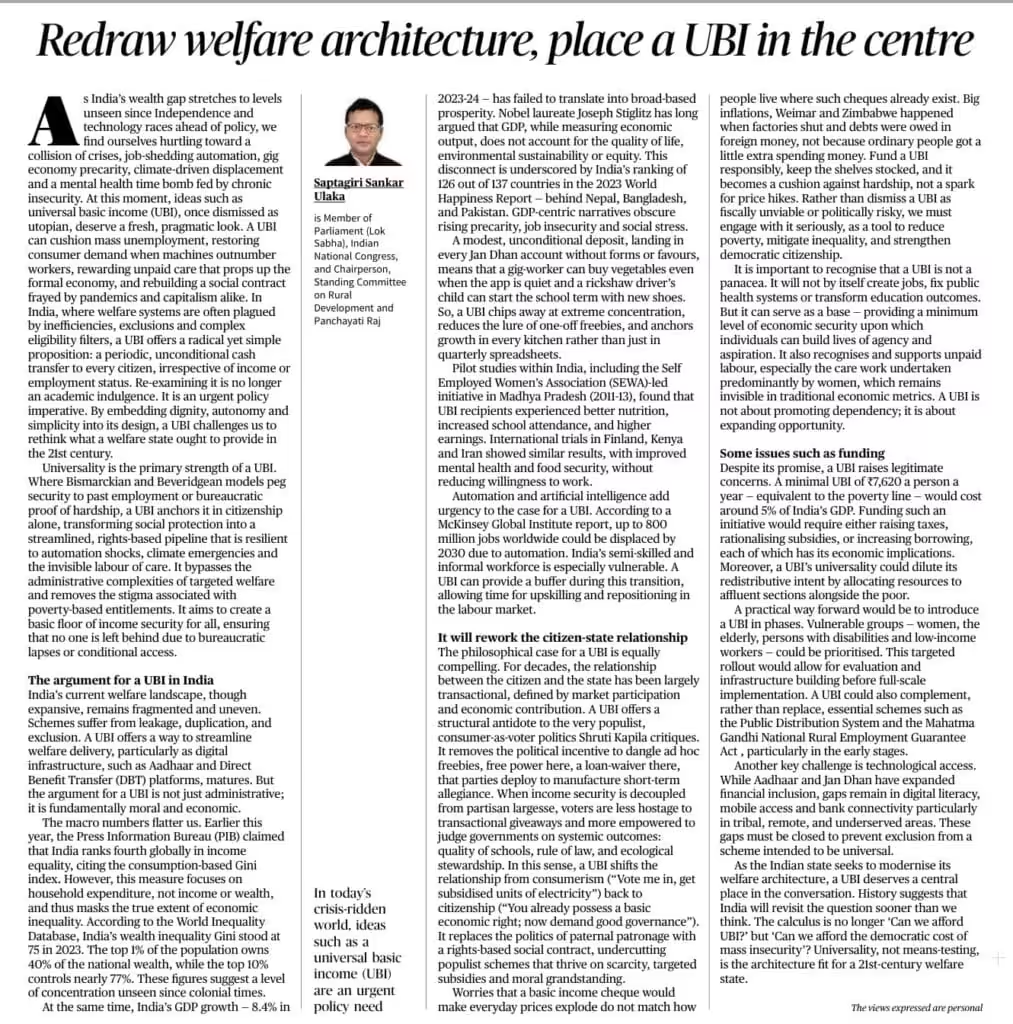
India’s current welfare system faces challenges like bureaucratic inefficiency, exclusion errors, and duplication of benefits. Amid economic slowdown, jobless growth, and rising automation, the author argues that India needs a universal, unconditional income transfer to ensure economic security and dignity for all citizens.
UPSC Relevance:
Economy and Social Justice
UPSC PYQ:
Q. Professor Amartya Sen has advocated important reforms in the realms of primary education and primary health care. What are your suggestions to improve their status and performance? (2016)
Universal Basic Income:
According to IMF: Universal basic income is an income support mechanism typically intended to reach all (or a very large portion of the population) with no (or minimal) conditions.
History of UBI:
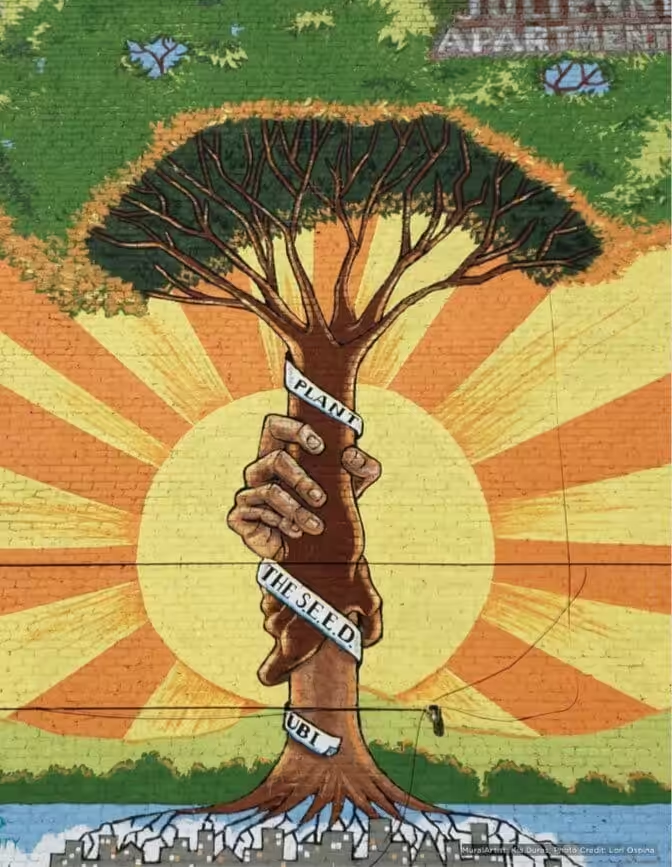
- In recent years, UBI went from a utopian proposal to a policy with growing currency. UBI experiments have been conducted in countries as different as Kenya, Finland, Namibia, India, and Canada.
- In the United States, variants of the UBI proposal were very much alive in the early second half of the twentieth century—including through figures like Martin Luther King, Jr., and Milton Friedman—but the conversation did not pick up much in subsequent decades.
In India UBI debate first formally introduced in the 2016–17 Economic Survey as a possible future welfare model.
https://www.indiabudget.gov.in/budget2017-2018/es2016-17/echap09.pdf
Characteristics:
Adapted from Bidadanure, 2019, “The Political Theory of Universal Basic Income”
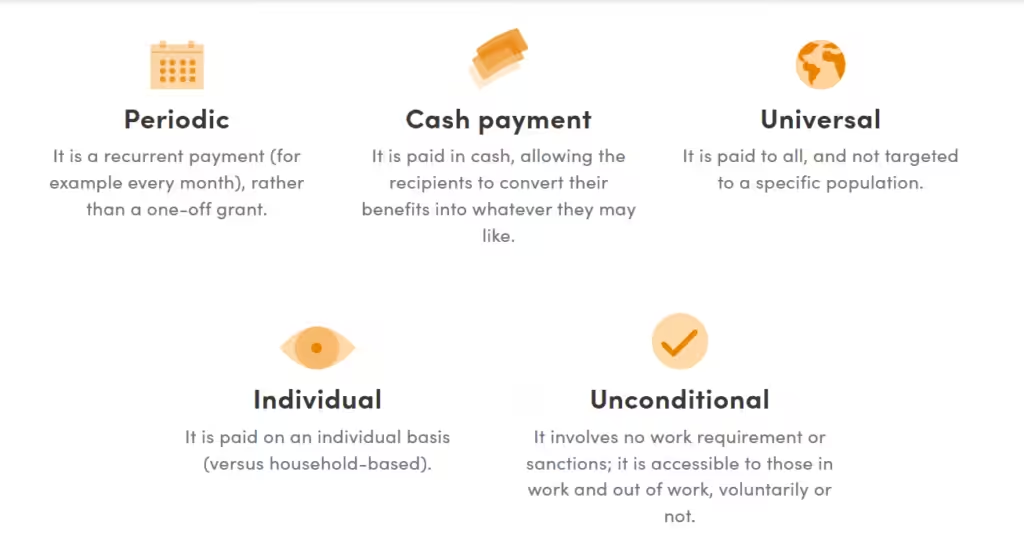
Why UBI is needed?:
- Growing unemployment and informal labour issues.
- Automation and AI threatening job security.
- Rising inequality despite high GDP growth.
- Policy discussions around rationalizing subsidies and Direct Benefit Transfer (DBT) inefficiencies.
Status of Universal Basic Income (UBI) in India
- India currently does not have a full, nationwide Universal Basic Income (UBI) scheme.
- However, the country has actively debated the concept and has implemented several large-scale Direct Benefit Transfer (DBT) cash schemes that function as a targeted or partial basic income for specific vulnerable groups.
- The discussion around UBI gained significant policy traction after the Economic Survey 2016-17 formally proposed the idea as an alternative to the government’s complex web of subsidies and welfare programs.
| Aspect | Description |
| Feasibility | India’s robust Jan-Dhan-Aadhaar-Mobile (JAM) trinity infrastructure has made the direct, digital transfer of cash (DBT) feasible on a massive scale, which is essential for a UBI system. |
| Pilot Projects | Small-scale, time-bound UBI pilots have been conducted, such as the SEWA (Self-Employed Women’s Association) pilot in Madhya Pradesh (2011-2012). These pilots showed positive impacts on health, nutrition, and productive investments without significantly discouraging work. |
| Challenges | The primary hurdles remain the high fiscal cost (estimated at 3.5% to 11% of GDP, depending on the benefit level), the risk of inflationary pressures, and the debate over replacing existing, well-established welfare schemes (like the Public Distribution System or MGNREGS). |
- In short, India is moving towards a model of Targeted Basic Income by expanding unconditional cash transfers to specific sections of the population rather than implementing a true universal scheme for all citizens.
Key Cash Transfer Schemes Resembling UBI
1. PM-KISAN (Pradhan Mantri Kisan Samman Nidhi)
- Target Group: Landholding farmer families across the country (subject to specific exclusion criteria, like being a taxpayer or institutional landholder).
- Mechanism: Unconditional income support.
- Benefit: ₹6,000 per year (transferred in three equal instalments of ₹2,000 every four months).
2. State-Specific Basic Income Schemes (Targeting Women)
| Scheme Name | State | Monthly Benefit (Approx.) |
| Gruha Lakshmi | Karnataka | ₹2,000 |
| Mukha Mantri Ladli Behna Yojana | Madhya Pradesh | ₹1,250 |
| Kalaignar Magalir Urimai Thittam | Tamil Nadu | ₹1,000 |
3. Rythu Bandhu Scheme (Telangana)
Benefit: ₹10,000 per acre per year (₹5,000 per crop season for Kharif and Rabi).
Target Group: Land-owning farmers.
Mechanism: Unconditional cash transfer for investment support.
Arguments in Favour and Against UBI:
| Favor | Against |
| Poverty and vulnerability reduction Poverty and vulnerability will be reduced in one fell swoop | Conspicuous spending Households, especially male members, may spend this additional income on wasteful activities. |
| Choice A UBI treats beneficiaries as agents and entrusts citizens with the responsibility of using welfare spending as they see best; this may not be the case with in-kind transfers. | Moral hazard (reduction in labour supply) A minimum guaranteed income might make people lazy and opt out of the labour market. |
| Better targeting of poor As all individuals are targeted, exclusion error (poor being left out) is zero though inclusion error (rich gaining access to the scheme) is 60 percent. | Gender disparity induced by cash Gender norms may regulate the sharing of UBI within a household – men are likely to exercise control over spending of the UBI. This may not always be the case with other in-kind transfers. |
| Insurance against shocks This income floor will provide a safety net against health, income and other shocks | Implementation Given the current status of financial access among the poor, a UBI may put too much stress on the banking system. |
| Improvement in financial inclusion Payment – transfers will encourage greater usage of bank accounts, leading to higher profits for banking correspondents (BC) and an endogenous improvement in financial inclusion. Credit – increased income will release the constraints on access to credit for those with low income levels. | Fiscal cost given political economy of exit Once introduced, it may become difficult for the government to wind up a UBI in case of failure. |
| Psychological benefits A guaranteed income will reduce the pressures of finding a basic living on a daily basis. | Political economy of universality – ideas for self-exclusion Opposition may arise from the provision of the transfer to rich individuals as it might seem to trump the idea of equity and state welfare for the poor. |
| Administrative efficiency A UBI in place of a plethora of separate government schemes will reduce the administrative burden on the state. | Exposure to market risks (cash vs. food) Unlike food subsidies that are not subject to fluctuating market prices, a cash transfer’s purchasing power may severely be curtailed by market fluctuations. |
“Wiping every tear from every eye” based on the principles of universality, unconditionality, and agency—the hallmarks of a Universal Basic Income (UBI)—is a conceptually appealing idea.
Tell Google you want more of this.
Add Anantam IAS as a preferred sourceOne tap, and this site shows up more often in your own Top Stories, AI Overviews and AI Mode. Remove it any time.