Hypersonic Glide Vehicles (HGV): Speed, Manoeuvre, and the New Race
A complete UPSC GS-III explainer on Hypersonic Glide Vehicles. Covers the boost-glide architecture, the difference between HGVs and hypersonic cruise missiles, the global race led by Russia, China, and the United States, India's HSTDV programme, BrahMos-II, and the implications for missile defence, deterrence, and arms control.
A hypersonic glide vehicle is a kind of weapon that breaks the neat categories military planners have used for sixty years. A ballistic missile arches into space and falls back along a calculable parabola. A cruise missile flies low and slow and turns. The hypersonic glide vehicle does neither. It is launched on a rocket like a ballistic missile, but instead of falling, it skips along the upper edge of the atmosphere at five times the speed of sound or more, manoeuvring as it goes. By the time a defender’s radar sees it, there is rarely enough time to do anything about it.
The result is a weapon that cannot be reliably tracked, cannot be predicted, and cannot be intercepted with the missile defence systems built for the previous era. That is why the United States, Russia, China, and India have all spent the last twenty years investing heavily in the technology, and why arms control specialists worry about how it could destabilise nuclear deterrence.
For UPSC, the topic sits at the intersection of defence technology, strategic affairs, and India’s evolving missile portfolio. This article walks through what an HGV is, how it differs from a hypersonic cruise missile, the physics of the boost-glide trajectory, the leading programmes around the world, India’s HSTDV and BrahMos-II efforts, and what this class of weapon means for deterrence, defence policy, and arms control.
What an HGV Actually Is
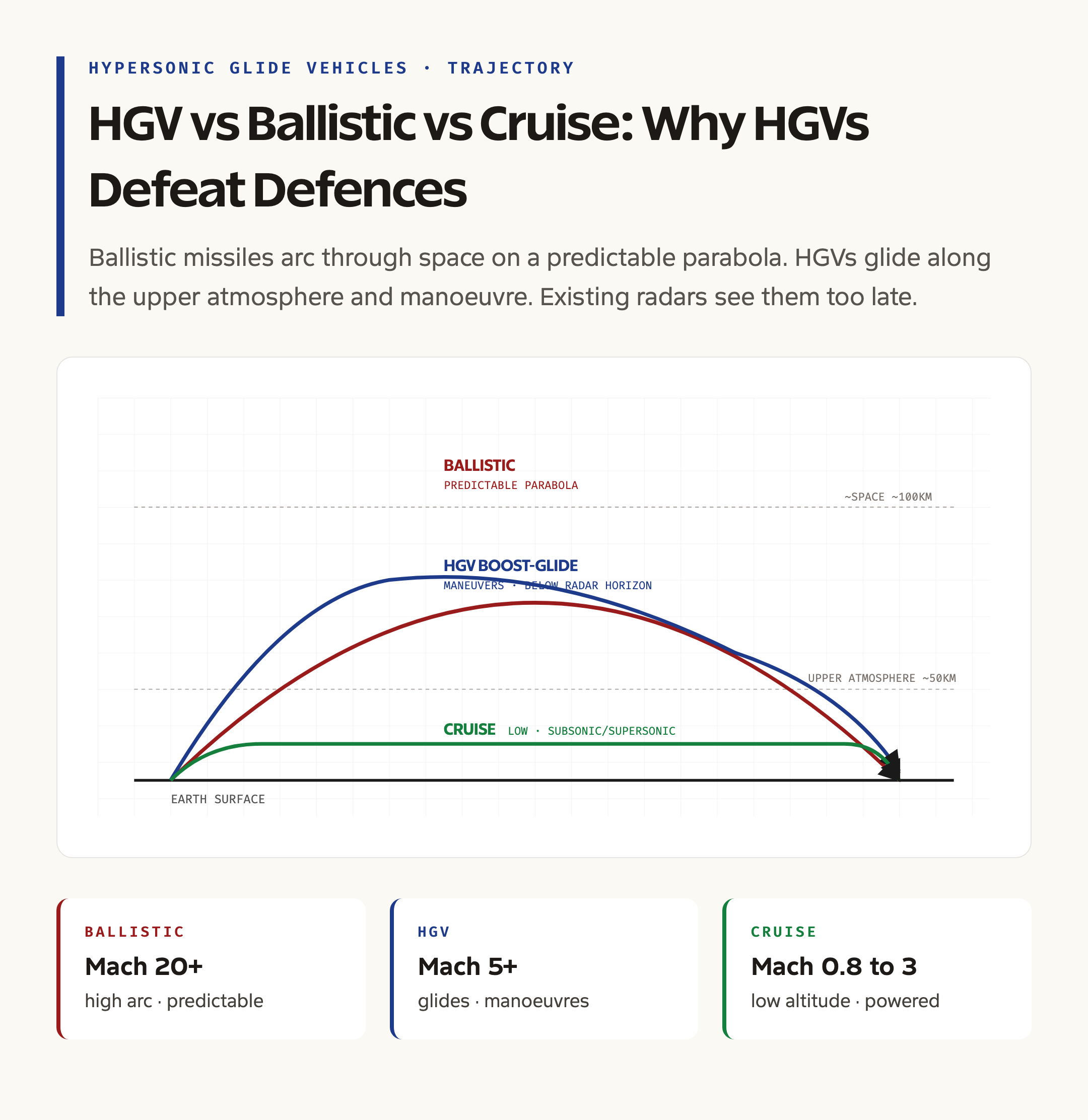
An HGV is a manoeuvring re-entry vehicle that travels at hypersonic speeds, defined as Mach 5 and above, after being lifted to high altitude by a rocket booster. The hypersonic threshold is not magical, but at Mach 5 the air ahead of the vehicle no longer has time to flow around it the way it does at lower speeds. Shock waves form, surface temperatures climb past 2,000 degrees Celsius, and the physics of flight changes character. Materials, control surfaces, and guidance systems all have to be designed for that regime.
The “glide” in the name is the key. The vehicle is not powered during most of its flight. It uses the kinetic energy imparted by the booster to surf along the upper atmosphere, with aerodynamic lift keeping it from falling and the thin air keeping drag manageable. By tilting its body and using small control surfaces, the HGV can change direction in flight, banking left or right, climbing or diving, on a path that looks nothing like the predictable arc of a ballistic re-entry.
This combination of speed and manoeuvre is what makes the weapon difficult to defend against. Existing missile defence systems, from the US Ground-Based Midcourse Defense to Russia’s A-235 and India’s emerging Ballistic Missile Defence, are designed against ballistic threats whose trajectories can be computed from a few seconds of radar data. An HGV defeats that geometry by refusing to commit to a path until the last moment.
How a Boost-Glide Trajectory Works
A boost-glide flight has three phases. The first is the boost phase, in which a rocket booster lifts the vehicle to altitudes typically between 40 and 100 kilometres. The booster can be a converted intercontinental ballistic missile, a dedicated medium-range rocket, or a smaller launcher depending on the desired range. At the end of the boost, the HGV separates from the booster.
The second phase is the glide. Instead of arcing into space, the HGV pulls down into a shallow re-entry, catching the upper atmosphere and using lift to extend its range. It can cruise at altitudes of 30 to 60 kilometres for thousands of kilometres, lower than a ballistic re-entry vehicle and higher than a cruise missile. Because the trajectory is depressed, the vehicle stays below the horizon of distant ground-based radars for longer than a ballistic threat. The defender’s first detection often comes from space-based infrared sensors picking up the booster, but the gliding phase produces a much weaker signature, especially against a busy atmospheric background.
The third phase is the terminal dive, where the HGV pitches over and accelerates onto its target. Even at this stage the vehicle continues to manoeuvre, complicating the work of any terminal interceptor.
The trade-off is energy. A boost-glide path bleeds kinetic energy slowly through atmospheric drag, so the vehicle covers less range than a pure ballistic shot from the same booster. In practice, intercontinental boost-glide systems use heavy-lift rockets to compensate, and shorter-range systems accept the geometry as the cost of unpredictability.
HGV vs Hypersonic Cruise Missile
The two weapons are often confused because they both fly at hypersonic speed, but the engineering is opposite. A hypersonic cruise missile is powered by an air-breathing engine throughout its flight, typically a scramjet that burns fuel in supersonic airflow. Russia’s Zircon and India’s BrahMos successor concepts are examples. The vehicle behaves like a very fast aeroplane, climbing, cruising, and turning under its own thrust.
An HGV is unpowered after the boost. It uses momentum from the rocket to glide. Russia’s Avangard and China’s DF-ZF are examples. The trade-off is interesting. A hypersonic cruise missile can sustain speed and choose its altitude flexibly, but its scramjet has a limited operating envelope and is a delicate piece of engineering. An HGV is simpler in propulsion terms, since the booster is a known technology, but the vehicle itself must survive sustained high temperatures and provide aerodynamic control without thrust, which is its own difficulty.
Both weapons are hypersonic. Both manoeuvre. Both fly low enough to defeat existing radars. But the boost-glide architecture is mature enough that two countries have already deployed operational systems, while flight-proven hypersonic cruise missiles remain mostly in test or limited service.
The Global Hypersonic Race
The United States led early development of boost-glide vehicles. The Defense Advanced Research Projects Agency tested the HTV-2 in 2010 and 2011, with the second flight breaking up after several minutes of hypersonic glide. The current US programmes are the Long Range Hypersonic Weapon, also known as Dark Eagle, an Army-Navy joint conventional system, and a sea-launched variant called Conventional Prompt Strike. Both use a Common Hypersonic Glide Body developed by Sandia National Laboratories.
Russia has been the most aggressive. The Avangard, declared operational in December 2019, is mated to UR-100UTTKh and Sarmat ICBMs and carries a nuclear or conventional payload at speeds Russian sources claim exceed Mach 20. The Avangard is the world’s first deployed strategic boost-glide weapon and is intended to defeat US national missile defence in any plausible nuclear exchange.
China’s DF-ZF, also called the WU-14, has been in flight test since 2014 and is reported to be operationally fielded on the DF-17 medium-range ballistic missile. Chinese state media has displayed the DF-17 in military parades. A 2021 test that orbited a glide vehicle around the Earth before landing on a target startled US analysts because it suggested a fractional orbital bombardment system architecture combined with manoeuvring re-entry.
North Korea claims a hypersonic glide capability with the Hwasong-8 tested in 2021. The technical maturity is debated. Iran has displayed mock-ups of a Fattah-class hypersonic system, and Pakistan has expressed interest, although neither has flight-tested anything comparable to the Russian, Chinese, or US programmes.
India’s Hypersonic Programme
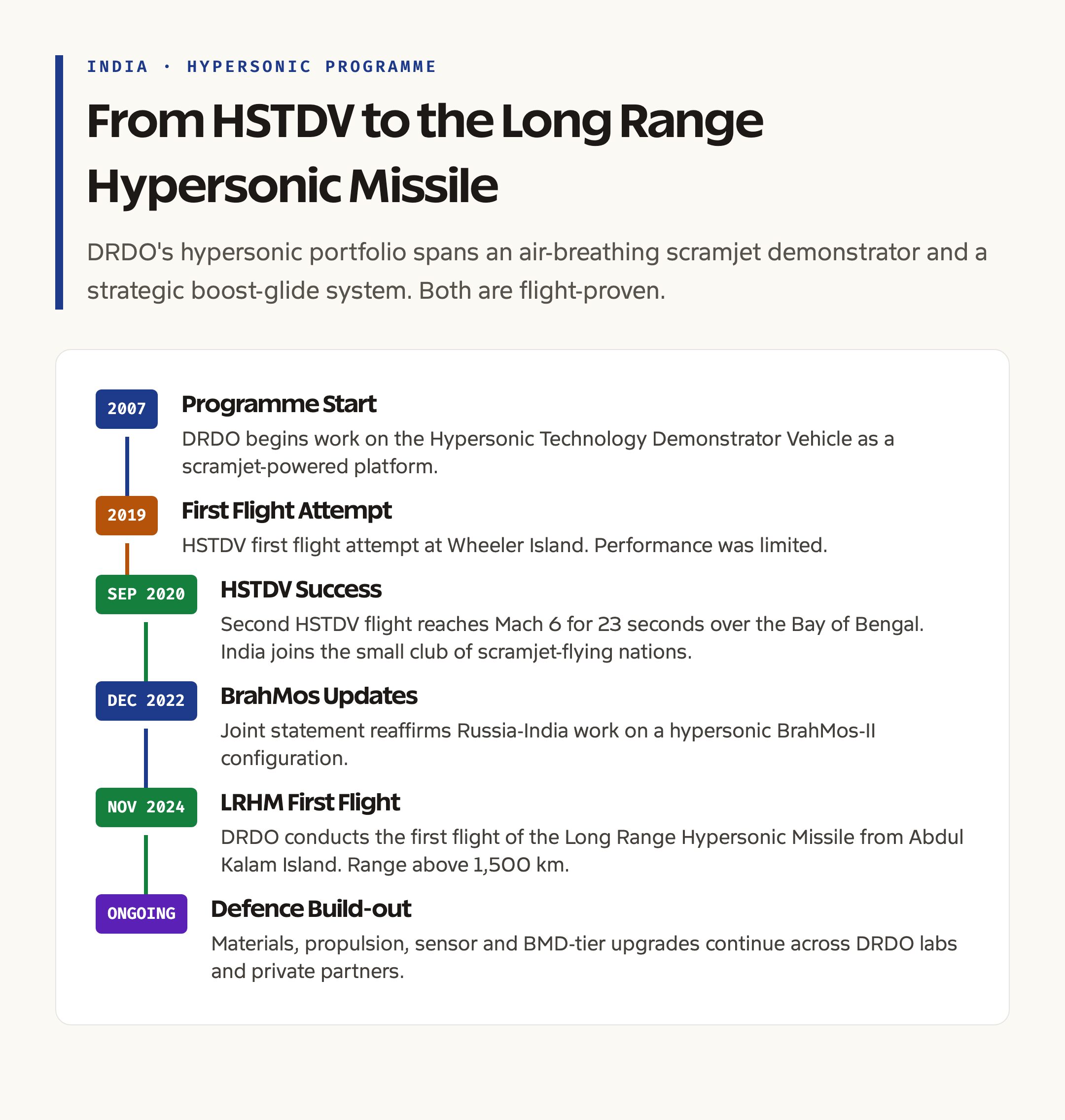
India’s effort began with the Hypersonic Technology Demonstrator Vehicle, the HSTDV, an air-breathing scramjet test platform developed by the Defence Research and Development Organisation. The first successful HSTDV flight was on 7 September 2020, when the vehicle flew for about 23 seconds at Mach 6 over the Bay of Bengal. The HSTDV is technically a scramjet demonstrator rather than a glide vehicle, but the materials, thermal protection, and guidance work it validated feed directly into the wider hypersonic portfolio.
In November 2024, DRDO conducted the first flight of the Long Range Hypersonic Missile from the Abdul Kalam Island launch facility. The system is reported to have a range above 1,500 kilometres and is being designed for delivery on multiple platforms including land mobile launchers and naval ships. While the official architecture has not been published in detail, the system fits the boost-glide profile, with India joining the small set of countries with a flight-tested long-range hypersonic capability.
The BrahMos-II programme, a joint venture with Russia, has been pitched as a hypersonic successor to the Mach 3 BrahMos cruise missile, though development has been slow and the technical configuration has shifted between scramjet and boost-glide concepts over the years.
India’s interest in hypersonic technology is shaped by three pressures. The first is the regional missile and missile-defence environment, where China’s DF-17 and Pakistan’s evolving capabilities matter. The second is the operational value of a system that can penetrate dense air defences. The third is the broader push for indigenous defence capability under the Atmanirbhar Bharat framework, where the defence budget reflects the prioritisation of next-generation systems.
Why HGVs Matter for Deterrence
The strategic effect of hypersonic glide vehicles cuts in several directions. The most discussed is the impact on missile defence. The US national missile defence architecture, designed against the limited threat of a North Korean ICBM, was never adequate against a Russian or Chinese strategic strike. HGVs make the inadequacy starker. A handful of Avangard or DF-17 vehicles could in principle penetrate any defence the US could build in the next decade, and Russian and Chinese planners use them as guarantors of second-strike credibility.
The second effect is on crisis stability. A hypersonic weapon compresses warning time, reducing the period between launch and impact below the threshold at which a leader can verify the attack and make a decision. In a fast-moving crisis, the temptation to launch on warning grows, which is exactly the dynamic arms control treaties have tried to dampen since the 1960s.
A third effect is on conventional warfare. Hypersonic weapons with conventional warheads can hold high-value, time-sensitive targets at risk on a global scale, which previously required either a large fleet of strike aircraft or a willingness to use a nuclear weapon. The blurring between conventional and nuclear roles is awkward for arms control because the same weapon can carry either payload, and a defender who detects a launch cannot easily tell which.
A fourth effect is the proliferation pressure. Once two or three states deploy operational hypersonic weapons, others come under pressure to follow, both to keep up with adversaries and to retain bargaining power in any future arms-control negotiation.
Materials and Engineering Challenges
Building a hypersonic glide vehicle is hard for reasons that are intrinsic to the physics. At Mach 5 and above, the leading edges of a vehicle reach surface temperatures that ordinary aerospace alloys cannot tolerate. Carbon-carbon composites, ultra-high-temperature ceramics, and ablative coatings are required, and even these wear at rates that limit reusability.
Plasma sheath effects complicate communication and guidance. The hot ionised gas around a hypersonic vehicle blocks radio signals over part of the flight envelope, which means the vehicle must navigate by inertial sensors and onboard software rather than receiving updated commands from a ground station.
Aerodynamic control at hypersonic speed is also non-trivial. Conventional control surfaces produce different effects than at lower speeds, and the boundary layer between hot gas and cool body changes with altitude, speed, and angle. Wind tunnel testing in this regime is expensive and limited, so much of the development work depends on computational fluid dynamics combined with sparse flight-test data.
Materials science research feeds back into the broader civilian industry. Heat-resistant ceramics developed for hypersonic vehicles find applications in jet engines, re-entry capsules, and even nuclear reactors. The push for hypersonic capability is one of the drivers of the strategic materials investment that countries describe under their critical minerals and rare earth strategies.
Detection, Defence, and the Sensor Race

Defending against hypersonic glide vehicles requires a different sensor architecture than defending against ballistic missiles. The US Space Development Agency has begun deploying a constellation of low-Earth-orbit infrared satellites, the Tracking Layer, designed to follow the dim signature of a gliding vehicle against the cold space background and the cluttered atmosphere. China’s military space programme is building parallel capability.
Interception remains the harder problem. Existing kinetic interceptors are designed to home on a known ballistic trajectory and have limited ability to chase a manoeuvring target. The US Glide Phase Interceptor and the Multi-Object Kill Vehicle programmes aim to address this, but the engineering is at the edge of what is feasible. Directed energy weapons, especially high-power lasers, are sometimes proposed as the long-term defensive answer because they engage at the speed of light, but power, atmospheric absorption, and lethality remain open problems.
For India, the implication is that the Ballistic Missile Defence programme cannot stay where it is. The two-tier interceptor architecture, with the Prithvi Air Defence and Advanced Air Defence missiles, is good against medium-range ballistic threats but inadequate against hypersonic glide vehicles. A new tier with space-based tracking and faster terminal interceptors is the natural next step, with implications for the internal security and defence-industrial planning that flow from it.
Arms Control and the Treaty Vacuum
The treaty regime that constrained the US-Soviet strategic balance is largely gone. The Intermediate-Range Nuclear Forces Treaty was abandoned in 2019. The Open Skies Treaty has unravelled. New START between the US and Russia is on its last legs and does not cover hypersonic glide vehicles in any meaningful way. China is not party to any nuclear arms control framework. The result is that an entire new class of weapon is being deployed without the verification, transparency, and crisis-management mechanisms that limited damage during the Cold War.
For India, this matters in two ways. First, the absence of multilateral hypersonic arms control means that any informal restraint will need to come from regional understandings, particularly with China, that are politically difficult. Second, the strategic logic of hypersonic deployment in Asia connects to broader nuclear-doctrine questions, including the credibility of India’s no-first-use posture against an adversary that can strike its leadership with little warning.
Prelims Pointers
A hypersonic glide vehicle travels at Mach 5 or faster, is launched on a rocket booster, and glides through the upper atmosphere using aerodynamic lift while manoeuvring. It differs from a hypersonic cruise missile, which is powered throughout its flight by a scramjet. Operational systems include Russia’s Avangard since December 2019 and China’s DF-ZF on the DF-17 missile. The US is developing the Long Range Hypersonic Weapon, also called Dark Eagle. India tested the Hypersonic Technology Demonstrator Vehicle in September 2020 and the Long Range Hypersonic Missile in November 2024. DRDO is the lead Indian agency. The HSTDV uses a scramjet and demonstrated Mach 6 flight. The Avangard reportedly flies at speeds above Mach 20.
Mains Practice Questions
- Hypersonic glide vehicles undermine the strategic stability that ballistic missile defence and arms control have rested on since the Cold War. Examine the technical and policy implications for India. (250 words)
- Compare hypersonic glide vehicles with hypersonic cruise missiles and assess India’s progress in both segments through the HSTDV, the Long Range Hypersonic Missile, and BrahMos-II. (250 words)
- Discuss the role of materials science, sensor architecture, and arms control in shaping the next decade of hypersonic weapons development. (250 words)
Way Forward
For India, the way forward is a portfolio approach. The HSTDV programme should continue to mature scramjet propulsion for the BrahMos-II class of hypersonic cruise missile, while the Long Range Hypersonic Missile programme establishes a credible boost-glide capability for strategic and theatre roles. Both efforts depend on sustained investment in materials, propulsion, guidance, and flight-test infrastructure.
The defensive side requires equally urgent work. Space-based infrared tracking, faster terminal interceptors, and integrated battle management against manoeuvring threats are all areas where India is currently behind the leading powers. The collaboration between DRDO, the Indian Space Research Organisation, and private industry needs to be deeper than it has been historically.
On the policy side, India should engage actively in any emerging multilateral discussion of hypersonic restraint, even if formal arms control is unlikely in the near term. Confidence-building measures with China, including pre-notification of test flights and limits on certain deployment patterns, would reduce the risk of inadvertent escalation. The broader border management and strategic-stability architecture of South Asia depends on getting these answers right.
The technology is here. It will spread. The question for India is whether to be a serious player in shaping its operational and normative limits, or a passive consumer of decisions made elsewhere.
Frequently Asked Questions
What is a hypersonic glide vehicle?
A hypersonic glide vehicle, or HGV, is a weapon that travels at five times the speed of sound or faster. It is launched on a rocket booster, separates at high altitude, and then glides along the upper atmosphere while manoeuvring toward its target, defeating the radars and interceptors built for ballistic threats.
How is an HGV different from a hypersonic cruise missile?
A hypersonic cruise missile is powered by a scramjet engine throughout its flight, like a very fast aircraft. A hypersonic glide vehicle is unpowered after the boost phase, using aerodynamic lift and the kinetic energy from the rocket to glide. Both fly at hypersonic speed but the engineering and trajectory are different.
Which countries have operational hypersonic glide vehicles?
Russia deployed the Avangard on intercontinental ballistic missiles in December 2019. China has fielded the DF-ZF glide vehicle on the DF-17 medium-range ballistic missile. The United States is testing the Long Range Hypersonic Weapon, also called Dark Eagle. India tested the Long Range Hypersonic Missile in November 2024.
What is the HSTDV?
The Hypersonic Technology Demonstrator Vehicle is an Indian scramjet-powered test platform developed by DRDO. It flew successfully on 7 September 2020 over the Bay of Bengal at about Mach 6 for 23 seconds, validating Indian work on materials, propulsion, and guidance for hypersonic flight.
Why are HGVs hard to defend against?
HGVs fly at altitudes between 30 and 60 kilometres, below the horizon of long-range ground radars, and they can manoeuvre during flight, so their trajectory cannot be predicted from early radar data. Existing missile defence systems were built against predictable ballistic arcs and are not effective against a manoeuvring hypersonic threat.
What is the Avangard?
The Avangard is a Russian hypersonic glide vehicle declared operational in December 2019. It is carried by intercontinental ballistic missiles such as the UR-100UTTKh and the future Sarmat. Russian sources describe speeds above Mach 20 with both nuclear and conventional payload options.
What is India’s BrahMos-II?
BrahMos-II is a joint India-Russia programme aimed at developing a hypersonic successor to the Mach 3 BrahMos cruise missile. The programme has had multiple configuration changes between scramjet and boost-glide concepts, and a flight-test schedule has not been formally announced.
How fast is hypersonic?
Hypersonic speed is defined as Mach 5 or faster, which is about 6,200 kilometres per hour at sea level. At this speed, shock waves form that change the physics of flight, and surface temperatures can exceed 2,000 degrees Celsius, requiring specialised heat-resistant materials.
What are the implications of HGVs for arms control?
Hypersonic glide vehicles have largely fallen outside existing arms control frameworks. They blur the line between conventional and nuclear weapons, compress decision time during a crisis, and complicate verification. Most analysts argue new transparency and crisis-management measures are needed to prevent inadvertent escalation.
What materials are used in HGVs?
Hypersonic glide vehicles use carbon-carbon composites, ultra-high-temperature ceramics like zirconium diboride, and ablative thermal-protection coatings to handle the heat of sustained flight at Mach 5 and above. Research in these materials feeds into civilian applications including jet engines and re-entry capsules.