Important Committees & Commissions for UPSC
Complete list of important committees and commissions for UPSC — Sarkaria Commission, Punchhi Commission, Ashok Mehta Committee, and more with recommendations.
India’s most important committees and commissions are the advisory bodies whose recommendations have shaped the country’s governance — from the Sarkaria and Punchhi Commissions on Centre–State relations, to the Balwant Rai Mehta and Ashok Mehta Committees on Panchayati Raj, the two Administrative Reforms Commissions, the Kothari and Radhakrishnan education commissions, the Narasimham banking committees, and the Mandal Commission on OBC reservation. This guide groups the 30+ most exam-relevant bodies by domain, with chairperson, year, and key recommendations for each.
Important Committees & Commissions for UPSC
Committees and commissions have shaped India’s governance framework since independence. UPSC regularly tests knowledge of these bodies — their mandate, key recommendations, and impact on policy. From the Sarkaria Commission on Centre-State relations to the Shah Commission on emergency, these bodies provide the intellectual foundation for India’s administrative and political reforms. This guide covers every committee and commission that matters for UPSC.
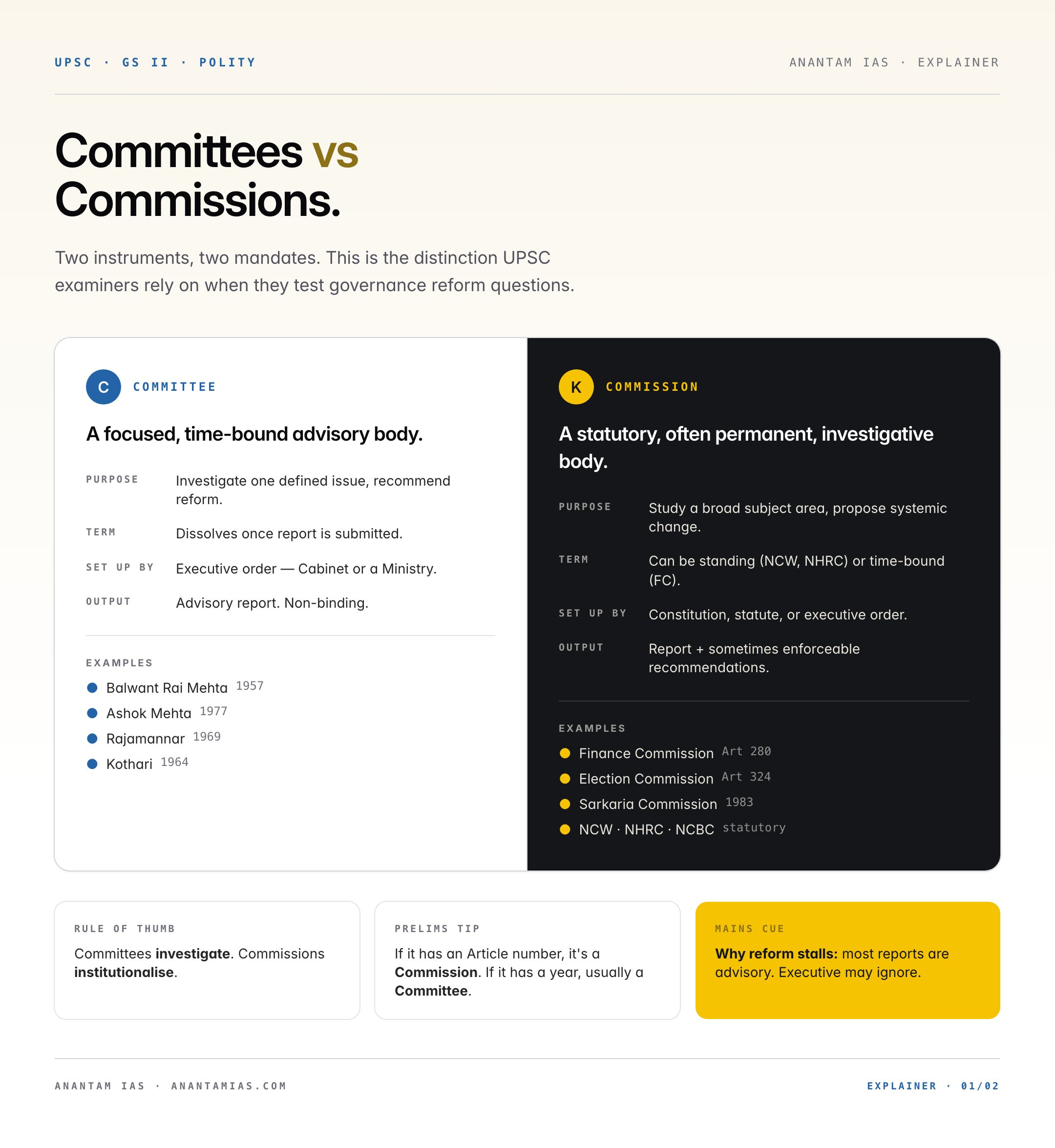
Understanding Committees vs Commissions
| Feature | Committee | Commission |
|---|---|---|
| Scope | Usually narrower, specific issue | Broader mandate, systemic review |
| Duration | Often shorter | Usually longer, multi-year |
| Authority | Advisory | Advisory, sometimes quasi-judicial |
| Examples | Ashok Mehta Committee | Sarkaria Commission |
| Legal Basis | Government resolution | Government resolution or statute |
Both are typically advisory — their recommendations aren’t binding on the government. However, influential commissions have fundamentally shaped legislation and policy.
Centre-State Relations
Sarkaria Commission (1983–1988)
| Feature | Detail |
|---|---|
| Chairman | Justice R.S. Sarkaria |
| Appointed By | Government of India (1983) |
| Subject | Centre-State Relations |
| Report Submitted | 1988 |
| Key Theme | Strengthening cooperative federalism |
Major Recommendations:
- Inter-State Council should be established under Article 263 (implemented in 1990)
- Governor should be a non-political person, eminent in public life
- Article 356 (President’s Rule) should be used sparingly, as a last resort
- Residuary powers of taxation should remain with Parliament
- All-India Services should be strengthened, not abolished
- National Development Council should be renamed and given constitutional status
- Consultation with Chief Minister before appointing the Governor
The Sarkaria Commission remains the most cited commission in UPSC questions on federalism.
Punchhi Commission (2007–2010)
| Feature | Detail |
|---|---|
| Chairman | Justice Madan Mohan Punchhi |
| Appointed By | Government of India (2007) |
| Subject | Centre-State Relations (review of Sarkaria) |
| Report Submitted | 2010 (7 volumes) |
Major Recommendations:
- Governor should be appointed from a panel prepared by a committee comprising PM, Home Minister, Lok Sabha Speaker, and concerned Chief Minister
- Governor’s tenure should be fixed at 5 years — removal only through a resolution of the state legislature
- Article 355 and 356 should be amended to limit misuse
- Inter-State Council should meet at least thrice a year
- Concurrent List should be minimized; more subjects to states
- Treaty-making power should involve states when subjects in State List are affected
- Lokayukta should be established in every state
Rajamannar Committee (1969)
| Feature | Detail |
|---|---|
| Chairman | Dr. P.V. Rajamannar |
| Appointed By | Government of Tamil Nadu |
| Subject | Centre-State Relations |
Key Recommendations:
- Finance Commission should be a permanent body
- Planning Commission should be abolished (eventually happened in 2015)
- Inter-State Council should be established
- Abolish All-India Services
- Residuary powers should go to states
Local Governance and Panchayati Raj
Balwant Rai Mehta Committee (1957)
| Feature | Detail |
|---|---|
| Chairman | Balwant Rai Mehta |
| Appointed By | Government of India |
| Subject | Community Development and National Extension Service |
Major Recommendations:
- Established the concept of democratic decentralization
- Recommended three-tier Panchayati Raj system: Gram Panchayat, Panchayat Samiti, Zila Parishad
- Panchayat Samiti should be the primary unit
- Genuine transfer of power and responsibility to local bodies
Rajasthan became the first state to implement Panchayati Raj based on these recommendations (1959), followed by Andhra Pradesh.
Ashok Mehta Committee (1977)
| Feature | Detail |
|---|---|
| Chairman | Ashok Mehta |
| Appointed By | Janata Party Government (1977) |
| Subject | Panchayati Raj Reform |
| Report | 1978 |
Major Recommendations:
- Two-tier system instead of three-tier (Zila Parishad and Mandal Panchayat)
- Zila Parishad should be the first point of decentralization
- Political parties should participate in Panchayat elections
- Compulsory taxation powers for Panchayats
- Regular elections every 5 years
- Reservation of seats for SC/ST
- Constitutional protection for Panchayati Raj institutions
Many of these recommendations were eventually incorporated in the 73rd Constitutional Amendment (1992).
GVK Rao Committee (1985)
Key Recommendations:
- District should be the basic unit of planning
- District Development Commissioner should be the chief coordinator
- Regular Panchayat elections
- Strengthened role of Zila Parishad
L.M. Singhvi Committee (1986)
Key Recommendations:
- Constitutional recognition for Panchayati Raj (eventually achieved through 73rd Amendment)
- Gram Sabha should be the base of decentralized democracy
- Nyaya Panchayats for village-level dispute resolution
- Judicial protection for Panchayat autonomy
Administrative Reforms
First Administrative Reforms Commission (1966–1970)
| Feature | Detail |
|---|---|
| Chairman | Morarji Desai (initially), K. Hanumanthaiah (later) |
| Appointed By | Government of India (1966) |
| Subject | Administrative reform across governance |
| Reports | 20 reports |
Key Recommendations:
- Establishment of Lokpal at Centre and Lokayukta in states
- Delegation of financial and administrative powers
- Reform of district administration
- Citizens’ grievance redressal mechanisms
- Personnel policy reforms
Second Administrative Reforms Commission (2005–2009)
| Feature | Detail |
|---|---|
| Chairman | Veerappa Moily |
| Appointed By | Government of India (2005) |
| Reports | 15 reports |
Key Reports and Themes:
| Report No. | Title | Key Focus |
|---|---|---|
| 1st | Right to Information | RTI implementation |
| 2nd | Unlocking Human Capital | Governance at state level |
| 4th | Ethics in Governance | Public service values, Lokpal |
| 5th | Public Order | Police reforms, internal security |
| 6th | Local Governance | Panchayati Raj strengthening |
| 7th | Capacity Building | Civil service reforms |
| 10th | Refurbishing of Personnel Administration | Recruitment, training, lateral entry |
| 13th | Organizational Structure | Government restructuring |
| 15th | State and District Administration | District governance reform |
The 4th Report (Ethics in Governance) is particularly important for GS Paper IV. The 10th Report on personnel administration is relevant for governance reform questions.
Education Commissions
Kothari Commission (1964–1966)
| Feature | Detail |
|---|---|
| Chairman | Dr. D.S. Kothari |
| Subject | Education reform |
| Key Recommendations | Common school system, 10+2+3 structure |
The Kothari Commission‘s recommendation of the 10+2+3 educational structure was adopted through the National Policy on Education (1968). It also recommended spending 6% of GDP on education — a target India still hasn’t consistently achieved.
Radhakrishnan Commission (1948)
| Feature | Detail |
|---|---|
| Chairman | Dr. S. Radhakrishnan |
| Subject | University education reform |
| Key Outcomes | Led to establishment of UGC |
Mudaliar Commission (1952)
| Feature | Detail |
|---|---|
| Chairman | Dr. A. Lakshmanaswami Mudaliar |
| Subject | Secondary education reform |

Police and Criminal Justice Reforms
Shah Commission (1977–1978)
| Feature | Detail |
|---|---|
| Chairman | Justice J.C. Shah |
| Subject | Excesses during Emergency (1975–77) |
| Key Finding | Documented widespread abuse of power during Emergency |
National Police Commission (1977–1981)
| Feature | Detail |
|---|---|
| Chairman | Dharma Vira |
| Reports | 8 reports |
| Subject | Comprehensive police reform |
Key Recommendations:
- Police should be insulated from political interference
- Establishment of State Security Commission
- Fixed tenure for police officers
- Separation of investigation and law and order functions
These recommendations were reiterated by the Supreme Court in the Prakash Singh case (2006), which directed states to implement police reforms.
Malimath Committee (2003)
| Feature | Detail |
|---|---|
| Chairman | Justice V.S. Malimath |
| Subject | Criminal justice system reform |
| Key Recommendations | Shift from adversarial to inquisitorial elements, victim compensation, witness protection |
Economic and Financial Commissions
Narasimham Committee
Narasimham Committee I (1991):
- Subject: Banking sector reforms
- Key Recommendations: Reduction of SLR and CRR, deregulation of interest rates, phased reduction of directed credit, asset classification and income recognition norms
Narasimham Committee II (1998):
- Subject: Banking sector reforms (further)
- Key Recommendations: Capital adequacy standards, merger of weak banks, stronger regulation, technology upgradation
Kelkar Committee (2002)
| Feature | Detail |
|---|---|
| Chairman | Vijay Kelkar |
| Subject | Tax reform |
| Key Recommendations | Simplified direct tax, broader tax base, phased GST introduction |
Raja Chelliah Committee (1991)
| Feature | Detail |
|---|---|
| Chairman | Raja J. Chelliah |
| Subject | Tax reforms |
| Key Recommendations | Reduction in tax rates, broader tax base, rationalization of customs and excise |
Social Justice Commissions
Mandal Commission (1979–1980)
| Feature | Detail |
|---|---|
| Chairman | B.P. Mandal |
| Subject | Socially and educationally backward classes |
| Key Recommendation | 27% reservation for OBCs in government jobs and educational institutions |
The Mandal Commission‘s recommendations were implemented in 1990 by the V.P. Singh government, triggering massive political and social upheaval. The Supreme Court upheld the reservations in the Indra Sawhney case (1992) with a 50% cap on total reservations.
Kalelkar Commission (1953–1955)
| Feature | Detail |
|---|---|
| Chairman | Kaka Kalelkar |
| Subject | First Backward Classes Commission |
| Outcome | Recommendations not accepted by government |
Quick Reference: Commission-Topic Mapping
| Topic | Key Commission(s) |
|---|---|
| Centre-State Relations | Sarkaria, Punchhi, Rajamannar |
| Panchayati Raj | Balwant Rai Mehta, Ashok Mehta, L.M. Singhvi |
| Administrative Reform | 1st ARC, 2nd ARC |
| Police Reform | National Police Commission, Prakash Singh (SC) |
| Banking Reform | Narasimham I & II |
| Tax Reform | Kelkar, Raja Chelliah |
| Education | Kothari, Radhakrishnan, Mudaliar |
| OBC Reservation | Mandal Commission |
| Emergency | Shah Commission |
| Criminal Justice | Malimath Committee |
Frequently Asked Questions
What is the difference between the Sarkaria and Punchhi Commissions?
Both examined Centre-State relations. The Sarkaria Commission (1983–88) was the first comprehensive review, recommending cooperative federalism and establishing the Inter-State Council. The Punchhi Commission (2007–10) reviewed Sarkaria’s recommendations and addressed new challenges like globalization, coalition politics, and governance reforms. Punchhi went further on Governor’s role reform.
Which committee recommended the three-tier Panchayati Raj system?
The Balwant Rai Mehta Committee (1957) first recommended the three-tier Panchayati Raj system consisting of Gram Panchayat, Panchayat Samiti, and Zila Parishad. The Ashok Mehta Committee later recommended a two-tier system. The 73rd Constitutional Amendment (1992) ultimately adopted the three-tier model.
How many reports did the Second ARC submit?
The Second Administrative Reforms Commission submitted 15 reports between 2006 and 2009, covering topics ranging from Right to Information and ethics in governance to local governance, public order, and personnel administration. The 4th Report on Ethics in Governance is especially important for UPSC GS Paper IV.
What did the Mandal Commission recommend?
The Mandal Commission recommended 27% reservation for Other Backward Classes (OBCs) in central government jobs and educational institutions. It identified 3,743 castes as socially and educationally backward. The recommendations were implemented in 1990 and upheld by the Supreme Court in the Indra Sawhney case (1992).
Why are committee recommendations important for UPSC?
Committees and commissions provide the intellectual framework behind India’s governance reforms. UPSC tests these in Prelims (factual questions about chairpersons and recommendations) and Mains (analytical questions on governance reform, federalism, and institutional design). Understanding committee recommendations helps frame policy-oriented Mains answers.