Important Treaties of India: Comprehensive List with Years and Provisions
Important treaties of India explained for UPSC: Indus Waters Treaty 1960, Tashkent 1966, Simla 1972, Mahakali 1996, BBIN 2015, LBA 2015, and more, with years, parties, and key provisions.
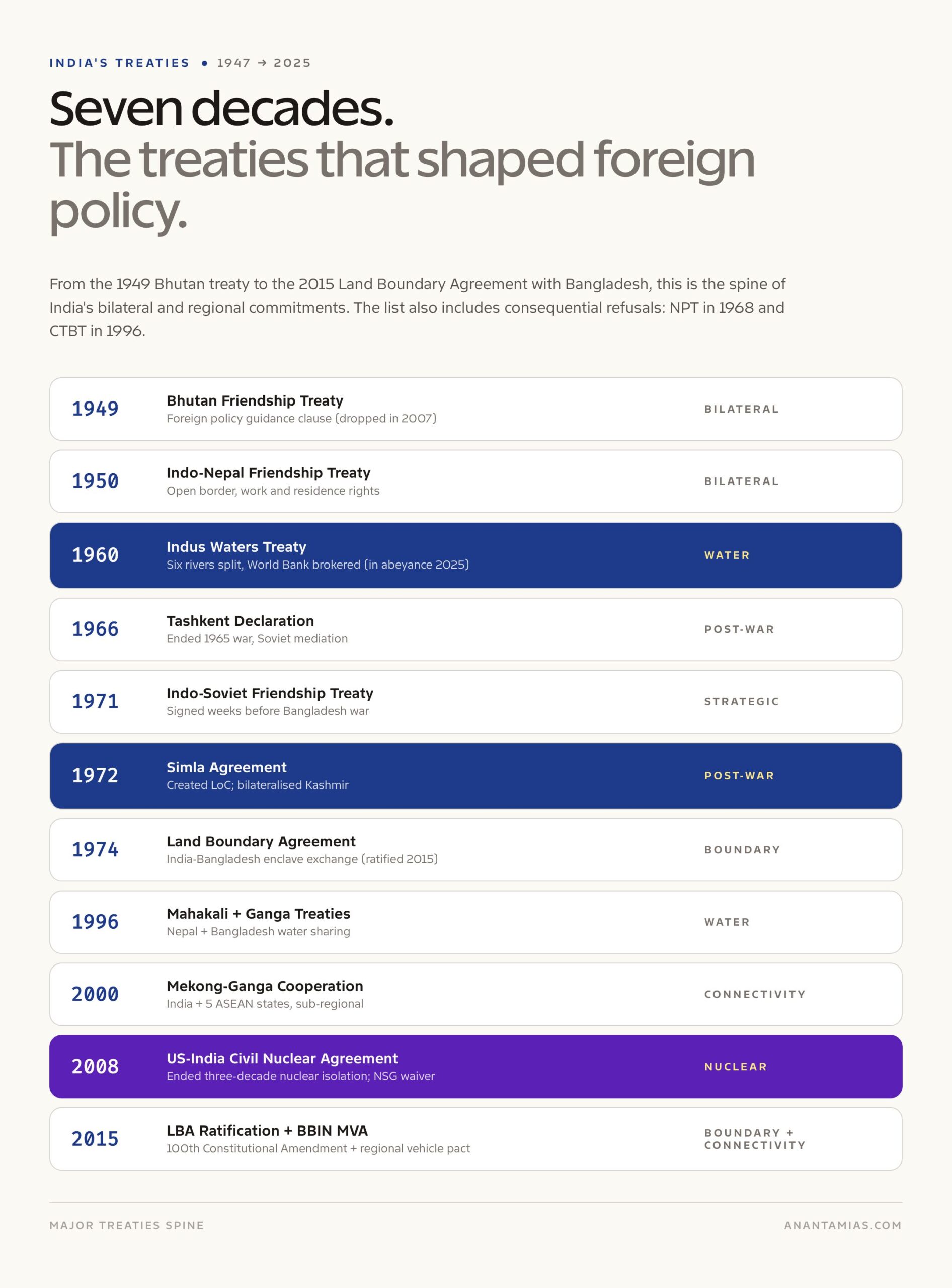
Important treaties of India form a continuous record of how the republic has managed its borders, its rivers, its security, and its economic openness since 1947. From the Indus Waters Treaty signed with Pakistan in 1960 to the Land Boundary Agreement ratified with Bangladesh in 2015, these documents reveal both the pressures and the choices that have defined India’s external relations.
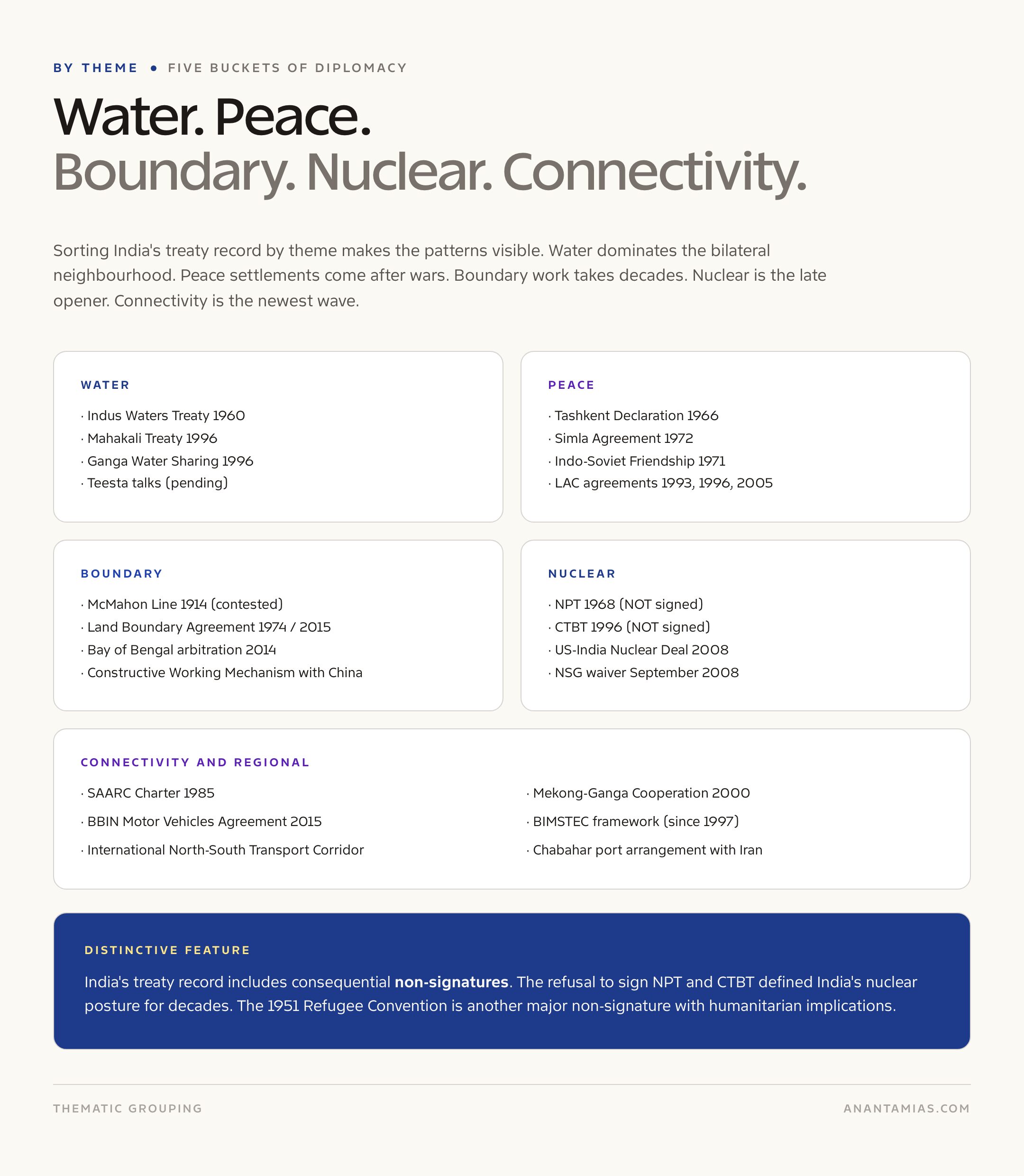
This list goes beyond the headline names. India is also a non-signatory to two of the most consequential treaties of the late 20th century: the Nuclear Non-Proliferation Treaty (NPT) and the Comprehensive Nuclear Test Ban Treaty (CTBT). Those refusals are themselves treaty-shaped decisions and have to be understood alongside the agreements India did sign. The result is a body of bilateral, regional, and multilateral commitments that map neatly onto UPSC GS-II syllabus on bilateral, regional, and global groupings.
This explainer walks through the important treaties of India in roughly chronological order, with the year, the parties, the key provisions, and the contemporary status. We’ll then cover the major treaties India has chosen not to sign, the role of India’s foreign policy doctrine in shaping these decisions, and the prelim and mains angles UPSC has favoured.
Quick Facts on India’s Treaty Record
- First major post-independence treaty. Treaty of Peace and Friendship with Bhutan, 1949 (amended 2007).
- Oldest active water treaty. Indus Waters Treaty 1960 with Pakistan, brokered by the World Bank.
- Most contested treaty. Simla Agreement 1972 with Pakistan, signed after the Bangladesh Liberation War.
- Largest land swap. Land Boundary Agreement with Bangladesh ratified in 2015.
- Nuclear non-signatures. Non-signatory to NPT (1968) and CTBT (1996).
- Civil nuclear opening. US-India Civil Nuclear Agreement signed 2008; NSG waiver same year.
- Recent regional treaty. BBIN Motor Vehicles Agreement 2015 (India, Bhutan, Bangladesh, Nepal).
- Border framework. McMahon Line under the Simla Convention 1914, contested by China.
The Foundational Treaties: 1947 to 1960
The first decade after independence saw India sign several foundational instruments that still shape its neighbourhood policy.
Treaty of Peace and Friendship with Bhutan, 1949 (amended 2007)
The 1949 treaty placed Bhutan’s external relations under Indian guidance and granted Bhutan free trade and transit through Indian territory. It was a sensitive arrangement because it limited Bhutanese sovereignty in foreign policy.
The treaty was substantially amended in February 2007. The new version dropped the clause that required Bhutan to be “guided by” India on foreign policy. The 2007 amendment recognised Bhutan as a fully sovereign state in its external affairs, removed the requirement for arms imports to come through India, and rebuilt the relationship on a partnership basis. The free trade and transit provisions were retained.
Indo-Nepal Treaty of Peace and Friendship, 1950
The 1950 treaty established a special relationship between India and Nepal. It allows Nepali citizens to live and work in India and Indians to do the same in Nepal under the open border arrangement. The treaty has been repeatedly reviewed but never formally renegotiated, despite Nepali demands for revision dating back to the 1990s.
Treaty of Peace and Friendship with Sikkim, 1950
Sikkim was a protectorate after 1950 under this treaty, with India responsible for defence, external affairs, and communications. Sikkim merged into India in 1975 as the 22nd state after a referendum.
Indus Waters Treaty, 1960
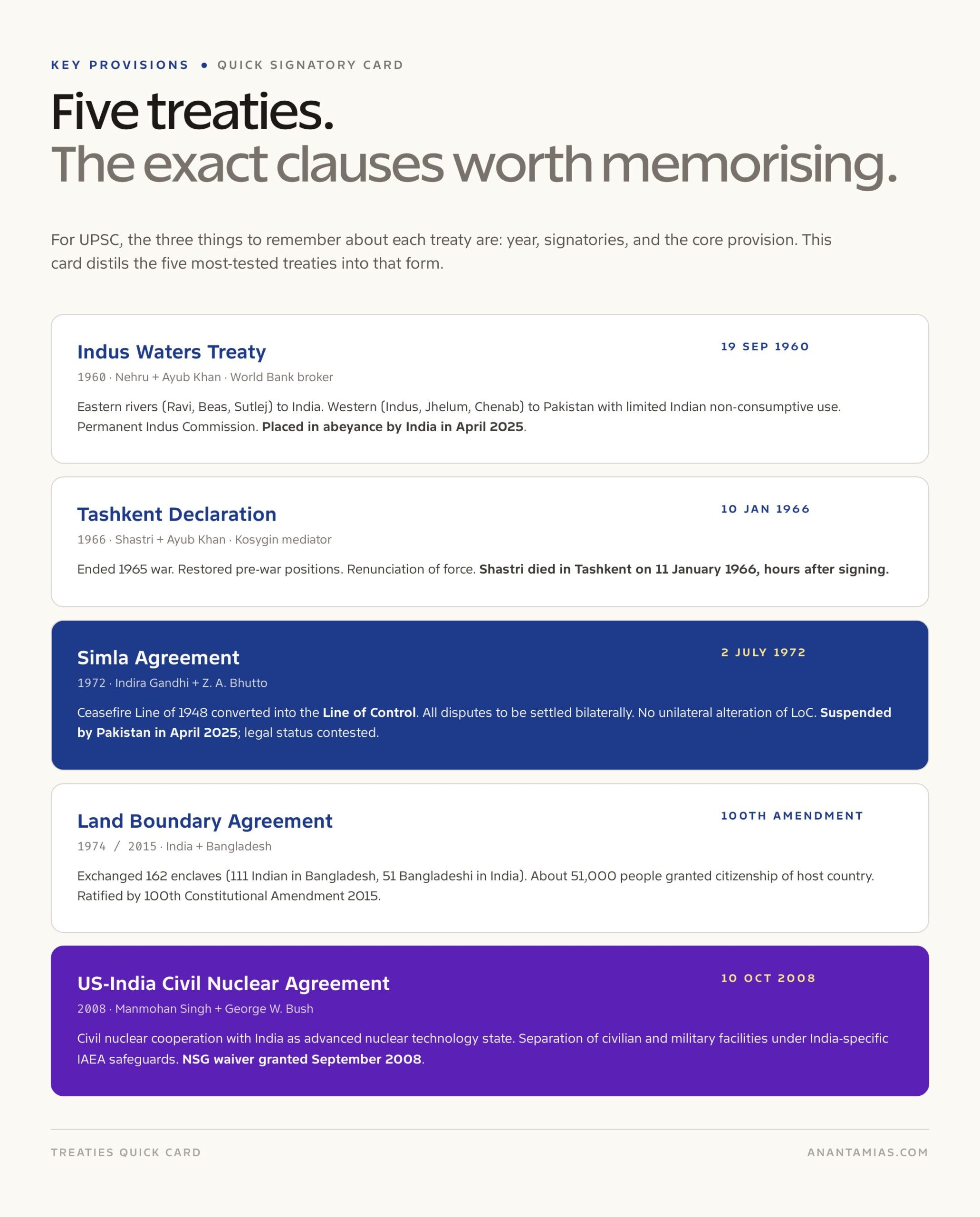
The Indus Waters Treaty is the single most studied bilateral instrument in India’s record. Signed on 19 September 1960 in Karachi by Prime Minister Jawaharlal Nehru and President Ayub Khan, with the World Bank as broker and guarantor, the treaty divides the six rivers of the Indus system between India and Pakistan.
Key provisions:
- Three eastern rivers (Ravi, Beas, Sutlej) allocated to India for unrestricted use.
- Three western rivers (Indus, Jhelum, Chenab) allocated to Pakistan, with India permitted limited non-consumptive use for hydropower, navigation, and a fixed quota for irrigation.
- A Permanent Indus Commission with one commissioner from each side.
- Dispute resolution mechanism with neutral experts and the Court of Arbitration.
The treaty has survived three Indo-Pak wars (1965, 1971, 1999) and ongoing tensions. India formally placed the treaty in abeyance in April 2025 following the Pahalgam terror attack, marking the first time New Delhi has suspended its operation since 1960. The legal and operational implications of the abeyance are still being worked out.
The Post-War Settlements: Tashkent and Simla
Two treaties define India’s diplomatic settlements after wars with Pakistan.
Tashkent Declaration, 1966
The Tashkent Declaration was signed on 10 January 1966 by Prime Minister Lal Bahadur Shastri and President Ayub Khan, with Soviet Premier Alexei Kosygin as mediator. It formally ended the 1965 Indo-Pakistan War.
Key provisions:
- Restoration of pre-war positions; troops to withdraw to lines held before 5 August 1965.
- Renunciation of force as a means of settling disputes.
- Restoration of diplomatic relations.
- Repatriation of prisoners of war.
Shastri died of a heart attack in Tashkent on 11 January 1966, hours after signing the declaration. The Tashkent settlement was viewed in India as restorative rather than punitive, and Shastri faced criticism for returning the strategic Haji Pir Pass that Indian forces had captured during the war.
Simla Agreement, 1972
The Simla Agreement was signed on 2 July 1972 by Prime Minister Indira Gandhi and President Zulfikar Ali Bhutto. It followed India’s decisive victory in the 1971 Bangladesh Liberation War.
Key provisions:
- Both governments to settle their disputes bilaterally through peaceful means.
- Establishment of a Line of Control (LoC) in Jammu and Kashmir, replacing the earlier Ceasefire Line of 1948.
- Mutual commitment to not alter the LoC unilaterally.
- Withdrawal of forces to international borders.
- Pakistan implicitly accepted bilateralism as the framework for Kashmir.
The Simla Agreement is significant because it bilateralised the Kashmir question and ruled out third party mediation. Pakistan announced its suspension of the agreement in April 2025 in response to India’s Indus Waters Treaty abeyance, but the legal status of that suspension is contested.
Border and Boundary Treaties
Sino-Indian Boundary: The McMahon Line, 1914
The McMahon Line was drawn at the Simla Convention 1913 to 1914 between British India and Tibet, with China’s representative present but refusing to sign the final document. The line runs along the watershed in the Eastern Himalayas and forms the basis of India’s claim on the eastern sector of the boundary with China.
China does not recognise the McMahon Line as a legal boundary. The 1962 Sino-Indian War was partly fought over this disputed eastern sector, and the line remains the de facto Line of Actual Control (LAC) in Arunachal Pradesh. India and China have signed several agreements to maintain peace along the LAC (1993, 1996, 2005, 2013) but no formal boundary settlement.
Land Boundary Agreement (LBA) with Bangladesh, 1974 (ratified 2015)
The Land Boundary Agreement was signed in 1974 between Prime Minister Indira Gandhi and Sheikh Mujibur Rahman to resolve boundary disputes and exchange enclaves between India and Bangladesh. The agreement included the demarcation of about 6.1 kilometres of undemarcated land border and the exchange of 162 enclaves: 111 Indian enclaves in Bangladesh and 51 Bangladeshi enclaves in India.
India did not ratify the agreement for decades due to constitutional concerns about altering the country’s territory. The 100th Constitutional Amendment Act of 2015 finally ratified the LBA. On 1 August 2015, the enclave exchange took place, ending the world’s largest enclave complex. About 14,000 Indian enclave residents and 37,000 Bangladeshi enclave residents got citizenship of their host country.
The 2015 ratification is one of the most significant achievements in India-Bangladesh relations.
Mahakali Treaty with Nepal, 1996
The Treaty between His Majesty’s Government of Nepal and the Government of India Concerning the Integrated Development of the Mahakali River was signed on 12 February 1996. It covers the Sarada Barrage, the Tanakpur Barrage, and the proposed Pancheshwar Multipurpose Project on the Mahakali river.
The Pancheshwar Project, a major hydroelectric and irrigation scheme, has not materialised in three decades despite the treaty. The Detailed Project Report has been pending Nepali approval since 2017. The treaty remains a useful framework even where implementation has lagged.
Regional and Connectivity Treaties
Ganga Water Sharing Treaty with Bangladesh, 1996
Signed in December 1996 by Prime Minister H. D. Deve Gowda and Sheikh Hasina, this 30-year treaty governs the sharing of Ganga waters at the Farakka Barrage during the dry season (1 January to 31 May). The treaty was a major breakthrough after decades of dispute and is due for renewal in 2026.
Mekong-Ganga Cooperation, 2000
Launched on 10 November 2000 in Vientiane, Laos, the Mekong-Ganga Cooperation (MGC) is a sub-regional initiative between India and five Southeast Asian countries: Cambodia, Laos, Myanmar, Thailand, and Vietnam. It focuses on tourism, culture, education, and transport linkages between the Ganga and Mekong basins.
The MGC sits alongside the BIMSTEC framework as a vehicle for India’s Act East policy engagement with mainland Southeast Asia.
BBIN Motor Vehicles Agreement, 2015
The Bangladesh-Bhutan-India-Nepal Motor Vehicles Agreement (MVA) was signed on 15 June 2015 in Thimphu. It allows the seamless movement of passenger, personal, and cargo vehicles among the four countries.
Bhutan has not ratified the agreement due to environmental and social concerns. The remaining three countries (India, Bangladesh, Nepal) have operationalised the framework on a trilateral basis. The BBIN initiative is one of the few regional connectivity instruments that has survived the freeze in SAARC.
Defence and Nuclear Treaties
India-USA Civil Nuclear Agreement, 2008
The 123 Agreement was signed on 10 October 2008 between India and the United States, ending three decades of nuclear isolation. The agreement was the culmination of negotiations that began in 2005 during PM Manmohan Singh and President George W. Bush’s joint statement.
Key provisions:
- US recognition of India as a state with advanced nuclear technology.
- Civil nuclear cooperation including reactor sales, fuel supply, and technology transfer.
- Separation of India’s civilian and military nuclear facilities under an India-specific IAEA safeguards arrangement.
- The Nuclear Suppliers Group (NSG) granted India a clean waiver in September 2008 to allow nuclear trade.
The agreement opened the door for India to import nuclear fuel and reactors from the US, France, Russia, and others. Implementation has been slow due to the Civil Liability for Nuclear Damage Act 2010, which has deterred suppliers concerned about supplier liability. Still, the 2008 deal remains one of the most consequential agreements in modern Indian diplomacy.
India-Russia Bilateral Agreements
India and Russia have layered their relationship through a Treaty of Peace, Friendship and Cooperation (1971), a Declaration on Strategic Partnership (2000), and the Annual Summit format since 2000. The 1971 treaty, signed by Indira Gandhi and Soviet leadership weeks before the Bangladesh war, contained mutual consultation clauses on security threats, though not a formal mutual defence pact.
The strategic partnership has anchored long-running cooperation in defence (Su-30MKI, T-90 tanks, BrahMos, S-400), nuclear energy (Kudankulam), and space (ISRO-Roscosmos joint projects). Recent layers include the 2014 Druzhba-Dosti vision and the 2024 strategic partnership document.
Treaties India Has Chosen Not to Sign
India’s treaty record also includes consequential refusals. These are part of the same diplomatic ledger.
Nuclear Non-Proliferation Treaty (NPT), 1968
India refused to sign the NPT on the grounds that it created an unequal system of nuclear haves and have-nots. The treaty recognises five Nuclear Weapon States (those that tested before 1 January 1967): USA, USSR, UK, France, China. All other signatories were required to commit to non-proliferation without acquiring nuclear weapons.
India’s view, articulated by Defence Minister Krishna Menon at the negotiations, was that the NPT was discriminatory and did not impose serious disarmament obligations on the five recognised nuclear powers. India’s first nuclear test in 1974 (Smiling Buddha) and the 1998 Pokhran-II tests reinforced this posture. India remains a non-signatory.
Comprehensive Nuclear Test Ban Treaty (CTBT), 1996
India also refused to sign the CTBT, which was opened for signature on 24 September 1996. India’s objection was that the treaty would lock in the asymmetry between weapon and non-weapon states by banning further tests without binding the five nuclear weapon states to a time-bound disarmament schedule.
Following the 1998 nuclear tests, India announced a unilateral moratorium on further nuclear testing, which it has maintained. India also remains outside the Nuclear Suppliers Group as a non-member but enjoys an NSG waiver since 2008.
UN Convention on the Law of the Sea (UNCLOS), 1982
India did sign and ratify UNCLOS in 1995. The treaty governs maritime zones, exclusive economic zones, and the international seabed area. India’s UNCLOS commitment shapes its positions on the Indian Ocean, the Bay of Bengal maritime boundary with Bangladesh (settled by arbitration in 2014), and recent maritime disputes in the South China Sea where India has supported freedom of navigation.
Refugee Convention, 1951
India is not a signatory to the 1951 UN Refugee Convention or its 1967 Protocol. India has nonetheless hosted millions of refugees from Tibet, East Pakistan (1971), Sri Lanka, Afghanistan, and Myanmar. The absence of a domestic refugee law and the non-signature of the Refugee Convention have led to ad hoc treatment of different refugee groups.
A Timeline of Important Treaties of India
A condensed timeline helps the year-and-name memory work that UPSC prelims often tests.
| Year | Treaty | Parties | Theme |
|---|---|---|---|
| 1949 | Treaty of Peace and Friendship | India, Bhutan | Bilateral framework |
| 1950 | Treaty of Peace and Friendship | India, Nepal | Bilateral framework |
| 1950 | Treaty of Peace and Friendship | India, Sikkim | Protectorate |
| 1960 | Indus Waters Treaty | India, Pakistan | Water sharing |
| 1966 | Tashkent Declaration | India, Pakistan | Post-war settlement |
| 1971 | Treaty of Peace, Friendship and Cooperation | India, USSR | Strategic |
| 1972 | Simla Agreement | India, Pakistan | Post-war settlement |
| 1974 | Land Boundary Agreement | India, Bangladesh | Boundary (ratified 2015) |
| 1985 | SAARC Charter | South Asian states | Regional cooperation |
| 1995 | UNCLOS ratification | Multilateral | Law of the sea |
| 1996 | Mahakali Treaty | India, Nepal | Water sharing |
| 1996 | Ganga Water Sharing | India, Bangladesh | Water sharing |
| 2000 | Mekong-Ganga Cooperation | India + 5 ASEAN | Connectivity |
| 2007 | Amended Friendship Treaty | India, Bhutan | Sovereign reset |
| 2008 | Civil Nuclear Agreement | India, USA | Nuclear |
| 2015 | LBA Ratification | India, Bangladesh | Boundary |
| 2015 | BBIN MVA | India, Bangladesh, Bhutan, Nepal | Connectivity |
How India Negotiates Treaties
India’s treaty-making practice follows a few consistent patterns. The Ministry of External Affairs typically leads negotiation in coordination with the relevant line ministries (Water Resources for river treaties, Defence for nuclear and military treaties, Commerce for trade agreements). The Union Cabinet approves major treaties. Some treaties, like those altering territory, require constitutional amendments, as the LBA did.
Implementation often runs through specialist joint mechanisms: the Permanent Indus Commission for the Indus treaty, the Joint Rivers Commission for India-Bangladesh, the Working Mechanism for Consultation and Coordination on India-China Border Affairs for the LAC.
India is not a member of the Vienna Convention on the Law of Treaties (1969) as a signatory. India follows the customary international law principles on treaty interpretation and execution.
Prelims and Mains Pointers for UPSC
For Prelims:
- Indus Waters Treaty signed in 1960; three eastern rivers to India, three western to Pakistan.
- Tashkent Declaration 1966 ended the 1965 war; Simla Agreement 1972 followed the 1971 war.
- LBA with Bangladesh ratified by the 100th Constitutional Amendment in 2015.
- India is not a signatory to the NPT (1968) or CTBT (1996).
- US-India Civil Nuclear Agreement signed 2008; NSG waiver same year.
- BBIN MVA signed 2015; Bhutan has not ratified.
For Mains:
- Examine the relevance of the Indus Waters Treaty in light of India’s 2025 decision to place it in abeyance.
- Discuss the significance of the Simla Agreement in shaping India-Pakistan diplomatic engagement.
- Analyse why India remains a non-signatory to the NPT and CTBT and how it has nonetheless secured access to civil nuclear cooperation.
- Evaluate the role of the 2015 Land Boundary Agreement in deepening India-Bangladesh relations.
Conclusion
The important treaties of India read as a continuous diplomatic record: foundation-building with Bhutan, Nepal, and Sikkim in the 1950s; war-and-water arrangements with Pakistan from 1960 to 1972; boundary resolution with Bangladesh in 1974 and 2015; nuclear opening with the US in 2008; and regional connectivity through BBIN, MGC, and BIMSTEC since the 2000s. The refusals, NPT and CTBT, are as important as the signatures.
For UPSC, the key habit is to remember treaties as a triad: year, parties, key provision. The Indus Waters Treaty, Simla Agreement, Tashkent Declaration, Mahakali Treaty, Ganga Water Sharing, LBA, Nuclear Deal, BBIN MVA, NPT non-signature, and CTBT non-signature cover most of what prelims and mains have asked over the past decade. Treat this list as the spine and add depth from current developments like the 2025 Indus Waters Treaty abeyance.
Frequently Asked Questions
What are the most important treaties of India?
The most important treaties of India include the Indus Waters Treaty 1960 with Pakistan, the Tashkent Declaration 1966, the Simla Agreement 1972, the Mahakali Treaty 1996 with Nepal, the Ganga Water Sharing Treaty 1996 with Bangladesh, the Land Boundary Agreement (ratified 2015), and the US-India Civil Nuclear Agreement 2008.
Why did India not sign the NPT?
India refused to sign the Nuclear Non-Proliferation Treaty (NPT) on the grounds that it was discriminatory. The treaty recognises only five states (USA, USSR, UK, France, China) as Nuclear Weapon States and binds all others to non-acquisition without imposing time-bound disarmament obligations on the five. India tested in 1974 and 1998 and remains outside the NPT.
What was the Tashkent Declaration?
The Tashkent Declaration was signed on 10 January 1966 by PM Lal Bahadur Shastri and President Ayub Khan with Soviet Premier Kosygin mediating. It ended the 1965 Indo-Pakistan War, restored pre-war positions, and committed both sides to peaceful settlement of disputes. Shastri died in Tashkent the next day.
What is the Simla Agreement?
The Simla Agreement was signed on 2 July 1972 by PM Indira Gandhi and Pakistan President Zulfikar Ali Bhutto after the 1971 Bangladesh War. It converted the Kashmir ceasefire line into the Line of Control and committed both countries to bilateral settlement of disputes.
When was the Indus Waters Treaty signed?
The Indus Waters Treaty was signed on 19 September 1960 in Karachi by PM Jawaharlal Nehru and President Ayub Khan, with the World Bank as broker. It divided the six Indus rivers between India and Pakistan. India placed the treaty in abeyance in April 2025 after the Pahalgam terror attack.
What is the Land Boundary Agreement with Bangladesh?
The Land Boundary Agreement (LBA) was signed in 1974 between Indira Gandhi and Sheikh Mujibur Rahman to resolve boundary disputes and exchange enclaves. India ratified it through the 100th Constitutional Amendment in 2015, exchanging 162 enclaves and granting citizenship to about 51,000 residents.
Has India signed the CTBT?
No. India has not signed the Comprehensive Nuclear Test Ban Treaty (CTBT), which opened for signature in 1996. India maintains a unilateral moratorium on nuclear testing since 1998 but has not joined the formal CTBT regime.