India’s Dugong Conservation Reserve Recognized by IUCN: Palk Bay, Seagrass, and the Sea Cow
A complete UPSC GS-III guide to India's Dugong Conservation Reserve in Palk Bay, recognised by the IUCN. Covers dugong biology, seagrass meadows, Schedule I protection under the Wildlife Protection Act, and the timeline from 1972 to 2025.
The IUCN’s recognition of India’s Dugong Conservation Reserve, the country’s first protected area dedicated to a single marine mammal, places Palk Bay on the global map of meaningful conservation success stories. Spread across more than 12,250 hectares of seagrass meadows off the Tamil Nadu coast, the reserve protects one of the last viable dugong populations in South Asia and the seagrass beds that the species depends on for survival. The international recognition is not symbolic. It opens up funding, technical support, and a research network that India’s domestic conservation framework alone could not have offered.
For a UPSC aspirant, the Dugong Conservation Reserve sits at the intersection of three syllabus threads: marine biodiversity, the framework of environmental laws in India, and the multilateral architecture of conservation through bodies like the IUCN. The reserve is also a quiet rebuttal to the assumption that India’s wildlife policy is overwhelmingly land-based and forest-centred.
Quick Facts on the Dugong Conservation Reserve
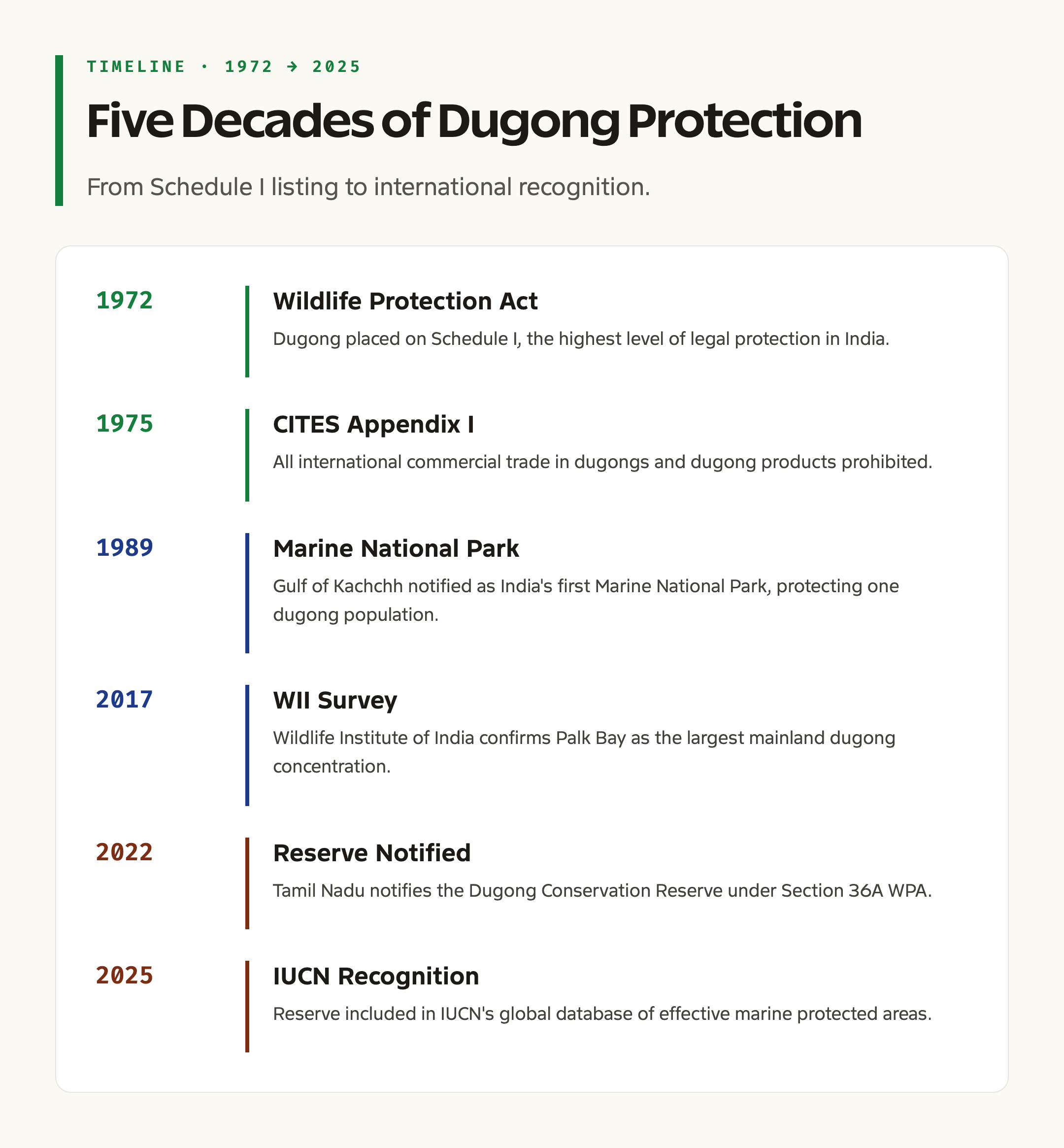
The Dugong Conservation Reserve is located in Palk Bay along the northeast coast of Tamil Nadu, between Adirampattinam and Amapattinam. It covers 448.34 square kilometres of shallow coastal waters, of which more than 12,250 hectares are seagrass meadows. The reserve was notified by the Government of Tamil Nadu in September 2022 under Section 36A of the Wildlife Protection Act, 1972, which empowers state governments to declare community reserves and conservation reserves outside the strict protected area network.
The IUCN, the International Union for Conservation of Nature, formally recognised the reserve in 2025 by including it in its global database of effective marine protected areas. This recognition does not change the legal status of the reserve under Indian law but adds international visibility and access to peer networks.
What the Reserve Protects
Background and Historical Context
The dugong, scientifically known as Dugong dugon, has been part of the South Indian coastal landscape for millennia. The species name in English derives from the Malay word duyung, meaning lady of the sea, and the animal also gives India one of its more enduring marine folktales: the mermaid sightings in colonial-era logs of British and Portuguese ships off the Coromandel and Malabar coasts were almost certainly dugongs feeding in shallow water.
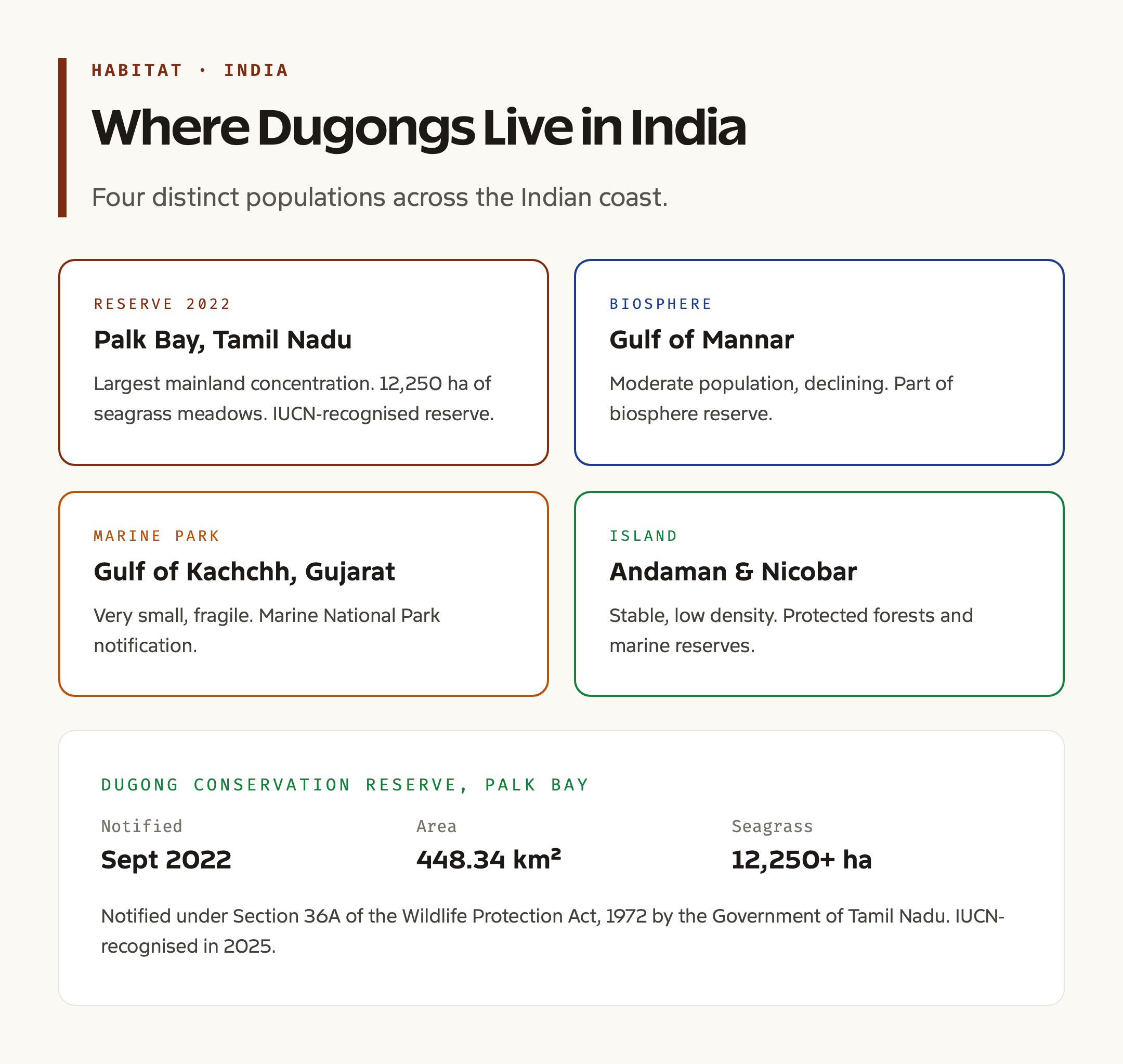
By the late twentieth century the population had collapsed. Traditional fisheries that had once tolerated occasional dugong bycatch turned aggressive as gill nets and trawlers replaced traditional gear. Boat strikes, oil spills, and the destruction of seagrass meadows by bottom trawling and coastal pollution drove the species to local extinction across much of its former range. By the 2000s, India retained dugongs only in four pockets: Palk Bay, the Gulf of Mannar, the Gulf of Kachchh in Gujarat, and the waters around the Andaman and Nicobar Islands. The Andaman population is the most stable. The Kachchh population is the most fragile. Palk Bay is the largest single concentration on the mainland.
The Dugong Conservation Reserve was the policy response. After more than a decade of advocacy by the Wildlife Institute of India, the Zoological Survey of India, and Tamil Nadu’s State Forest Department, the reserve was notified in 2022. The IUCN recognition in 2025 closed the international loop. Read this against the broader picture of biodiversity conservation in India and the country’s network of coastal regulation zones to see how marine and terrestrial frameworks now interlock.
Key Provisions and Reserve Design
The reserve is governed by Section 36A of the Wildlife Protection Act, which allows for a less strict regime than national parks or wildlife sanctuaries while still imposing meaningful restrictions on extractive activity. Within the reserve, bottom trawling is prohibited, gill net mesh sizes are regulated, and any new development that affects seagrass habitat requires clearance from the State Forest Department. Traditional fishing using sustainable gear continues, recognising the rights and livelihoods of coastal communities.
A management plan prepared by the Wildlife Institute of India identifies three core zones for strict protection, four buffer zones for regulated traditional use, and a peripheral zone for community-led monitoring. Local fisher cooperatives are formally involved in patrolling, mortality reporting, and seagrass restoration. This community model is closer in spirit to the Forest Rights Act framework on land than to the older fortress conservation model of national parks.
Why the Reserve Matters
The reserve matters first for the dugong itself. India holds one of only three significant dugong populations in the South Asia and Indo-Pacific region west of Indonesia, the others being in the Persian Gulf and along the East African coast. Losing the Indian population would create a permanent biogeographic gap.
It matters second for seagrass. The 12,250 hectares of seagrass meadow inside the reserve are not just dugong food. Seagrass is one of the most efficient blue carbon sinks on the planet, sequestering carbon at rates many times higher than tropical rainforests on a per-hectare basis. The reserve thus doubles as a marine climate action measure, even though it was designed for a single species.
It matters third for the recognition principle. Including the reserve in the IUCN list of effective marine protected areas is the kind of international validation that the Indian conservation establishment has not always cultivated. It opens up funding, peer review, and a steady flow of technical assistance.
Detailed Analysis: The Dugong Itself
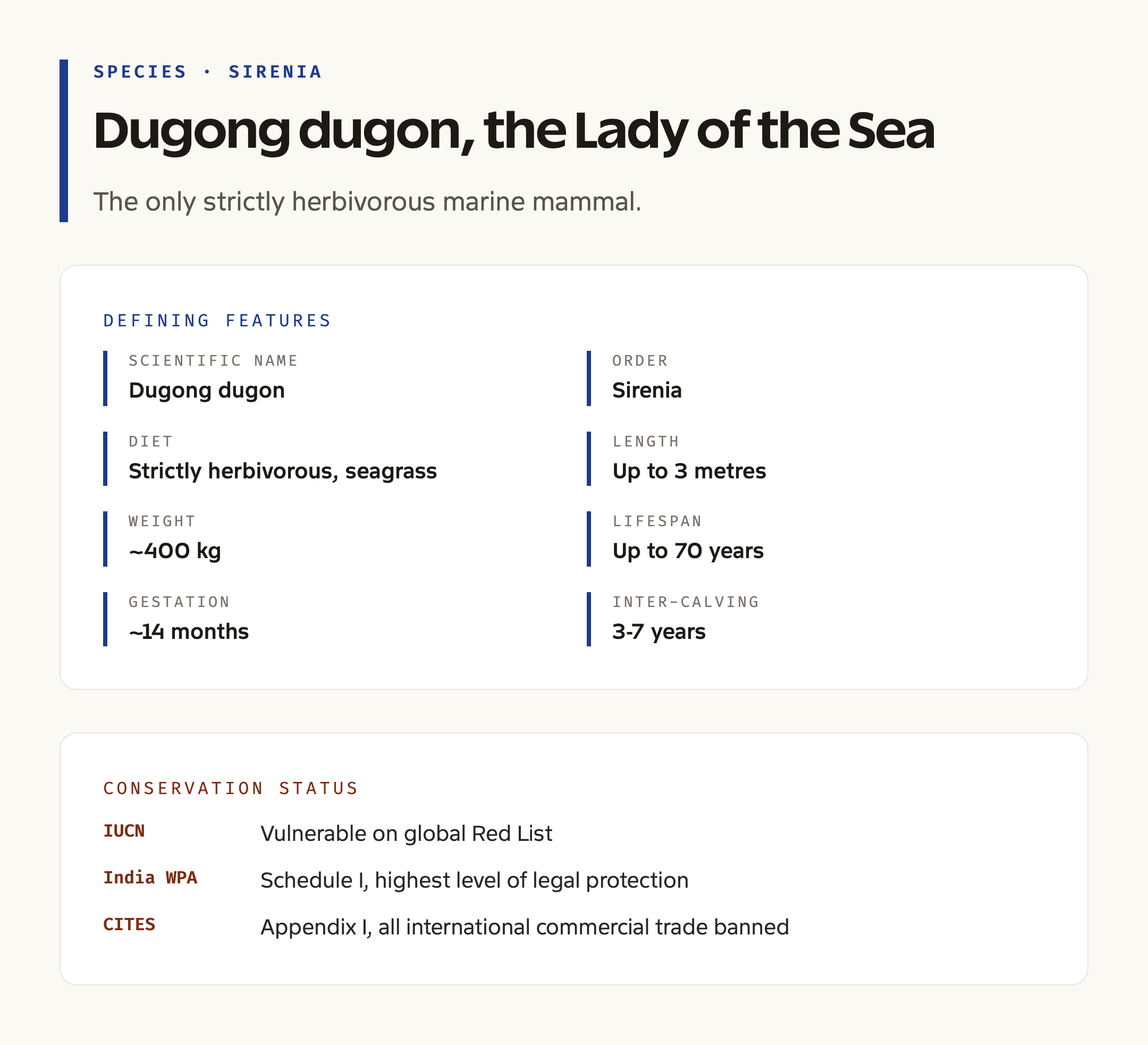
The dugong is a strictly herbivorous marine mammal, the only one of its kind. Manatees, its cousins in the order Sirenia, eat freshwater plants. Dugongs feed almost exclusively on seagrass and have a uniquely downturned snout adapted for grazing the seabed. They reach lengths of three metres and weights of around 400 kilograms. Females give birth to a single calf after a gestation of around fourteen months and the calf may stay with the mother for up to two years. Lifespan in the wild can reach 70 years.
Dugongs are slow-moving, shy, and largely solitary, although they sometimes form loose herds of up to 200 individuals where seagrass is abundant. They communicate through low-frequency chirps and barks. They surface to breathe every few minutes and travel along well-established underwater paths between feeding grounds. The combination of slow reproduction and predictable movement makes them especially vulnerable to bycatch and boat strikes.
In conservation status, the dugong is listed as Vulnerable on the IUCN Red List globally. In India, the species is on Schedule I of the Wildlife Protection Act, which provides the highest level of protection and prohibits any hunting, capture, or trade. The species is also listed under Appendix I of CITES, banning all international commercial trade.
Comparative Look: India’s Major Dugong Habitats
| Habitat | Approximate Population | Status | Key Threats |
|---|---|---|---|
| Palk Bay (Tamil Nadu) | Largest mainland concentration | Protected (Reserve, 2022) | Trawling, gill nets, boat strikes |
| Gulf of Mannar | Moderate, declining | Biosphere Reserve | Coastal pollution, illegal fishing |
| Gulf of Kachchh (Gujarat) | Very small, fragile | Marine National Park | Industrial pollution, oil tankers |
| Andaman & Nicobar | Stable, low density | Protected forests, marine reserves | Habitat fragmentation, boat strikes |
This is also where the dugong story connects to other marine and coastal frameworks: the Mangrove ecosystem that cushions the Sundarbans, the marine pollution controls under MARPOL, and the wider Wildlife Protection Act, 1972 framework that gives the species its legal teeth.
Challenges in Reserve Management
The first challenge is enforcement on the water. A 448 square kilometre reserve cannot be patrolled the way a forest beat can. Tamil Nadu Forest Department has limited marine patrol capacity and depends heavily on fisher cooperatives for compliance. The second is cross-border drift. Dugongs move freely between Indian and Sri Lankan waters in the Palk Strait, and protection on one side without coordination on the other yields limited results.
A third challenge is climate. Seagrass meadows are sensitive to sea surface temperature, sediment runoff, and ocean acidification. Even with perfect enforcement of the reserve, climate stress on the meadows could undermine the food base. The fourth is sand mining and illegal trawling along the Tamil Nadu coast, both of which damage seagrass directly and indirectly through sediment plumes.
Prelims Pointers
The Dugong Conservation Reserve is in Palk Bay, Tamil Nadu, notified in 2022 under Section 36A of the Wildlife Protection Act, 1972. It covers 448.34 square kilometres including more than 12,250 hectares of seagrass. The IUCN recognised the reserve in 2025. The dugong is Dugong dugon, the only strictly herbivorous marine mammal, and is on Schedule I of the WPA and Appendix I of CITES. It is Vulnerable on the IUCN Red List.
Indian dugong populations are found in Palk Bay, the Gulf of Mannar, the Gulf of Kachchh, and around the Andaman and Nicobar Islands. The species has a gestation of around fourteen months, lifespan of up to 70 years, and feeds almost exclusively on seagrass.
Mains Questions
Discuss the ecological significance of seagrass meadows and evaluate the contribution of the Dugong Conservation Reserve to India’s marine biodiversity strategy. Examine the institutional architecture for marine protected areas in India and the role of community participation in conservation. Critically assess the conservation status of the dugong in India, with reference to threats, legal protection, and recent policy interventions.
A complete answer would treat the dugong not as an isolated charismatic species but as an indicator of seagrass ecosystem health, and it would link the reserve to the broader debate about India’s blue economy, sustainable fisheries, and climate adaptation along the coast.
Way Forward
The route forward involves four steps. The first is bilateral coordination with Sri Lanka under the Bay of Bengal Large Marine Ecosystem framework, so that protection extends across the Palk Strait. The second is investment in marine patrol infrastructure for the Tamil Nadu Forest Department. The third is integration of the reserve into the climate change adaptation strategy, recognising seagrass as a blue carbon sink. The fourth is replication, with similar reserves planned for the Gulf of Kachchh and the Andaman waters.
The dugong is unlikely to recover quickly. Its slow reproduction means even a perfectly protected population doubles in decades, not years. But the reserve and its IUCN recognition give the species something it has not had in living memory: a place where it can be left alone.
Frequently Asked Questions
What is the Dugong Conservation Reserve?
It is India’s first protected area dedicated to dugongs, located in Palk Bay along the Tamil Nadu coast. It was notified by the Government of Tamil Nadu in September 2022 under Section 36A of the Wildlife Protection Act, 1972, and covers 448.34 square kilometres including more than 12,250 hectares of seagrass.
Why did the IUCN recognise the reserve?
The IUCN included the reserve in its global database of effective marine protected areas in 2025 because the reserve meets international criteria for management effectiveness, community participation, and habitat protection. Recognition does not alter Indian law but adds international visibility and access to peer support.
What is a dugong?
The dugong, Dugong dugon, is a marine mammal in the order Sirenia. It is the only strictly herbivorous marine mammal and feeds almost exclusively on seagrass. The name comes from the Malay duyung, meaning lady of the sea. Dugongs grow up to three metres long, weigh around 400 kilograms, and can live up to 70 years.
Where are dugongs found in India?
Dugongs are found in four locations: Palk Bay, the Gulf of Mannar, the Gulf of Kachchh in Gujarat, and the waters around the Andaman and Nicobar Islands. Palk Bay holds the largest mainland population.
What is the conservation status of the dugong?
The dugong is listed as Vulnerable on the IUCN Red List. In India, it is on Schedule I of the Wildlife Protection Act, 1972, which provides the highest level of legal protection. It is also on Appendix I of CITES, banning all international commercial trade.
Why is seagrass important?
Seagrass meadows are highly efficient blue carbon sinks, sequestering carbon at rates higher than tropical rainforests on a per-hectare basis. They also stabilise sediments, support fisheries, and provide habitat for dugongs, sea turtles, and seahorses.
What threats do dugongs face in India?
The main threats are bycatch in gill nets and trawls, boat strikes, habitat loss from coastal pollution, sediment runoff that smothers seagrass, and increasingly climate stress on seagrass meadows from rising sea temperatures.
Is the dugong a fish?
No. The dugong is a mammal in the order Sirenia, which also includes manatees. It breathes air, gives birth to live young, and nurses its calves. The mistaken identification of dugongs as mermaids by historical sailors is part of the species’ folklore.
Does the reserve allow fishing?
Traditional fishing using sustainable gear is allowed in the buffer zones of the reserve. Bottom trawling is prohibited and gill net mesh sizes are regulated to reduce dugong bycatch. The community zone allows fisher cooperatives to participate in monitoring and seagrass restoration.
What is the role of the Wildlife Institute of India?
The Wildlife Institute of India in Dehradun designed the management plan for the reserve, leads scientific monitoring of the dugong population, and coordinates with the Tamil Nadu Forest Department and fisher cooperatives on enforcement and community engagement.