Indian Air Force Day: History, Date and Significance
Indian Air Force Day on 8 October marks the 1932 raising of the IAF. Explore its history, significance, Air Force Stations, rank structure and UPSC relevance.
Indian Air Force Day is celebrated every year on 8 October, marking the day in 1932 when the Indian Air Force was formally raised. In 2026 it falls on 8 October as the 94th anniversary of the force, observed with a ceremonial parade and a fly-past traditionally held at Air Force Station Hindon near Delhi.
Introduction
Every 8 October, the skies over Hindon Air Force Station echo with the thunder of Sukhois, Rafales, Tejas light combat aircraft and the ceremonial fly-past of the Surya Kiran aerobatic team. This is Indian Air Force Day, the anniversary of the day in 1932 when the Royal Indian Air Force was formally raised as an auxiliary of the Royal Air Force. What began as a single squadron with four Westland Wapiti biplanes and five Indian pilots has grown into the world’s fourth-largest air force, with roughly 1,700 aircraft and 1.7 lakh personnel guarding a 15,200 km land border and a 7,500 km coastline.
For UPSC aspirants, Air Force Day is more than a parade. It is a window into India’s evolving air doctrine, indigenisation drives like the HAL Tejas and AMCA programmes, theatre command debates, and the IAF’s humanitarian footprint from Operation Rahat to Vande Bharat evacuations. This note unpacks the history, organisation, traditions and strategic significance of the day, with a Prelims-ready fact sheet and Mains-ready analytical angles.
Quick Facts at a Glance
| Particular | Detail |
|---|---|
| Observed on | 8 October every year |
| Year established | 1932 (as Royal Indian Air Force) |
| 2026 edition | 94th Anniversary |
| Main venue (traditional) | Air Force Station Hindon, Ghaziabad |
| Motto of the IAF | Nabha Sparsham Deeptam (“Touch the sky with glory”) |
| Supreme Commander | President of India |
| Operational head | Chief of the Air Staff (CAS) |
| Headquarters | Vayu Bhawan, New Delhi |
| Personnel strength | About 1.7 lakh (active) |
| Aircraft inventory | Approx. 1,700 |
| Rank | 4th largest air force globally |
| Post-1947 wars fought | 1947-48, 1962, 1965, 1971, 1999 (Kargil) |
| Chief of Air Staff (2026) | Air Chief Marshal in command from Vayu Bhawan |
Background and Historical Context
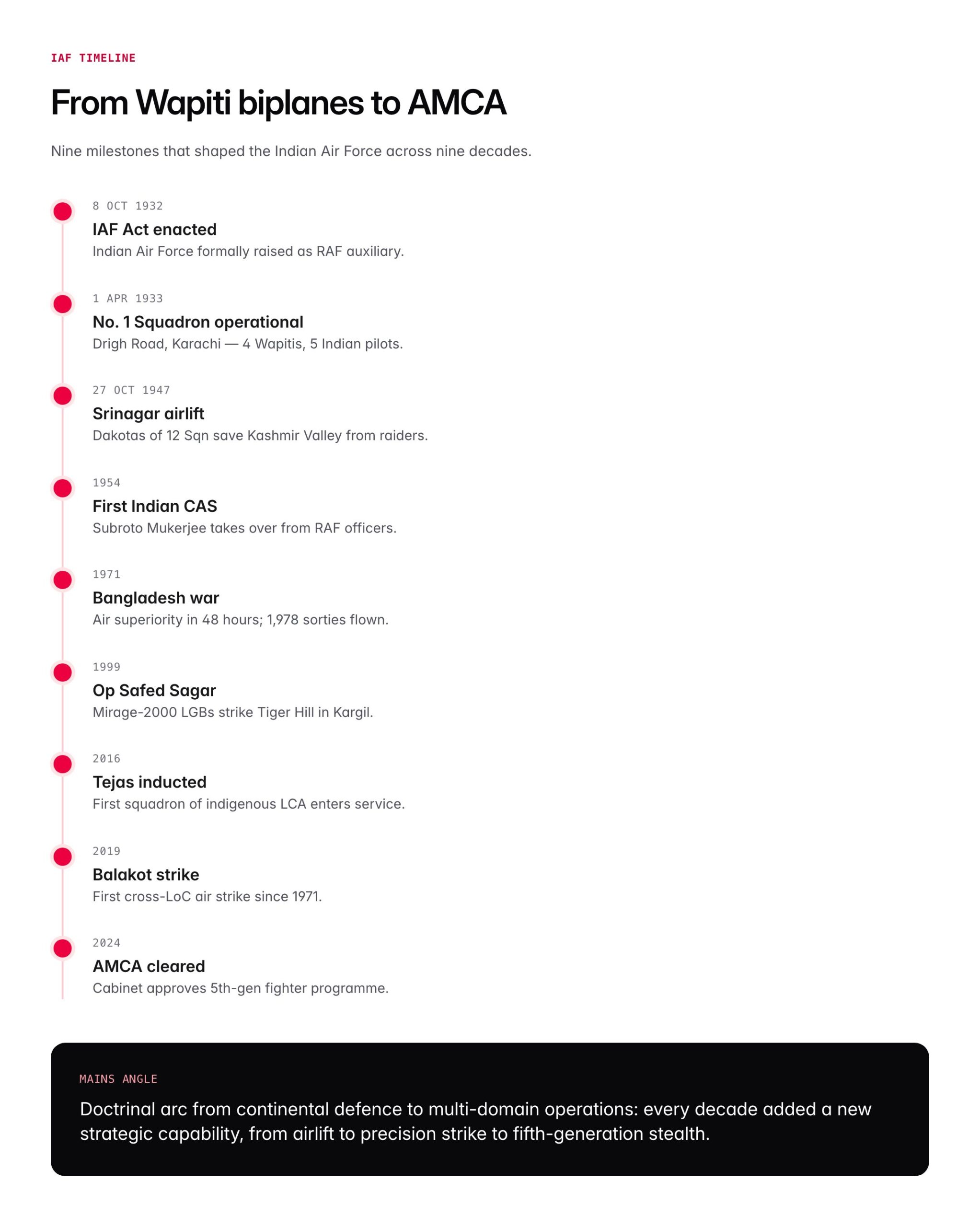
The Indian Air Force traces its birth to the Indian Air Force Act of 1932, passed by the Government of India on 8 October 1932. The first squadron, No. 1 Squadron IAF (the “Tigers”), became operational on 1 April 1933 at Drigh Road, Karachi, flying the Westland Wapiti IIA. The initial cadre consisted of five Indian pilots commissioned from the Royal Air Force College, Cranwell: Subroto Mukerjee, Harish Chandra Sircar, Bhupendra Singh, Aizad Baksh Awan and Amarjeet Singh. Subroto Mukerjee would later become the first Indian Chief of the Air Staff in 1954.
During the Second World War, the force expanded rapidly, flying missions in Burma against the Japanese and earning the prefix “Royal” from King George VI in 1945 for wartime service. After independence in 1947, the IAF was partitioned with the Royal Pakistan Air Force, retaining the bulk of squadrons and infrastructure. Its baptism by fire came within months, airlifting the 1 Sikh Regiment into Srinagar on 27 October 1947 aboard Dakotas of No. 12 Squadron, a sortie that saved the Kashmir Valley from tribal raiders.
The prefix “Royal” was dropped in 1950 when India became a republic, and the force was renamed simply the Indian Air Force. Subsequent decades saw transformative conflicts, the 1971 war which produced the iconic Keelor brothers and the Battle of Longewala, and the 1999 Kargil air campaign (Operation Safed Sagar) where Mirage-2000s used laser-guided bombs at altitudes above 18,000 feet. Post-2019, the Balakot airstrike against Jaish-e-Mohammed camps marked the first time India used air power across the Line of Control since 1971.
Key Features and Traditions of Air Force Day
The Hindon Parade and Fly-Past
The centrepiece of Air Force Day is the ceremonial parade and aerial display at Air Force Station Hindon, the IAF’s largest base. The Chief of the Air Staff takes the salute, followed by an investiture, a static display of fighters and transports, and an hour-long fly-past featuring the Surya Kiran Aerobatic Team (Hawk Mk 132 jets) and the Sarang Helicopter Display Team (ALH Dhruv). Since 2022, rehearsal venues have rotated, with Chandigarh, Prayagraj and Chennai hosting the main event to spread public outreach beyond the National Capital Region.
The IAF Motto and Ensign
The motto Nabha Sparsham Deeptam is drawn from the eleventh chapter of the Bhagavad Gita, where Arjuna describes the cosmic form of Krishna as touching the sky with glory. The IAF ensign features the Indian tricolour in the canton and the IAF roundel in the fly, a blue disk bearing the tricolour with the Ashoka Chakra replaced by the circular IAF emblem.
Commands and Organisation
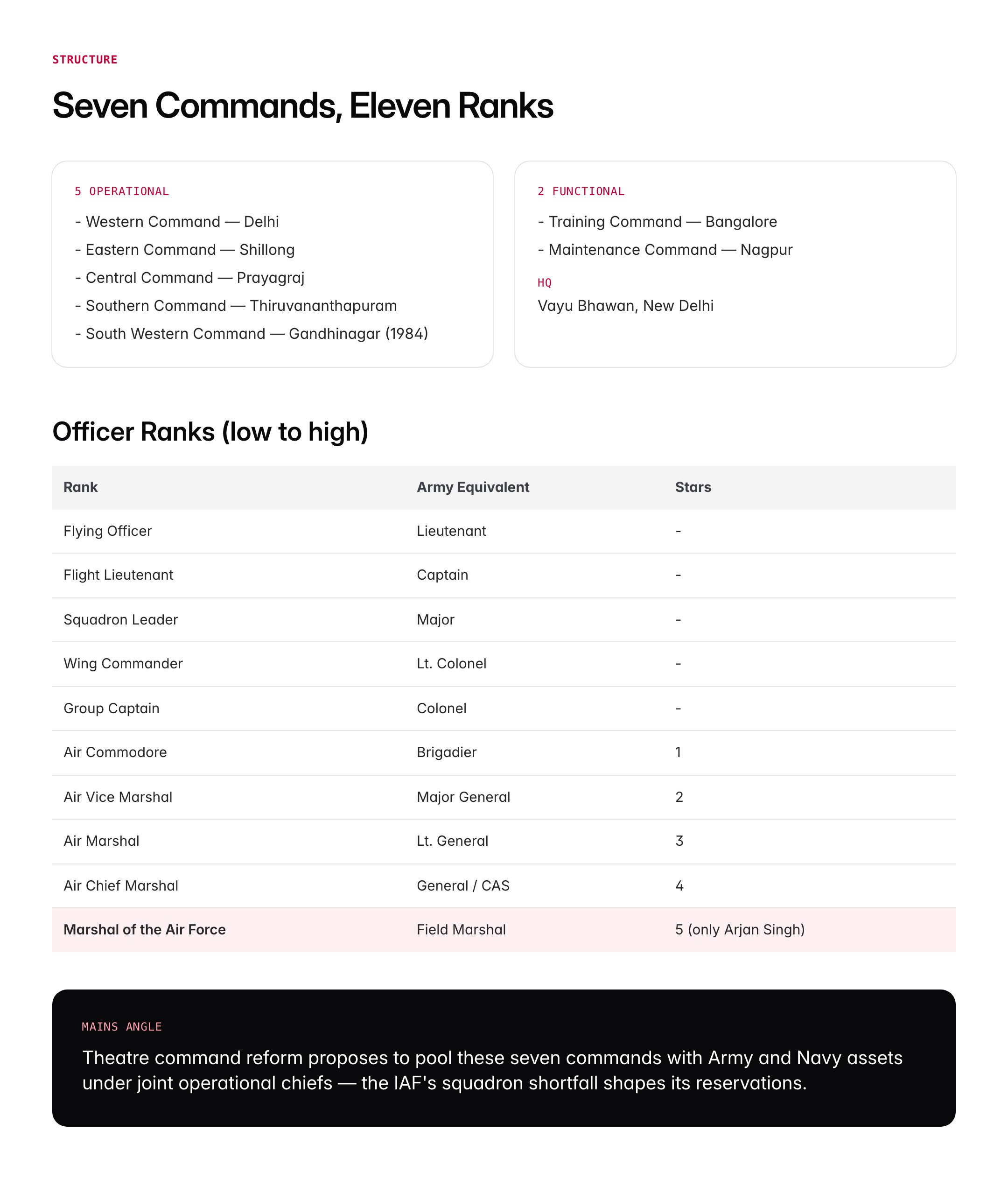
The IAF is divided into seven commands: five operational (Western, Eastern, Central, Southern, South Western) and two functional (Training Command at Bangalore, Maintenance Command at Nagpur). Each operational command is led by an Air Officer Commanding-in-Chief holding the rank of Air Marshal. The seventh was created in 1984 as South Western Air Command at Gandhinagar to handle the desert sector.
Rank Structure
IAF officer ranks mirror the Royal Air Force pattern: Pilot Officer, Flying Officer, Flight Lieutenant, Squadron Leader, Wing Commander, Group Captain, Air Commodore, Air Vice Marshal, Air Marshal, Air Chief Marshal and the five-star Marshal of the Air Force, an honorary rank held only by Arjan Singh (conferred 2002).
Squadrons and Aircraft
The IAF’s sanctioned strength is 42 fighter squadrons but the current holding is about 31. Front-line types include the Dassault Rafale, Sukhoi Su-30MKI, HAL Tejas Mk-1A, Mirage-2000, MiG-29UPG and the soon-to-be-retired Jaguar. Transport and helicopter fleets include the C-17 Globemaster III, C-130J Super Hercules, Il-76, An-32, Chinook CH-47F and Apache AH-64E.
Significance for UPSC and General Knowledge
- Tests GS Paper 3 themes of internal security, defence indigenisation, and disaster management where the IAF plays a lead airlift role.
- Highlights civil-military fusion through missions like Vande Bharat (COVID-19 evacuation) and Operation Rahat (Uttarakhand, 2013).
- Anchors discussion on theatre commands and the role of the Chief of Defence Staff, a reform triggered by the Kargil Review Committee.
- Connects to foreign-policy questions on strategic autonomy, Make in India procurement, and QUAD exercises like Malabar and Tarang Shakti.
- Offers a hook for essay topics on valour, leadership, and the ethos of service before self.
- Provides factual fodder for Prelims one-liners on wars, aircraft, aces and Param Vir Chakra recipients.
Detailed Analysis: The IAF’s Strategic Evolution
India’s air power doctrine has matured across four distinct phases. The auxiliary phase (1932-1947) saw the IAF as an adjunct to the RAF, constrained in role and strength. The continental-defence phase (1947-1971) pivoted the force towards defending borders, with lessons from the 1962 Sino-Indian war exposing gaps in high-altitude operations and leading to the acquisition of MiG-21s and the raising of the Mountain Strike Corps aviation assets.
The power-projection phase (1971-1999) was defined by the decisive air campaign in the Bangladesh Liberation War, where the IAF achieved air superiority over East Pakistan within 48 hours, flying 1,978 sorties and losing only 45 aircraft. Operation Meghdoot in 1984 saw Cheetah helicopters insert troops onto the Siachen Glacier at altitudes above 20,000 feet, the world’s highest battlefield. Kargil in 1999 demonstrated precision-guided munitions at high altitude, with Tiger Hill retaken in part through Mirage-2000 strikes.
The multi-domain phase (1999-present) has reshaped the IAF around network-centric warfare, integrated air command and control, and cross-border strike capability. The 2016 surgical strikes and 2019 Balakot operation underlined a willingness to use air power below the nuclear threshold. Indigenisation accelerated with the HAL Tejas, ASTRA Mk-1 air-to-air missile, BrahMos-A cruise missile and the fifth-generation Advanced Medium Combat Aircraft (AMCA) programme cleared by the Cabinet Committee on Security in March 2024.
Humanitarian and disaster relief have become a fifth operational pillar. IAF airlifts during the 2004 tsunami, 2013 Kedarnath floods, 2015 Nepal earthquake, 2018 Kerala floods and 2020-21 COVID-19 oxygen lift have cemented its role as the nation’s first responder. Under Operation Ganga (2022), the IAF evacuated Indian students from conflict-hit Ukraine, flying C-17s into Bucharest, Budapest and Rzeszow.
Comparative Perspective: Global Air Force Days
| Country | Air Force Day | Year Raised | Noteworthy Tradition |
|---|---|---|---|
| India | 8 October | 1932 | Fly-past at Hindon, Surya Kiran aerobatics |
| United Kingdom | 1 April (RAF Day) | 1918 | Trooping the Colour, Red Arrows display |
| United States | 18 September | 1947 | Separate service since 1947, Thunderbirds team |
| Russia | 12 August | 1912 | Aviadarts international flying competition |
| China (PLAAF) | 11 November | 1949 | Zhuhai Airshow biennial showcase |
| Pakistan | 7 September | 1947 | Marks 1965 war defence day |
| Israel | IAF Day with Yom Ha’atzmaut | 1948 | Fly-past over Masada and Tel Aviv |
India’s IAF is distinctive in being one of the few air forces globally with combat experience in five post-1947 wars and with certified operations at the world’s highest permanent battlefield on Siachen.
Challenges and Criticisms
Despite the ceremonial pride of Air Force Day, the IAF confronts structural challenges. The squadron shortfall, down to roughly 31 of the sanctioned 42 squadrons, has been flagged repeatedly by the Parliamentary Standing Committee on Defence. The phased retirement of MiG-21 Bisons by 2025 and Jaguar deep-strike fleet by 2030 creates a capability window that the delayed Multi-Role Fighter Aircraft tender and slow Tejas Mk-1A deliveries have struggled to plug.
Critics also point to slow indigenisation, with the AMCA fifth-generation fighter still years from first flight and continued dependence on foreign engines, radars and air-to-air missiles. The theatre command debate has seen the IAF argue for retaining centralised control of air assets given their limited numbers, a position some analysts describe as turf-protection. Gender integration has advanced with women fighter pilots since 2016 and Group Captain Shaliza Dhami taking the first female combat unit command, yet representation in combat roles remains below 5 per cent. Environmental costs of fly-pasts and debates over the 2021 Agnipath short-service recruitment model add further layers to public discussion.
Prelims Pointers
- Indian Air Force Day is observed on 8 October, marking the 1932 Indian Air Force Act.
- First squadron: No. 1 Squadron “Tigers”, became operational 1 April 1933 at Drigh Road, Karachi.
- First Indian Chief of the Air Staff: Air Marshal Subroto Mukerjee (1954).
- Motto: Nabha Sparsham Deeptam, from the Bhagavad Gita.
- The IAF has seven commands, with South Western Command at Gandhinagar being the newest (1984).
- Only Marshal of the Air Force: Arjan Singh, conferred 2002.
- Aerobatic teams: Surya Kiran (Hawk Mk 132) and Sarang (ALH Dhruv).
- First Param Vir Chakra awardee from the IAF: Flying Officer Nirmal Jit Singh Sekhon, posthumously, 1971 war.
- Headquarters: Vayu Bhawan, New Delhi.
- Sanctioned fighter squadron strength: 42; current strength around 31.
- IAF roundel colours: saffron, white and green with a central Ashoka-inspired disc.
- Operation Safed Sagar: IAF code name for the 1999 Kargil air campaign.
Mains Practice Questions
Question 1: Trace the evolution of Indian air power doctrine from 1947 to the present, highlighting the role of the Indian Air Force in shaping India’s strategic culture.
- Map four doctrinal phases: continental defence, power projection, precision warfare and multi-domain operations.
- Cite 1971 Bangladesh campaign, 1999 Kargil, 2019 Balakot, and humanitarian missions as inflection points.
- Evaluate indigenisation milestones (Tejas, BrahMos-A, AMCA) and persistent gaps such as squadron shortfall and engine dependence.
Question 2: “The creation of theatre commands is essential for integrated warfare but raises questions about the autonomy of the Indian Air Force.” Discuss.
- Explain the CDS mandate, integrated battle areas, and proposed Air Defence, Maritime and Land theatre commands.
- Present IAF concerns: limited squadron strength, flexibility of air power, and resource centralisation.
- Suggest a middle path drawing on Israeli, American and Chinese models of theatre-level command.
Conclusion
Indian Air Force Day is a compact annual reminder of how a five-pilot auxiliary in 1932 grew into a continental air power with nuclear delivery, space-surveillance and humanitarian reach. The fly-past over Hindon is ceremonial, but the doctrinal questions it surfaces about squadron numbers, indigenisation, theatre commands and the ethics of cross-border strike are very much live.
For UPSC aspirants, 8 October is a date worth anchoring in both factual memory and analytical frameworks. Pair the Prelims pointers above with Mains themes of strategic autonomy, Make in India defence production and disaster response, and the day becomes a full-spectrum revision node for GS Paper 3. Touch the sky with glory, as the motto goes, but keep the feet rooted in facts.
Frequently Asked Questions
What is Indian Air Force Day and when is it celebrated?
Indian Air Force Day is observed every year on 8 October to mark the formal raising of the Indian Air Force under the Indian Air Force Act of 1932. The day features a ceremonial parade, investiture and fly-past, traditionally held at Air Force Station Hindon near Delhi, and honours the service of IAF personnel past and present.
Why is Indian Air Force Day important for UPSC aspirants?
The day anchors GS Paper 3 topics on internal security, defence modernisation, indigenisation under Make in India and disaster management. It also offers factual hooks for Prelims on IAF ranks, wars, aircraft and leaders like Subroto Mukerjee and Arjan Singh, plus essay angles on valour and strategic culture.
How is Indian Air Force Day related to the Chief of Defence Staff reform?
Air Force Day speeches increasingly reference theatre commands proposed under the CDS created in 2019. The IAF argues its limited 31-odd squadrons must remain centrally controlled, making the CDS-led integration debate central to every Air Force Day address since 2020.
Who was the first Indian Chief of the Air Staff?
Air Marshal Subroto Mukerjee became the first Indian Chief of the Air Staff on 1 April 1954. A member of the original 1933 cadre of No. 1 Squadron, he led the IAF through its early post-independence expansion until his death in 1960, and is regarded as the father of the Indian Air Force.
What is the motto of the Indian Air Force?
The IAF motto is Nabha Sparsham Deeptam, meaning ‘Touch the sky with glory.’ It is drawn from the eleventh chapter of the Bhagavad Gita, where Arjuna describes the cosmic form of Krishna. The motto reflects the force’s aspirational ethos and is prominently displayed on the IAF crest.
Which is the only five-star rank holder in IAF history?
Marshal of the Air Force Arjan Singh is the only officer ever promoted to the five-star rank in the Indian Air Force. Conferred in January 2002, he commanded the IAF during the 1965 war and was known for transforming it into a modern jet-age force. He passed away in 2017.
What aircraft form the backbone of the modern IAF?
The IAF’s current fighter fleet includes the Dassault Rafale, Sukhoi Su-30MKI, HAL Tejas Mk-1A, Mirage-2000 and MiG-29UPG. Transport and helicopter capability comes from C-17 Globemaster III, C-130J, Il-76, An-32, Chinook CH-47F and Apache AH-64E, with the AMCA fifth-generation fighter under development.
What is the difference between Air Force Day and Armed Forces Flag Day?
Air Force Day on 8 October is a service-specific commemoration of the IAF’s 1932 raising. Armed Forces Flag Day on 7 December is tri-service, honouring soldiers, sailors and airmen killed in action and raising funds for their welfare. The former celebrates an institution, the latter supports veterans and families.