
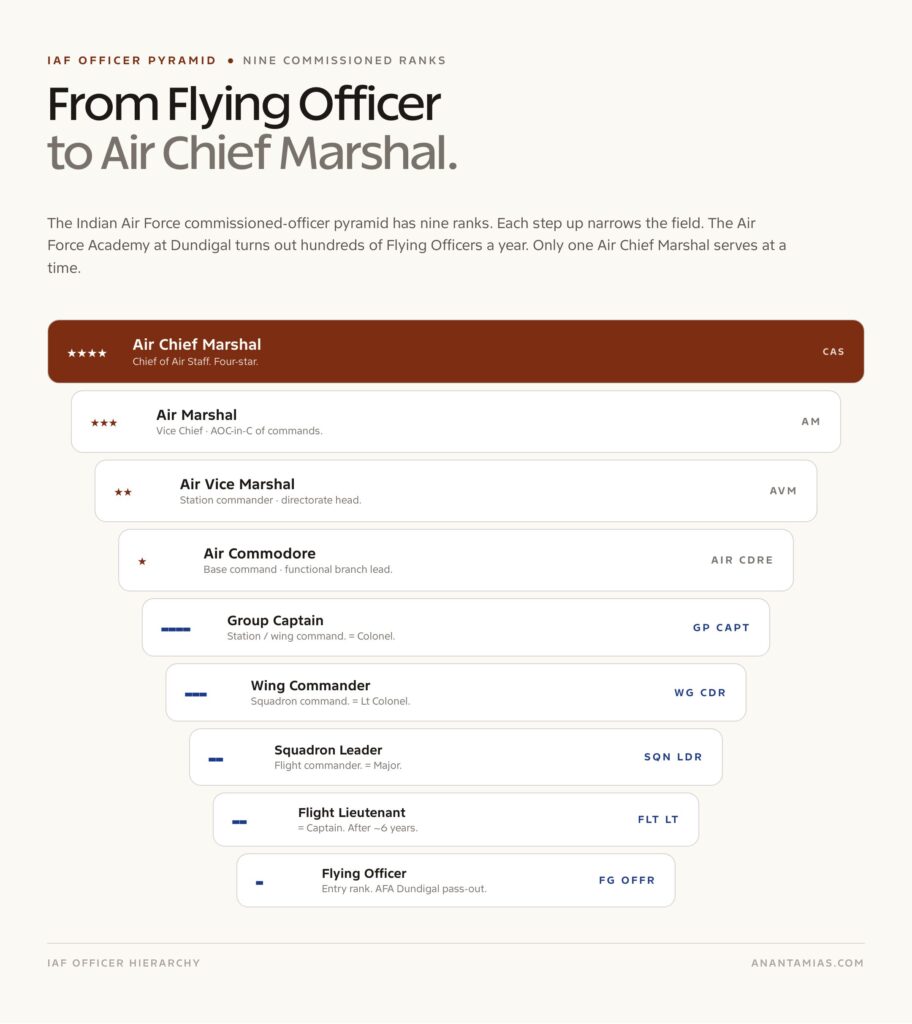
The Indian Air Force is the world’s fourth largest air arm. It runs more than 60 active squadrons and roughly 1.7 lakh personnel across fighter, transport, helicopter, and special operations roles. Holding all of this together is a rank structure inherited from the Royal Air Force in 1932, then adapted to Indian conditions after 1950. Indian Air Force ranks tell you who commands what, who reports to whom, who flies a Rafale and who wrenches it back to airworthiness.
This article walks through every Indian Air Force rank — commissioned officer, junior commissioned officer, and airman — with insignia descriptions and the equivalent Army and Navy ranks alongside. You’ll see how Air Chief Marshal sits with General and Admiral, how a Wing Commander aligns with a Lieutenant Colonel and a Commander, and where the IAF’s distinctive Master Warrant Officer fits in the larger picture. UPSC asks rank-equivalence questions in Prelims and defence-organization questions in Mains.
By the end of this article you’ll be able to recall every Indian Air Force rank in order, identify its insignia, and align it with sister-service equivalents.
Quick Facts About Indian Air Force Ranks
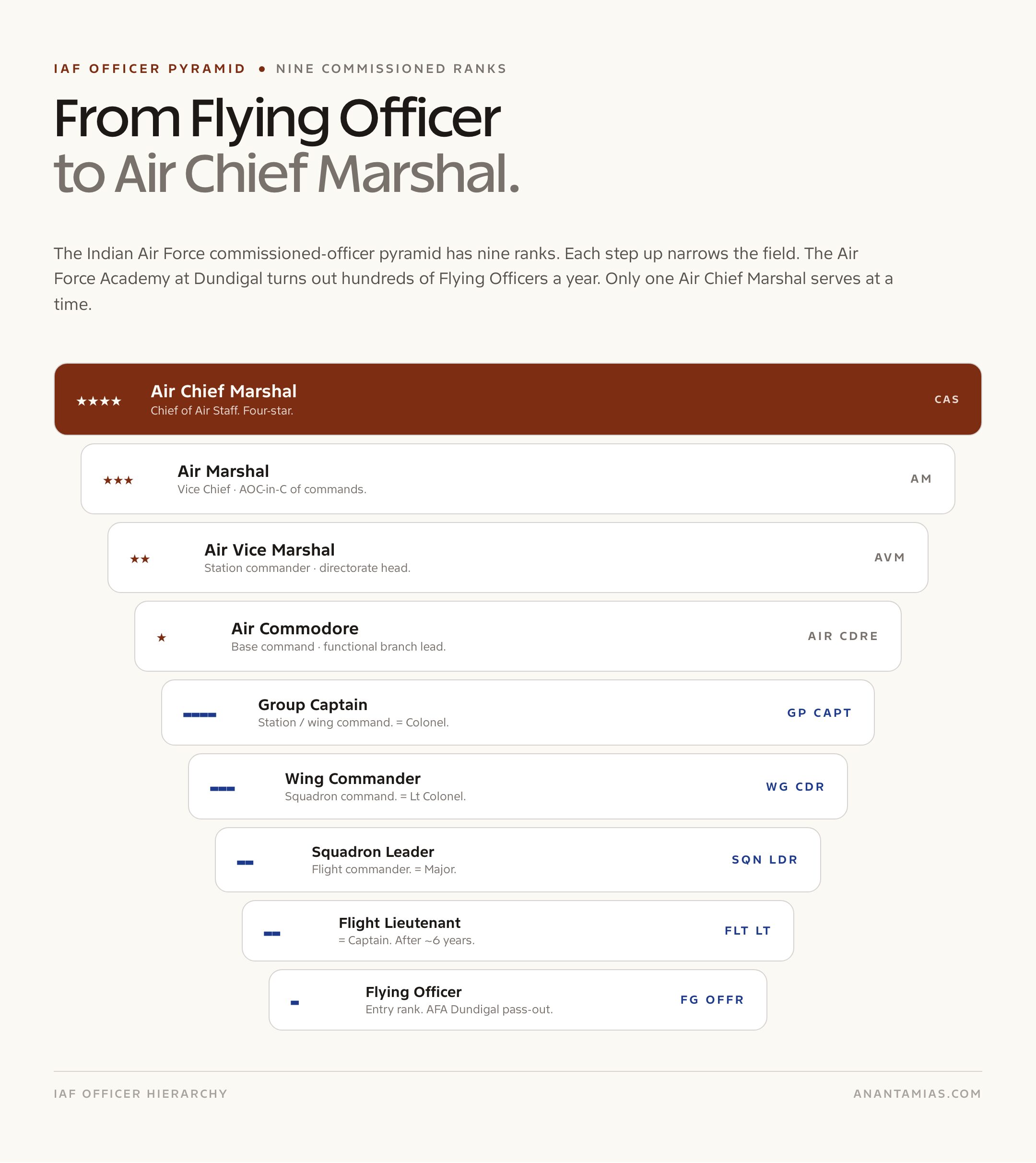
- Highest IAF rank in peacetime: Air Chief Marshal (ACM), four-star general equivalent
- Highest ceremonial rank: Marshal of the Indian Air Force (five-star, conferred only once on Arjan Singh in 2002)
- Total commissioned officer ranks: 9 (ACM to Flying Officer)
- Junior commissioned officer ranks: 3 (MWO, WO, JWO)
- Airman ranks: 4 (Sgt, Cpl, LAC, AC)
- IAF founded: October 8, 1932 as Royal Indian Air Force
- “Royal” prefix dropped: January 26, 1950
- IAF motto: नभः स्पृशं दीप्तम् (Nabhah Sprsam Diptam) — “Touch the Sky with Glory”
- Headquarters: Air Headquarters (Vayu Bhavan), New Delhi
- Operational commands: 5 (Western, South-Western, Central, Eastern, Southern) plus Training and Maintenance Commands
How Indian Air Force Ranks Are Structured
The IAF rank pyramid has three broad tiers. Commissioned officers (CO) hold the King’s Commission, today granted by the President of India, and command flying units and stations. Junior Commissioned Officers (JCO) — called Junior Warrant Officers, Warrant Officers, and Master Warrant Officers — bridge officers and airmen, often with decades of technical depth. Airmen are the operational backbone — sergeants, corporals, leading aircraftsmen, and aircraftsmen who maintain aircraft, run airfields, handle radar, refuel sorties, and load weapons.
Officer ranks split into three groups: Air Officers (Air Chief Marshal, Air Marshal, Air Vice Marshal, Air Commodore), Senior Officers (Group Captain, Wing Commander, Squadron Leader), and Junior Officers (Flight Lieutenant, Flying Officer). Each group has its distinct insignia base — Air Officers carry a sword and baton beneath stars on their epaulettes, Senior Officers use stripes on a light blue band, and Junior Officers use plain stripes.
Background and Historical Context of IAF Rank Structure
When the Royal Indian Air Force was raised on October 8, 1932 with one squadron of four Westland Wapiti biplanes flown by six pilots, it inherited the RAF rank structure outright. The first Indian commissioned officers were Subroto Mukerjee, Harish Chandra Sirkar, Bhupendra Singh, Aizad Baksh Awan, Amarjeet Singh, and Tejhuran Sen, commissioned at RAF Cranwell. RAF rank titles — Pilot Officer, Flying Officer, Flight Lieutenant, Squadron Leader, Wing Commander, Group Captain, Air Commodore, Air Vice Marshal, Air Marshal, and Air Chief Marshal — were adopted in full.
After Independence, the “Royal” prefix was dropped on January 26, 1950 when India became a Republic. The IAF retained the rank nomenclature but replaced British insignia with the State Emblem of India (Ashoka’s Lion Capital). The position of Pilot Officer was abolished in 1965, making Flying Officer the entry-level commissioned rank. Air Marshal Arjan Singh was promoted to the ceremonial five-star rank of Marshal of the Indian Air Force in January 2002, becoming the only IAF officer ever to hold it — equivalent to the Army’s Field Marshal title held by Sam Manekshaw and K.M. Cariappa. Read about fighter jets of India and aircraft carriers of India for context on the platforms these ranks operate.
Indian Air Force Commissioned Officer Ranks
Marshal of the Indian Air Force (MIAF)
The five-star ceremonial rank, awarded only once. Marshal of the Indian Air Force Arjan Singh DFC commanded the IAF during the 1965 war and was promoted to the rank by President K.R. Narayanan on January 26, 2002. He retained the rank until his death in 2017. Insignia carries the national emblem above the IAF crest, a sword and baton crossed, and an eagle.
Air Chief Marshal (ACM)
The highest active rank, four-star general equivalent. The Chief of the Air Staff (CAS) holds this rank. The ACM commands the entire IAF, reports to the Chief of Defence Staff and the Defence Minister, and is a member of the Chiefs of Staff Committee. Insignia: national emblem above a sword and baton crossed within a laurel wreath, with four five-pointed stars below.
Air Marshal (AM)
Three-star rank. Air Marshals head IAF operational and training commands — Vice Chief of Air Staff, Air Officer Commanding-in-Chief (AOC-in-C) of Western Air Command and other commands. Roughly 12 to 15 Air Marshals serve at any time. Insignia: national emblem above sword and baton crossed within laurel wreath, with three stars.
Air Vice Marshal (AVM)
Two-star rank. AVMs typically command Air Force stations, head specialized directorates at Air HQ, and serve as Senior Air Staff Officers (SASO) at command headquarters. Insignia: national emblem with sword and baton crossed in laurel wreath, two stars below.
Air Commodore (Air Cdre)
One-star rank — the most junior of the Air Officer ranks. Air Commodores command large bases, head functional branches, and may lead training establishments. Insignia: national emblem above sword and baton crossed within laurel wreath, no stars.
Group Captain (Gp Capt)
Senior officer rank, equivalent to Colonel in the Army. Group Captains command flying stations and lead operational wings. Insignia: four narrow light blue stripes on the rank slide.
Wing Commander (Wg Cdr)
Senior officer rank, equivalent to Lieutenant Colonel. Wing Commanders typically command flying squadrons — leading 16 to 24 aircraft and 100 to 300 personnel. Insignia: three narrow light blue stripes.
Squadron Leader (Sqn Ldr)
Senior officer rank, equivalent to Major. Squadron Leaders are flight commanders within squadrons and section heads in staff appointments. Insignia: two narrow light blue stripes with a thicker centre stripe.
Flight Lieutenant (Flt Lt)
Junior officer rank, equivalent to Captain. Promotion to Flight Lieutenant typically happens after six years of commissioned service. Insignia: two narrow light blue stripes.
Flying Officer (Fg Offr)
Entry-level commissioned rank, equivalent to Lieutenant. Newly commissioned officers from the Air Force Academy at Dundigal hold this rank. Insignia: one narrow light blue stripe.
The earlier Pilot Officer rank — equivalent to Second Lieutenant — was abolished in 1965.
Junior Commissioned Officer Ranks (JCO)
These ranks bridge officers and airmen. They’re called Junior Commissioned Officers in the Army; the IAF uses Warrant Officer designations.
- Master Warrant Officer (MWO): Most senior airman rank, equivalent to Subedar Major (Army) and Master Chief Petty Officer 1st Class (Navy). Insignia: IAF eagle above three stripes within a laurel wreath
- Warrant Officer (WO): Equivalent to Subedar. Insignia: IAF eagle above three stripes
- Junior Warrant Officer (JWO): Equivalent to Naib Subedar. Insignia: three stripes with the IAF eagle
Airman Ranks
These are the IAF’s other-ranks personnel — the technicians, ground crew, drivers, dog handlers, MT operators, and support staff.
- Sergeant (Sgt): Three chevrons. Equivalent to Havildar (Army)
- Corporal (Cpl): Two chevrons. Equivalent to Naik (Army)
- Leading Aircraftsman (LAC): Single chevron with propeller. Equivalent to Lance Naik
- Aircraftsman (AC): Plain shoulder strap. Equivalent to Sepoy
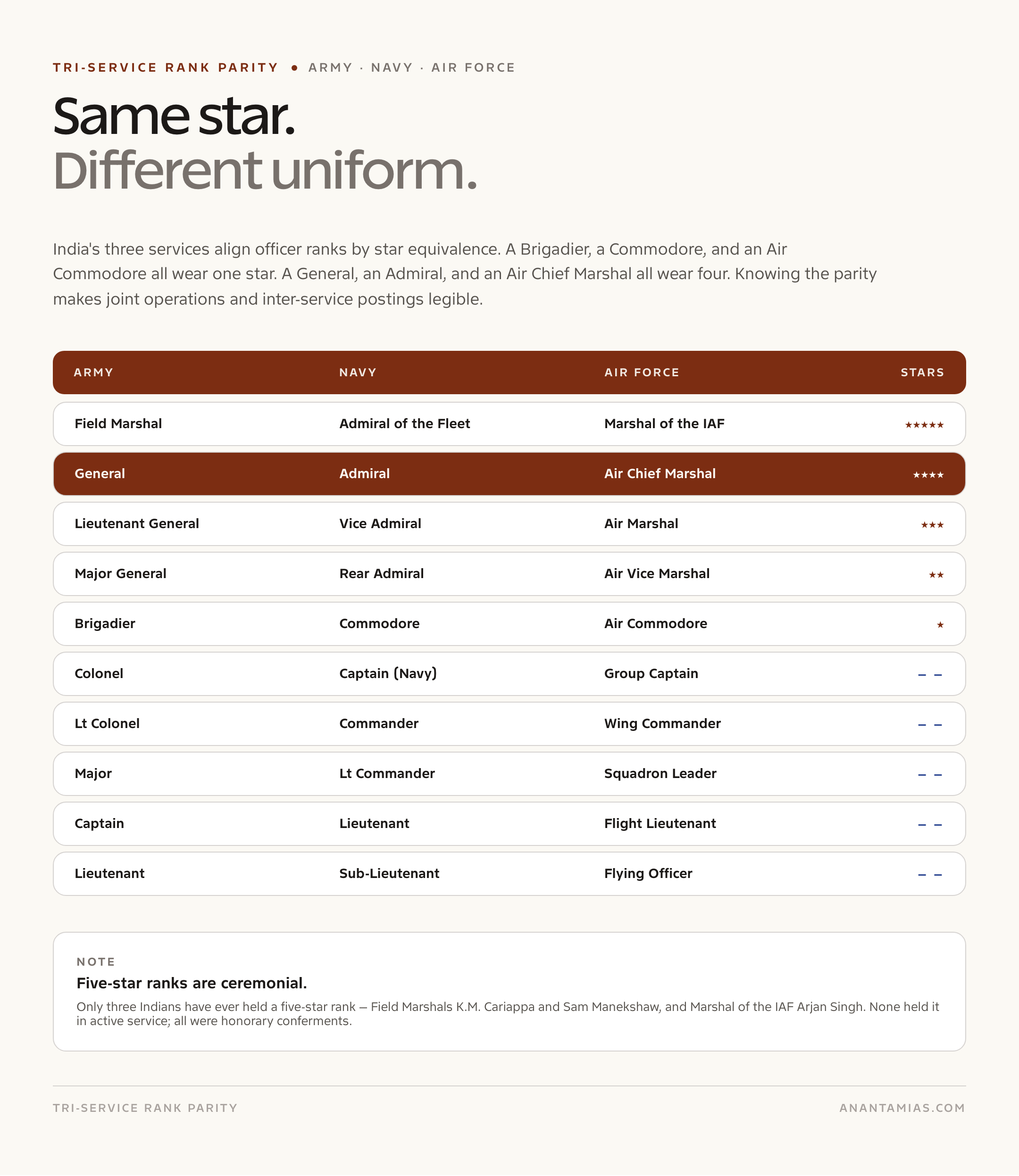
Comparative Rank Table: Army, Navy, Air Force
The Government of India formally publishes equivalence among the three services. Below is the comparative table for officer ranks.
| Indian Army | Indian Navy | Indian Air Force | Stars |
|---|---|---|---|
| Field Marshal | Admiral of the Fleet | Marshal of the Air Force | 5 |
| General | Admiral | Air Chief Marshal | 4 |
| Lieutenant General | Vice Admiral | Air Marshal | 3 |
| Major General | Rear Admiral | Air Vice Marshal | 2 |
| Brigadier | Commodore | Air Commodore | 1 |
| Colonel | Captain | Group Captain | — |
| Lieutenant Colonel | Commander | Wing Commander | — |
| Major | Lieutenant Commander | Squadron Leader | — |
| Captain | Lieutenant | Flight Lieutenant | — |
| Lieutenant | Sub-Lieutenant | Flying Officer | — |
Junior Commissioned Officers also have cross-service parity: Subedar Major / Master Chief Petty Officer 1st Class / Master Warrant Officer share equivalence. Among airmen, Havildar / Petty Officer / Sergeant are parallel, as are Naik / Leading Seaman / Corporal.
Indian Air Force Insignia Conventions
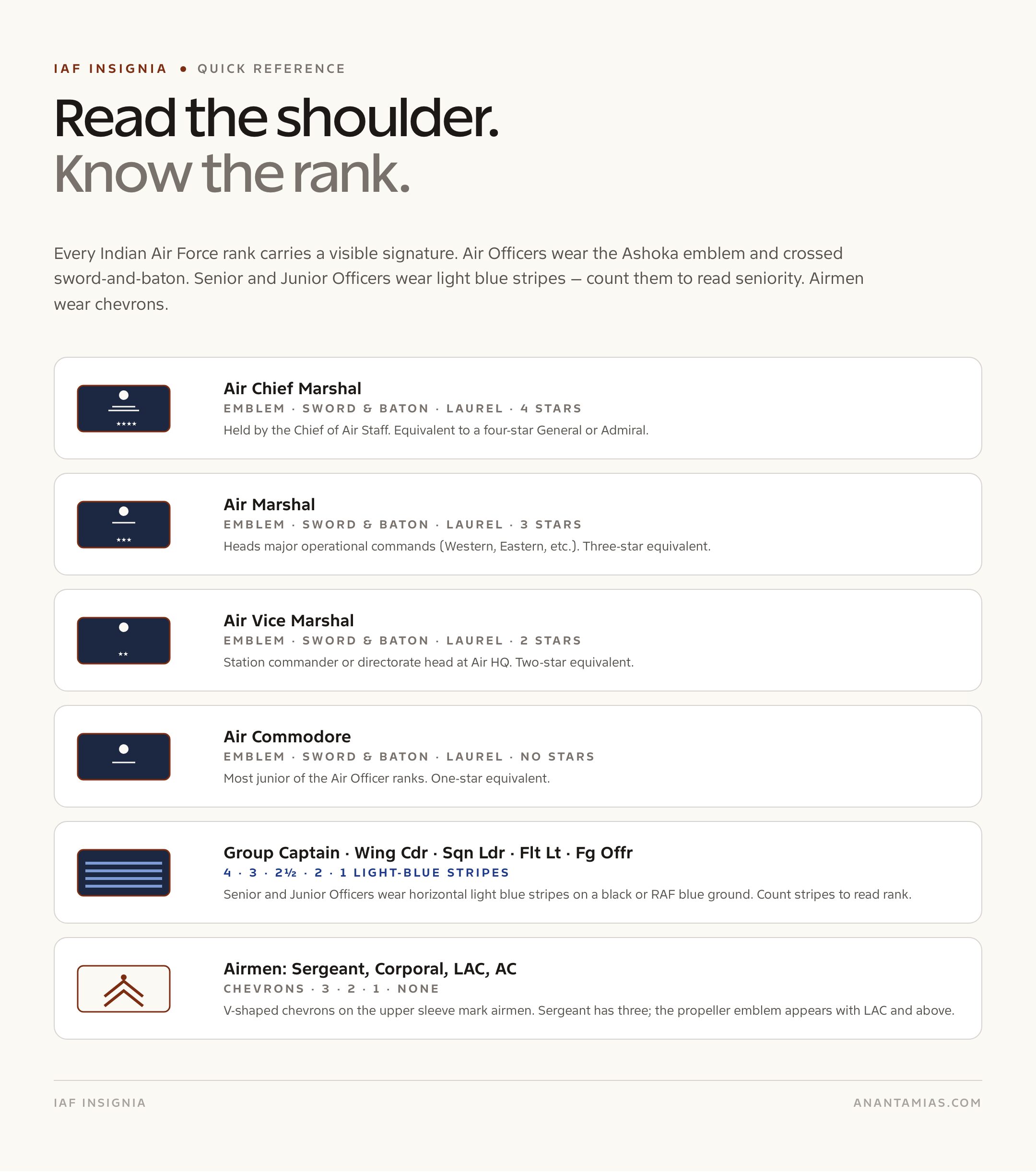
IAF insignia draws on a small visual grammar with consistent meaning.
- National Emblem (Ashoka Lion Capital) appears on all Air Officer ranks (Air Cdre and above), signifying authority delegated by the President of India
- Crossed sword and baton indicate flag-rank status, present from Air Commodore upward
- Laurel wreath surrounds the emblem on AVM, AM, and ACM ranks
- Stars above the laurel: 1 for AVM, 2 for AM, 3 for ACM — note this scheme differs from Army’s epaulette stars
- Light blue stripes identify Group Captain through Flying Officer; the number of stripes decreases with seniority moving down
- Chevrons (V-shapes) identify airmen ranks; pointing downward, with a small propeller emblem
The IAF uniform colour scheme — distinct light blue against the Army’s olive green and the Navy’s white — was standardized in the 1950s.
How Indian Air Force Officers Get Commissioned
Officer commissions come through several streams: National Defence Academy (NDA) at Khadakwasla, Combined Defence Services Examination (CDSE), Air Force Common Admission Test (AFCAT), NCC Special Entry, Short Service Commission (SSC), and direct technical entry. After basic training, cadets undergo flying or ground duty training at the Air Force Academy, Dundigal (Hyderabad), and are commissioned as Flying Officers. Promotion follows a fixed time-scale until Squadron Leader, then becomes selection-based.
The career trajectory typically runs: Flying Officer (entry) → Flight Lieutenant (after 4 years) → Squadron Leader (after 6 years) → Wing Commander (after 13 years) → Group Captain (selection) → Air Commodore (selection) → Air Vice Marshal → Air Marshal → Air Chief Marshal.
Challenges and Significance
The Indian Air Force rank structure carries colonial DNA but operates in an increasingly multi-domain battlespace. Cyber, space, and unmanned systems blur the lines between flying and technical branches. The push for theater commands — proposed since the 2018 Shekatkar Committee and accelerated under the Chief of Defence Staff established in 2019 — will reshape how Air Marshals and AVMs commanding existing air commands will report under joint structures.
Rank equivalence with sister services also drives Sixth and Seventh Pay Commission debates over pay parity, command appointments at integrated formations, and seniority in joint operations. The 2025-26 push for greater integration under Integrated Theatre Commands will test whether the existing rank pyramid can evolve fast enough.
Prelims Pointers
- Highest active Indian Air Force rank: Air Chief Marshal (four-star general equivalent)
- Only Marshal of the Indian Air Force: Arjan Singh, promoted January 2002
- IAF Chief of Air Staff holds the rank of Air Chief Marshal
- Entry-level commissioned IAF rank is Flying Officer; Pilot Officer abolished 1965
- Air Force Academy is located at Dundigal near Hyderabad
- Wing Commander is equivalent to Army’s Lieutenant Colonel and Navy’s Commander
- Air Vice Marshal is equivalent to Major General and Rear Admiral
- IAF motto: Nabhah Sprsam Diptam (Touch the Sky with Glory), from Bhagavad Gita 11:24
- IAF was founded on October 8, 1932 (Air Force Day)
- “Royal” prefix dropped on January 26, 1950
- Five operational commands plus Training and Maintenance Commands
Mains Practice Questions
- Discuss the rank structure of the Indian Air Force and its rationale. How does it compare with the Army and Navy? (GS Paper 3, 10 marks)
- Examine the proposed Integrated Theatre Commands and their impact on existing single-service rank hierarchies. (GS Paper 3, 15 marks)
- The Chief of Defence Staff was established in 2019. Evaluate its significance for inter-service coordination and rank equivalence. (GS Paper 3, 10 marks)
- Trace the evolution of Indian Air Force ranks since 1932 and the influence of the Royal Air Force tradition. (GS Paper 1, 10 marks)
Way Forward
As India moves toward theatre command structures and multi-domain operations, Indian Air Force ranks will need re-examination. Specialist career streams for cyber, space, and unmanned systems may require new designations. Lateral entry from civilian aviation and defence research is being discussed. The fundamental pyramid — single-star to four-star, JCO to airman — will likely remain, but its internal pathways will broaden. Until then, the structure described in this article governs every appointment, promotion, command, and posting across more than 60 IAF squadrons.
Frequently Asked Questions
What is the highest rank in the Indian Air Force?
The highest active rank in the Indian Air Force is Air Chief Marshal (ACM), held by the Chief of Air Staff. The ceremonial five-star rank, Marshal of the Indian Air Force, has been awarded only once — to Arjan Singh in 2002.
Who holds the rank of Air Chief Marshal in 2026?
The Air Chief Marshal is the Chief of Air Staff of the Indian Air Force. The current holder commands all IAF operations and serves on the Chiefs of Staff Committee.
What is the lowest commissioned rank in the IAF?
Flying Officer is the lowest commissioned rank in the Indian Air Force. The earlier Pilot Officer rank was abolished in 1965. New officers from the Air Force Academy at Dundigal are commissioned as Flying Officers.
Is Wing Commander equivalent to Colonel in the Army?
No. Wing Commander in the IAF is equivalent to Lieutenant Colonel in the Army and Commander in the Navy. Group Captain is equivalent to Colonel.
What is the IAF equivalent of a Brigadier?
Air Commodore in the Indian Air Force is equivalent to Brigadier in the Army and Commodore in the Navy. It’s the most junior Air Officer rank.
Who are JCOs in the Indian Air Force?
The IAF’s equivalents of Junior Commissioned Officers are Master Warrant Officer (MWO), Warrant Officer (WO), and Junior Warrant Officer (JWO). They bridge officer and airman ranks.
What is the salary structure for IAF officers?
IAF officer pay follows the 7th Central Pay Commission scales, ranging from Pay Level 10 for Flying Officers to Pay Level 18 (Apex Scale) for the Air Chief Marshal, plus Military Service Pay and allowances.
How do you become an officer in the Indian Air Force?
Entry routes include the National Defence Academy after Class 12, Combined Defence Services Examination after graduation, Air Force Common Admission Test, NCC Special Entry, and direct technical entry. All candidates undergo training at the Air Force Academy, Dundigal.
What does the IAF rank insignia symbolize?
The Ashoka Lion Capital on Air Officer ranks symbolizes presidential authority. Crossed sword and baton indicate flag rank. Stars (one to four) denote the level within Air Officer ranks. Light blue stripes mark Senior and Junior Officer ranks.
When is Indian Air Force Day celebrated?
Indian Air Force Day is celebrated on October 8 every year, marking the IAF’s establishment on October 8, 1932. The annual parade is held at Air Force Station Hindon (Ghaziabad) since 2022.
Tell Google you want more of this.
Add Anantam IAS as a preferred sourceOne tap, and this site shows up more often in your own Top Stories, AI Overviews and AI Mode. Remove it any time.