IPMDA: The Quad’s Maritime Domain Awareness Partnership and India’s SAGAR Vision
The Quad's most substantive deliverable is a data-sharing arrangement, not a fleet. How IPMDA tracks dark shipping, and why awareness is not interdiction.
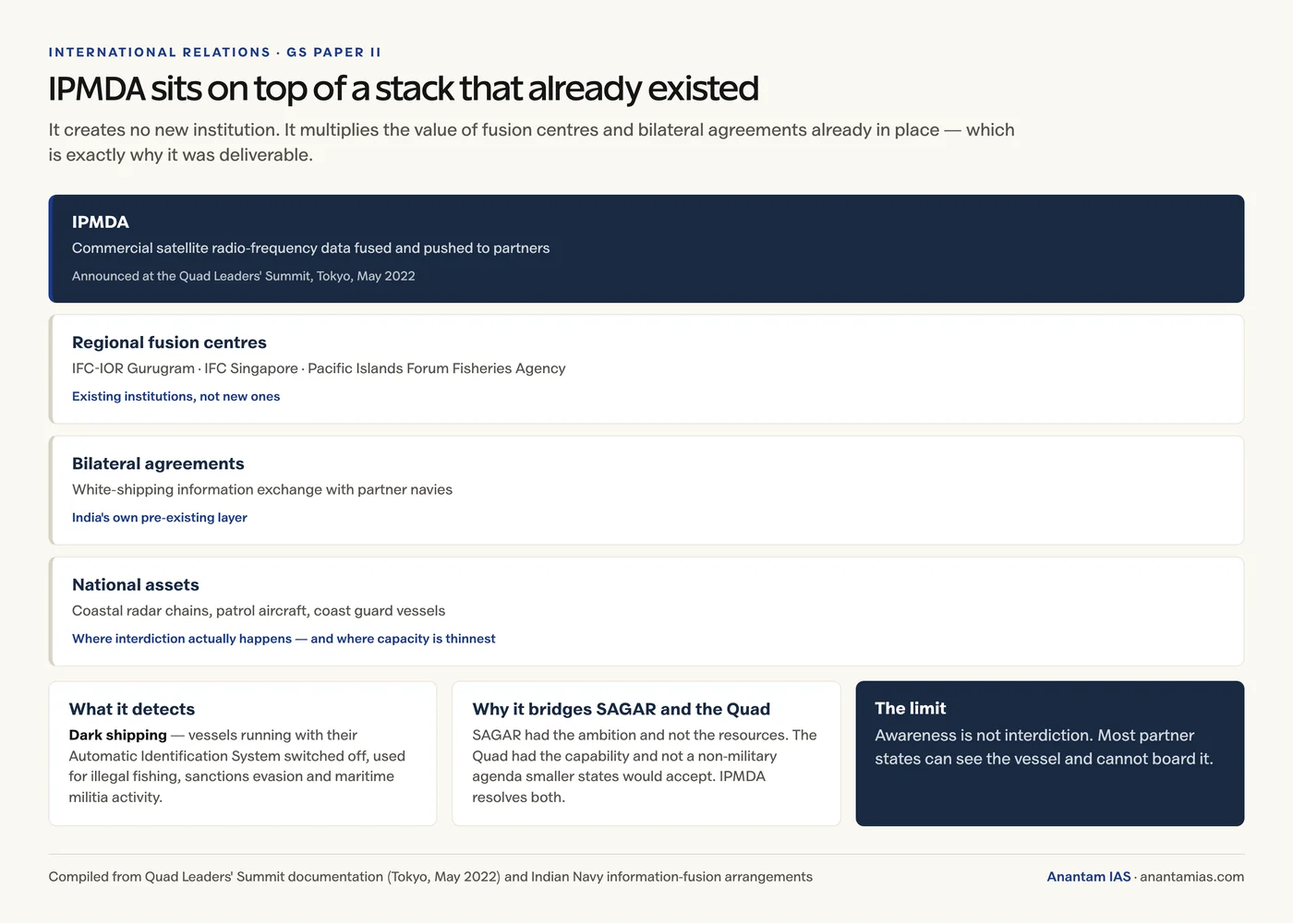
IPMDA — the Indo-Pacific Partnership for Maritime Domain Awareness — is the Quad’s most substantive deliverable, and it is not a military arrangement. Announced at the Quad Leaders’ Summit in Tokyo in May 2022, it fuses commercial satellite radio-frequency data with existing information-fusion centres so partner states can see what is moving through their waters in near real time, including vessels that have switched off their transponders.
What Problem It Solves
- Most Indo-Pacific states have vast exclusive economic zones and very little capacity to monitor them.
- Dark shipping — vessels operating with their Automatic Identification System switched off — is used for illegal, unreported and unregulated fishing, sanctions evasion and maritime militia activity.
- Radio-frequency detection from commercial satellites picks up emissions from vessels that are not broadcasting AIS, so the picture no longer depends on cooperation from the vessel.
How It Works
- Commercially procured RF data is fused with AIS and other feeds and pushed to partner states as a near-real-time common operating picture.
- It is delivered through existing regional fusion centres rather than a new institution: the Information Fusion Centre – Indian Ocean Region at Gurugram, the Information Fusion Centre in Singapore, the Pacific Islands Forum Fisheries Agency, and a Pacific hub.
- Framed as maritime safety, fisheries enforcement and humanitarian and disaster response, which is what makes participation politically possible for states unwilling to appear in a containment coalition.
Why It Matters for India
- It converts SAGAR from a declaratory doctrine into a serviced capability. India’s ambition to be a net security provider was always constrained by resources; IPMDA supplies capability at Quad scale.
- The Gurugram fusion centre, which hosts international liaison officers, becomes a regional hub rather than a recipient.
- It complements India’s bilateral white-shipping information exchange agreements without displacing them.
- It strengthens the constabulary side of the Quad, which is the part smaller states are willing to engage with.
The Critical Assessment
- Awareness is not interdiction. Knowing that a vessel is fishing illegally does not create the coast guard capacity to board it. Most partner states lack the assets, so the picture can outrun the ability to act on it.
- Commercial dependence. The system rests on data purchased from private providers, raising continuity, cost and control questions.
- Fragile framing. Presented as constabulary, its principal strategic utility is tracking grey-zone activity — militia fishing fleets, survey vessels, submarine movement. Partners understand this, which limits how far some will lean in.
- Coverage gaps persist in the western Indian Ocean, which matters most to India and least to the other Quad members.
- Autonomy calculus. Deeper integration into a Quad-run picture sits in tension with India’s strategic autonomy and its own bilateral arrangements.
Where It Sits in the Wider Architecture
IPMDA is one layer of a stack: bilateral white-shipping agreements at the base, regional fusion centres in the middle, and IPMDA as the data multiplier on top. Alongside it sit the Indian Ocean Rim Association, the Indian Ocean Naval Symposium, and the Colombo Security Conclave. The strategic frame is set out in our note on Indo-Pacific geopolitics, and the naval-diplomacy side in the Quad summit.
Frequently Asked Questions
What is IPMDA?
The Indo-Pacific Partnership for Maritime Domain Awareness, announced at the Quad Leaders’ Summit in Tokyo in May 2022. It is a data-sharing initiative that fuses commercial satellite radio-frequency data with existing regional fusion centres to give partner states a near-real-time picture of vessel activity in their waters.
Is IPMDA a military alliance?
No. It is a data-sharing arrangement framed around maritime safety, illegal fishing enforcement and disaster response. That framing is deliberate: it allows ASEAN and Indian Ocean states to participate without appearing to join a security coalition directed at any country.
What is dark shipping?
Vessels operating with their Automatic Identification System switched off, so they do not appear on standard tracking. It is associated with illegal, unreported and unregulated fishing, sanctions evasion and maritime militia activity. Radio-frequency detection can locate such vessels because they still emit other signals.
How does IPMDA relate to India’s SAGAR vision?
SAGAR positioned India as a net security provider in the Indian Ocean, but the ambition always exceeded available resources. IPMDA supplies capability at Quad scale while India’s Information Fusion Centre at Gurugram acts as a regional hub, which turns the doctrine into a serviced capability.
What are the main limitations of IPMDA?
Awareness is not interdiction: most partner states lack the coast guard capacity to act on the information. It also depends on commercially purchased data, has coverage gaps in the western Indian Ocean, and its constabulary framing sits uneasily with its principal strategic use in tracking grey-zone activity.
Which fusion centres does IPMDA work through?
It works through existing centres rather than creating a new institution, including the Information Fusion Centre – Indian Ocean Region at Gurugram, the Information Fusion Centre in Singapore, and Pacific regional arrangements including the Pacific Islands Forum Fisheries Agency.
Practice Questions
Prelims MCQs
1. IPMDA was announced at the Quad Leaders’ Summit held in:
- (a) New Delhi, 2021
- (b) Tokyo, 2022
- (c) Hiroshima, 2023
- (d) Wilmington, 2024
Answer: (b) Tokyo, 2022
2. The Information Fusion Centre – Indian Ocean Region is located at:
- (a) Kochi
- (b) Visakhapatnam
- (c) Gurugram
- (d) Port Blair
Answer: (c) Gurugram
3. ‘Dark shipping’ refers to vessels that:
- (a) Operate only at night
- (b) Have switched off their Automatic Identification System
- (c) Carry unlit cargo
- (d) Are registered under flags of convenience
Answer: (b) Have switched off their Automatic Identification System
4. IPMDA primarily relies on which data source to detect non-broadcasting vessels?
- (a) Undersea acoustic sensors
- (b) Commercial satellite radio-frequency data
- (c) Coastal radar only
- (d) Aerial patrols
Answer: (b) Commercial satellite radio-frequency data
5. SAGAR, as an Indian maritime doctrine, was announced in:
- (a) 2014
- (b) 2015
- (c) 2018
- (d) 2022
Answer: (b) 2015
Mains Questions
- “IPMDA bridges the gap between India’s SAGAR vision and the Quad’s collective Indo-Pacific strategy.” Make a critical assessment of the statement focusing on IPMDA.
- Examine the argument that maritime domain awareness without interdiction capacity delivers limited security value.
- Discuss the role of information fusion centres in India’s Indian Ocean strategy.
- Assess why non-military initiatives have proved to be the Quad’s most deliverable agenda.
- Evaluate the tension between deeper Quad integration and India’s strategic autonomy.