ITER Project: The International Thermonuclear Experimental Reactor and India’s Role in Fusion’s Biggest Bet
A complete UPSC GS-III explainer on the ITER project, the world's largest tokamak under construction at Cadarache, France. Covers the seven international partners, the physics of magnetic confinement fusion, the deuterium-tritium fuel cycle, the Q ratio target, India's contribution through the Institute for Plasma Research, and how ITER feeds into DEMO and the long road to commercial fusion power.
The sun runs on fusion. Hydrogen nuclei in the solar core collide at temperatures of fifteen million degrees and crushing pressures, and the outcome of those collisions is a small amount of mass converted into a very large amount of energy. Every star in the night sky works by the same principle. Engineers and physicists have spent more than seven decades trying to copy that process inside a machine on Earth. The ITER project is the largest and most ambitious attempt yet, and it is the closest the human species has come to a functional fusion reactor.
ITER stands for International Thermonuclear Experimental Reactor. The Latin word “iter” also means “the way,” which is the project’s chosen pun on its purpose. The site is at Cadarache, in the village of Saint-Paul-lès-Durance in southern France. Seven partners share the cost, the components, and the eventual scientific results: the European Union, India, the United States, Russia, China, Japan, and South Korea. Together they account for more than half the world’s population and a comparable share of global research spending. ITER is the largest scientific collaboration in human history, larger even than the Large Hadron Collider.
This article walks through what ITER is trying to do, why fusion has been so hard, how a tokamak works, what India contributes, and where the project sits in the long road from a tabletop experiment in the 1950s to a commercial fusion power plant somewhere later this century. The relevant context for UPSC GS-III is dense and worth a careful tour.
What Fusion Actually Is
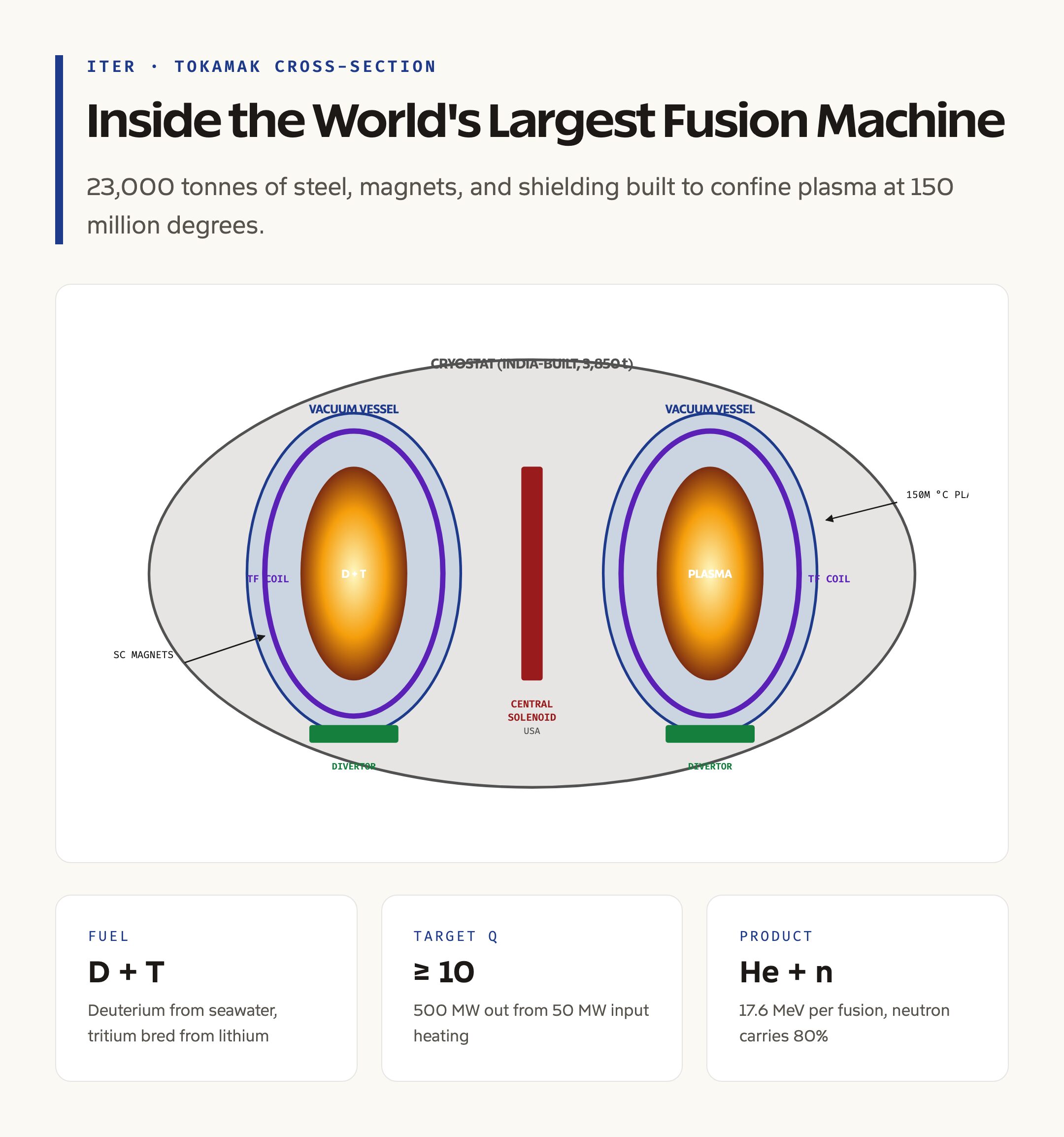
Fusion is the opposite of fission. In fission, a heavy nucleus such as uranium-235 is split into lighter fragments, releasing energy. In fusion, two light nuclei are pushed close enough that the strong nuclear force overcomes the electrostatic repulsion between them, and they merge into a heavier nucleus. The mass of the product is slightly less than the sum of the inputs, and the missing mass becomes energy through the famous mass-energy equivalence.
The easiest fusion reaction to engineer uses two isotopes of hydrogen: deuterium, which has one proton and one neutron, and tritium, which has one proton and two neutrons. Their fusion product is helium-4, plus a free neutron, plus a packet of energy worth 17.6 megaelectronvolts. About 80 percent of the energy goes into the kinetic energy of the neutron, and the rest goes into the helium nucleus. The neutron carries the energy out of the plasma and into a surrounding blanket, where it can be captured as heat and converted to electricity through a steam cycle. For the deeper physics and the connection to civilian power, see the article on India’s nuclear programme and on nuclear energy.
Why Fusion is Hard
Two nuclei repel each other electrostatically because they both carry positive charge. To get them close enough for the strong nuclear force to take over, the nuclei must collide with enormous kinetic energy. In practice, that means heating a deuterium-tritium gas to roughly 150 million degrees Celsius, ten times hotter than the core of the sun. At that temperature the gas is fully ionised, with electrons stripped from nuclei. The result is plasma, a fourth state of matter that behaves like an electrically conducting fluid.
No solid container can hold a 150-million-degree plasma. Any wall would either melt the wall or cool the plasma instantly. Two main confinement strategies exist. The first is inertial confinement, where lasers compress a tiny pellet of fuel for a few nanoseconds. The United States National Ignition Facility uses this method and crossed the scientific breakeven threshold in 2022. The second is magnetic confinement, where a powerful magnetic field shapes the plasma into a torus and holds it away from the walls for many seconds at a time. ITER is a magnetic confinement device.
What a Tokamak Is
The tokamak was invented in the Soviet Union in the 1950s. The word is a Russian acronym for “toroidal chamber with magnetic coils.” A tokamak shapes plasma into a doughnut-shaped torus and confines it using two superimposed magnetic fields. The toroidal field, generated by ring-shaped coils around the chamber, runs along the axis of the doughnut. The poloidal field, generated by an induced current in the plasma itself, runs around the cross-section of the doughnut. The combined field forms a helical pattern that traps charged particles on tight spiral trajectories.
A tokamak’s plasma must be heated to fusion temperatures, held stable for long enough to fuse a meaningful fraction of the fuel, and prevented from touching the walls. Heating uses a combination of ohmic resistance from the plasma current, neutral beam injection, and radio-frequency heating. Stability depends on a careful tuning of the magnetic field profile. The wall, called the first wall, is lined with materials such as tungsten and beryllium that can survive the neutron flux and the occasional plasma contact. India runs its own tokamak programme through the Institute for Plasma Research, with the SST-1 and Aditya machines feeding directly into ITER’s design experience.
The ITER Machine
ITER is the largest tokamak ever built. The vacuum vessel is twenty metres tall and twenty metres in diameter. The plasma volume is 840 cubic metres, eight times larger than the next biggest tokamak. The total weight of the machine is around 23,000 tonnes. The site at Cadarache covers 180 hectares of cleared and instrumented land, with assembly halls, cryogenic plants, power supplies, and a tokamak complex sized like a small skyscraper.
The headline target is a Q ratio of at least 10, where Q is the ratio of fusion power output to external heating power input. ITER aims to inject 50 megawatts of heating power and produce 500 megawatts of fusion power for periods of 400 to 600 seconds. That would be a tenfold gain, the first time in history a fusion device produces substantially more energy than it consumes from the wall. ITER will not generate electricity for the grid. It is a physics machine, designed to demonstrate the conditions, not a power plant.
The Seven Partners and the Procurement Model
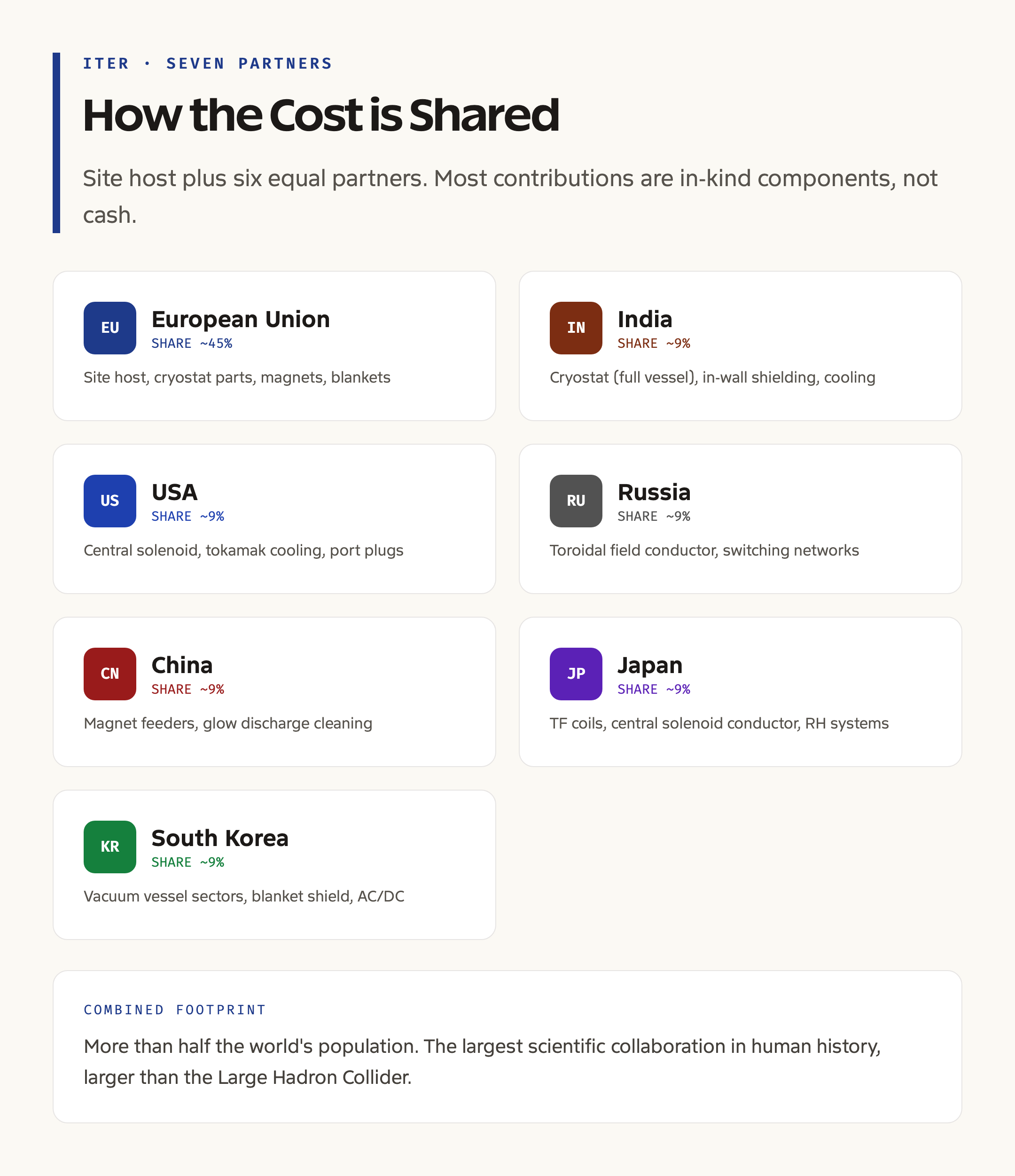
ITER is funded and built by seven members. The European Union hosts the site and pays roughly 45 percent of the construction cost. India, the United States, Russia, China, Japan, and South Korea each pay roughly 9 percent. The unusual feature is that the contributions are mostly in kind rather than in cash. Each member procures specific components in its own industry and delivers them to Cadarache for assembly. The cryostat is built by India. The toroidal field magnets are split between Japan and Europe. The vacuum vessel is split between Europe and Korea. The central solenoid comes from the United States. The blanket modules and the divertor cassettes are split across multiple members.
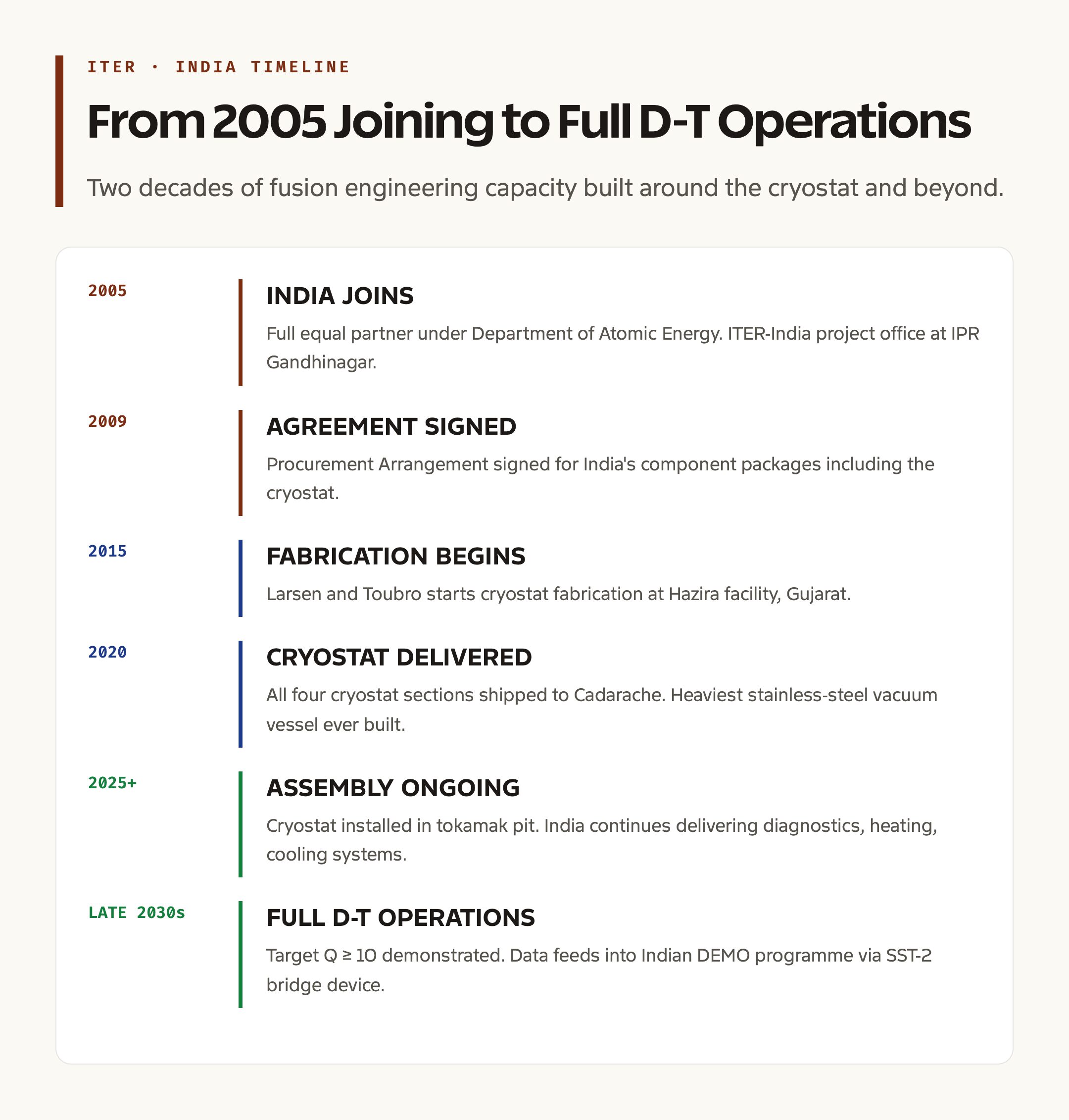
The procurement model has the advantage of building real industrial fusion capacity in every member country. It has the disadvantage of coordination cost. Components must meet the same interface standards across continents, and any delay in any partner’s deliverable propagates to the whole assembly schedule. ITER has slipped repeatedly from its original first-plasma date of 2018 to a current target later this decade, with full deuterium-tritium operations pushed to the late 2030s.
India’s Contribution
India joined ITER in 2005 as a full equal partner. The Department of Atomic Energy is the lead agency, and the Institute for Plasma Research at Gandhinagar is the primary executing institution through its dedicated ITER-India project office. India’s main component contribution is the cryostat, which is the giant vacuum-tight steel vessel that surrounds the entire tokamak and holds the cryogenic temperatures needed for the superconducting magnets. The cryostat weighs 3,850 tonnes, the largest stainless steel vacuum vessel ever built, and was fabricated by Larsen and Toubro at its Hazira facility before shipment to France.
Beyond the cryostat, India delivers the in-wall shielding, the cooling water system, parts of the cryogenic distribution system, several plasma diagnostics, and elements of the heating systems including ion cyclotron and electron cyclotron sources. Indian industry, public research institutions, and private vendors are deeply involved. The ITER work has built a domestic fusion engineering ecosystem that feeds back into India’s indigenous SST-1 superconducting tokamak and into the proposed Indian DEMO programme.
What Comes After ITER: DEMO and Commercial Fusion
ITER is a research machine. It will demonstrate that a burning plasma is possible at the engineering scale and produce the validated physics needed for the next step. That next step is DEMO, short for demonstration power plant. DEMO would actually generate electricity from fusion, on the order of one gigawatt of net output. Each ITER member is independently planning a DEMO programme on a timeline of the 2040s and 2050s. India’s roadmap envisages a SST-2 device as a bridge between SST-1 and an Indian DEMO.
Commercial fusion plants would come after DEMO. Industry forecasts vary widely, with optimistic private fusion startups claiming pilot plants in the 2030s using alternative concepts such as spherical tokamaks, stellarators, and inertial confinement. Most mainstream estimates put commercial fusion power on the grid in the second half of the twenty-first century. The relevance of fusion to climate policy depends on whether that timeline can be compressed.
Why Fusion is Worth the Wait
Fusion has structural advantages over fission as a power source. The fuel is essentially unlimited. Deuterium can be extracted from seawater. Tritium is bred inside the reactor blanket from lithium, which is abundant. There is no risk of a runaway chain reaction. If the plasma is disturbed, it cools and the reaction stops, the opposite of a fission criticality accident. The waste is short-lived. The activated structural materials decay to background levels in about a century, compared to thousands of years for fission spent fuel. There is no weapons-usable material in the fuel cycle.
The energy density is enormous. A kilogram of deuterium-tritium fuel releases about ten million times the energy of a kilogram of coal. A few grams of fuel can power a city for a day. The engineering challenge is what stands between that promise and the grid. ITER’s job is to remove that engineering doubt.
Prelims and Mains Pointers
For prelims, the high-yield facts are the location at Cadarache in France, the seven partners, the use of magnetic confinement in a tokamak, the deuterium-tritium fuel cycle, the target Q of at least 10, and the 500 megawatt fusion output. India’s main component is the cryostat. ITER is research, not power generation. The Latin meaning “the way” is a frequent question.
For mains, the angle is energy security and climate policy. India’s energy demand is growing, fossil fuel imports are politically and economically costly, and the renewable rollout has structural limits. Fusion sits alongside small modular reactors and the national quantum mission as long-horizon technology bets that pay off only with sustained government commitment over decades. ITER is the most visible of those bets, and India’s full partner status is a strategic position that few developing economies have secured. The cost is real and the timeline is long, but the payoff, if fusion works, would be transformative.
Conclusion
ITER is a singular project. Seven members building one machine across three continents, financing it largely through component deliveries rather than cash, betting on a physics that has resisted demonstration for seventy years. The early dates have slipped. The cost has grown. The science is hard. None of that erases what ITER represents. It is the first chance the human species has at a power source that runs on water and produces no greenhouse gas, no long-lived waste, and no risk of meltdown. India’s role in ITER is the most significant share of any fusion project in the country’s history, and the institutional and industrial capacity it has built will outlive the experiment. The path to commercial fusion is long. ITER is the gate at the entrance.