Justice Delayed at Scale: India’s Judicial Pendency Crisis
A UPSC Mains GS2 editorial on India's five-crore judicial backlog, the judge-population ratio, and the structural fixes that would actually unclog the courts.
A case that takes longer to decide than the child it concerns takes to finish school isn’t a delayed verdict. It’s a denied one. As accessed on 31 May 2026, the National Judicial Data Grid shows roughly 4.92 crore cases pending across India’s district and high courts, and the Supreme Court is carrying about another 92,000 on top. Round it and you reach a number that should stop any future administrator cold: close to five crore disputes waiting for an answer. That isn’t a backlog. It’s a parallel population, the size of a large country, living inside the court system and waiting for it to get to them.
The old line that “justice delayed is justice denied” has hardened from a maxim into a measurable, dated, daily-updating fact. And the honest part of this topic, the part that earns marks, is that the fix was never going to be a stern speech about delay. The numbers point somewhere unglamorous: too few judges, unfilled vacancies, a manual process, a government that sues itself into its own queue, and a clearance rate that loses ground every single year. So the real question isn’t whether the courts are slow. It’s why, structurally, they can’t catch up, and what would actually let them.
The Issue, Framed
The fight here isn’t about whether courts are overloaded. Everyone agrees they are. The fight is about what the overload is made of, and therefore what would clear it.
Let’s fix the vocabulary first, because the debate drowns in numbers used loosely. Pendency is simply the total stock of cases that haven’t yet been finally disposed of, every undisposed matter on the books on a given day. It is not the same as delay. A case filed last week is “pending” but not “delayed.” The 245th Report of the Law Commission, its 2014 study titled Arrears and Backlog, drew exactly this line: pendency is the whole pile, while arrears or backlog is the part that has crossed a reasonable processing time and shouldn’t still be sitting there. So when a politician quotes the headline pendency figure as if it were all “delay,” that’s the first analytical mistake to avoid.
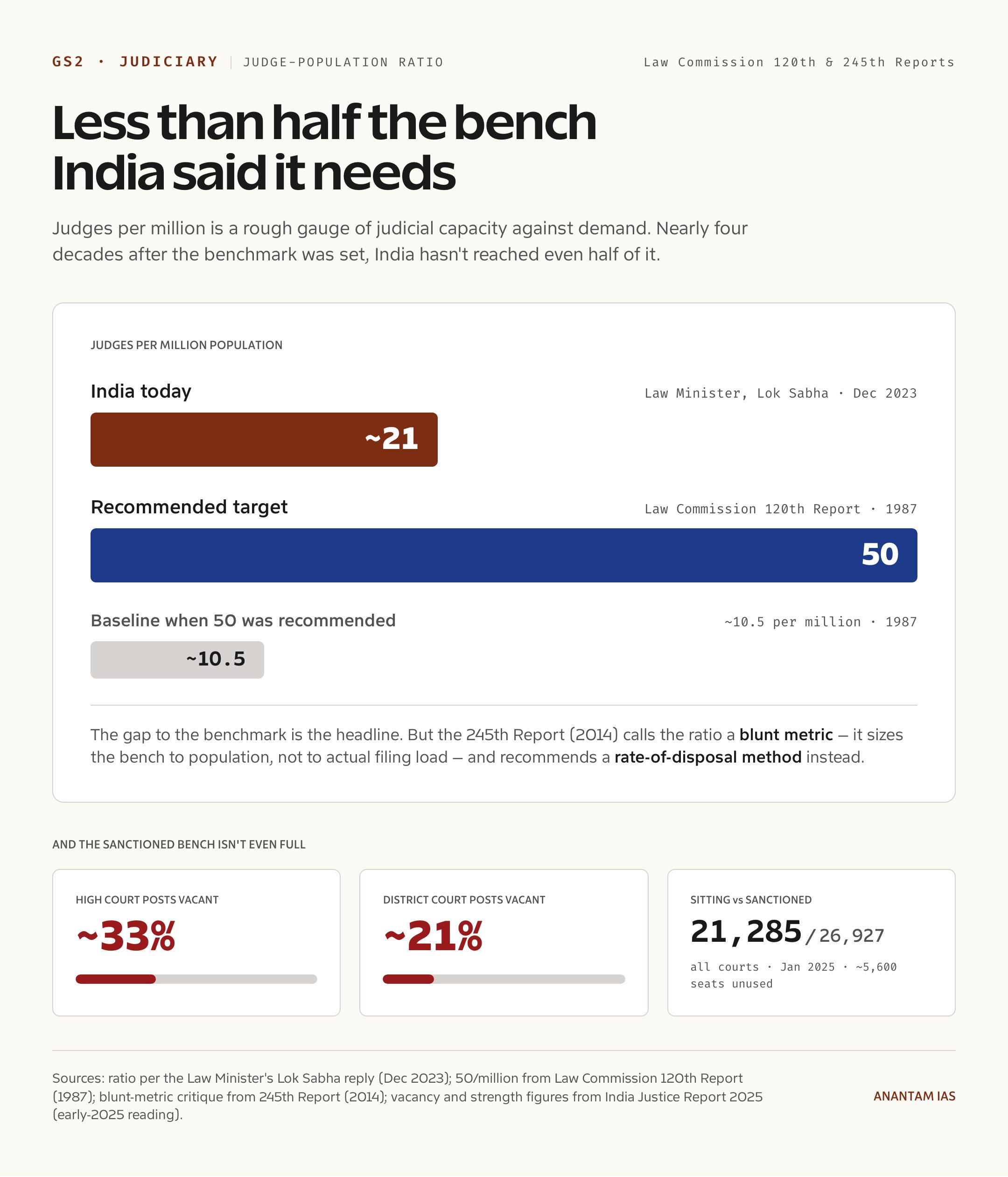
The second term is the one that drives most reform arguments. The judge-population ratio is the number of judges per million people, a rough gauge of how much judicial capacity a country has relative to the demand it faces. The Law Minister told the Lok Sabha in December 2023 that India sits at roughly 21 judges per million. The Law Commission’s 120th Report, back in 1987, recommended 50 per million, up from the then-prevailing 10.5. So nearly four decades on, India hasn’t reached even half the bench its own expert body said it needed.
A third idea matters for any serious answer. The case-clearance rate (CCR) is the share of incoming cases the system disposes of in a year, calculated as cases disposed divided by cases filed. A CCR of exactly 100% means the courts finish as many as they receive, treading water. Anything below 100% means the pile grows. India’s CCR has hovered in the 90s in recent years by various secondary estimates, which is why each year tends to end with more cases pending than it began. The figure isn’t from a single official audit, so treat it as a directional indicator, not a precise statistic.
And one more, because it carries half the solution. Alternative Dispute Resolution (ADR) is the family of mechanisms that settle disputes outside a full court trial, mediation, arbitration, conciliation, and Lok Adalats, the “people’s courts” that resolve matters by compromise. ADR is the pressure-release valve. Whether it actually relieves the pressure depends on whether the State builds it out or leaves it on paper.
A clean diagnosis, then. The pile is real and growing. But “the courts are slow” is the symptom. The disease is a capacity-and-process gap the system has under-treated for decades.
What the Data Says
The numbers are where you have to slow down, because the pile isn’t one block. It’s a pyramid, and where a case sits decides almost everything about it.
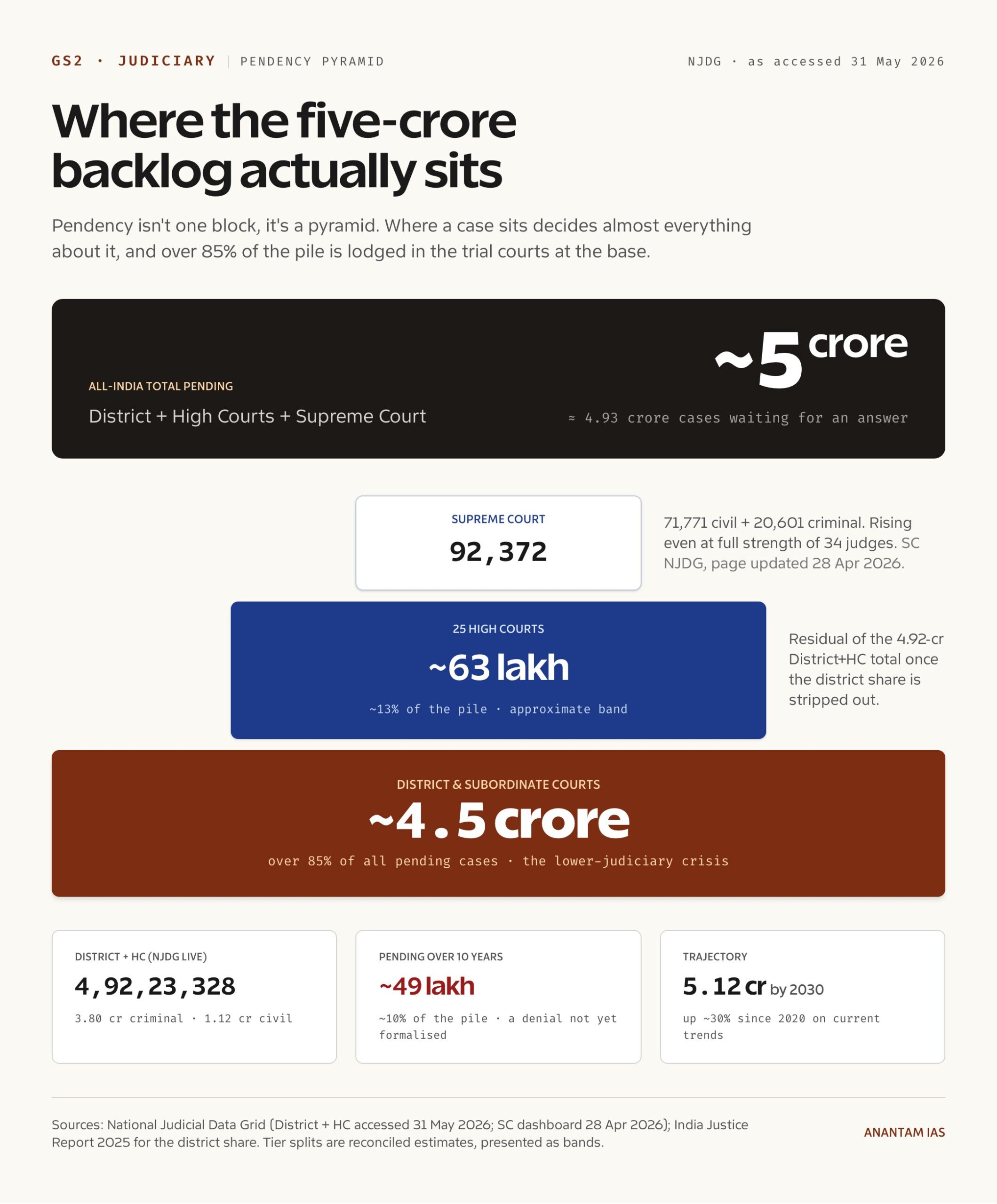
Start at the base. As accessed on 31 May 2026, the National Judicial Data Grid, the public real-time dashboard that tracks case data court by court, records 4,92,23,328 pending cases across the district and high courts, split into 3,80,25,683 criminal and 1,11,97,645 civil matters. The India Justice Report 2025, the benchmarking study released on 15 April 2025 by Tata Trusts and partners, found that over 85% of all pending cases sit in the district and subordinate courts, more than 4.5 crore matters. So the crisis is overwhelmingly a lower-judiciary crisis. The headlines fixate on the Supreme Court; the queue lives in the trial courts where most citizens actually go.
The middle band is the high courts, which carry roughly 62 to 63 lakh cases. Treat that as an estimate, not a hard count: the NJDG dashboard aggregates district and high courts together, so the high-court-only figure is the residual once you strip out the district share the India Justice Report identifies. It’s a band, and it’s dated, but it places the high courts squarely between the trial-court base and the apex.
At the apex sits the Supreme Court, with about 92,372 cases pending, 71,771 civil and 20,601 criminal, on its own NJDG dashboard page updated 28 April 2026. The India Justice Report had cited a slightly lower 88,417 as of August 2024. The two don’t clash; they’re different snapshot dates, and the trend is upward even though the Court now runs at its full sanctioned strength of 34 judges. Use the 85,000-to-92,000 band and date it, because this is live data that moves.
Now the texture that turns a number into an indictment. On the same NJDG dashboard, roughly 10% of pending cases, close to 49 lakh matters, have been waiting more than ten years, and another chunk for five to ten years. A decade-plus wait isn’t a delay anymore. It’s a denial that simply hasn’t been formalised. The India Justice Report adds the trajectory: pendency has risen about 30% since 2020 and, on current trends, is projected to reach 5.12 crore by 2030. So the line is still climbing.
Why can’t the system catch up? Two structural facts. First, capacity. In January 2025 there were 21,285 sitting judges against a sanctioned strength of 26,927 across all courts, the India Justice Report records, which means roughly 33% of high-court posts and about 21% of district-court posts lay vacant. The country isn’t even using the bench it has already approved. Second, the inflow. The single largest litigant in India is the government, with various estimates putting the Centre and states together at 46 to 50% of all pending cases. Treat that as an estimated range, not one audited figure, but the direction is undisputed: the State sues, appeals, and gets sued at a scale that means roughly half the queue is, in part, self-inflicted.
And the human cost concentrates in the criminal docket. The National Crime Records Bureau’s Prison Statistics India 2022, the latest comprehensive release, found 75.08% of India’s prison population, 4,34,302 of about 5.73 lakh inmates, were undertrials, people awaiting or undergoing trial, not convicts, in jails running at 131% of capacity. The data is two years old and should be flagged as such, but the meaning is brutally current: when trials crawl, the unconvicted poor sit in overcrowded prisons paying the price of delay in advance.
The Case For
Before the gloom, the genuinely good news, because a one-sided answer that only catalogues failure misses half the marks. India is acting, and some of it is working.
The digital backbone is being built at scale. The Union Cabinet approved e-Courts Phase III on 13 September 2023 as a Central Sector Scheme, four years, an outlay of ₹7,210 crore, more than four times Phase II. It targets full digitisation of legacy records, universal e-filing and e-payments, e-Sewa Kendras for citizens without devices, and a unified judicial technology platform. This isn’t a pilot. It’s the data infrastructure that already put case information live on the NJDG, and Phase III is meant to make the courts paperless end to end.
Targeted fast-tracking demonstrably moves the needle. There are 774 functional Fast Track Special Courts (FTSCs), including 398 exclusive POCSO courts for child-sexual-offence cases, across 29 states and union territories. They have disposed of about 3.61 lakh cases at roughly 7.41 cases per court per month, more than double the regular-court rate of about 3.18. So dedicated benches with narrowed jurisdiction clear cases faster. That’s not a theory; it’s a measured result.
Out-of-court settlement now has a statutory spine. The Mediation Act 2023, which received assent on 15 September 2023, is India’s first standalone mediation law, and it requires mediation to conclude within 120 days, extendable by 60. Alongside it, the National Lok Adalats disposed of over 4 crore cases, both pre-litigation and pending, in 2024 alone. That’s a parallel disposal engine running beside the formal courts, and at that volume it’s not a token.
The top court is showing what disposal-led management looks like. By secondary accounts, the Supreme Court cut its own pendency by nearly 5% between November 2024 and May 2025, clearing more than it took in over that window. The precise clearance figure rests on a secondary aggregator and should be verified against a court release before quoting, but the proof-of-concept stands: a court that prioritises disposal can shrink its pile.
And the diagnostics have transformed. A decade ago, “pendency” was anecdote. Today the NJDG gives real-time, public, age-disaggregated data, and the India Justice Report benchmarks states against one another. So the debate has shifted from impression to evidence, which is the precondition for any serious reform. You can’t manage what you can’t measure, and India can finally measure this.
The Case Against
Here’s what the optimism walks past. Every initiative above is real, and every one of them is being outrun by the scale of the problem it’s meant to solve.
The arithmetic is unforgiving. Roughly 4.9 to 5.0 crore cases are pending, the district courts carry about 85% of them, and the pile is growing, up about 30% since 2020 and headed for 5.12 crore by 2030 on current trends. Disposing 4 crore matters through Lok Adalats in a year is impressive until you set it beside an inflow that keeps the net stock climbing. So the achievements are real in absolute terms and insufficient in relative terms.
The capacity gap is the root, and it’s decades old. Twenty-one judges per million against a recommended fifty isn’t a recent slip; it’s a benchmark set in 1987 and never met. Worse, the country won’t even fill the posts it has sanctioned, with roughly a third of high-court seats and a fifth of district seats vacant. Building courts and schemes while leaving the bench understaffed is like widening a highway and refusing to hire drivers.
The State feeds the very queue it complains about. With the government at an estimated 46 to 50% of pending litigation, the largest single source of cases is the same authority that funds the reforms. The National Litigation Policy of 2010 was meant to make the government a “responsible litigant” and cut reflexive appeals. Its implementation has been patchy at best. So one arm of the State pours cases in while another tries to drain them out.
The delay then lands hardest on those least able to bear it. Tie the threads together: a slow trial court, an undertrial who can’t make bail, and a prison at 131% capacity. Three-quarters of India’s prisoners are awaiting trial. For them, pendency isn’t an abstraction on a dashboard. It’s months or years of incarceration before any finding of guilt, the harshest possible expression of “justice delayed.”
And the process drags structurally, not occasionally. Routine adjournments, repeated postponements often sought as a tactic, are a documented primary driver of delay, which is why the Chief Justice’s office has pushed a backlog strategy centred on curbing them. Add procedural complexity and a clearance rate stuck near the 90s, and the machine is built to fall a little further behind each year. The crisis isn’t an event. It’s the default setting of a system that hasn’t been re-engineered for its caseload.
The Deeper Structural Read
Step back from the dashboard and the real fault line shows. Pendency isn’t a single problem with a single owner. It’s a systems failure where capacity, process, the State’s own behaviour, and the criminal-justice pipeline all feed the same drain, and no one actor controls all four.
Begin with the constitutional stakes, because that’s what lifts this above administration. Article 21 has been read by the Supreme Court to include the right to a speedy trial, most famously in Hussainara Khatoon v. State of Bihar (1979), the case that exposed undertrials jailed longer than any sentence they could have received. Article 39A directs the State to ensure equal justice and free legal aid so that opportunity isn’t denied by poverty. And Article 50 asks the State to separate the judiciary from the executive. Read together, these aren’t decoration. They make timely, accessible justice a constitutional obligation, not a service-delivery target. A five-crore backlog isn’t only an efficiency problem; it’s a slow, structural breach of a promise the Constitution makes to every citizen.
Now the diagnostic that should bother any future administrator most. The strongest argument for more judges, the 21-versus-50 ratio, is also the bluntest. The 245th Law Commission Report said so directly: judge-population ratio is a crude metric, because it sizes the bench to population rather than to actual filing load, which varies enormously by region and case type. The Report proposed a rate-of-disposal method instead, fixing the number of judges a court needs by how fast it clears cases against how fast they arrive. So the honest reform target isn’t a slogan-friendly “50 per million.” It’s a court-by-court calculation of how much bench each docket actually needs. The blunt ratio gets you political attention; the disposal method gets you the right answer.
There’s a separation-of-powers layer below all of this. Judges are appointed through the collegium, a process the executive both participates in and, critics argue, slow-walks through delayed clearances and returned files, which is part of why a third of high-court seats stay empty. So vacancies aren’t purely a recruitment-calendar problem; they sit at the friction point between the judiciary that nominates and the executive that processes. Pendency, at this layer, is a downstream cost of an upstream appointments tangle. (The appointments debate, collegium versus the struck-down National Judicial Appointments Commission, is a full topic of its own; for pendency it’s enough to see that the empty bench is partly a governance standoff, not just a paperwork backlog.)
And here’s the part that reframes the whole crisis. The single biggest lever isn’t inside the courtroom at all. If the government, the source of roughly half the litigation, became a disciplined litigant, the inflow would fall before a single new judge was sworn in. So a large slice of a “judicial” problem is really an executive-behaviour problem wearing a judicial costume. That’s the structural read worth carrying into an answer: the courts are the place the failure shows up, but not the only place it’s made.
What Should Be Done
So what would actually unclog the courts? Not a plea for “judicial reform” in the abstract, but a set of moves with named owners and measurable targets. Eight of them, and none is a slogan.
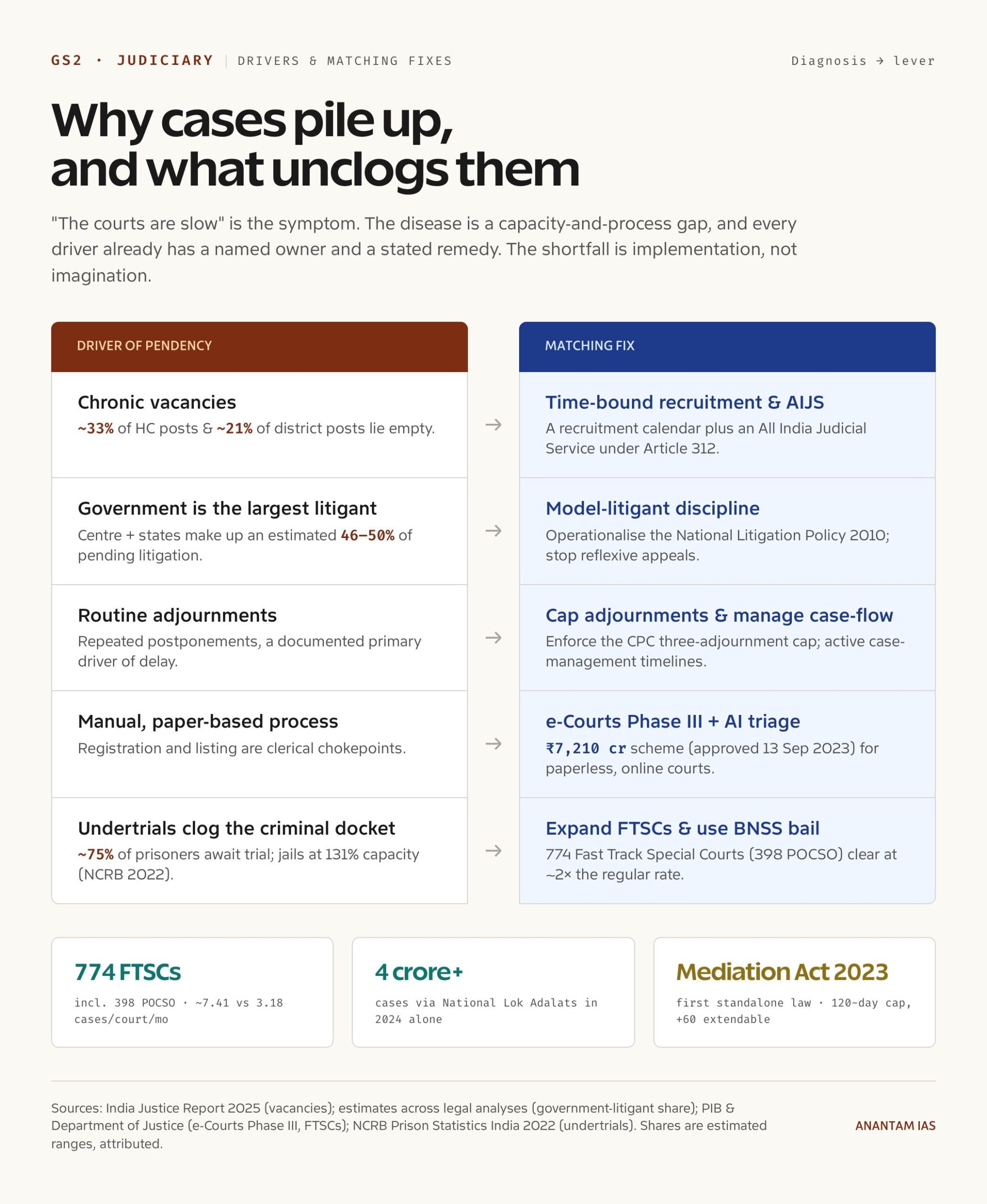
- Fill vacancies on a clock. Set a standardised, time-bound recruitment calendar for district judges and a firm timeline for clearing high-court collegium recommendations, so a third of the bench stops sitting empty. The India Justice Report 2025 backs an All India Judicial Service, a national, examination-based cadre for the lower judiciary under Article 312, to make recruitment regular instead of episodic. You can read the broader appointments tangle in judicial appointments: collegium, NJAC and the search for balance.
- Size the bench to the docket, not the slogan. Raise sanctioned strength toward the 50-per-million benchmark, but compute the real need court by court using the 245th Report’s rate-of-disposal method, so judges are added where filing load is heaviest rather than spread evenly by headcount. Capacity targeted at the bottlenecks beats capacity scattered by population.
- Build the courtrooms the judges will sit in. Sanctioning a post does nothing if there’s no courtroom, no staff, and no digital facility for it. Fund the infrastructure pillar, courtrooms, residential and digital facilities, alongside the e-Courts scheme, so new appointments translate into actual sittings rather than names on a roster.
- Finish e-Courts Phase III and layer AI triage on top. Complete the ₹7,210-crore Phase III rollout, then add artificial-intelligence tools for the dull, high-volume work, auto-classification of filings, scheduling optimisation, defect detection, and translation, so registration and listing stop being manual chokepoints. Technology should clear the queue’s clerical fat before any case reaches a judge.
- Curb adjournments and manage case-flow actively. Enforce the Civil Procedure Code’s cap of three adjournments per party and put courts on active case-management timelines, the core of the Chief Justice’s stated backlog strategy. Routine postponement is the cheapest delay to eliminate and among the most effective.
- Make the government a model litigant for real. Operationalise the National Litigation Policy, set up empowered dispute-resolution committees inside ministries, and stop reflexive appeals against settled questions. If the State at 46 to 50% of the docket disciplined its own filing, the inflow would fall faster than any other single measure could cut the stock.
- Mainstream mediation and Lok Adalats. Fully implement the Mediation Act 2023, mandate pre-litigation mediation for suitable commercial and civil disputes, and scale the National Lok Adalats that already cleared 4 crore-plus matters in 2024. Every dispute settled outside court is one that never enters the pile.
- Decongest the criminal docket and the prisons. Expand FTSCs and exclusive POCSO courts where they’ve shown double the disposal rate, and use the bail and plea-bargaining provisions of the Bharatiya Nagarik Suraksha Sanhita to cut the undertrial population. Speeding criminal trials isn’t only about clearing cases; it’s about emptying jails of people not yet convicted of anything.
Every one of these strengthens the system without weakening any safeguard. A court with a full bench, a digital pipeline, a disciplined State litigant, and a working ADR valve is a court that can finally dispose of more than it takes in. That’s the entire point of reform: not faster verdicts at the cost of fairness, but a system that clears its queue because it’s better built, not because it cuts corners.
For Your Mains Answer
This is a GS2 gift. One topic touches the structure and functioning of the judiciary, separation of powers, government policy and its implementation gaps, the protection of vulnerable sections, and e-governance, all at once.
GS paper mapping: GS2: structure, organisation and functioning of the judiciary; separation of powers and checks and balances; government policies and interventions and the issues in their design and implementation; mechanisms for protection of vulnerable sections; and transparency and e-governance.
PSIR-optional relevance: In Paper I (Indian Government and Politics), pendency feeds directly into the judiciary, judicial review, and the judicial-activism-versus-restraint debate, and into reform-and-accountability questions. In Paper I (Political Theory), it’s a live illustration of the Rule of Law and of access to justice as a substantive component of justice, the gap Amartya Sen frames as nyaya (realised justice) versus niti (just institutions on paper). In Paper II (Comparative Politics), judge-population ratios and case-management models across democracies, and the global turn toward ADR, give you ready comparative material.
Likely question frames:
- “Justice delayed is justice denied.” Examine the structural drivers of judicial pendency in India and evaluate whether recent reforms are adequate to the scale of the problem.
- Pendency in India’s courts is as much a problem of executive behaviour and process design as of judicial capacity. Critically analyse.
- Discuss how technology, alternative dispute resolution, and judicial-strength reform can together address the backlog in Indian courts, with reference to recent measures.
Quotable data points:
- ~4.92 crore cases pending in district and high courts (NJDG, 31 May 2026); close to 5 crore all-India with the Supreme Court’s ~92,000.
- Over 85% of pending cases sit in district and subordinate courts, more than 4.5 crore matters.
- ~10% of cases, close to 49 lakh, have been pending more than ten years.
- ~21 judges per million against the Law Commission’s recommended 50 per million (120th Report, 1987).
- High-court vacancies ~33%, district-court vacancies ~21%; 21,285 sitting judges against 26,927 sanctioned.
- Government is the largest litigant, an estimated 46 to 50% of pending cases.
- 75% of prisoners are undertrials, jails at 131% capacity.
- e-Courts Phase III: ₹7,210 crore, approved 13 September 2023; 774 FTSCs (398 POCSO) at twice the regular disposal rate; Lok Adalats cleared 4 crore-plus cases in 2024.
- Pendency up ~30% since 2020, projected at 5.12 crore by 2030.
Keywords to use: pendency, arrears and backlog, judge-population ratio, case-clearance rate, rate-of-disposal method, alternative dispute resolution, model litigant, speedy trial, access to justice.
Syllabus linkages: functioning of the judiciary, separation of powers, Article 21 (speedy trial), Article 39A (legal aid), Article 50, All India Judicial Service (Article 312), government policy implementation, e-governance, protection of vulnerable sections.
Balanced conclusion line: A justice system measured by how fast it answers its weakest litigant cannot be reformed by exhortation alone; closing a five-crore gap needs a full bench, a disciplined State litigant, a digital pipeline, and a working ADR valve, working together, because each fixes a different part of the same drain.
How to Build the Answer
Open with the gap, not a definition. The line that lands is that India’s courts are carrying close to five crore pending cases and the pile is still growing, which makes “justice delayed is justice denied” a measurable fact, not a maxim. That first sentence tells the examiner you’ve grasped both the scale and the structural nature of the problem. A definition of pendency can follow in the second sentence. The opening should frame the failure, not recite a glossary.
Bring data in early, but ration it. A strong first body paragraph can carry three figures: ~4.92 crore pending, 85% in the district courts, and 21 judges per million against a recommended 50. Then say what they prove, that the crisis is a lower-judiciary, capacity-and-process problem, not a Supreme Court story. UPSC rewards the move from fact to inference. The figure is the anchor; the “this means…” is the mark.
The second body paragraph should steelman the State. If your stance criticises the pace of reform, first credit what’s working, e-Courts Phase III, the FTSC disposal rate, 4 crore Lok Adalat cases, so the answer reads balanced rather than reflexively negative. Only then show why the achievements are outrun by the scale.
The way forward must be grouped, not scattered. Cluster the fixes into capacity (fill vacancies, AIJS, disposal-method sizing), process (curb adjournments, AI triage, e-Courts), inflow (model-litigant discipline, ADR), and criminal-justice (FTSCs, BNSS bail). Use the topic’s own vocabulary, rate-of-disposal method, model litigant, speedy trial, so the answer reads like governance analysis, not a news recap.
Close on the constitutional link, Articles 21, 39A, and 50, and on judgment. The last line shouldn’t echo the introduction. The reliable pattern is “the goal is not faster verdicts alone, but a system that clears its queue because it’s better built,” which balances speed with fairness.
Common Mistakes to Avoid
- Don’t treat the whole five crore as “delay.” Pendency includes fresh cases. Distinguish pendency from arrears or backlog, the way the 245th Report does, or you’ve misread the problem.
- Don’t lean only on the judge ratio. The 21-versus-50 line is vivid but blunt. Pair it with the rate-of-disposal method, or an examiner who knows the 245th Report will mark you as surface-level.
- Don’t go one-sided. This topic has a genuine “India is acting” side. Credit e-Courts, FTSCs, and Lok Adalats before showing they’re outpaced.
- Don’t forget the executive’s role. The government as the largest litigant is the move most answers miss. Naming it signals structural understanding.
- Don’t forget the citizen. Name the undertrial in a 131%-full jail, the litigant in a ten-year-old case. UPSC rewards policy that names who’s harmed.
A Compact Answer Spine
- Introduction: Open with the scale, close to five crore and rising; define pendency and distinguish it from arrears in the next line.
- Evidence: Three attributed figures, ~4.92 crore total, 85% in district courts, 21 judges per million, each tied to an implication.
- Arguments: What India is doing right (e-Courts, FTSCs, ADR), then why it’s insufficient against the scale and inflow. Keep both fair.
- Structural diagnosis: Capacity plus process plus the State-as-litigant plus the criminal pipeline; constitutional stakes under Articles 21, 39A, 50.
- Way forward: Grouped guardrails, each with an owner, judiciary, executive, NALSA/Lok Adalats, Department of Justice.
- Conclusion: Adapt the balanced conclusion line to the exact question wording.
Diagram or Flowchart Idea
For a 15-marker, draw one causal chain, not a decorative mind map. The cleanest format: few judges plus high vacancies plus a government that over-litigates → inflow outpaces disposal (CCR in the 90s) → stock climbs toward 5 crore → ten-year waits and 75% undertrials → fixes (fill bench, disposal-method sizing, model-litigant discipline, e-Courts and AI, ADR). The examiner reads that logic in five seconds.
For a 10-marker, skip the diagram unless it’s genuinely simple. A two-column table, “Drivers of pendency” against “Matching fix,” vacancies-to-recruitment-calendar, government-litigant-to-National-Litigation-Policy, adjournments-to-three-adjournment-cap, does more work and is faster to evaluate under time pressure.
Ethics and Governance Angle
Add one ethical line even in a GS2 answer. Pendency isn’t only an efficiency metric; it asks who bears the cost when the system stalls. Here that’s a concrete person: the undertrial sitting in a 131%-overcrowded jail before any verdict, the litigant whose property dispute outlives the parties to it. Naming that citizen sharpens the answer.
Then convert the empathy into design. Don’t merely say “speed up the courts.” Say how: expand fast-track and POCSO benches, use BNSS bail and plea-bargaining to release undertrials, give the poor a working legal-aid and Lok Adalat route under Article 39A. That’s the move from moral language to administrative maturity.
A sentence pattern that travels across topics: “The objective, timely justice, is constitutionally mandated, but its delivery depends on capacity, process discipline, and the State’s own restraint as a litigant.” It accepts the goal without pretending a slogan delivers it, which is exactly what a balance question rewards.
How to Use Data Without Sounding Mechanical
Use fewer numbers than you know. Three well-explained figures beat ten scattered ones. Lead with one big number, close to five crore pending, the national scale; use a second for the structure, 85% in the district courts; and use a third for the diagnosis, 21 judges per million against a recommended 50. One scale figure, one structure figure, one capacity figure is usually enough.
Never leave a statistic standing alone. Follow it with “This means…” or “The policy implication is…” That tiny move turns a fact sheet into analysis. The 75%-undertrial figure means nothing until you add that delay translates into pre-conviction incarceration of the poor; then it’s an argument.
Date your live numbers. NJDG figures change daily, so write “as accessed on 31 May 2026” rather than stating a hard count as timeless. An examiner trusts an answer that knows its data is a snapshot more than one that pretends a moving number is fixed.
One last sweep: cut any line that sounds impressive but does no work, and replace it with a fact, a cause, a consequence, or a reform. That habit separates an answer that feels informed from one that feels memorised. Write for marks, not for noise. Always be specific.
FAQ
How many cases are pending in Indian courts right now?
As accessed on 31 May 2026, the National Judicial Data Grid shows about 4.92 crore cases pending across the district and high courts, with the Supreme Court carrying roughly another 92,000, bringing the all-India total close to five crore. These are live figures that change daily, so any answer should date them and attribute them to the NJDG rather than state a fixed count.
What is the judge-population ratio and why does it matter?
The judge-population ratio is the number of judges per million people. India sits at about 21 per million, while the Law Commission’s 120th Report (1987) recommended 50. So India has less than half the bench its own expert body said it needed. That said, the 245th Report calls the ratio a blunt metric and recommends a rate-of-disposal method instead, sizing each court by its actual filing load rather than by population.
Is the government really the biggest litigant in India?
Yes, by most estimates. Various legal analyses put the Centre and states together at roughly 46 to 50% of all pending cases, making the State the single largest source of litigation. The figure is an estimated range rather than one audited number, but the implication is consistent: disciplining government litigation, through the National Litigation Policy and fewer reflexive appeals, could cut the inflow faster than almost any other single measure.
What is India already doing to reduce the backlog?
Several things at once. e-Courts Phase III (₹7,210 crore, approved September 2023) is digitising the courts; 774 Fast Track Special Courts, including 398 exclusive POCSO courts, dispose of cases at about twice the regular rate; the Mediation Act 2023 gives mediation a statutory base; and the National Lok Adalats cleared more than 4 crore cases in 2024. The catch is scale: pendency rose about 30% since 2020 and is projected at 5.12 crore by 2030, so these measures are real but currently outrun by the inflow.