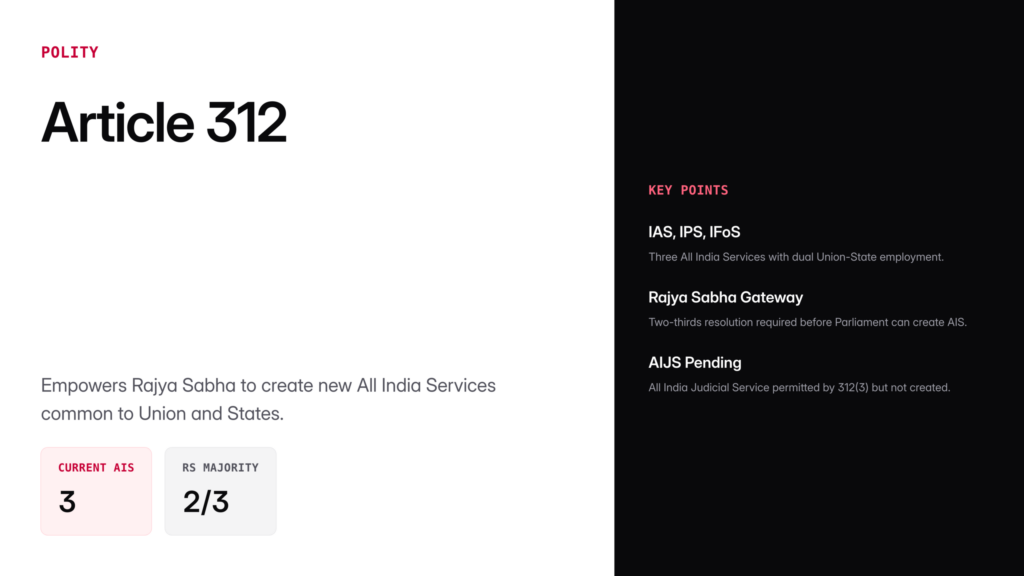
Article 312 of the Indian Constitution is the provision that makes possible India's unique All India Services (AIS) — services that are recruited and trained by the Centre but whose officers serve both the Union and the States. The article empowers the Rajya Sabha, by a resolution supported by not less than two-thirds of the members present and voting, to declare that it is necessary in the national interest to create one or more All India Services common to the Union and the States. This unusual federal mechanism makes the Rajya Sabha — the council of states — the gatekeeper of services that constitute what Sardar Patel called the "steel frame" of India.
Text and Constitutional Scheme
Article 312 appears in Part XIV of the Constitution, which deals with "Services Under the Union and the States." The key clauses are:
- 312(1): Notwithstanding anything in Chapter VI of Part VI or Part XI, if the Rajya Sabha declares by a resolution, supported by not less than two-thirds of the members present and voting, that it is necessary or expedient in the national interest to do so, Parliament may by law provide for the creation of one or more All India Services, including an All India Judicial Service, common to the Union and the States, and regulate their recruitment and conditions of service.
- 312(2): The services known as the Indian Administrative Service (IAS) and the Indian Police Service (IPS) shall be deemed to be services created by Parliament under this article.
- 312(3): The All India Judicial Service referred to in clause (1) shall not include any post inferior to that of a district judge as defined in Article 236.
- 312(4): Laws passed under this article are not to be deemed amendments to the Constitution under Article 368.
Together with Articles 308–311, Article 312 establishes the constitutional framework for civil services in India.
Why All India Services Are Unique
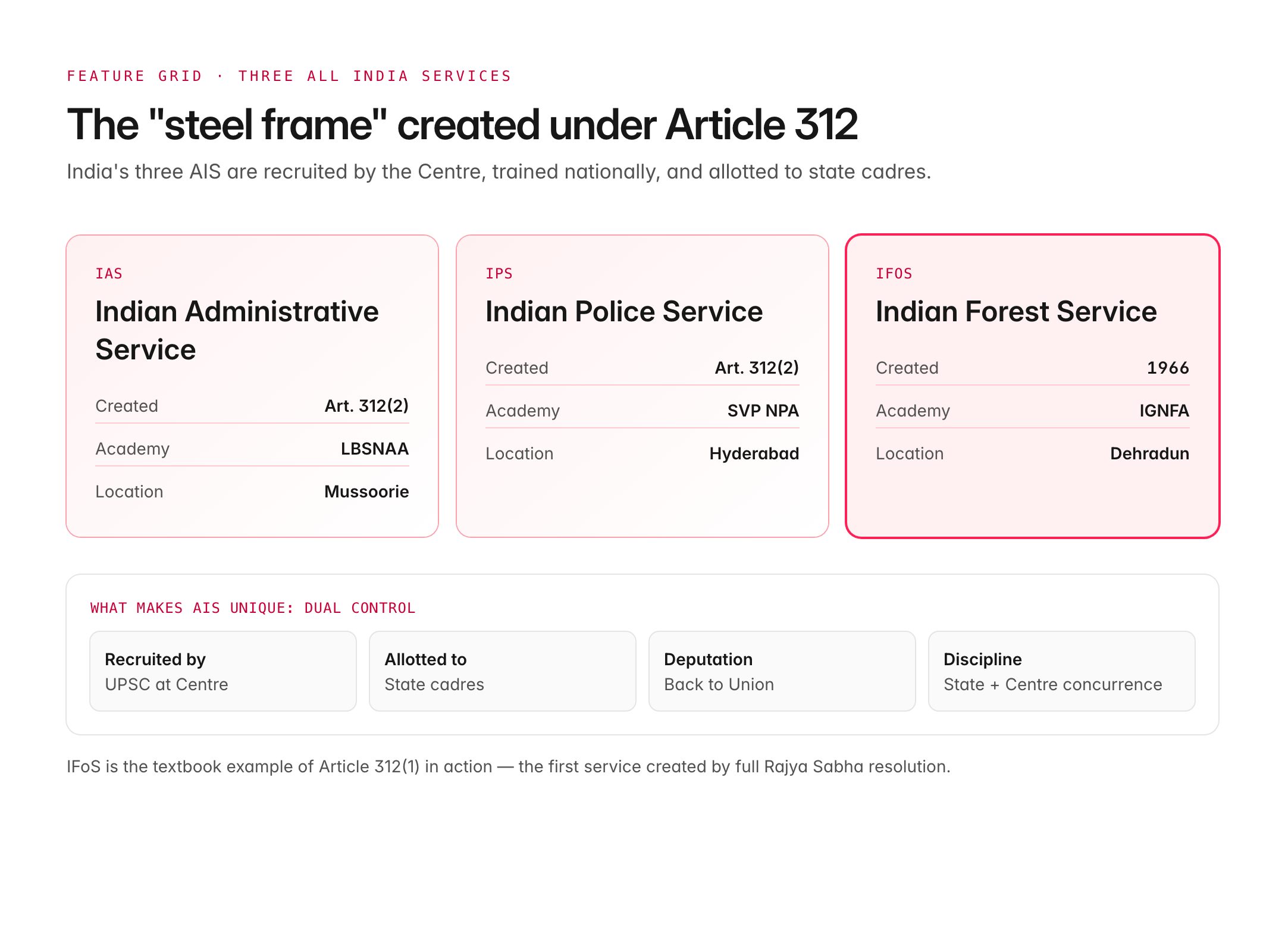
The AIS are distinctive because they combine central recruitment with dual control:
- Recruited and trained by the Centre through the Union Public Service Commission (UPSC).
- Allotted to state cadres, where officers spend the majority of their careers.
- Central deputation under the tenure system brings them back to Union ministries periodically.
- Disciplinary authority is shared: the State takes day-to-day action, but major penalties require the Centre's concurrence.
This structure is designed to preserve national unity, professional standards, and cross-state perspectives, while ensuring state-level administrative experience.
Existing All India Services
India currently has three All India Services:
| Service | Year Created | Training Academy |
|---|---|---|
| Indian Administrative Service (IAS) | Deemed created by Article 312(2) | LBSNAA, Mussoorie |
| Indian Police Service (IPS) | Deemed created by Article 312(2) | SVP NPA, Hyderabad |
| Indian Forest Service (IFoS) | 1966, by Rajya Sabha resolution under Article 312 | IGNFA, Dehradun |
The Indian Forest Service was the first AIS created under the full Rajya Sabha resolution procedure, making it the textbook example of Article 312 in action.
All India Judicial Service (AIJS)
Article 312(3) expressly permits the creation of an All India Judicial Service, but this service does not yet exist. Proposals for an AIJS have been made since the 1950s and were discussed by the First and Eighth Law Commissions, the Malimath Committee, and successive constitutional reform panels.
Arguments for an AIJS:
- Uniform standards of recruitment and training for district judges.
- Attracts national talent by improving pay and mobility.
- Addresses vacancies in subordinate judiciary.
- Promotes inclusion through reservation at entry.
Arguments against:
- Federalism concerns — judiciary is under state control in its lower tiers.
- Language barriers in states with local language court proceedings.
- High Court opposition in several states, citing autonomy of state judiciary.
As of today, most High Courts have expressed reservations, and the proposal remains under discussion.
Procedure for Creating a New AIS
The procedure under Article 312(1) is demanding:
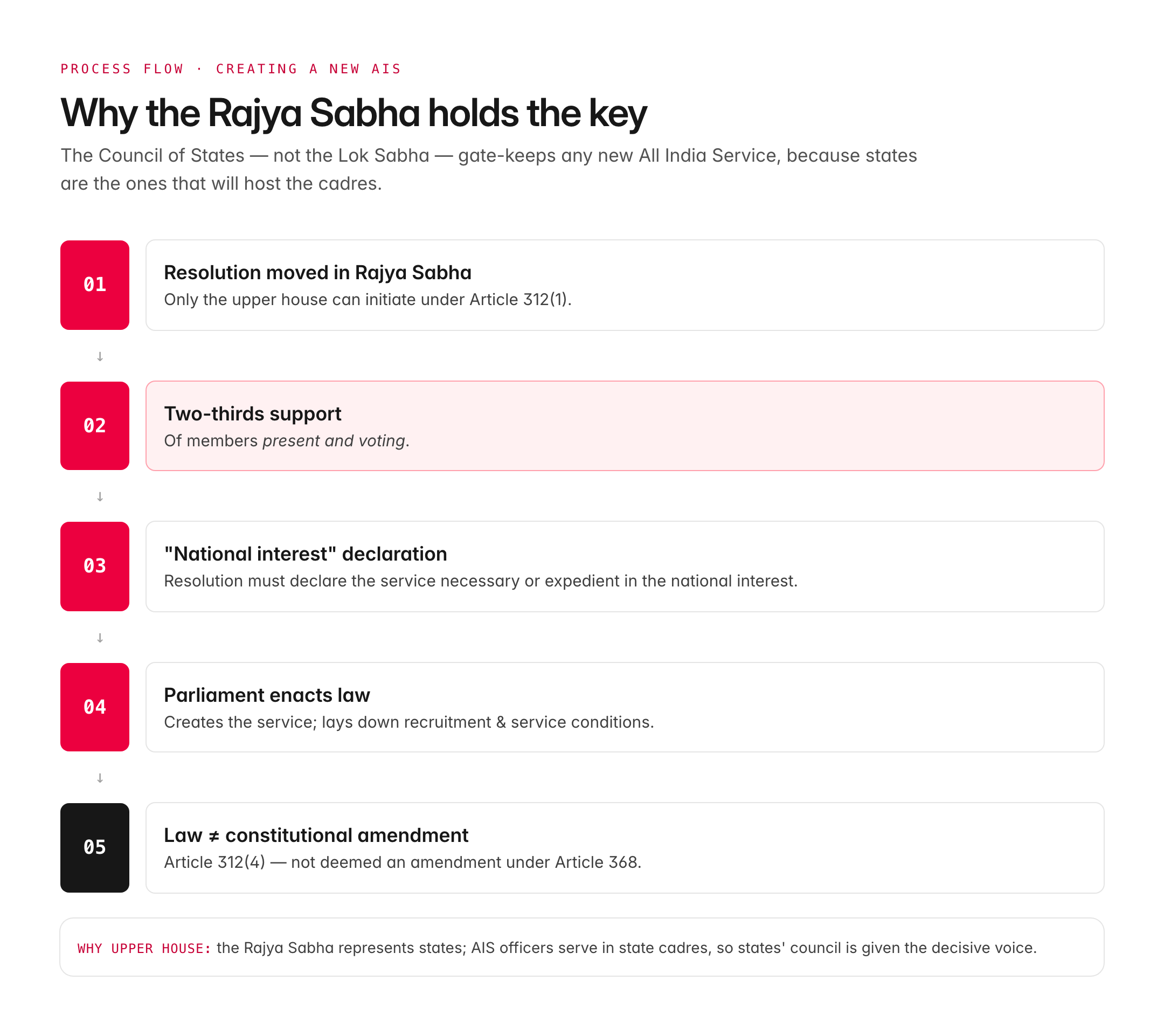
- A resolution must be moved in the Rajya Sabha.
- It must be supported by two-thirds of members present and voting.
- The resolution must declare that the new service is necessary or expedient in the national interest.
- Parliament then enacts a law creating the service and laying down recruitment and conditions of service.
No similar authority is given to the Lok Sabha, because the Rajya Sabha represents the states whose administrations will be affected by any new AIS.
Related Provisions
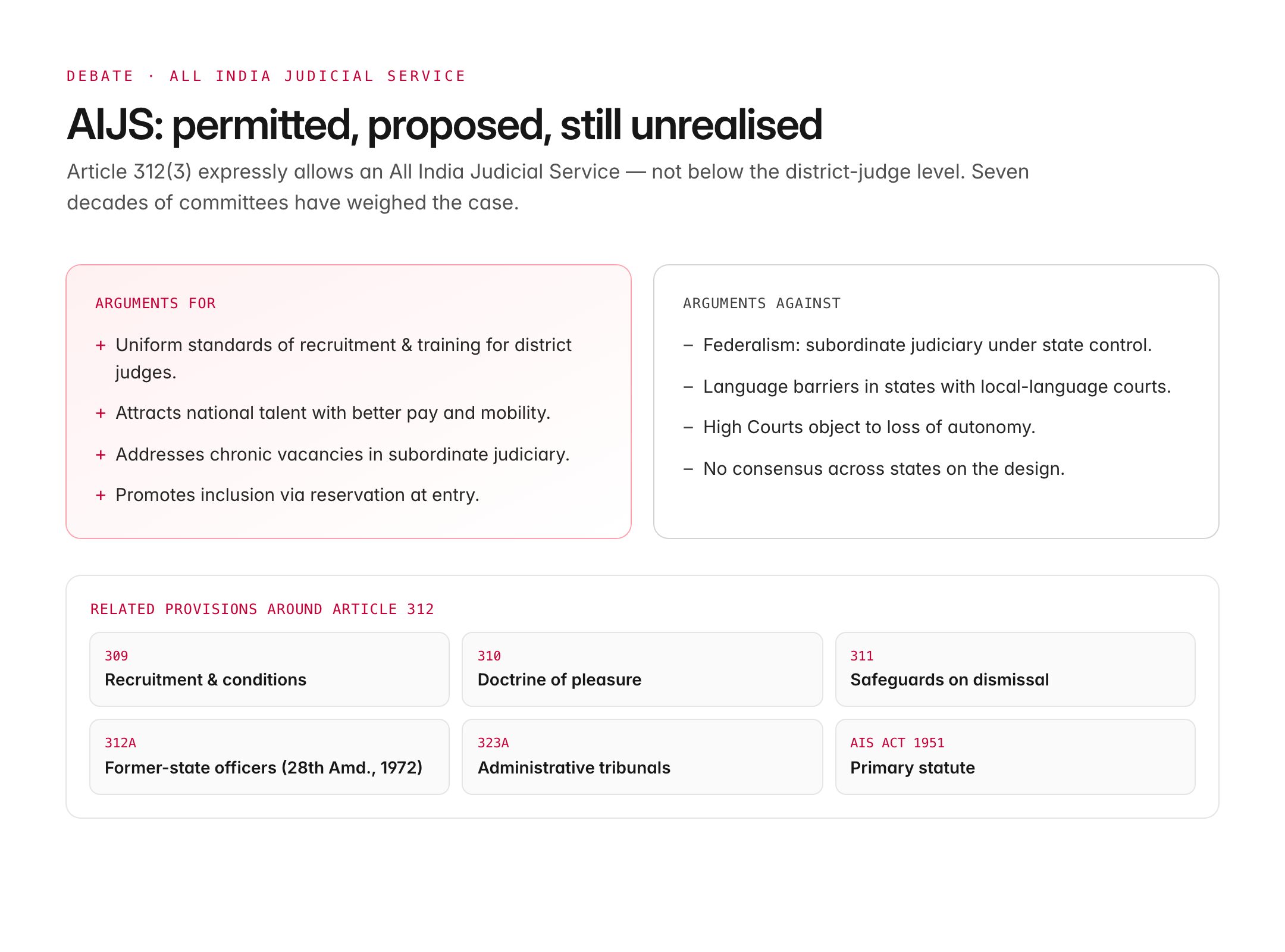
A cluster of provisions work alongside Article 312:
| Article | Subject |
|---|---|
| Article 308 | Interpretation — "State" excludes J&K for services chapter |
| Article 309 | Recruitment and conditions of service |
| Article 310 | Doctrine of pleasure |
| Article 311 | Safeguards for civil servants against arbitrary dismissal |
| Article 312A | Conditions of service of officers of former states — inserted by 28th Amendment, 1972 |
| Article 323A | Administrative tribunals |
The All India Services Act, 1951 is the primary statute under Article 312, and rules made under it — like the All India Services (Conduct) Rules, 1968 — govern the day-to-day working of AIS officers.
Significance and Contemporary Debates
Article 312 is significant for several reasons:
- Cement of federal unity. Officers trained together and rotated between states and the Centre forge a common administrative culture.
- Rajya Sabha's substantive role. Few provisions give the upper house an exclusive gatekeeping function; this is one.
- Professional baseline. AIS officers bring a degree of administrative consistency across otherwise very different states.
Contemporary debates include:
- The IAS (Cadre) Rules amendment proposal (2022) on central deputation, which several states viewed as eroding state consent.
- The long-pending AIJS proposal.
- Demands for a new AIS in areas such as engineering, health, or education.
UPSC Relevance
Prelims focus: Part XIV, three existing AIS, IFoS creation year (1966), Rajya Sabha two-thirds majority, AIJS provision under 312(3), exception for district judges, and related provisions (Articles 309, 311, 312A).
Mains GS angle:
- GS II — structure, organisation and functioning of the executive; appointment to various constitutional posts; role of civil services in a democracy; issues relating to federal structure.
- GS IV — ethical aspects of civil service neutrality and accountability.
Sample PYQ angle: UPSC has asked about the role of civil services in a democracy and about federal tensions around deputation rules. A strong answer begins with Article 312's text, explains the AIS as a vehicle of federal cohesion, evaluates the AIJS debate, and ends with suggestions — such as transparent cadre rules, minimum fixed tenure, and protection under Articles 310 and 311 — to strengthen both state autonomy and civil service independence.
Tell Google you want more of this.
Add Anantam IAS as a preferred sourceOne tap, and this site shows up more often in your own Top Stories, AI Overviews and AI Mode. Remove it any time.