Laws Governing Gold Import in India: Customs Act, Baggage Rules and the Ranya Rao Case
Complete UPSC explainer on Indian gold import law: Customs Act 1962 sections 2(39), 104, 111, 123; Baggage Rules 2016 duty-free allowance and 1 kg cap; Green vs Red channel; FEMA and BIS framework; Ranya Rao 2025 DRI smuggling case.
The smuggling of gold into India is governed by a layered legal architecture that brings together customs law, foreign exchange law, baggage rules, and an enforcement apparatus headed by the Directorate of Revenue Intelligence. The framework is technical, but it sits at the intersection of three policy concerns. The Indian state taxes gold imports because they have a substantial impact on the current account deficit. It limits private import to control the leakage of foreign exchange. It penalises smuggling because the duty differential between legal and illegal imports creates a permanent incentive to evade.
The arrest of Kannada actress Ranya Rao at Bengaluru airport in March 2025, allegedly carrying over 14 kilograms of gold from Dubai, brought the legal framework back into public attention. The case is a textbook illustration of how the Customs Act, 1962, the Baggage Rules, 2016, and the Green and Red channel system at airports work together. It also illustrates the operational role of the Directorate of Revenue Intelligence in detecting commercial-scale smuggling that exploits private travel routes.
This guide walks through the statutory framework for gold imports, the duty-free allowance for bona fide travellers, the trigger thresholds for criminal prosecution, the burden of proof on the accused under Section 123, and the policy debate on why gold smuggling persists despite a comprehensive legal regime. The topic connects with the wider law on internal security and the constitutional questions around mandatory disclosure of arrest grounds under Article 22 that arise in any DRI arrest.
Quick Facts on Gold Import Law
The principal statute is the Customs Act, 1962. Section 2(39) defines smuggling as importing goods secretly to evade duty or to violate import prohibitions. Section 111 provides for confiscation of goods imported contrary to law. Section 104 governs arrest powers, with smuggling above 50 lakh rupees treated as a non-bailable offence. Section 123 reverses the burden of proof in gold seizure cases: once the seizure is shown, the accused must prove the gold is not smuggled. The Baggage Rules, 2016, govern personal imports. Duty-free jewellery allowance, available only after one year of stay abroad, is up to 20 grams for men with a 50,000 rupee value cap and up to 40 grams for women with a 1 lakh rupee value cap. Passengers who have stayed abroad for at least six months can import up to 1 kilogram of gold on payment of duty (currently around 15 percent plus cess). Imports exceeding 1 kilogram are prohibited goods. The Green Channel is for travellers with no dutiable goods; the Red Channel is for declared imports. The Directorate of Revenue Intelligence is the principal enforcement agency for commercial gold smuggling.
What the Statutory Framework Covers
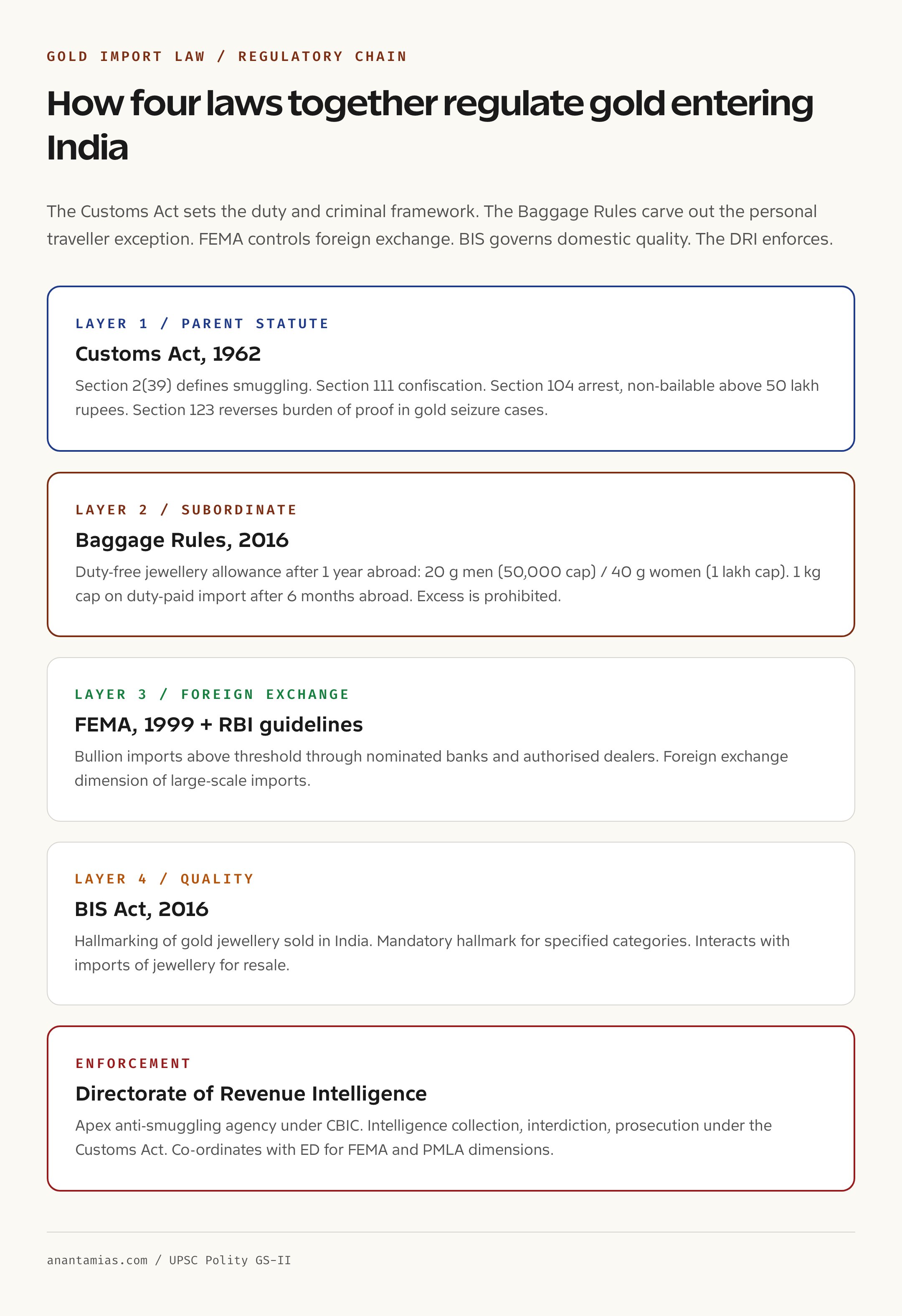
The Customs Act, 1962, is the parent legislation for all import regulation in India, including gold. The Act defines the powers of customs officers, the penalties for evasion, the framework for confiscation, and the conditions for arrest and prosecution. The Act is reinforced by the Baggage Rules, 2016, which govern the goods that a private traveller may bring into India through baggage. The Foreign Exchange Management Act, 1999, regulates the foreign exchange dimensions of gold imports, including the requirement that bullion imports above a threshold be done through nominated banks and authorised dealers under guidelines issued by the Reserve Bank of India. The Bureau of Indian Standards Act, 2016, governs the hallmarking of gold jewellery sold in India, which interacts with imports of jewellery for resale.
Together, these laws create a layered regime. The Customs Act sets the duty and the criminal framework. The Baggage Rules carve out the personal traveller exception. FEMA controls the foreign exchange flow. The BIS regime governs domestic quality. Enforcement is shared between customs officers, the Directorate of Revenue Intelligence for serious smuggling, and the Enforcement Directorate when foreign exchange or money laundering offences are also alleged.
Background and Policy Context
India is the world’s second largest consumer of gold, after China. Indian household gold holdings are estimated to exceed 25,000 tonnes, more than the official reserves of any government. The domestic demand for gold is structural, driven by household savings preferences, religious and ceremonial use, and dowry tradition in parts of the country. Domestic production is negligible, which means almost all the gold consumed in India is imported.
The policy challenge is that high gold imports widen the current account deficit and consume foreign exchange. Successive governments have tried to manage the demand through import duties, which currently sit at around 15 percent including cesses. The duty creates a price differential between legally imported gold in India and gold purchased abroad, which in turn creates an incentive for smuggling. Gold dealers can sell smuggled gold at a discount to the legal price and still earn a margin, while buyers save the duty. The economics is the principal driver of smuggling, and no enforcement effort can fully neutralise it as long as the duty differential exists.
The Customs Act, 1962, and the Baggage Rules together regulate the flow of gold across the border. The Directorate of Revenue Intelligence and the customs preventive units operate at airports, seaports, and land borders. The 2025 Ranya Rao case is one of many recent cases where commercial-scale smuggling has used the cover of private travel to bring in significant quantities of gold.
The Customs Act Framework: Sections 2(39), 104, 111 and 123
Section 2(39) of the Customs Act defines “smuggling” as any act or omission that renders goods liable to confiscation under Section 111 or Section 113. The definition covers both clandestine import and import in violation of any prohibition or restriction. The Act distinguishes between dutiable goods imported without payment of duty and prohibited goods imported in violation of an import restriction. Both are smuggling, but the consequences and enforcement intensity vary.
Section 111 lists the categories of imported goods liable to confiscation. The categories include goods imported by sea, air, or land without authorisation, goods that exceed the declared quantity, goods that are concealed in baggage or in transport, and goods that violate the conditions of the Baggage Rules. The confiscation can be absolute, in which case the goods are forfeited to the State, or it can be subject to redemption fine, which allows the importer to reclaim the goods on payment of a fine in addition to the duty.
Section 104 governs arrest powers. Customs officers can arrest a person if they have reason to believe that the person has committed an offence under the Act. For offences involving goods of value above 50 lakh rupees, the offence is non-bailable, which means bail is not available as a matter of right; the accused must apply to a magistrate or session court. The 50 lakh threshold is critical in commercial gold smuggling cases, where the value typically exceeds the limit.
Section 123 is one of the most consequential provisions for gold cases. It reverses the ordinary burden of proof. Once the prosecution shows that gold has been seized in the reasonable belief that it is smuggled, the burden shifts to the accused to prove that the gold is not smuggled. The reverse burden reflects the practical reality that the smuggler has the documentary trail and the State does not. The provision has been upheld by the Supreme Court as a reasonable allocation of evidentiary burden in customs cases.
Why It Matters
The legal framework matters for three reasons. The first is fiscal. Gold import duty is a significant source of customs revenue. Smuggling erodes the revenue and forces the government to either increase the duty (which deepens the smuggling incentive) or to absorb the loss. The second reason is foreign exchange. Smuggled gold leaves the foreign exchange leakage outside the formal banking system, which complicates the management of the current account deficit. The third reason is the integrity of the import regulation regime. A regime that is widely evaded loses public legitimacy and creates pressure for unprincipled relaxation.
The framework also matters for individual rights. The reverse burden under Section 123, the non-bailable nature of offences above 50 lakh rupees, and the broad arrest power under Section 104 create a strong State-side hand. The constitutional safeguards under Article 22 and the Bharatiya Nagarik Suraksha Sanhita apply to every customs arrest, including the right to be informed of the grounds of arrest. The interplay between customs law and constitutional safeguards is a recurring litigation theme.
Detailed Analysis: The Baggage Rules, 2016
The Baggage Rules, 2016, set out what a private traveller can bring into India without paying customs duty and what must be declared. The rules carve out two specific provisions for gold.
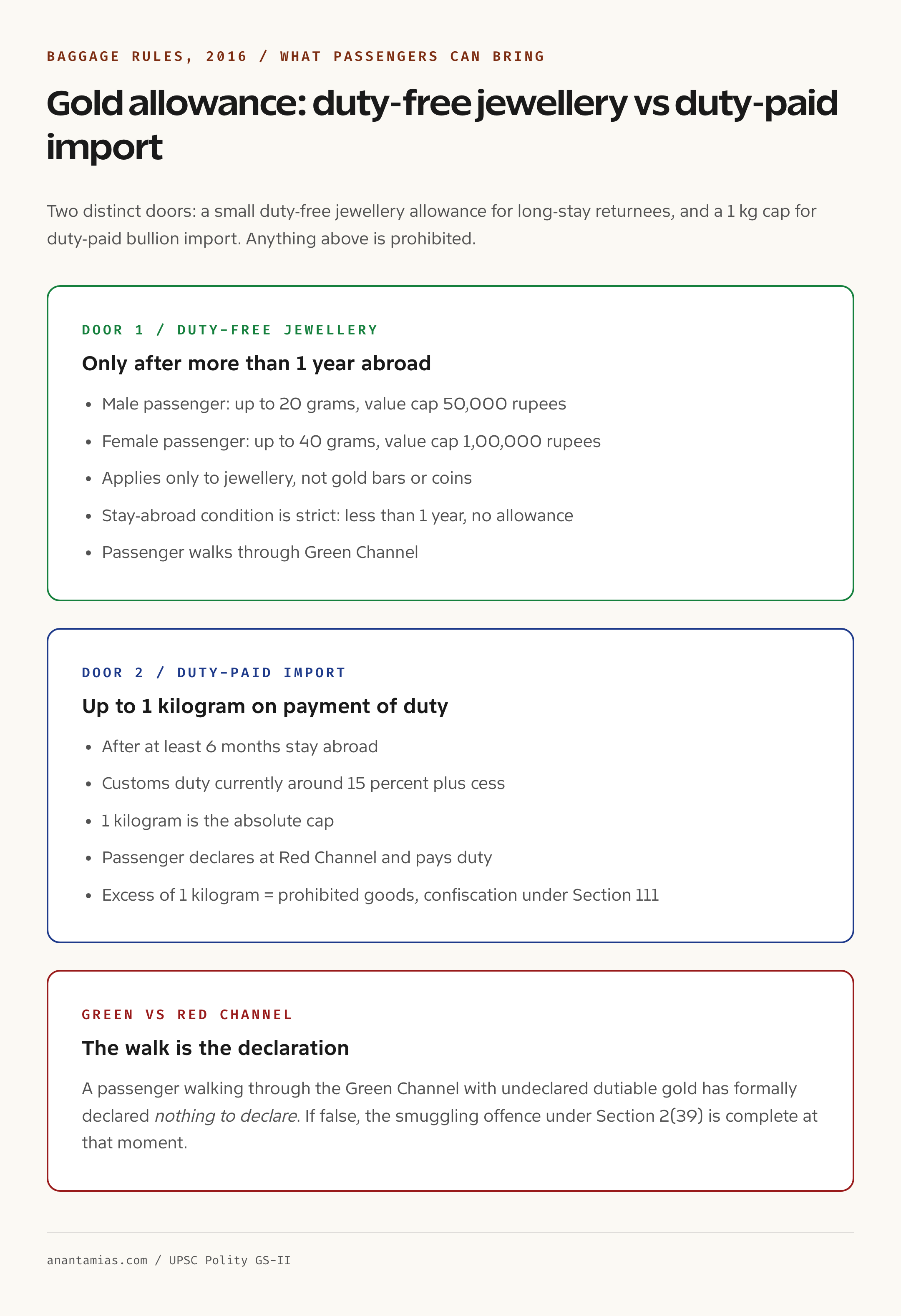
The first is the duty-free jewellery allowance. The allowance is available only to passengers who have stayed abroad for more than one year. For a male passenger, the allowance is up to 20 grams of jewellery with a value cap of 50,000 rupees. For a female passenger, the allowance is up to 40 grams with a value cap of 1 lakh rupees. The allowance applies only to jewellery, not to gold bars or coins. A passenger carrying gold bars must pay the applicable duty regardless of the value or weight.
The second is the import on payment of duty. Passengers who have stayed abroad for at least six months can import up to 1 kilogram of gold on declaring it and paying the customs duty (currently around 15 percent plus applicable cess). The 1 kilogram cap is absolute. Gold imported in excess of 1 kilogram is treated as prohibited goods and is liable for confiscation under Section 111. The passenger may also face prosecution under the criminal provisions of the Customs Act.
The Green Channel and the Red Channel system at international airports operationalises the Baggage Rules. The Green Channel is for passengers with no dutiable goods to declare. The Red Channel is for passengers carrying goods that are dutiable or that exceed the duty-free allowance. A passenger who walks through the Green Channel while carrying gold above the duty-free allowance is automatically committing an offence under the Customs Act, even before any concealment is established. The Green Channel walk-through is the formal declaration that the passenger has nothing to declare. If the declaration is false, the smuggling offence is complete.
Comparative Look: The Ranya Rao Case
The Ranya Rao case of March 2025 illustrates how the framework operates in practice. According to the Directorate of Revenue Intelligence, Ranya Rao, a Kannada film actress, arrived at Kempegowda International Airport, Bengaluru, on a flight from Dubai. She was carrying over 14 kilograms of gold concealed on her person and in her baggage. She allegedly attempted to walk through the Green Channel without declaring the gold. The DRI, acting on intelligence about her travel pattern, intercepted her and conducted a search.
The legal sequence that followed is the standard sequence for commercial gold smuggling. The gold was seized under Section 110 of the Customs Act. The seizure activated the reverse burden under Section 123. Ranya Rao was arrested under Section 104 because the value of the seized gold exceeded the 50 lakh rupee threshold and the offence was non-bailable. She was produced before a magistrate within 24 hours, in compliance with Article 22 and the BNSS. She was remanded to judicial custody pending further investigation.
The case raised additional questions. The reported pattern of multiple Dubai trips suggested commercial smuggling rather than a one-off offence. The Enforcement Directorate’s interest reflected the foreign exchange and money laundering dimensions, which trigger the Prevention of Money Laundering Act, 2002. The investigation has continued through 2025, with the prosecution case being built on the basis of seized gold, travel records, and corroborative evidence.
Challenges and Reform Options

Three structural challenges affect gold smuggling enforcement. The first is the duty differential. As long as the customs duty on gold remains high, the economic incentive to smuggle remains. Periodic discussion of duty rationalisation has not produced sustained policy change because of the fiscal cost of any reduction. The second challenge is the use of legitimate travel routes for commercial smuggling. Personal baggage is harder to scrutinise than commercial cargo. Random checking and intelligence-based interdiction can deter but cannot eliminate the practice. The third challenge is the geographic spread of the smuggling network. Commercial smuggling rings have linked sources in the Gulf with distribution networks in India that operate through several airports and entry points.
Reform options under discussion include a calibrated reduction in the import duty to narrow the smuggling incentive, an enhancement of intelligence sharing between the DRI, customs preventive units, and state police, and a tightening of the reporting and reconciliation requirements for nominated banks under FEMA. None of these measures is novel; the question has been about the political will to commit fiscal resources to a long-term reduction in the duty differential.
Prelims Pointers
The principal statute for gold import regulation is the Customs Act, 1962. Section 2(39) defines smuggling, Section 111 provides for confiscation, Section 104 governs arrest, and Section 123 reverses the burden of proof. The 50 lakh rupee threshold makes smuggling offences non-bailable. The Baggage Rules, 2016, allow duty-free jewellery only after one year of stay abroad: 20 grams for men with a 50,000 rupee cap and 40 grams for women with a 1 lakh rupee cap. Passengers who have stayed abroad for six months can import up to 1 kilogram of gold on payment of duty (currently around 15 percent plus cess). Imports above 1 kilogram are prohibited. The Green Channel is for no-declaration passengers; the Red Channel is for declared imports. The Directorate of Revenue Intelligence is the principal enforcement agency. The Ranya Rao case, March 2025, involved over 14 kilograms of gold seized at Bengaluru airport.
A common trap statement: “The duty-free gold allowance applies to all passengers regardless of duration of stay abroad.” This is incorrect. The allowance is conditional on more than one year of stay abroad. Another trap: “A passenger can import up to 1 kilogram of gold without paying duty after six months abroad.” This is incorrect. The 1 kilogram cap applies on payment of duty; the duty-free allowance is separately limited to jewellery and small quantities.
Mains Practice Questions
- The Indian gold import regime combines customs law, baggage rules, foreign exchange law, and quality regulation. Discuss the architecture and the policy logic that holds it together. (GS Paper 2 / GS Paper 3, 250 words)
- Section 123 of the Customs Act, 1962, reverses the burden of proof in gold seizure cases. Examine the constitutional and policy justification for this provision. (GS Paper 2, 150 words)
- The duty differential is the fundamental driver of gold smuggling in India. Critically examine the reform options available to reduce smuggling. (GS Paper 3, 250 words)
- The Ranya Rao case illustrates the operational role of the Directorate of Revenue Intelligence in commercial gold smuggling. Discuss the functions of the DRI and its place in the enforcement architecture. (GS Paper 3, 150 words)
Way Forward
The gold import legal regime in India is well developed, but its effectiveness is shaped by the duty differential and the demand for gold in the household sector. A gradual reduction in import duty, combined with stronger intelligence-led enforcement and a continued emphasis on hallmarking and BIS standards, would reduce the smuggling incentive without compromising fiscal revenue. The legal framework itself does not require fundamental reform; it requires consistent implementation and periodic recalibration.
For UPSC aspirants, the topic is a useful illustration of how multiple legal regimes converge on a single problem. The interaction between the Customs Act, the Baggage Rules, FEMA, and the BIS framework, and the constitutional safeguards under Article 22 and the BNSS, makes for a rich integrated understanding. The Ranya Rao case is a contemporary anchor that connects the technical statutory provisions with public attention.
Frequently Asked Questions
Which law primarily governs gold imports in India?
The Customs Act, 1962, is the primary statute. It defines smuggling, provides for confiscation of contraband, governs arrest powers and bail, and reverses the burden of proof in gold seizure cases. The Baggage Rules, 2016, made under the Act, govern personal imports by travellers. The Foreign Exchange Management Act and the BIS Act add the foreign exchange and quality dimensions.
What is the duty-free gold allowance for Indian travellers?
The duty-free allowance is available only to passengers who have stayed abroad for more than one year. The allowance is up to 20 grams of jewellery for men with a 50,000 rupee value cap, and up to 40 grams of jewellery for women with a 1 lakh rupee value cap. The allowance is for jewellery only and does not apply to gold bars or coins.
How much gold can a returning Indian passenger import on payment of duty?
A passenger who has stayed abroad for at least six months can import up to 1 kilogram of gold on payment of the applicable customs duty, currently around 15 percent plus cess. The 1 kilogram cap is absolute. Imports above 1 kilogram are treated as prohibited goods and are liable for confiscation and prosecution.
What does Section 123 of the Customs Act do?
Section 123 reverses the ordinary burden of proof in gold seizure cases. Once the prosecution shows that gold has been seized in the reasonable belief that it is smuggled, the burden shifts to the accused to prove that the gold is not smuggled. The reverse burden reflects the practical reality that the documentary trail is held by the smuggler.
What is the difference between the Green Channel and the Red Channel at airports?
The Green Channel is for passengers who have no dutiable goods to declare. The Red Channel is for passengers carrying goods that are dutiable or exceed the duty-free allowance. A passenger who walks through the Green Channel while carrying undeclared dutiable goods is committing a customs offence at that moment.
What was the Ranya Rao case about?
In March 2025, the Directorate of Revenue Intelligence intercepted Kannada actress Ranya Rao at Bengaluru airport allegedly carrying over 14 kilograms of gold from Dubai. She is alleged to have walked through the Green Channel without declaring the gold. She was arrested under Section 104 of the Customs Act, the offence being non-bailable because the value exceeded 50 lakh rupees. The case triggered DRI investigation, judicial custody, and parallel ED proceedings on foreign exchange and money laundering dimensions.
What is the role of the Directorate of Revenue Intelligence in gold smuggling cases?
The DRI is the apex anti-smuggling agency under the Central Board of Indirect Taxes and Customs. It collects intelligence on smuggling networks, conducts interdictions at airports, seaports, and land borders, and prosecutes offences under the Customs Act. The DRI typically handles commercial-scale smuggling that exceeds the operational threshold of routine customs preventive units.
Why is gold smuggling a persistent problem despite a comprehensive legal regime?
The fundamental driver is the duty differential between legally imported gold and gold purchased abroad. As long as the import duty creates a price gap, the economic incentive to smuggle persists. Enforcement can deter but cannot eliminate smuggling without a corresponding reduction in the duty differential or a structural reduction in domestic demand for gold.
How do FEMA and the RBI guidelines apply to gold imports?
The Foreign Exchange Management Act, 1999, governs the foreign exchange dimensions of gold imports. The Reserve Bank of India issues guidelines on import of bullion through nominated banks and authorised dealers. Commercial-scale gold imports are restricted to authorised channels, and any import outside these channels can attract FEMA penalties in addition to the customs offences.
What is the relationship between the Customs Act provisions and constitutional safeguards under Article 22?
Every customs arrest must comply with Article 22 of the Constitution, which requires that the arrested person be informed of the grounds of arrest, be allowed to consult a legal practitioner, and be produced before a magistrate within 24 hours. The Bharatiya Nagarik Suraksha Sanhita provisions on arrest disclosure also apply. Customs powers under Section 104 are subject to these constitutional safeguards.