The Directorate of Revenue Intelligence is the Government of India’s apex anti-smuggling intelligence agency. It is the agency that surfaces in news reports about gold seizures at airports, narcotics busts at ports, hydroponic weed shipments at international cargo terminals, and commercial fraud investigations involving large import-export operations. It is also the agency that operates almost entirely in the background, since its work is intelligence-led and its public profile is restricted by the nature of the cases it handles.
For a UPSC aspirant, the DRI is a useful case study in how a non-statutory intelligence agency can wield statutory powers through a layered legal architecture. The directorate is not constituted by an Act of Parliament. Its officers are not, in their own right, statutory law enforcement officers. But once they are notified as Customs Officers under the Customs Act, 1962, and as authorised officers under the Narcotic Drugs and Psychotropic Substances Act, 1985, they acquire formidable powers of search, seizure, arrest, and prosecution.
This guide walks through the DRI’s establishment and parent body, its mandate covering both outright smuggling and commercial fraud, the statutory powers it exercises through borrowed authority, its lead agency role under the Anti-Smuggling National Coordination Centre, the unique role it plays under COFEPOSA, and how the directorate connects to broader internal security and border management frameworks.
Establishment and Parent Body
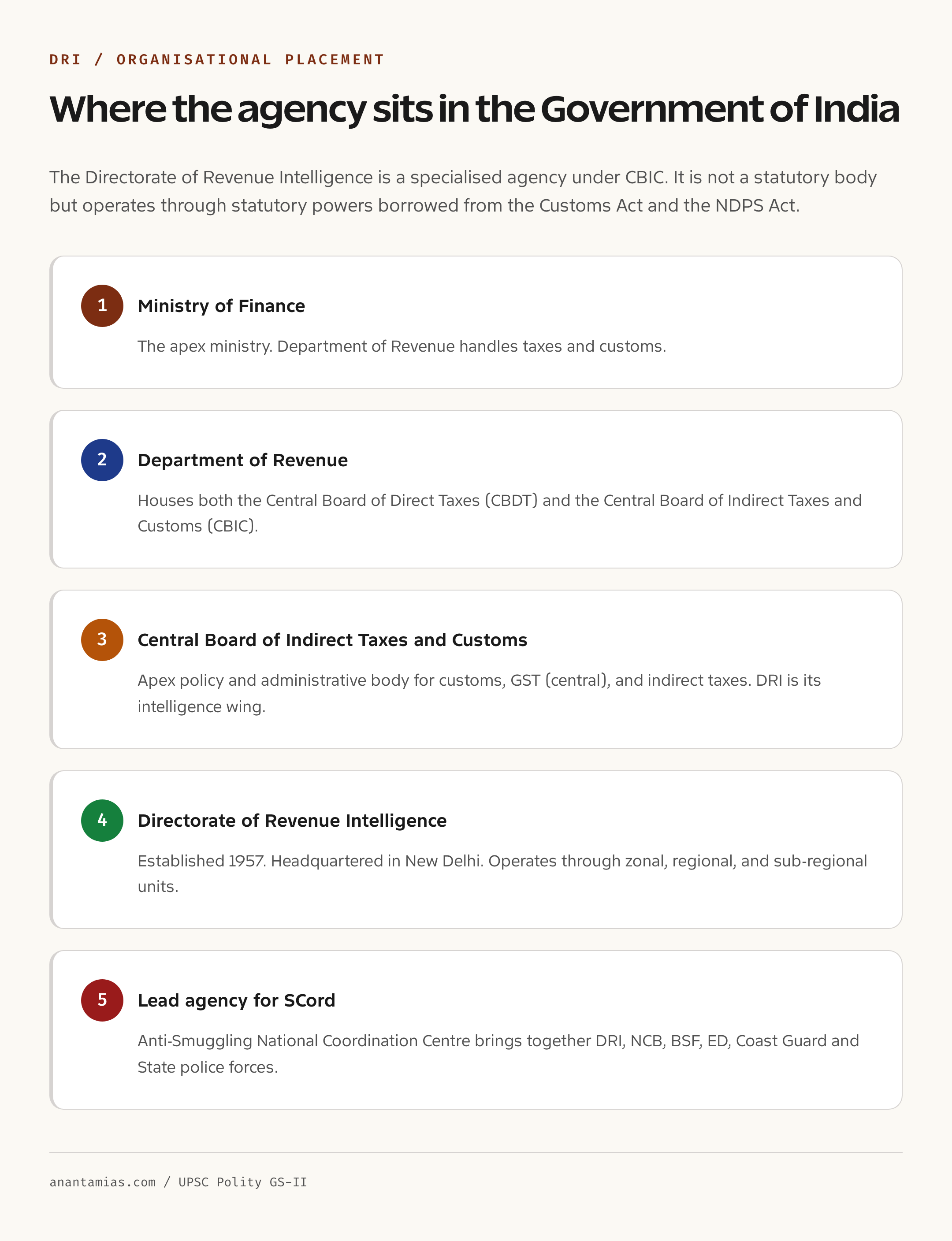
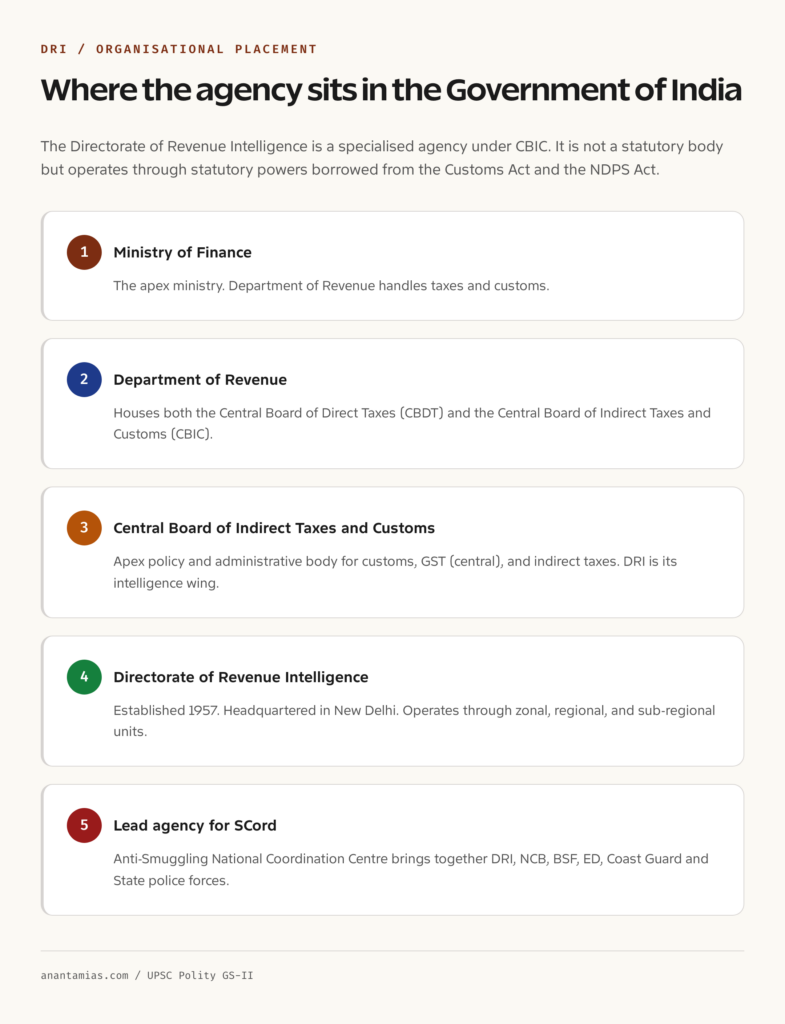
The Directorate of Revenue Intelligence was established in 1957. It functions as a specialised agency under the Central Board of Indirect Taxes and Customs, which sits under the Department of Revenue in the Ministry of Finance. The CBIC is the apex policy and administrative body for indirect taxes and customs, and the DRI is its dedicated intelligence and enforcement wing for smuggling and customs-related offences.
The directorate is headquartered in New Delhi. It operates through a network of zonal units, regional units, and sub-regional units spread across the country, with a particular concentration at major ports, airports, land border points, and metropolitan cities. The Director General of DRI heads the agency. Officers are drawn from the Indian Revenue Service (Customs and Indirect Taxes), with secondments from related services and police forces for specialised functions.
The 1957 establishment date is older than several other intelligence and enforcement agencies that are now better known. The directorate’s longevity has given it a deep institutional memory of smuggling networks, modus operandi, and intelligence sources. Successive amendments to the Customs Act and the NDPS Act have expanded its statutory toolkit, while the agency has remained organisationally lean.
Mandate: Outright Smuggling
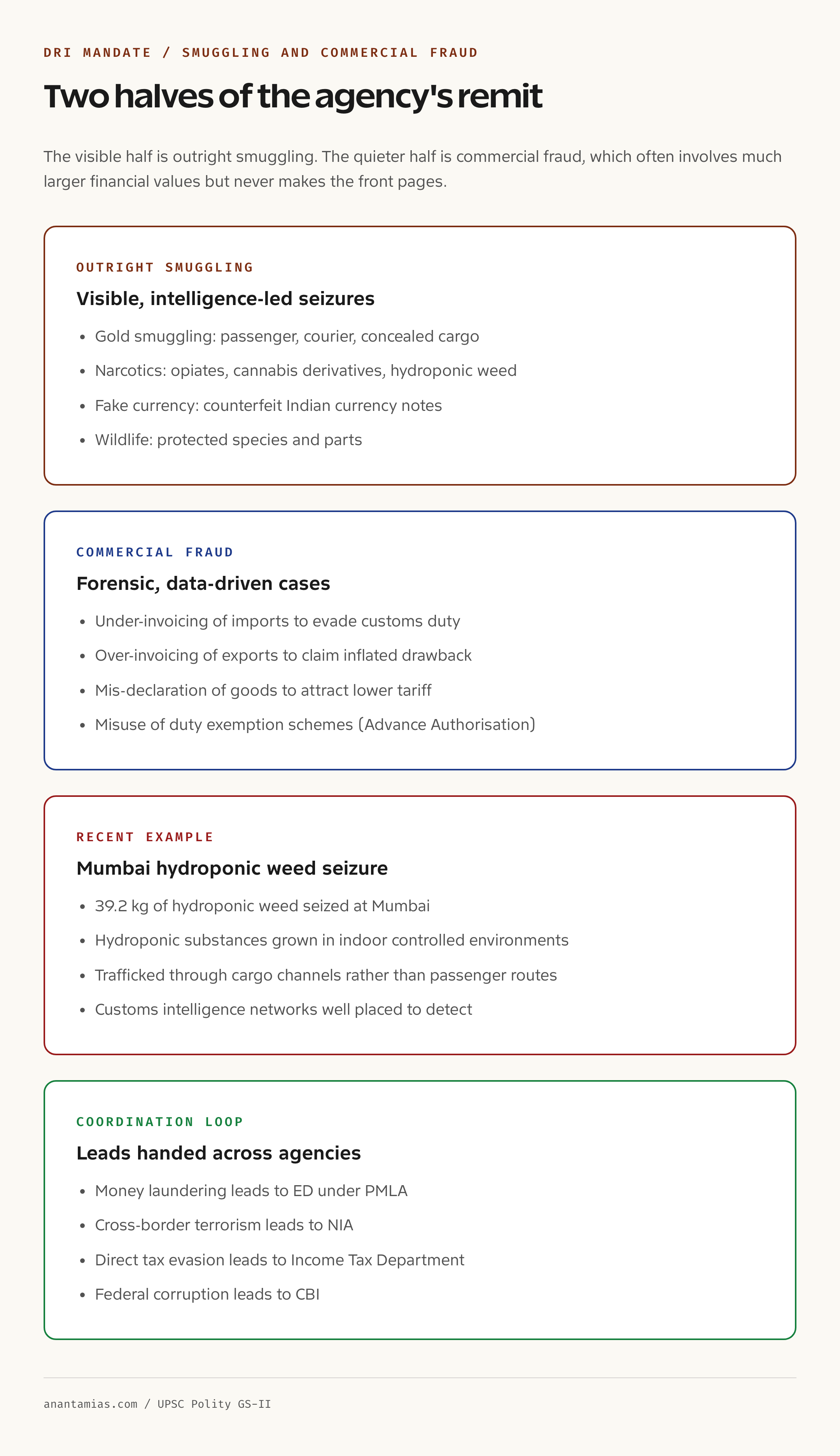
The DRI’s first and most visible mandate is preventing outright smuggling. The agency is the lead intelligence agency on smuggling of gold, narcotics, fake currency, and wildlife. Each of these categories carries a different legal framework, but the DRI sits at the centre of the intelligence picture.
Gold smuggling has been a recurring DRI priority. The agency tracks consignments coming in through air passenger routes, courier shipments, and concealed cargo. Modus operandi has evolved from simple passenger concealment to sophisticated routing through multiple transit points. Recent years have seen significant DRI seizures of gold along with parallel investigations into the chain of receivers and financiers.
Narcotics smuggling is the second major area. The DRI works alongside the Narcotics Control Bureau on cases involving international trafficking of opiates, cannabis derivatives, synthetic drugs, and increasingly hydroponic weed. The 39.2 kg hydroponic weed seizure at Mumbai is a recent example. Hydroponic weed is grown in indoor controlled environments and trafficked through cargo channels, and the DRI’s customs intelligence networks are well placed to detect it.
Fake currency interdiction and wildlife smuggling round out the outright smuggling mandate. The DRI handles cases involving fake Indian currency notes, often originating from cross-border sources, and works with the National Crime Records Bureau and State police forces on prosecution. Wildlife smuggling cases involve protected species and parts, and the DRI coordinates with the Wildlife Crime Control Bureau and the Ministry of Environment, Forest and Climate Change.
Mandate: Commercial Fraud
The DRI’s second mandate, less visible but financially significant, is combating commercial fraud. Commercial fraud in the customs context typically involves under-invoicing of imports to evade customs duty, over-invoicing of exports to claim inflated drawback or other export incentives, mis-declaration of goods to attract a lower tariff, and misuse of duty exemption schemes such as the Advance Authorisation Scheme.
These cases run quietly through the agency. They depend on data analytics, information sharing with foreign customs administrations, examination of importer-exporter records, and forensic accounting. The financial values involved often run into hundreds of crores of rupees, and the prosecutions can take years. The DRI’s commercial intelligence work plugs into India’s broader trade-policy and revenue-protection effort.
The shift to GST in 2017 reduced one slice of the DRI’s earlier remit. Indirect taxes on goods were largely subsumed into GST, and CGST authorities took over the enforcement of GST evasion. The DRI’s customs mandate, however, remained intact. Customs duty, IGST on imports, and customs-related compliance continue to be its enforcement focus.
Statutory Authority: Customs Act, 1962
The DRI is not a statutory body. There is no Act of Parliament establishing the directorate. The agency is constituted by executive order. Its officers therefore have no inherent statutory powers as DRI officers. The legal architecture compensates by routing statutory powers through other Acts.
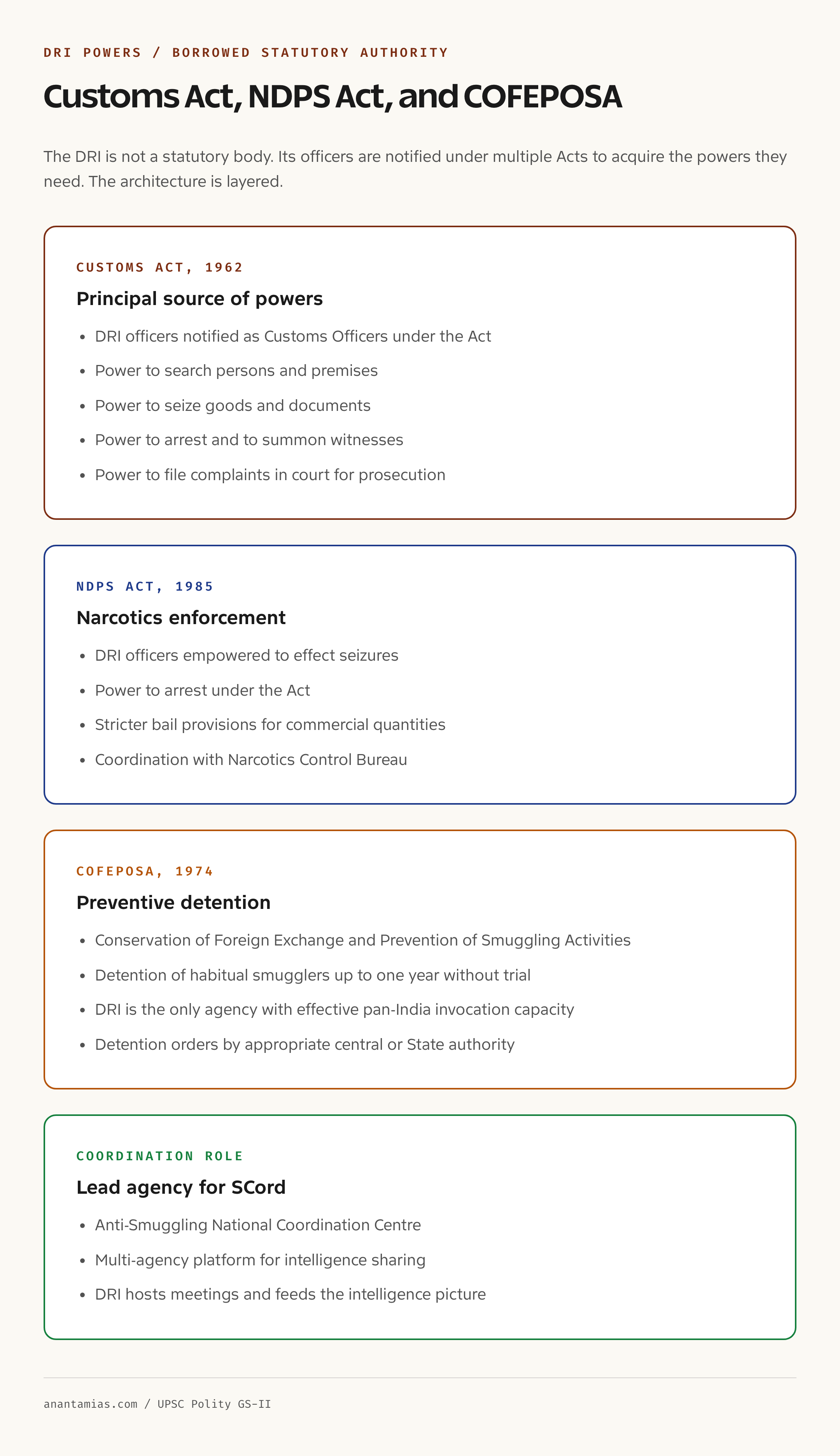
The Customs Act, 1962 is the first such Act. The Central Government has notified DRI officers as Customs Officers under the Act. Once so notified, they exercise the full range of customs officer powers. These include the power to search persons and premises, the power to seize goods and documents, the power to arrest, the power to summon and examine persons, and the power to file complaints in court for prosecution. The notification mechanism is what makes a DRI investigator legally indistinguishable from a customs officer at the operational level.
The Customs Act framework also defines smuggling, prescribes penalties, and lays down the adjudication process. Show cause notices, confiscation orders, and personal penalties all flow through the Customs Act. The DRI’s investigations typically end either in adjudication before Customs authorities or in prosecution before designated courts.
Statutory Authority: NDPS Act, 1985
The Narcotic Drugs and Psychotropic Substances Act, 1985 is the second source of DRI’s statutory powers. The Central Government has empowered DRI officers to effect seizures and make arrests under the NDPS Act. This is what allows the agency to handle narcotics cases beyond the customs envelope.
The NDPS Act carries some of the strictest penalties in Indian criminal law. Offences involving commercial quantities can attract minimum sentences of ten years, with maximums of twenty years. Bail provisions are restrictive. The DRI’s role is to detect, investigate, and prosecute under the Act, often in coordination with the Narcotics Control Bureau, which is the primary central agency dedicated to narcotics enforcement.
The NDPS empowerment also gives the DRI a key role in international narcotics intelligence sharing. The agency liaises with foreign counterpart agencies, with Interpol, and with the United Nations Office on Drugs and Crime. The international dimension is particularly important for cases involving synthetic drugs and hydroponic substances, where source countries and trafficking routes change rapidly.
Lead Agency for SCord
The DRI is the lead agency for the Anti-Smuggling National Coordination Centre, abbreviated as SCord. SCord is a multi-agency coordination platform established to harmonise the anti-smuggling efforts of the various central agencies operating in this space. These include the DRI itself, the Narcotics Control Bureau, the Border Security Force, the Directorate of Enforcement, the Coast Guard, and the State police forces.
SCord meetings bring agency heads and senior officers together to share intelligence, deconflict operations, and coordinate large-cycle enforcement actions. The DRI’s role as the lead agency reflects its long institutional history and its centrality in the customs intelligence ecosystem. Hosting SCord also gives the DRI visibility into the work of other agencies and a coordinating influence on national anti-smuggling priorities.
COFEPOSA and Preventive Detention
The Conservation of Foreign Exchange and Prevention of Smuggling Activities Act, 1974, better known as COFEPOSA, is the preventive detention statute that allows the State to detain habitual smugglers and foreign exchange offenders for up to one year without trial. The DRI is, in practice, the only agency with the capacity to invoke COFEPOSA effectively across the country.
COFEPOSA detention orders are issued by the appropriate central or State authority on the basis of evidence and proposals submitted by enforcement agencies. The DRI’s intelligence and case files are the principal source of such proposals. The agency’s capacity to track repeat offenders, assemble evidence of the pattern of smuggling, and present a coherent case to the detaining authority gives it a unique role under the Act.
COFEPOSA is a controversial instrument. Preventive detention without trial sits at the edge of the constitutional framework, and challenges to detention orders are regularly heard by High Courts and by the Supreme Court. The Act survived constitutional scrutiny in early cases on the strength of its narrow targeting and its procedural safeguards, but its use is necessarily kept tight. The DRI’s centrality to the COFEPOSA process is therefore both an institutional strength and a source of significant responsibility.
Coordination With Other Agencies
The DRI works alongside a constellation of other agencies. The Narcotics Control Bureau leads on dedicated narcotics cases. The Directorate of Enforcement leads on foreign exchange and money laundering investigations under FEMA and PMLA. The Income Tax Department leads on direct tax evasion. The Central Bureau of Investigation handles federal corruption and economic offences. The State police forces enforce general criminal law.
The DRI’s customs intelligence often surfaces leads that are then handed off to one or more of these agencies. A gold smuggling case may yield evidence of money laundering, which goes to the ED. A narcotics case may reveal links to cross-border terrorism, which goes to the National Investigation Agency. The DRI’s value lies partly in the original intelligence and partly in its ability to feed leads into the broader enforcement ecosystem.
Challenges and Reform Demands
The agency faces several recurring challenges. Manpower has not kept pace with the growth of trade volumes and the diversification of smuggling networks. The agency’s non-statutory status has periodically been raised as an issue, with proposals to give it a statutory foundation similar to the National Investigation Agency or the Directorate of Enforcement. Coordination with State police forces remains uneven.
Some legal challenges have also questioned the DRI’s powers. The Supreme Court’s decision in Canon India Private Limited v. Commissioner of Customs (2021) raised questions about whether DRI officers could issue show cause notices in certain situations. The Government responded with the Finance Act, 2022 amendments that clarified the DRI’s authority retrospectively. The episode illustrates the legal vulnerability that flows from operating through borrowed statutory powers rather than a dedicated establishing Act.
UPSC Relevance and Likely Questions
The DRI is a frequently appearing topic in GS Paper II and GS Paper III for prelims and mains. Prelims questions typically test the parent ministry, the year of establishment, the relevant Acts, and the lead agency role under SCord. Mains questions can ask candidates to discuss the DRI’s role in border management and internal security, to evaluate the trade-off between non-statutory flexibility and statutory authority, or to compare the DRI with other federal enforcement agencies.
A strong answer should identify the DRI as the apex anti-smuggling intelligence agency under CBIC and the Ministry of Finance, mention 1957 as the year of establishment, list the Customs Act 1962 and NDPS Act 1985 as the two main statutory pillars, mention the SCord coordination role, and note the COFEPOSA preventive detention authority. Reference to the Canon India case and the Finance Act 2022 fix shows depth, as does mention of recent operational examples such as the hydroponic weed seizure.
Frequently Asked Questions
What is the Directorate of Revenue Intelligence?
The Directorate of Revenue Intelligence is the apex anti-smuggling intelligence agency of India. It functions under the Central Board of Indirect Taxes and Customs in the Ministry of Finance and was established in 1957.
Is the DRI a statutory body?
No. The DRI is not constituted by an Act of Parliament. Its officers are notified as Customs Officers under the Customs Act, 1962 and as authorised officers under the NDPS Act, 1985, which gives them statutory powers of search, seizure, arrest, and prosecution.
What is the DRI’s mandate?
The DRI’s mandate covers preventing outright smuggling of gold, narcotics, fake currency, and wildlife, and combating commercial fraud such as under-invoicing of imports, over-invoicing of exports, mis-declaration of goods, and misuse of duty exemption schemes.
What is SCord and what is the DRI’s role in it?
SCord is the Anti-Smuggling National Coordination Centre, a multi-agency platform that harmonises India’s anti-smuggling efforts. The DRI is the lead agency for SCord and hosts its meetings and intelligence-sharing functions.
What is COFEPOSA and how does the DRI use it?
COFEPOSA is the Conservation of Foreign Exchange and Prevention of Smuggling Activities Act, 1974, which allows preventive detention of habitual smugglers for up to one year without trial. The DRI is, in practice, the only agency with the capacity to invoke COFEPOSA effectively across India.
Under which Acts does the DRI exercise its main powers?
The DRI exercises its main statutory powers under the Customs Act, 1962 for customs offences and under the Narcotic Drugs and Psychotropic Substances Act, 1985 for narcotics offences. It also relies on COFEPOSA, 1974 for preventive detention.
Tell Google you want more of this.
Add Anantam IAS as a preferred sourceOne tap, and this site shows up more often in your own Top Stories, AI Overviews and AI Mode. Remove it any time.