Lexicon Ethics Book: Which Edition to Buy, How to Read It and What It Won’t Do for GS Paper IV
A reading guide to Chronicle's Lexicon for Ethics, Integrity and Aptitude: the 2026 12th edition, how it maps to the GS IV syllabus and a four-week plan to use it.
The Lexicon ethics book from Chronicle sits on almost every GS Paper IV shelf, and the doubt you have about it is a fair one: is a dictionary of ethics terms something you read, or something you consult? It is the second. The Lexicon for Ethics, Integrity and Aptitude arranges the syllabus as definitions, distinctions, thinkers and quotations, with a case-study section at the back. That makes it an excellent revision index and a weak first book, because the paper rewards reasoning on a case more than recall of a term.
Aspirants generally handle it in one of three ways. Some read it cover to cover as their only ethics book and arrive at the exam with six hundred crisp definitions and no practice at a 250-word case. Others hear that it’s just a keyword list, never buy it, and spend the week before Mains struggling to define probity in a single line.
The middle path is to own it and not to read it. It is wise to pair the Lexicon with one textbook, open it after each textbook chapter to sharpen the terms, and give the saved hours to writing case studies. Before the section map, I want to settle which edition to buy, because the copies on sale carry three different page counts.
What the Lexicon is, and which edition to buy
The Lexicon for Ethics, Integrity and Aptitude is a GS Paper IV reference from Chronicle Publications, compiled by the Chronicle Editorial Team with Niraj Kumar. The 2026 edition is the 12th edition, published in November 2025 and listed at 594 pages on Amazon.in. The Hindi edition, द लेक्सिकन नीतिशास्त्र, सत्यनिष्ठा व अभिरुचि, is a 2026 print of 608 pages.
- Publisher: Chronicle Publications, New Delhi.
- English edition: 12th edition, 2026, published 11 November 2025, 594 pages.
- Hindi edition: 2026, published 27 November 2025, 608 pages.
- Structure: two parts, Ethics, Integrity and Aptitude theory, then a Case Study part, plus a glossary of key terms.
The page count on other listings runs from 575 to 592. They are resellers of the same book, so check that the title says 2026 and the publisher says Chronicle before you order.
The theory half doesn’t date much; empathy meant the same thing in 2019. What changes each year is the case-study half, which includes an analysis of recent GS IV papers. That analysis is the reason to buy the current print instead of a senior’s copy.
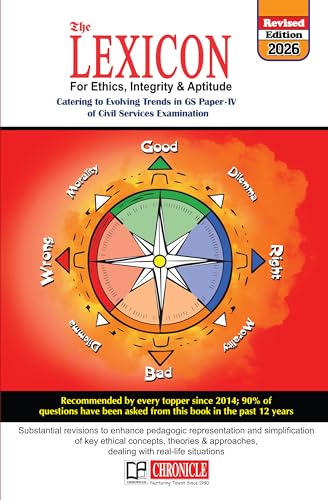
The Lexicon for Ethics, Integrity and Aptitude 2026, Chronicle (12th Edition)
- 594 pages, Chronicle Publications, compiled by the Chronicle Editorial Team with Niraj Kumar
- Theory sections that follow the GS IV syllabus, plus thinkers, quotations and a glossary
- A case-study part with an analysis of recent GS IV papers
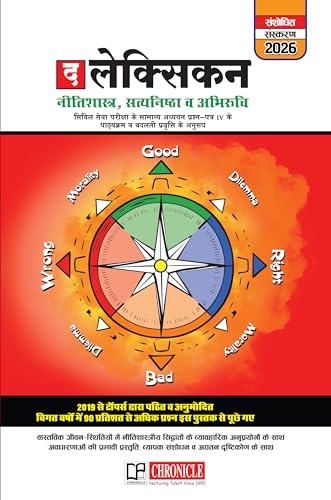
द लेक्सिकन: नीतिशास्त्र, सत्यनिष्ठा व अभिरुचि 2026, Chronicle (हिंदी संस्करण)
- 608 पेज, Chronicle Publications, 2026 संस्करण
- GS पेपर IV के पाठ्यक्रम के क्रम में परिभाषाएँ, विचारक और उद्धरण
- हिंदी माध्यम में मुख्य परीक्षा लिखने वालों के लिए
If you write Mains in Hindi, buy the Hindi edition. The terms you define in the exam hall should be the ones you revised, not your own translation of an English entry.
Who the Lexicon is for, and who should start elsewhere
The Lexicon ethics book suits aspirants who understand the syllabus but can’t yet define its terms crisply, and repeaters who want a revision index. A first-timer with no ethics reading at all should start with a textbook and come to the Lexicon a month later.
GS Paper IV carries 250 marks. In the 2026 paper, Section A set 13 questions at 10 marks each and Section B set 6 case studies at 20 marks each, a split of 130 against 120. A term-by-term reference serves Section A directly. It serves Section B only indirectly, through the vocabulary you bring to a case. The 2026 GS IV paper with model answers shows how that split played out.
Use it as a core reference if:
- You can explain a concept in a paragraph but can’t define it in one line.
- Your answers lack thinkers, quotations or administrative examples.
- This is your second attempt and you want a single index to revise the syllabus from.
Start somewhere else first if:
- You haven’t read any ethics yet. Read a textbook chapter before you read its Lexicon entry.
- Case studies are where you lose marks. That problem is solved by writing, not by reading more terms.
- You’re hoping one book will cover the paper. This one was never built to do that.
The publisher also pitches the book at state PSC papers. If your state Mains has an ethics paper, compare its syllabus with the UPSC list below before assuming the same map works.
The section map against the GS IV syllabus
The UPSC syllabus for GS IV names seven areas plus case studies, and the Lexicon’s theory part follows them closely. This is how the sections line up and how to use each one.
| Syllabus area | Lexicon section | How to use it |
|---|---|---|
| Ethics and human interface | Ethics, Values and Morality; Ethical Behaviour | Read properly; these terms anchor every other section |
| Attitude | Attitude | Read the definitions and the distinctions between related terms |
| Aptitude and foundational values | Aptitude and Foundational Values for Civil Services | Read; the most-used section for 10-mark questions |
| Emotional intelligence | Emotional Intelligence | Read, then add one administrative example per concept |
| Moral thinkers and philosophers | Contributions of Moral Thinkers and Philosophers; Quotations and Sayings | Read the thinkers; pick 15 quotations, not 150 |
| Civil service values and ethics in public administration | Civil Services Values and Ethics in Public Administration | Read; cross-check every law and code it cites |
| Probity in governance | Probity in Governance | Read; strong on RTI, codes of conduct and citizen’s charters |
| Case studies | Analysis of past papers; Lexicon of Case Studies; Conflict of Interest; Professional Codes; International Relations, Corporate Ethics and Ethical Issues | Read the paper analysis, then practise |
| All areas | Glossary | Lookup only |
That leaves seven sections to read properly, the quotations to thin down and the glossary to consult. Each theory section pairs with an explainer on this site that gives the reasoning the Lexicon compresses:
- Normative ethical frameworks for the ethics and human interface section.
- Attitude and behaviour for the attitude section.
- Foundational values of civil services for the aptitude section.
- Emotional intelligence for the Goleman and ability models.
- Western moral thinkers and Indian moral thinkers for the thinkers section.
- Probity in governance for the last theory section.
How to read the Lexicon ethics book in four weeks
The method is textbook first, Lexicon second, recall third. Forty-five minutes a day for four weeks, with Sundays kept for case studies.
- Week 1, ethics, values and attitude. Read the textbook chapter, then the matching Lexicon section. Close the book and write ten terms from memory, each as one line plus one example.
- Week 2, aptitude, foundational values and emotional intelligence. Same routine. For every value, write where a district officer would show it or fail to.
- Week 3, thinkers, quotations, civil service values and probity. Choose 15 quotations you can place in an answer, and for each thinker write the one position the paper can ask about.
- Week 4, the case-study part. Read the analysis of past papers, then write eight timed cases at 20 minutes each, using the steps for solving case studies.
Every Sunday, write two case studies from the practice set and check them against the stakeholders and options you should have named. If your one-line definitions after a section score under six out of ten, you read it; you didn’t study it. Halve the section and try again.
What to skip, and what to cross-check
Skip reading the glossary front to back, and skip memorizing the quotations lists in full. Fifteen quotations you can place accurately are worth more than a hundred you half remember, and a misplaced quotation reads worse than none.
Cross-check anything that can change or be misattributed:
- Quotations. Popular quotations are often misattributed. Before one goes into your notes, confirm who said it from a reliable source.
- Laws, rules and codes. Anything on RTI, codes of conduct or anti-corruption law should be checked against the current official text.
- Committee and commission references. Read the Second ARC report on ethics in governance note before you quote its recommendations from a summary.
Don’t lift the book’s examples straight into answers. Thousands of candidates own the same book, so its stock examples are the least distinctive thing you can write. Replace them with examples from your own reading of the news.
What the Lexicon will not do
The Lexicon ethics book won’t teach you to write a case study, and that half of the paper carries nearly as many marks as the other. It won’t give you a connected account of ethical theory; it gives you the theory one entry at a time. It won’t replace a textbook, and it won’t tell you what you think, which is what a GS IV answer needs to show.
Coaching shelves sell it as the ethics book. It’s the ethics index you revise from after the real preparation is done.
Lexicon vs Subba Rao and Roy Chowdhury vs M. Karthikeyan
Three books get bought for GS IV and they do different jobs. The best ethics books page on this site sets out the full choice; this is the short version.
| Book | Pages and edition | What it is | Verdict |
|---|---|---|---|
| The Lexicon for Ethics, Integrity and Aptitude, Chronicle | 594, 12th edition, 2026 | A term-by-term reference with thinkers, quotations and a case-study part | The pick for revision and vocabulary |
| Ethics, Integrity and Aptitude, G. Subba Rao and P.N. Roy Chowdhury | 640, 9th edition | A full textbook that walks the syllabus in order, with new chapters on AI and environmental ethics | The pick for a primary textbook |
| Ethics, Integrity and Aptitude, M. Karthikeyan (McGraw Hill) | 544, 5th edition | A compact textbook with administrative examples | The pick for a repeater’s lean second read |
For most aspirants the pairing is one textbook plus the Lexicon, and nothing else. Subba Rao and Roy Chowdhury as the primary, the Lexicon as the index, and the saved time spent writing case studies.
Is there a Lexicon ethics PDF?
No official free one. Chronicle sells the Lexicon as a paperback through booksellers and Amazon.in; it doesn’t give the book away as a PDF. The scans that circulate are pirated copies of older editions, and an older edition is exactly the copy whose past-paper analysis stops years short of the paper you’ll sit.
The Lexicon is a good book that too many aspirants read as a textbook. Buy the current edition, read it after your textbook one section at a time, thin the quotations to what you can use and give the rest of your ethics hours to writing case studies. Used that way, it’s the fastest revision you’ll do before Mains. Read cover to cover as your only book, it leaves you with definitions and no answers. Start with the foundational values section this week, after the matching textbook chapter.
Frequently Asked Questions
Is the Lexicon enough for UPSC GS Paper IV?
No. It is a term-by-term reference that serves the theory questions well, but it does not teach you to write case studies and it does not replace a textbook. Pair it with one primary textbook and spend the saved time writing cases.
Which edition of the Lexicon for Ethics should I buy?
The 2026 edition, which is the 12th edition from Chronicle, published in November 2025. The theory half changes little, but the case-study part carries an analysis of recent papers that only the current print has.
Who is the author of the Lexicon for Ethics, Integrity and Aptitude?
It is published by Chronicle Publications and compiled by the Chronicle Editorial Team with Niraj Kumar, which is how the current Amazon.in listing credits it. Most booksellers list it under Niraj Kumar’s name.
Is there a Hindi edition of the Lexicon?
Yes. Chronicle publishes a Hindi edition titled द लेक्सिकन नीतिशास्त्र, सत्यनिष्ठा व अभिरुचि, listed at 608 pages for 2026. If you write Mains in Hindi, revise from that one.
Should I read the Lexicon before or after a textbook?
After. Read a textbook chapter first for the reasoning, then the matching Lexicon section to sharpen the terms, then write ten one-line definitions from memory.
Lexicon or Subba Rao, which is better for ethics?
They do different jobs. Subba Rao and Roy Chowdhury is a full textbook and the better primary book; the Lexicon is a revision index. Most aspirants should own one of each and no third ethics book.
How long does it take to cover the Lexicon?
About four weeks at forty-five minutes a day if you read it section by section after your textbook and keep Sundays for case studies. Reading it cover to cover takes longer and helps less.
Is there a free Lexicon ethics PDF?
There is no official free PDF. Chronicle sells the book as a paperback, and the scans online are pirated copies of older editions whose past-paper analysis is years out of date.