Attitude is a person's settled mental disposition — the way they think or feel about someone or something — while behaviour is the outward action that others can actually observe. Attitude is private and inferred; behaviour is public and observed. The two are linked but rarely identical, and the gap between them is one of the most studied problems in ethics and social psychology.
A citizen at the counter cannot directly see your attitude. She can only see your behaviour. The compass extract on Attitude & Behaviour draws this distinction in four lines; the ethical and administrative implications fill an entire literature. This guide unpacks the distinction, examines the famous attitude-behaviour gap, and shows how the gap plays out in Indian public administration.
The Compass Distinction
The compass extract presents a four-row comparison.
| Basis | Attitude | Behaviour |
|---|---|---|
| Meaning | A person's mental view of how he/she thinks or feels about something. | An individual's or group's actions, moves, conduct or functions toward other persons. |
| What is it? | A person's mindset. | A person's conduct. |
| Reflects | What do you think or feel? | What do you do? |
| Defined by | The way we perceive things. | Social norms. |
The distinction is mental vs behavioural — the inside of the head vs the outside of the body. Attitude is private; behaviour is public. Attitude is inferred; behaviour is observed.
Why the Distinction Matters
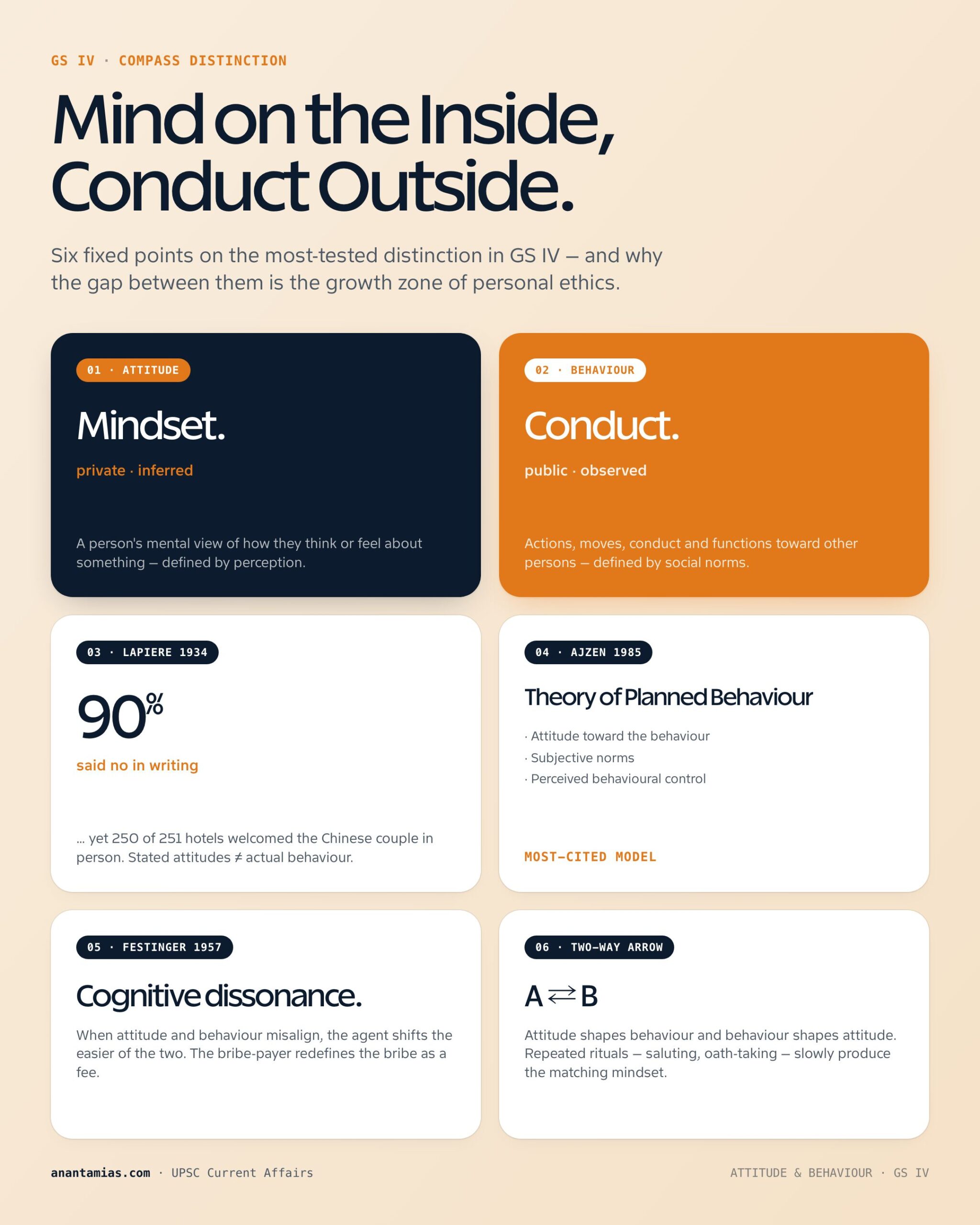
If attitude and behaviour were perfectly aligned, ethics would be simpler. We could measure attitudes and predict behaviour exactly. The reality is messier: attitudes predict behaviour imperfectly. The gap between the two is one of the most studied phenomena in social psychology, and it has direct administrative consequences.
The LaPiere Paradox (1934)
Sociologist Richard LaPiere travelled across the United States with a Chinese couple in 1930-32 — a period of strong anti-Chinese prejudice. They visited 251 hotels and restaurants. They were refused service only once. After the trip, LaPiere wrote to the same establishments asking whether they would serve Chinese guests. Over 90% replied "No."
The behaviour and the attitude diverged dramatically. The stated attitude (prejudiced) and the actual behaviour (welcoming) were almost mirror opposites.
The lesson: stated attitudes do not perfectly predict behaviour, and observed behaviour does not perfectly reveal attitude. Both must be examined, separately and together.
"The greatest discovery of any generation is that human beings can alter their lives by altering their attitudes of mind." — William James
Why Attitudes and Behaviours Diverge
The literature identifies several reasons.
- Situational pressure — norms, peers, fear of consequence override attitude.
- Habit — established behaviour persists even after attitude changes.
- Multiple competing attitudes — the strongest doesn't always win.
- Strength of attitude — weak attitudes don't drive behaviour.
- Specificity mismatch — a general attitude may not predict a specific behaviour.
- Self-monitoring — high self-monitors adapt behaviour to context regardless of attitude.
- Time and effort cost — behaviour aligned with attitude is sometimes too expensive.
The companion compass chapter on Factors Influencing Relation Between Attitude and Behaviour develops this into a structured framework.
Theoretical Frameworks for the Attitude-Behaviour Link
Theory of Reasoned Action (Fishbein & Ajzen, 1975)
Behaviour is predicted by behavioural intention, which is in turn predicted by attitude toward the behaviour and subjective norms (what important others expect).
Theory of Planned Behaviour (Ajzen, 1985, 1991)
Adds perceived behavioural control — how confident the agent is that she can perform the behaviour. The fuller equation:
Behaviour ← Intention ← Attitude + Subjective Norm + Perceived Behavioural Control
This is the most cited model in social psychology and underlies many public-information campaigns (anti-smoking, condom use, seat-belt adoption, COVID-vaccine uptake).
Cognitive Dissonance (Festinger, 1957)
When attitude and behaviour misalign, the agent feels psychological discomfort and resolves it by changing one of them — usually the easier one. A bribe-paying citizen who believes corruption is wrong either changes her behaviour, changes her attitude ("everyone does it; it's the only way"), or changes her perception ("this isn't really a bribe, it's a fee").
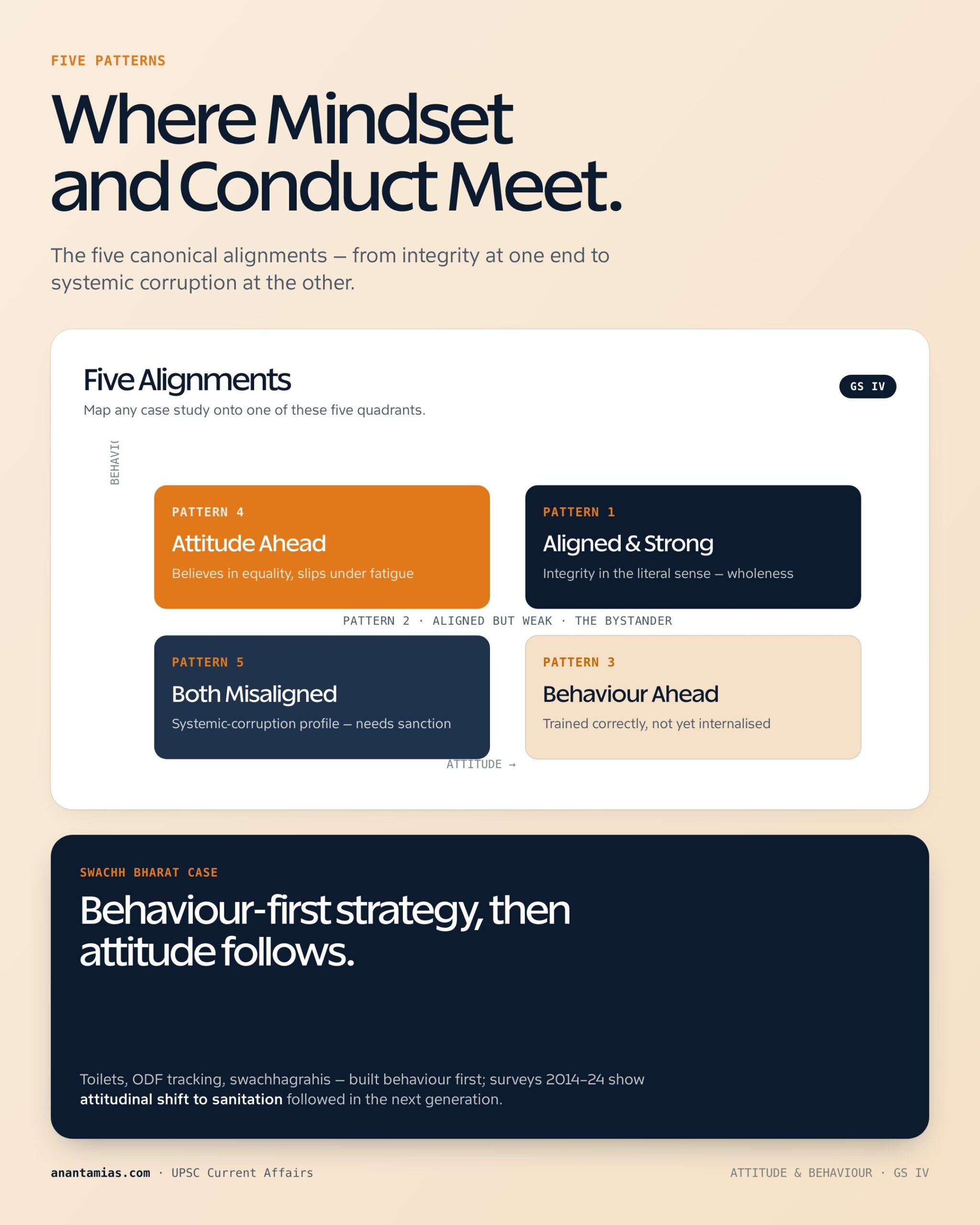
Five Patterns in the Attitude-Behaviour Relationship
Pattern 1 — Aligned and Strong
Attitude and behaviour pull together. The honest officer who refuses every bribe; the empathetic doctor who consistently shows up for the patient. This is integrity in the literal sense — wholeness.
Pattern 2 — Aligned but Weak
Attitude is in the right direction but weak; behaviour is consistent but unimpressive. The officer mildly disapproves of corruption and avoids it without resisting it. This is the bystander position — common, comfortable, and morally insufficient.
Pattern 3 — Behaviour Ahead of Attitude
Behaviour is ethical (because of training, fear of consequence, or social pressure) while attitude is not yet aligned. A new officer trained at LBSNAA behaves correctly but has not yet internalised why. The attitudinal layer catches up over time — often years.
Pattern 4 — Attitude Ahead of Behaviour
Attitude is correct but behaviour fails. The officer believes in equality but, under fatigue, treats certain citizens dismissively. This is the most common form of the attitude-behaviour gap and the most easily remediable through reflective practice.
Pattern 5 — Both Misaligned
Neither attitude nor behaviour is ethical. This is the systemic-corruption profile that requires legal sanction, not psychological intervention.
Attitude → Behaviour and Behaviour → Attitude
The arrow runs both ways.
Attitude shapes behaviour is the obvious direction. Less obvious but equally well-documented is behaviour shapes attitude. Repeated behaviour — under reinforcement, peer modelling, or even self-perception — produces matching attitude.
This is why rituals work. Saluting the flag, taking the oath of office, attending morning briefings, observing Gandhi Jayanti — these behavioural routines slowly produce the matching attitudinal layer in officers and citizens alike.
"We are what we repeatedly do. Excellence, then, is not an act, but a habit." — Aristotle (often paraphrased from Nicomachean Ethics, II.4)
The behavioural-economics literature on nudges (Thaler & Sunstein, 2008) leverages this direction: change the choice architecture, and the attitudes follow over time.
Two Indian Case Studies
Case 1 — Swachh Bharat and the Behaviour-First Strategy
Launched in 2014, Swachh Bharat Abhiyan explicitly inverted the conventional wisdom that attitudes drive behaviour. It started with behaviour change — building toilets, organising clean-up drives, tracking open-defecation-free villages, deploying swachhagrahis — on the premise that attitudes would follow. Survey evidence over 2014-2024 suggests significant attitudinal shift toward sanitation, especially among the next generation. The case illustrates behaviour → attitude as a viable public-policy direction.
Case 2 — The Police Officer and the Lathi
A senior police officer in Uttar Pradesh in 2018 noticed that custodial behaviour by junior constables — abusive language, casual physical force — was producing complaints despite formal training that taught the opposite. Investigation revealed that the stated attitude (citizen-respect) and the operating behaviour (rough handling) had diverged sharply. The reform combined affective training (emotional-intelligence modules), modelling (visible senior officer behaviour), accountability (CCTV in lock-ups), and peer-feedback (constable-to-constable reflection). After eighteen months, complaints dropped measurably. The case shows the attitude-behaviour gap closing through coordinated intervention on both layers.
Implications for the Civil Servant
Self-Audit
The conscientious officer asks regularly: what is the gap between my stated attitudes and my actual behaviour? The gap is the growth zone of personal ethics.
Subordinate Management
Trying to change an officer's behaviour without addressing her attitude produces superficial compliance. Trying to change attitudes without offering behavioural pathways produces frustrated good intentions. Both layers need attention simultaneously.
Citizen-Facing Service
Citizens experience your behaviour, not your attitude. Even an officer with excellent attitudes must learn the behavioural grammar — eye contact, tone, gesture, language — that signals her attitudes correctly.
Policy Design
Policies that depend on citizen behaviour change must address attitude, norm, and capability — not just one. The Theory of Planned Behaviour is a useful design checklist.
UPSC Syllabus Relevance
GS-IV explicitly names attitude — its influence and relation with thought and behaviour. The attitude-behaviour distinction is therefore a high-frequency Mains topic.
Past-Year Prompts
- "What is the difference between 'attitude' and 'aptitude'? Discuss the role of both in the success of a civil servant." — 2017 (related distinction).
- "Some people feel that values keep changing with time and situation, while others strongly believe that there are certain universal and eternal human values." — 2018.
- "Distinguish between 'attitude' and 'behaviour'. With suitable examples, discuss how attitudes influence behaviour." — 2020 paraphrased.
- "How will you apply emotional intelligence in administrative practices to address the attitude-behaviour gap?" — 2022 paraphrased.
Mains Answer-Writing Tips
- Open with the compass four-row distinction — examiner recognises the source.
- Bring in the LaPiere paradox for an evidence-based hook.
- Use the Theory of Planned Behaviour equation as the analytical anchor.
- Cite Swachh Bharat for the behaviour-first strategy.
- Close with the two-way arrow — attitude shapes behaviour and vice versa.
Prelims Pointers
- Richard LaPiere (1934) — first empirical demonstration of attitude-behaviour discrepancy.
- Fishbein & Ajzen — Theory of Reasoned Action (1975).
- Icek Ajzen — Theory of Planned Behaviour (1985, 1991).
- Leon Festinger (1957) — cognitive dissonance.
- Daryl Bem (1967) — self-perception theory; behaviour shapes attitude.
- Thaler & Sunstein (2008) — Nudge; choice-architecture as behaviour intervention.
FAQ
Is attitude always more important than behaviour?
For ethics, attitude is the upstream condition; for accountability, behaviour is the observable evidence. Both matter. Public administration is held to behavioural standards; private ethics is held to attitudinal standards.
Can a person with bad attitudes behave well?
Yes — through fear, training, social pressure, or strategic self-monitoring. But the alignment is fragile; under stress or unobserved conditions, the underlying attitude tends to surface. Sustainable ethical practice requires alignment, not just compliance.
Can good attitudes coexist with bad behaviour?
Routinely. The attitude-behaviour gap is the most common form of moral failure. The answer is reflective practice, not self-condemnation.
Should training focus on attitudes or behaviour?
Best practice is both, in coordination. Behavioural training without attitudinal grounding produces robotic compliance; attitudinal sermons without behavioural pathways produce frustrated idealism. Civil-service academies increasingly use case-based simulation that touches both layers.
How can a junior officer assess her own attitude-behaviour gap?
Three practical instruments: journaling (record decisions and underlying reasons), peer feedback (a trusted colleague's observation), and citizen feedback (anonymous service surveys). Combined, they expose gaps the officer cannot see alone.
The attitude-behaviour distinction is not a debate question — both are essential, and both deserve the officer's attention. The four-row compass table is the easy memorisation; the harder, lifelong work is keeping the two layers aligned in your own conduct, file by file, day by day.
The attitude-behaviour distinction is not a debate question — both are essential, and both deserve the officer's attention. The four-row compass table is the easy memorisation; the harder, lifelong work is keeping the two layers aligned in your own conduct, file by file, day by day.
Tell Google you want more of this.
Add Anantam IAS as a preferred sourceOne tap, and this site shows up more often in your own Top Stories, AI Overviews and AI Mode. Remove it any time.