Liquid Nano Clay (LNC): The Nanotechnology That Turns Sand Into Farmland in Seven Hours
A complete UPSC GS-III explainer on Liquid Nano Clay. Covers the Desert Control technology, how clay nanoparticles bind sand particles, water and fertiliser savings, UAE and India trial sites, the link to desertification and SDG-15 land degradation neutrality, and policy context.
Liquid Nano Clay is the kind of technology that sounds too good to be true and then, in field trials, mostly is true. Mix natural clay with water, run it through a patented process that breaks the clay into nanoparticles, and you get a thin liquid that, when poured onto sandy soil, coats every grain of sand with a nanometre-thin film of clay. The treated soil now holds water and nutrients the way a loamy soil would, instead of letting them drain through in minutes. The transformation that natural soil-formation processes take centuries to do, this technology achieves in around seven hours.
The headline application is desert greening. Roughly forty percent of the Earth’s land surface is dryland, and a growing share of that is degrading toward outright desert under the combined pressure of climate change, overgrazing, and unsustainable irrigation. India has roughly 96 million hectares classified as degraded, including the Thar desert, large stretches of arid Rajasthan, Gujarat’s Kutch, and pockets across the Deccan plateau. The conventional response, sand fixation with shelterbelts and slow soil-building with organic matter, takes decades and is expensive at scale. Liquid Nano Clay offers a different approach: change the physics of the sand itself, so that water and nutrients stay in the root zone long enough for crops to grow.
For UPSC GS-III, LNC sits at the intersection of nanotechnology, agriculture policy, climate adaptation, and the international land-degradation negotiations under the UN Convention to Combat Desertification. This article walks through what LNC is, how it works at the particle level, the trials that have been run in the UAE and elsewhere, the cost and water-saving calculations, where it fits into India’s drylands policy, and the regulatory and ecological questions that follow.
Quick Facts on Liquid Nano Clay
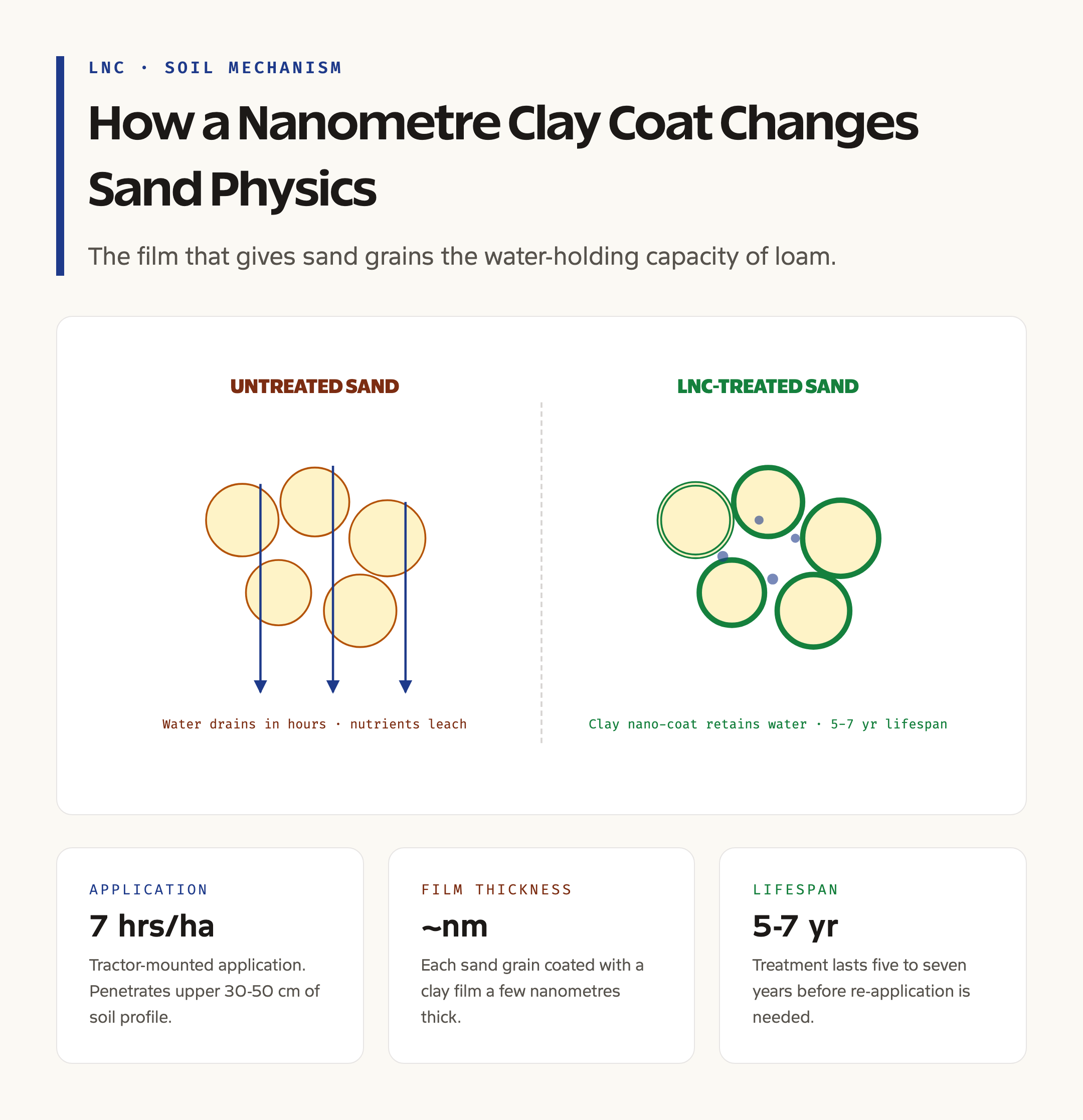
Liquid Nano Clay is a patented soil amendment developed by the Norwegian-Emirati company Desert Control. The technology starts with natural montmorillonite clay, mixes it with water, and applies a proprietary mechanical and chemical process that disperses the clay into nanoparticles. The resulting liquid, when applied to sandy or degraded soil, infiltrates the upper 30 to 50 centimetres of the soil profile and coats individual sand grains with a thin clay layer.
The treated soil retains water and nutrients far better than untreated sand. Field trials report water consumption reductions of 30 to 50 percent compared to untreated control plots growing the same crops. Yields increase. Fertiliser use declines. The application takes about seven hours per hectare on a tractor-mounted system.
Desert Control was founded in 2016 by Ole Morten Olesen and Kristian Olesen, a Norwegian father-son team. The first major commercial trials ran in the UAE from 2017 onward, and the company listed on the Oslo Euronext stock exchange in 2021. As of 2026, Desert Control has commercial deployments in the UAE, Saudi Arabia, and California, and pilot trials in several other countries. Indian field trials are at an early stage at a handful of research stations.
How Liquid Nano Clay Works at the Particle Level
The physics of sandy soil is the problem LNC solves. A grain of sand is a polished mineral particle, typically quartz, with a smooth surface and very low surface area per unit mass. Sand has almost no capacity to hold water against gravity or to bind to nutrients. Water poured onto sand drains through the pores and disappears below the root zone within hours. Fertiliser leaches at the same rate. This is why deserts and sandy soils support so little plant growth even when irrigated.
A loamy or clay soil has a different physics. Clay particles are platelets just a few micrometres across, with very high surface area per unit mass. The platelets carry electrostatic charges that attract water molecules and nutrient ions. A clay-rich soil holds water against gravity, releases it slowly to plant roots, and acts as a chemical reservoir for nutrients.
LNC bridges these two worlds. The patented process mills natural clay into nanoparticles, suspended in water at a controlled concentration. When the suspension is applied to sandy soil, gravity carries the nanoparticles down through the pores between sand grains. As the water drains away, the clay nanoparticles attach to the sand grain surfaces, depositing a film a few nanometres thick. The sand grain now has a clay-coated surface with the chemical and physical properties of a clay soil, while retaining the porous structure and drainage characteristics of sand. The result is a hybrid soil that holds water and nutrients like clay but does not waterlog like clay.
The treatment lasts five to seven years before the clay coating washes off or degrades, at which point a re-treatment is needed. Crops grown on treated soil over multiple years also build up some organic matter, which improves the soil further independent of the nano-clay coat.
Field Trials and Documented Performance
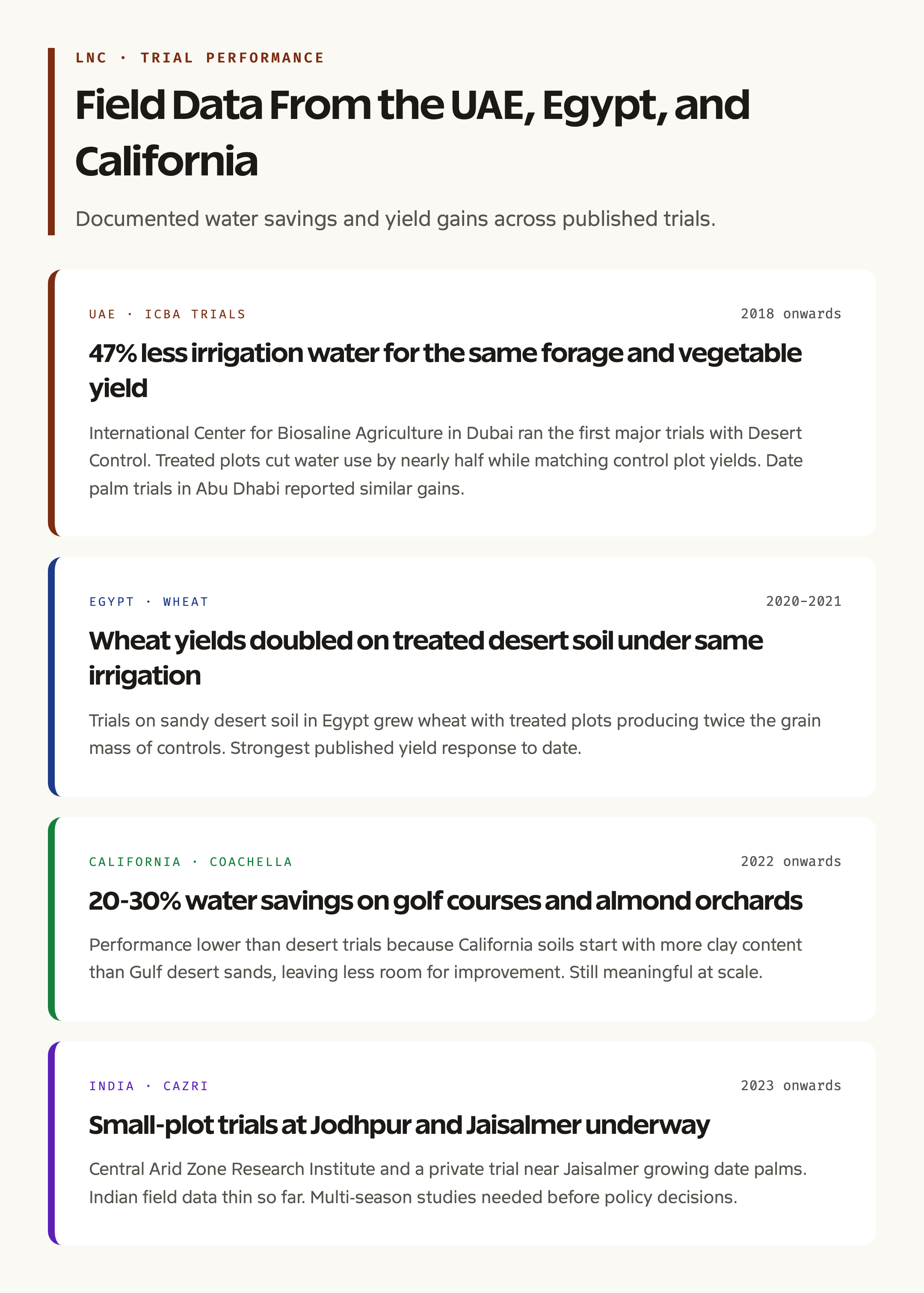
The most-cited trial data comes from the UAE. From 2018 onward, Desert Control ran trials with the International Center for Biosaline Agriculture in Dubai, growing forage and vegetable crops on treated and control plots. The treated plots used 47 percent less irrigation water for the same yield, or produced higher yields with the same water. Subsequent trials with date palms in Abu Dhabi reported similar water savings.
A trial in Egypt in 2020-2021 grew wheat on treated and untreated sandy desert soil, with treated plots yielding double the grain mass of controls under the same irrigation. Trials in Saudi Arabia have grown alfalfa, vegetables, and ornamental landscaping with documented water reductions in the 30 to 50 percent range.
The California pilot, launched in 2022 in the Coachella Valley, tested LNC on golf courses and almond orchards. Water savings of 20 to 30 percent have been reported, lower than the desert trials because California soils start with more clay content than Gulf desert soils, leaving less room for improvement.
Indian trials are at an earlier stage. Reports from 2023 and 2024 describe small-plot trials at the Central Arid Zone Research Institute in Jodhpur, Rajasthan, and a private trial near Jaisalmer growing date palms. The publicly available data from Indian trials is thin, and longer multi-season studies are needed before policy decisions can be made.
Cost and Water Economics
The economics depend on the price of LNC application versus the price of the water and fertiliser it saves, plus the value of the additional crop yield. Desert Control has reported application costs in the range of 1,800 to 3,000 US dollars per hectare for the seven-hour treatment, with a five to seven year functional lifespan. Annualised, that is 250 to 600 dollars per hectare per year.
In Gulf countries with desalinated irrigation water, the economics work because desalinated water is expensive and the saved volume more than covers the LNC cost. In California, where water has a real but lower price, the case is closer. In rainfed Indian agriculture, the case is hardest, because the saved water has no direct cash cost. Where LNC could pencil out in India is in irrigated arid zones with groundwater depletion concerns or in high-value horticulture, where the saved energy of pumping irrigation water and the higher yield justify the upfront cost.
The fertiliser saving is also non-trivial. Roughly 20 to 30 percent of fertiliser nitrogen applied to sandy soils is lost to leaching, polluting groundwater and emitting nitrous oxide, a potent greenhouse gas. LNC’s nutrient-retention effect captures more of the fertiliser before it leaches. In a country with India’s fertiliser subsidy bill of more than 1.5 lakh crore rupees per year, even small percentage reductions in fertiliser use have policy weight.
Desertification and the SDG Land Degradation Target
Desertification is the degradation of dryland ecosystems toward conditions that no longer support productive use, driven by climate, overgrazing, deforestation, salinity from poor irrigation, and other pressures. The UN Convention to Combat Desertification, abbreviated UNCCD, is the international treaty that addresses it. India ratified UNCCD in 1996 and hosted the COP-14 conference in 2019, making the high-profile commitment to restore 26 million hectares of degraded land by 2030.
Sustainable Development Goal 15.3 sets the global target of land degradation neutrality, meaning that the area of newly degraded land in any year should not exceed the area of restored land. India’s 26-million-hectare commitment is the headline contribution to the global LDN target.
Liquid Nano Clay is one technology in a much larger toolkit for addressing land degradation. Reforestation, contour bunding, check dams, agroforestry, conservation agriculture, and traditional water-harvesting structures are the dominant restoration measures, particularly in dryland India. LNC could complement these in arid pockets where conventional methods are slow or expensive, but it is unlikely to replace them. The strategic question for Indian policy is where LNC fits in the mix, not whether it replaces the rest.
Where LNC Fits in Indian Drylands Policy
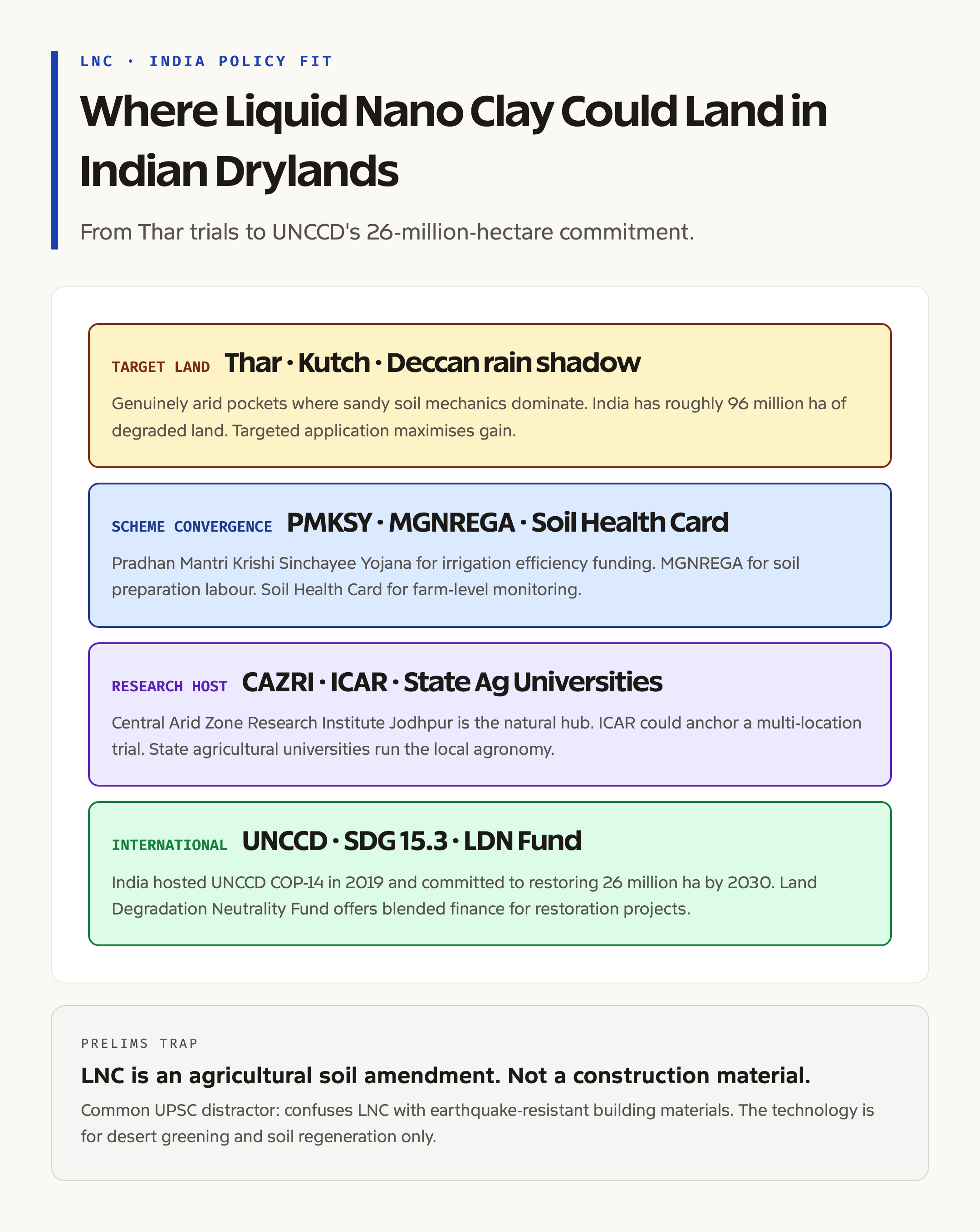
India’s dryland agriculture programmes run through a patchwork of central and state schemes. The Pradhan Mantri Krishi Sinchayee Yojana funds irrigation efficiency. The National Mission for Sustainable Agriculture covers soil health and dryland farming. The Desert Development Programme and the Drought Prone Areas Programme, both folded into PMKSY, fund watershed development in arid districts. MGNREGA, the rural employment guarantee, funds large amounts of soil and water conservation work as part of its work-creation mandate. The Soil Health Card scheme provides farm-level soil-quality data.
Where LNC could be tested at policy scale is in the convergence of these schemes. A pilot in a dryland district could combine MGNREGA work for soil preparation, PMKSY funding for the LNC application, and Soil Health Card monitoring of post-application soil quality. The Central Arid Zone Research Institute in Jodhpur is the natural research host. The Indian Council of Agricultural Research could anchor a multi-location trial.
Whether such a programme would be cost-effective depends on the trials. The published international data suggests strong performance in genuinely sandy desert soils, weaker performance in clay-rich soils, and intermediate performance in the loamy red and black soils that dominate Indian agriculture. Targeting LNC at genuinely arid pockets, the Thar desert, parts of the Deccan rain shadow, the Kutch region, would maximise the gain, while saturating the rest of Indian agriculture with LNC would not.
How LNC Compares to Other Soil Technologies
LNC is not the only nanotechnology aimed at agriculture. Nano fertilisers, including nano urea and nano DAP commercialised by IFFCO from 2021, deliver nitrogen and phosphorus in nanoparticulate form for higher uptake efficiency. Nano-pesticides deliver active ingredients more efficiently than bulk formulations. Hydrogels and superabsorbent polymers retain water in the root zone but degrade faster than LNC.
The comparison most often made is between LNC and conventional bentonite clay amendment. Bulk bentonite clay can be added to sandy soil to improve its water retention, but the application rate needed to make a difference is several tonnes per hectare. Nano-formulated clay achieves the same effect at a fraction of the mass, because the nanoparticles cover all the sand-grain surfaces rather than mixing as a bulk component. The cost-per-effect comparison is more nuanced, but for genuine desert soils, LNC is competitive.
Biochar, a charcoal-like soil amendment produced from agricultural waste through pyrolysis, is the other major dryland soil technology. Biochar improves water retention, sequesters carbon, and is produced from local waste streams, all of which are policy positives. Biochar is unlikely to be displaced by LNC in most Indian contexts, but the two could be complementary in deeply degraded soils.
Regulatory and Ecological Questions
LNC is a soil amendment based on natural clay, so its regulatory profile is benign compared to a synthetic chemical input. The clay used is typically montmorillonite or kaolinite, both naturally occurring minerals with established safety records. The processing creates nanoparticles, which raises the same questions that apply to other nano-materials in agriculture about long-term environmental fate.
The Indian Council of Agricultural Research and the Central Insecticides Board would be the natural regulatory points if LNC were registered as an agricultural input in India. The Bureau of Indian Standards has nanotechnology product standards under development, and the Department of Science and Technology’s Nano Mission has supported research on the environmental safety of agricultural nano-materials.
Ecological questions remain. The long-term fate of the clay nanoparticles, whether they accumulate in the soil profile, whether they affect soil microbial communities, and whether they leach into groundwater under heavy rainfall are open questions for any non-trivial deployment. The published research suggests minimal off-target effects, but the studies are short and the ecological evidence base for tropical and Indian conditions specifically is thin.
What to Watch Going Forward
Three trends will shape whether LNC enters Indian agriculture meaningfully through the next decade. The first is the trial data. CAZRI, ICAR, and state agricultural universities running multi-season trials in genuinely arid Indian conditions will produce the cost-benefit numbers that policy decisions need. The second is the cost trajectory. Manufacturing of nano-clay at Indian scale, possibly under a domestic licensing or technology transfer arrangement, would significantly lower the per-hectare cost. The third is the convergence with Indian climate-adaptation finance, both domestic budget through CAMPA-like funds and international flows under the UNCCD’s Land Degradation Neutrality Fund.
For UPSC, the testable elements are the basic mechanism (clay nanoparticles coating sand grains), the developer (Desert Control, Norwegian-Emirati company), the documented performance (40-50 percent water savings, seven hours per hectare, multi-year duration), the desertification context (UNCCD, SDG 15.3, India’s 26-million-hectare commitment), and the policy intersection with PMKSY, MGNREGA, and dryland agriculture programmes. The prelims trap to avoid is conflating LNC with construction or building materials. LNC is an agricultural soil technology, not a structural material.
Frequently Asked Questions
What is Liquid Nano Clay in simple terms?
Liquid Nano Clay is a soil amendment that turns natural clay into nanoparticles suspended in water. When poured onto sandy soil, the nanoparticles coat individual sand grains with a thin clay film, giving the sand the water-retention and nutrient-retention properties of a clay or loamy soil. The treatment takes about seven hours per hectare and lasts five to seven years.
How does LNC save water?
Sandy soil has almost no capacity to hold water against gravity, so irrigation drains away within hours. LNC’s clay coating on each sand grain creates a structure that holds water and nutrients in the root zone for days, the way a loamy soil would. Field trials in the UAE, Egypt, and Saudi Arabia report 30 to 50 percent less water use for the same yield.
Who developed Liquid Nano Clay?
Liquid Nano Clay was developed by Desert Control, a Norwegian-Emirati company founded in 2016 by Ole Morten Olesen and Kristian Olesen. The company listed on the Oslo Euronext stock exchange in 2021 and has commercial deployments in the UAE, Saudi Arabia, and California.
Is Liquid Nano Clay a construction material?
No. This is the most common UPSC prelims trap on the topic. LNC is an agricultural soil amendment for soil regeneration, water retention, and crop yield improvement on sandy or degraded soils. It is not a construction material, an earthquake-resistance product, or a building component.
What is the policy relevance of LNC for India?
India has committed to restoring 26 million hectares of degraded land by 2030 under the UNCCD framework, contributing to SDG 15.3 land degradation neutrality. LNC is one technology in the toolkit that could fit alongside watershed development, agroforestry, and conservation agriculture, particularly in genuinely arid pockets like the Thar desert and parts of Kutch. Policy traction depends on Indian field trial data, which is still at early stages.