Loamy soil — often called simply loam — is widely regarded as the most fertile and agriculturally productive soil type in the world. It is not a distinct pedological class like red, black, or laterite soil, but a textural category defined by a balanced proportion of sand, silt, and clay. This balance gives loam the right combination of drainage, aeration, moisture retention, and nutrient-holding capacity that crops need. For UPSC aspirants, understanding loamy soil is essential because it underpins high-productivity zones in the Indo-Gangetic plains, the Brahmaputra valley, and several river deltas.
| Loamy soil at a glance | Detail |
|---|---|
| Also called | Loam |
| Composition | ~40% sand, 40% silt, 20% clay (USDA triangle) |
| Category | A textural class, not a soil order/type |
| pH | ~6.0–7.0 (slightly acidic to neutral) |
| Key traits | Balanced drainage, moisture retention, aeration and high fertility |
| Best for | The widest range of crops of any soil |
| In India | Dominant in alluvial belts (Indo-Gangetic plains, Brahmaputra valley, deltas); alluvial soils cover ~43% of the country |
What Is Loamy Soil?
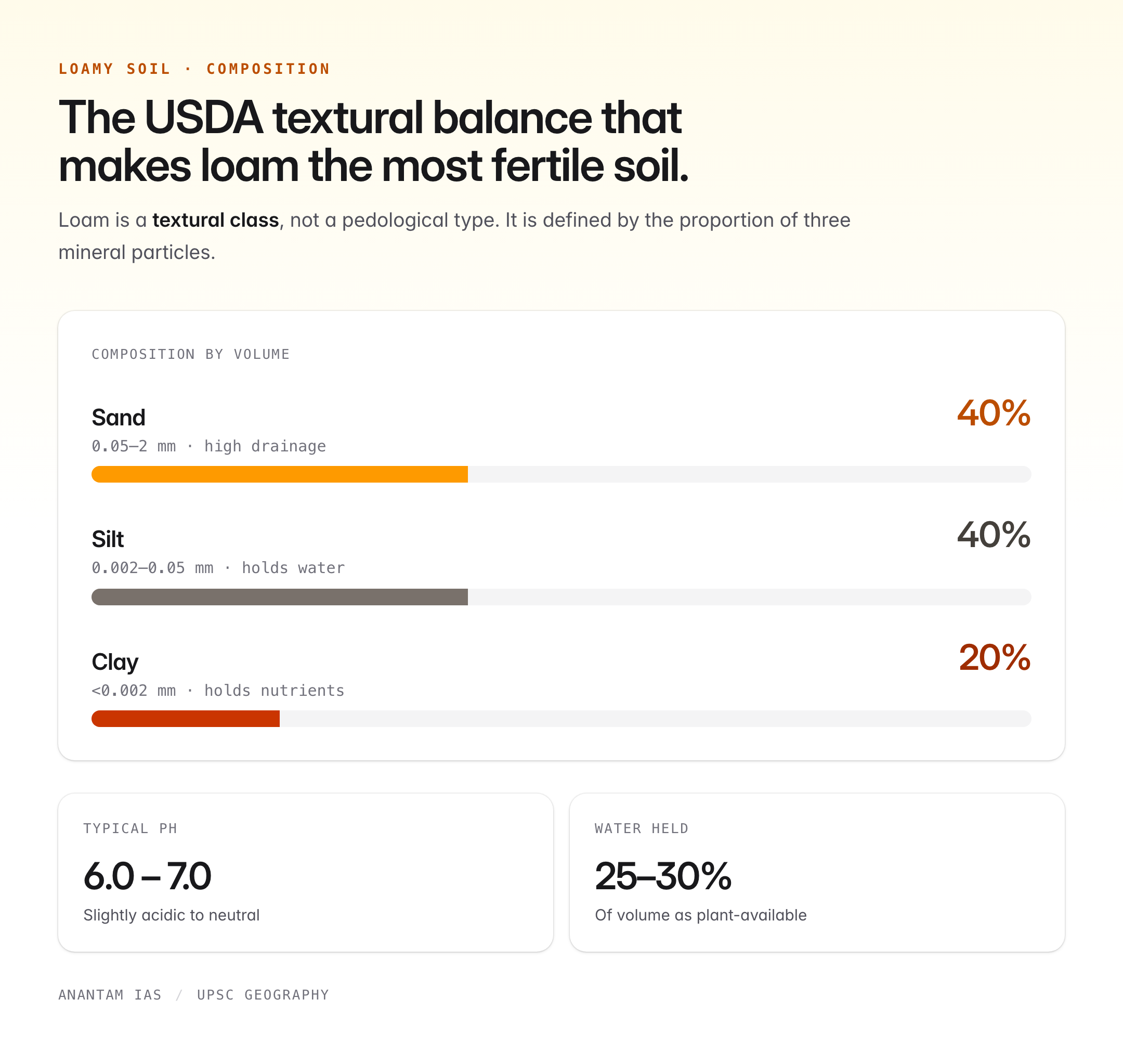
Loam is defined by soil texture — the relative proportion of three mineral particles:
| Particle | Size | Property |
|---|---|---|
| Sand | 0.05–2 mm | High drainage, low water retention, loose |
| Silt | 0.002–0.05 mm | Moderate drainage, smooth feel, holds water |
| Clay | <0.002 mm | Poor drainage, high nutrient retention, sticky |
As per the USDA textural triangle, a soil is classified as loam when it contains approximately:
- 40% sand
- 40% silt
- 20% clay
Variants such as sandy loam, silty loam, and clay loam shift these proportions. A sandy loam has higher sand content (good for root crops); silt loam is finer and holds more water; clay loam is heavier and richer in nutrients.
Physical and Chemical Characteristics
Loamy soil combines the best properties of its three components while minimising their weaknesses.
| Property | Loamy Soil Behaviour |
|---|---|
| Texture | Soft, crumbly, dark-coloured when moist |
| Water retention | High — holds ~25–30% of its volume as plant-available water |
| Drainage | Good — avoids waterlogging |
| Aeration | Adequate pore space for roots and microbes |
| Organic matter | High — promotes humus formation |
| pH | Typically 6.0 to 7.0 (slightly acidic to neutral) |
| Nutrient availability | High N, P, K; good cation exchange capacity |
| Tillage | Easy to plough; workable over a wide moisture range |
| Compaction risk | Low |
| Erosion risk | Moderate; reduced with crop cover |
Loam's structure is granular, which gives it crumbly texture ideal for seed germination. The presence of clay ensures nutrient holding (cation exchange), while sand ensures drainage, and silt holds moisture between irrigations.
Why Loamy Soil Is Ideal for Agriculture
Three features make loam the preferred soil for most crops:
- Balanced water regime — enough moisture for germination without waterlogging.
- Nutrient reservoir — clay fraction retains cations (Ca²⁺, Mg²⁺, K⁺, NH₄⁺) that roots can absorb.
- Biological activity — pore space and organic matter support earthworms, bacteria, and mycorrhizae that cycle nutrients.
Loam is sometimes described as a "self-regulating" soil — it does not require heavy inputs of water or nutrients to sustain a crop, unlike sandy or clayey extremes.
Loamy Soil in India: Distribution
Although loam appears in many regions, certain belts of India are famous for their loam-dominated soils:
| Region | Type | Character |
|---|---|---|
| Upper Gangetic plain (Punjab, Haryana, western UP) | Alluvial loam (khadar and bhangar) | Wheat-rice bowl of India |
| Middle Gangetic plain (Bihar, eastern UP) | Alluvial silty loam | Rice, jute, sugarcane |
| Brahmaputra valley (Assam) | Alluvial loam with sand bars | Rice, tea, jute |
| Indus delta remnants (north Gujarat) | Alluvial loam | Cotton, pulses |
| Mahanadi, Godavari, Krishna, Kaveri deltas | Deltaic silty loam | Rice, sugarcane |
| Terai region (Uttarakhand, Bihar foothills) | Heavy loam with organic matter | Sugarcane, rice |
| Malwa plateau (Madhya Pradesh) | Loamy black soil transition | Wheat, soybean |
| Kerala Midlands | Lateritic loam | Coconut, spices |
The Indian Council of Agricultural Research (ICAR) and National Bureau of Soil Survey and Land Use Planning (NBSS&LUP) classify Indian soils into eight major orders; loam textures cut across multiple orders — especially Entisols (young alluvium) and Inceptisols (maturing alluvium).
Crops Suited to Loamy Soil
Loam supports the widest crop range of any soil type. Specific preferences:
| Crop Category | Examples | Loam Variant Preferred |
|---|---|---|
| Cereals | Wheat, rice, maize, barley | Silty loam to clay loam |
| Pulses | Gram, moong, arhar, lentil | Sandy loam to loam |
| Oilseeds | Mustard, groundnut, sesame | Sandy loam |
| Sugarcane | Sugarcane | Silty to clay loam, moisture-retentive |
| Vegetables | Potato, tomato, onion, cauliflower | Sandy loam |
| Horticulture | Apple, mango, citrus | Well-drained loam |
| Cash crops | Cotton, tobacco, jute | Loam to silty loam |
| Plantation | Tea, coffee | Lateritic loam / acidic loam |
| Fibre crops | Jute, mesta | Silty loam of Ganga delta |
Root crops prefer sandy loam because it is loose enough for tuber expansion. Paddy prefers clay loam because the clay holds standing water. Orchards demand deep, well-drained loam to prevent root rot.
Loam vs Other Soil Types: A Comparison
| Property | Sandy Soil | Clayey Soil | Silty Soil | Loamy Soil |
|---|---|---|---|---|
| Drainage | Excessive | Poor | Moderate | Good |
| Water retention | Low | Very high | High | Balanced |
| Aeration | Very high | Poor | Moderate | Good |
| Nutrient retention | Low | High | Moderate | High |
| Workability | Easy but dry | Difficult; cracks when dry | Slippery | Easy and stable |
| Suitability | Root crops, legumes | Rice, cotton | Wheat, pulses | Almost all crops |
| Erosion vulnerability | High | Low | High | Moderate |
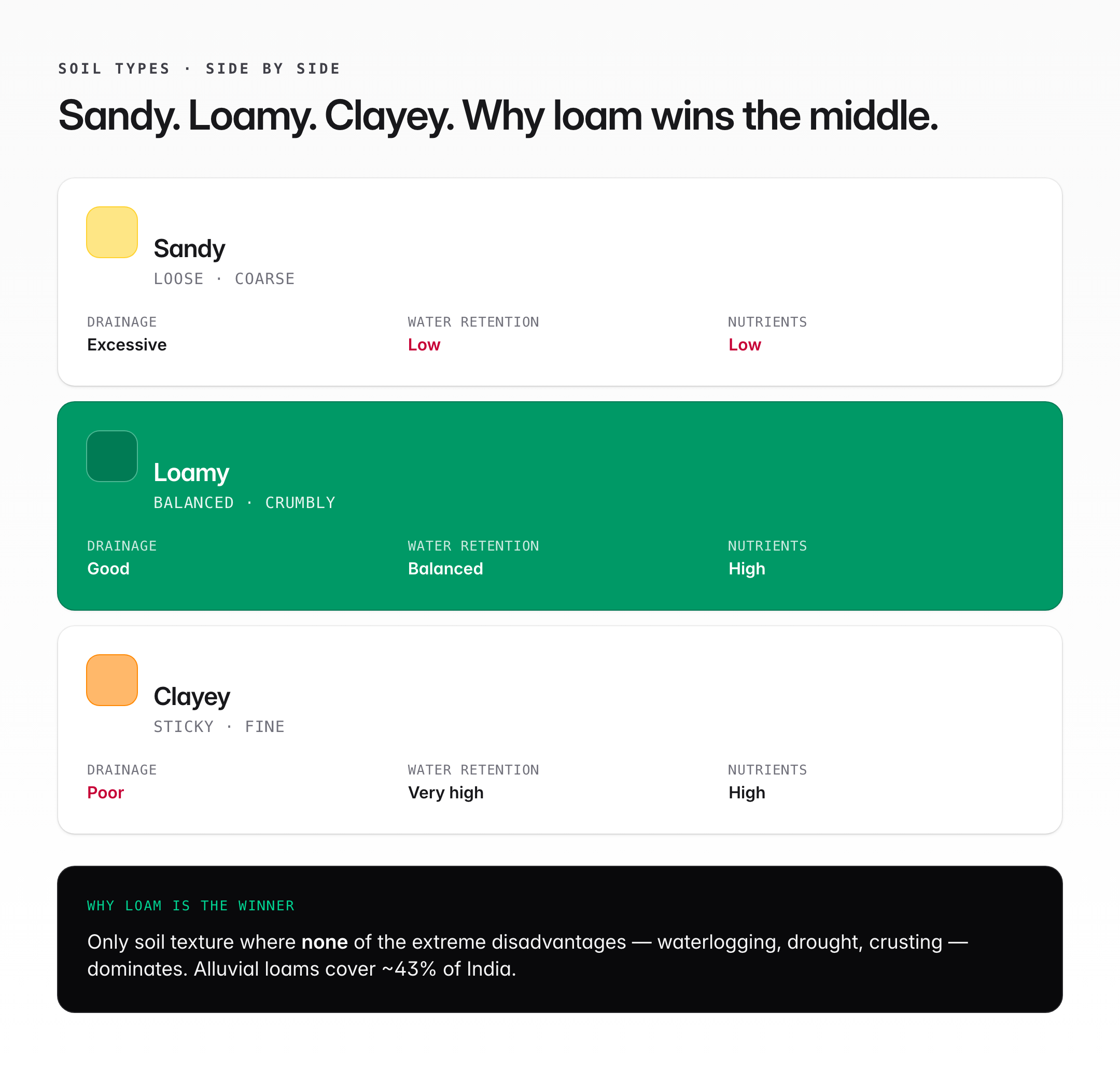
Loam is the only texture where none of the extreme disadvantages (waterlogging, drought, crusting) dominates.
Management of Loamy Soil
Even though loam is fertile, sustained cropping depletes organic matter. Good practice includes:
- Crop rotation — legume in every cycle to fix nitrogen.
- Green manuring — dhaincha, sun hemp ploughed in at flowering.
- Farmyard manure and compost — 5–10 tonnes/ha annually.
- Mulching — reduces evaporation, moderates temperature.
- Conservation tillage — protects structure and humus.
- Balanced NPK plus micronutrients — prevent hidden hunger (Zn, Fe).
Loam is vulnerable to compaction by heavy machinery and to sheet erosion on slopes, especially after monsoon-time ploughing. In the Punjab wheat–rice system, prolonged monoculture has caused micro-nutrient depletion (Zn, Mn) and falling organic carbon, demonstrating that even the "best" soil needs stewardship.
Loam in Soil Classification Systems
- USDA Textural Triangle — defines loam by exact percentages of sand/silt/clay.
- ICAR Soil Classification — groups loam-textured alluvium under Alluvial Soils (~43% of India's area).
- FAO-WRB — loam textures mostly fall under Fluvisols (young alluvial) and Cambisols (slightly weathered).
The alluvial soils of India, which are predominantly loam, cover nearly 43% of the country's total land area — the single largest soil group.
UPSC Relevance
Loamy soil is a staple Prelims topic under Geography and Agriculture. Remember that loam is defined by texture, not colour or origin — approximately 40% sand, 40% silt, 20% clay. A common Prelims trap asks whether loam is a “type” of soil or a “textural class” (answer: textural class). The alluvial soils of the Ganga–Brahmaputra plains — dominantly loamy — cover ~43% of India, the largest single coverage. For GS Paper I (Geography), loam links to Indian soil classification, Ghaggar–Yamuna khadar/bhangar distinction, and river-basin fertility. For GS Paper III (Agriculture), loam is central to crop suitability, soil health card scheme, Green Revolution success in Punjab-Haryana, and the emerging concerns of soil organic carbon decline and ground-water depletion in loam-dominated belts. Link loam with ICAR, NBSS&LUP, Krishi Vigyan Kendras, and Soil Health Mission. In Essay on food security or sustainable agriculture, loam is a productive anchor example. Avoid the common error of calling loam a “river-deposited soil” — it is a texture that can occur in alluvium, black soil, or laterite. Precision on this distinction separates average answers from top ones.
Tell Google you want more of this.
Add Anantam IAS as a preferred sourceOne tap, and this site shows up more often in your own Top Stories, AI Overviews and AI Mode. Remove it any time.